Circe’s 2021 pitch deck presents a highly technical, industrial-scale vision for transforming methane into value-added products like food protein, methanol, and biodegradable polymers. The company positions itself as a 'group of companies' with a heavy R&D focus, leveraging partnerships with Russian and Austrian research institutes. While the deck excels at defining the scale of the problem—citing a 7-10 billion tonne annual waste estimate—and provides a clear historical roadmap of reactor development, it lacks critical financial data. There is no mention of unit economics, specific funding r…
Key takeaways
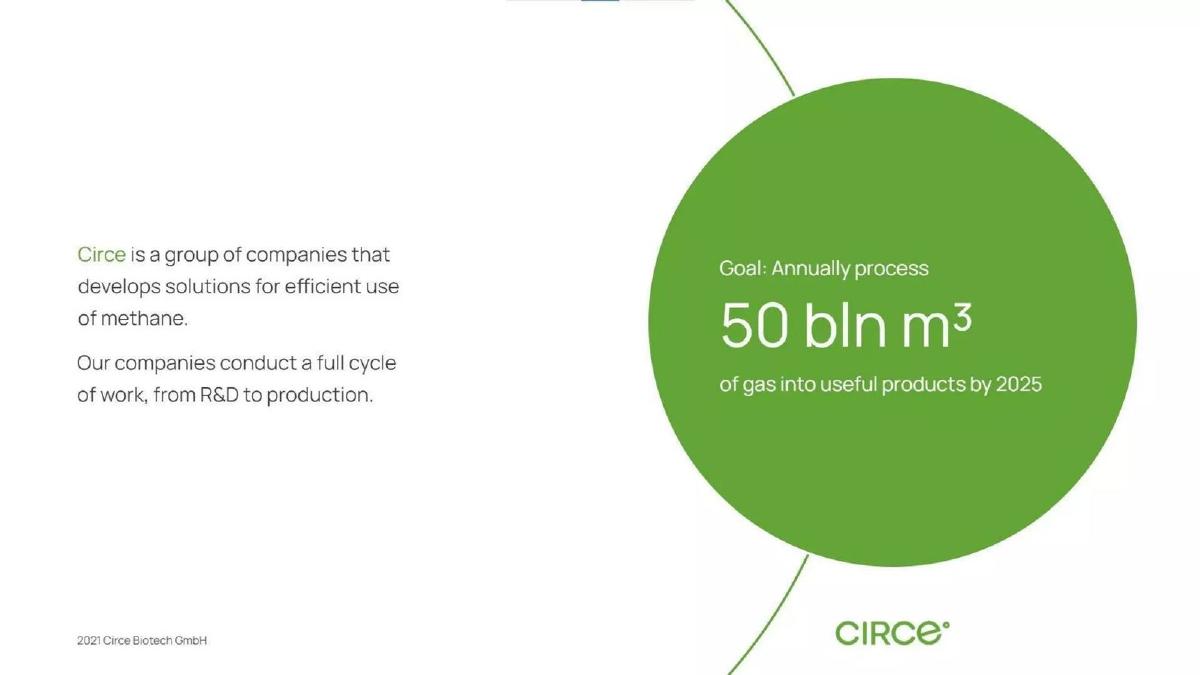
- The company sets an ambitious goal to annually process 50 billion cubic meters of gas into useful products by 2025 (Slide 6).
- Circe identifies a significant protein deficiency in Russia of 2-2.5 million tonnes, valued at approximately $1.166 billion in 2020 (Slide 17).
- The technical roadmap shows a progression from the first experimental bioreactor in June 2019 to automatic machine testing in July 2020 (Slide 10).
- The team structure is split between 20 full-time employees and 25-30 outsourced staff across locations like Moscow, Vienna, and St. Petersburg (Slide 14).
- The business model is diversified across four branches: Protein (feed & food), Methanol, Liquefied Natural Gas, and Biodegradable Polymers (Slide 16).
- Scientific validation is supported by residency at the Skolkovo Science and Technology Center and partnerships with institutes like IBPM RAS and TU Wien (Slide 9).
- Future milestones include the production of commercial batches for feed protein in Q3 2022 and food protein in Q2 2023 (Slide 12).
- The deck completely omits financial asks, valuation, and current revenue, focusing instead on market volume and technical capacity.
Executive Summary: The Industrial Biotech Play
Circe Biotech’s 2021 pitch deck is a study in industrial scaling and technical milestones. Rather than focusing on consumer branding or software-style growth metrics, the deck leans heavily into the 'hard tech' of gas fermentation. The company positions itself as a solution to two global crises: greenhouse gas emissions (specifically methane) and food insecurity. By converting methane—a potent greenhouse gas—into high-value proteins and polymers, Circe attempts to bridge the gap between heavy industry and sustainable biotechnology. However, the deck is notably localized to the Russian market, which dictates much of its market sizing and partnership strategy.
Slides 1-3: Vision and Navigation
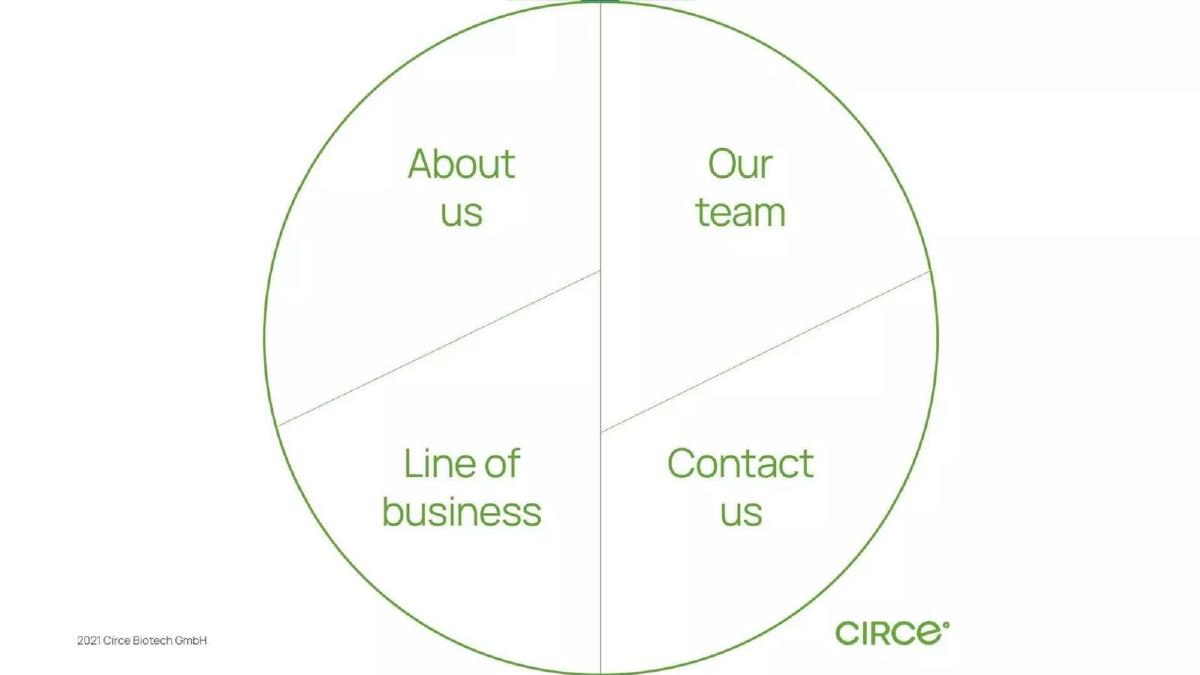
The deck opens with a high-impact image of a breaching whale and the tagline "SUPPLYING THE FUTURE." Slide 1 also specifies the company's focus: "Innovative tech in production of liquefied natural gas." This is slightly confusing as the later slides focus more on protein, but it establishes the company's roots in gas processing. Slide 2 provides a simple four-quadrant table of contents: About us, Our team, Line of business, and Contact us. Slide 3 is a minimalist transition slide that leads into the company's core narrative.
Slides 4-6: The Problem and The Mission
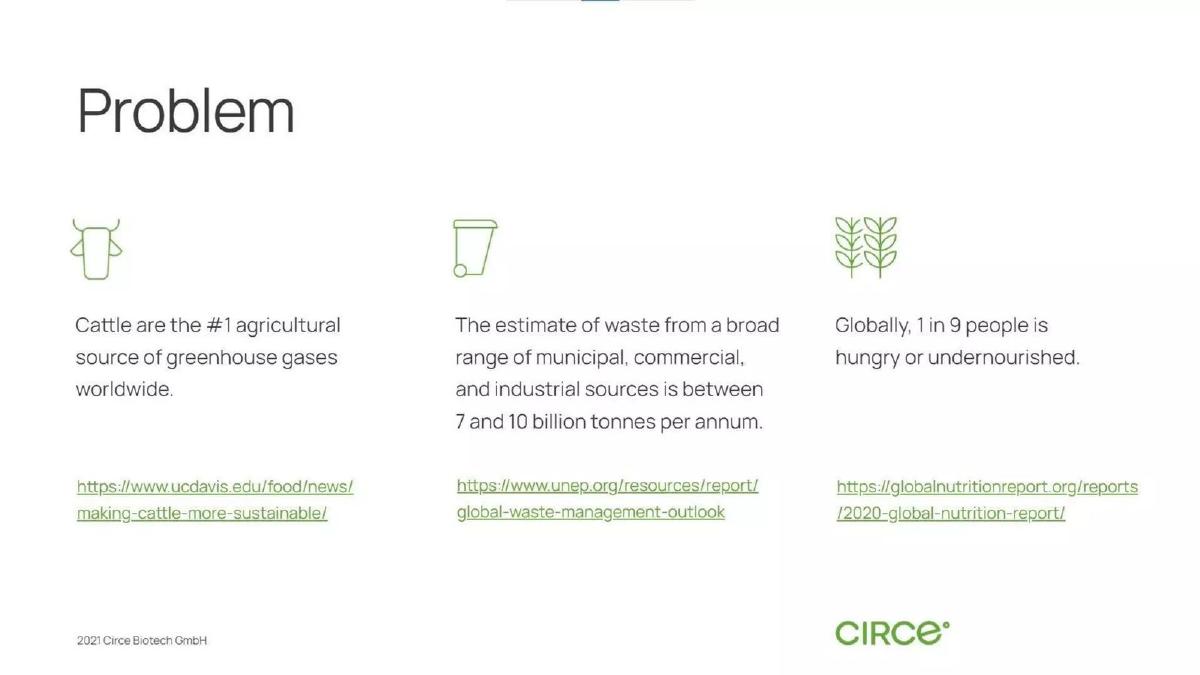
Slide 4 defines the problem through three pillars: cattle as the #1 agricultural source of greenhouse gases, the 7-10 billion tonnes of annual waste, and the fact that 1 in 9 people globally are undernourished. This sets a broad, humanitarian stage for their technology. Slide 5 states their mission: "Implement new energy-efficient technologies in the present, with concern for the state of the Earth in the future." Slide 6 introduces the first major metric: a goal to "Annually process 50 bln m3 of gas into useful products by 2025." This is a massive industrial target that moves the company out of the 'startup' realm and into the 'infrastructure' realm.
Slides 7-9: Values and Scientific Foundation
Slides 7 and 8 use industrial imagery (green silos) to highlight core values: Environmental friendliness, Contemporary technologies, Investment in the future, Reliable development, and Closed loop products. Slide 9, titled "Science is at the heart of our work," is a critical validation slide. It lists partnerships with IBPM RAS, SEMENOV ICP, SRI PCM, PENZSTU, and TU WIEN. It also notes that Circe is a resident of the Skolkovo Science and Technology Center , a major Russian innovation hub. This slide is intended to de-risk the technology by showing it isn't being developed in a vacuum.
Slides 10-12: The Roadmap from Past to Future
The roadmap is split across three slides, providing a granular look at their development cycle. Slide 10 (The Past) shows the start of the bioprotein line in Feb 2018 and the creation of "Bioreactor 1.0" in June 2019. It culminates in automatic machine testing in July 2020. Slide 11 (The Present) covers late 2020 to mid-2021, highlighting a cooperation agreement with the Technical University of Vienna and the start of a "Biodegradable polymers line." Slide 12 (The Future) sets clear deadlines for commercialization: Q3 2022 for feed protein and Q2 2023 for food protein. For an investor, this timeline is the most important part of the deck, as it defines the pre-revenue window.
Slides 13-15: Team and Geography
Slide 13 is a transition to the team section. Slide 14 provides a geographical map of their operations, showing a distributed team across St. Petersburg, Moscow, Puschino, Penza, and Vienna. The headcount is listed as 20 FTE (Staff) and 25-30 FTE (Outsourcing). While the headcount is healthy for a biotech startup, the lack of specific founder bios or 'hero' slides for the C-suite is a missed opportunity to build personal trust with investors. Slide 15 is another visual transition using a coral reef pattern.
Slides 16-20: Business Branches and Market Sizing
Slide 16 introduces the four business branches: Protein, Methanol, LNG, and Biodegradable polymers. The subsequent slides (17-20) provide 'Target Market' data for each. Slide 17 is the most detailed, noting an "Annual protein deficiency" in Russia of 2-2.5 million tonnes, which was equal to ~$1,166 mln in 2020. Slide 18 shows the methanol market, where Russia produces 4.46 million tonnes (5% of world production) with a 25% annual growth rate. Slide 19 covers LNG (29 million tonnes in Russia), and Slide 20 covers biodegradable polymers (a tiny 0.01 million tonnes in Russia but with a 9% growth rate). These slides effectively argue that even a small percentage of market capture would result in significant tonnage.
Slide 21: The Contact and The Ask (or lack thereof)
The final slide provides contact information for Halie Lynch, CEO , with a Moscow address. Notably, there is no 'Ask' slide. There is no mention of how much money is being raised, the valuation, or the specific use of funds. This suggests the deck may be used for general business development or that the 'Ask' is delivered in a separate, private document.
What Works in This Deck
Clear Technical Progression: The roadmap (Slides 10-12) is excellent. It shows a logical evolution from research to experimental reactors to automatic testing and finally to commercial batches. · Market Specificity: Instead of just quoting 'Global TAM,' the deck gets very specific about the Russian protein deficiency (Slide 17). This makes the business case much more tangible. · Scientific Credibility: Listing specific research institutes and the Skolkovo residency (Slide 9) provides the necessary 'proof of life' for a biotech company. · Visual Consistency: The use of circles and a green/dark-grey palette creates a professional, cohesive brand identity throughout the 21 slides.
What Is Missing from This Deck
The Financial Ask: There is no slide detailing how much capital the company is seeking or what milestones that capital will buy. · Unit Economics: While the deck mentions market prices for protein, it says nothing about the cost of production. In gas fermentation, the 'yield' and 'energy cost' are the two most important metrics, both of which are absent. · Competitive Landscape: There are several other global players in the methane-to-protein space (e.g., Unibio, Calysta). Failing to mention them or explain Circe's competitive advantage (e.g., lower capex reactors) is a significant gap. · Team Biographies: We see headcount and locations, but we don't see the faces or pedigrees of the people leading the charge.
What a Founder Should Copy
The 'Group of Companies' Positioning: If you are working on a platform technology that can produce multiple outputs (protein, fuel, plastic), Slide 16 is a great way to visualize those 'branches' without confusing the viewer. · The Historical Roadmap: Many founders only show the future. Circe’s inclusion of 'The Past' (Slide 10) builds confidence that they can actually hit their future targets because they have a track record of building hardware. · Geographical Context: If your startup has a specific regional advantage (like access to cheap gas or a specific market deficit), highlight it as clearly as Circe does on Slide 17.
Frequently asked questions
- What exactly does Circe produce?
- According to slide 16, Circe operates four distinct business branches. Their primary focus appears to be 'Protein: feed & food,' which aims to address protein deficiencies. They also produce Methanol, Liquefied Natural Gas (LNG), and Biodegradable polymers. The common thread across these products is the use of methane as a primary feedstock, processed through their proprietary fermentation and reactor technology.
- Where is Circe based and where do they operate?
- The company is incorporated as Circe Biotech GmbH. Slide 14 and the contact slide (Slide 21) indicate a heavy presence in Russia, with offices or research hubs in Moscow, St. Petersburg, Puschino, and Penza. They also maintain a presence in Vienna, Austria, and cite a cooperation agreement with the Technical University of Vienna (TU Wien) on slide 11.
- What is the scale of the market opportunity they are targeting?
- Circe focuses heavily on the Russian market. Slide 17 notes a 7.2 million tonne soy protein market in Russia, with a $1.166 billion import gap. They also highlight the global methanol market (89.2 million tonnes) and the LNG market (356 million tonnes), though their specific production targets within these massive global commodities are not detailed beyond their 50 billion cubic meter processing goal.
- Who is leading the company according to the deck?
- The deck identifies Halie Lynch as the CEO on slide 21. While slide 14 mentions that the staff includes 20 FTEs consisting of engineers and scientists with 'proven expertise,' it does not provide individual biographies, past successes, or specific names for the technical leadership team, which is a notable omission for a science-heavy startup.
- Is Circe currently generating revenue?
- The deck does not list any revenue figures. Based on the 'Future' roadmap on slide 12, the company was in a pre-commercial phase at the time of the 2021 deck. They projected their first commercial batch of feed protein for Q3 2022 and food protein for Q2 2023, suggesting that the company was primarily R&D and pilot-focused during this fundraising cycle.