The Cirrus Identity pitch deck is a textbook example of traction-first fundraising. With only nine slides, the company avoids the common pitfall of over-explaining technical architecture, instead focusing on the commercial validation of their 'Online Guest Pass for Enterprise.' At the time of the raise, the startup boasted $225,000 in Annual Recurring Revenue (ARR) and a staggering 86% gross margin, metrics that immediately de-risk the investment for seed-stage participants. The deck leans heavily on social proof, showcasing a roster of elite academic institutions like Brown, Carnegie Mellon,…
Key takeaways
- The company led with a strong traction signal, reporting $225K ARR on slide 2.
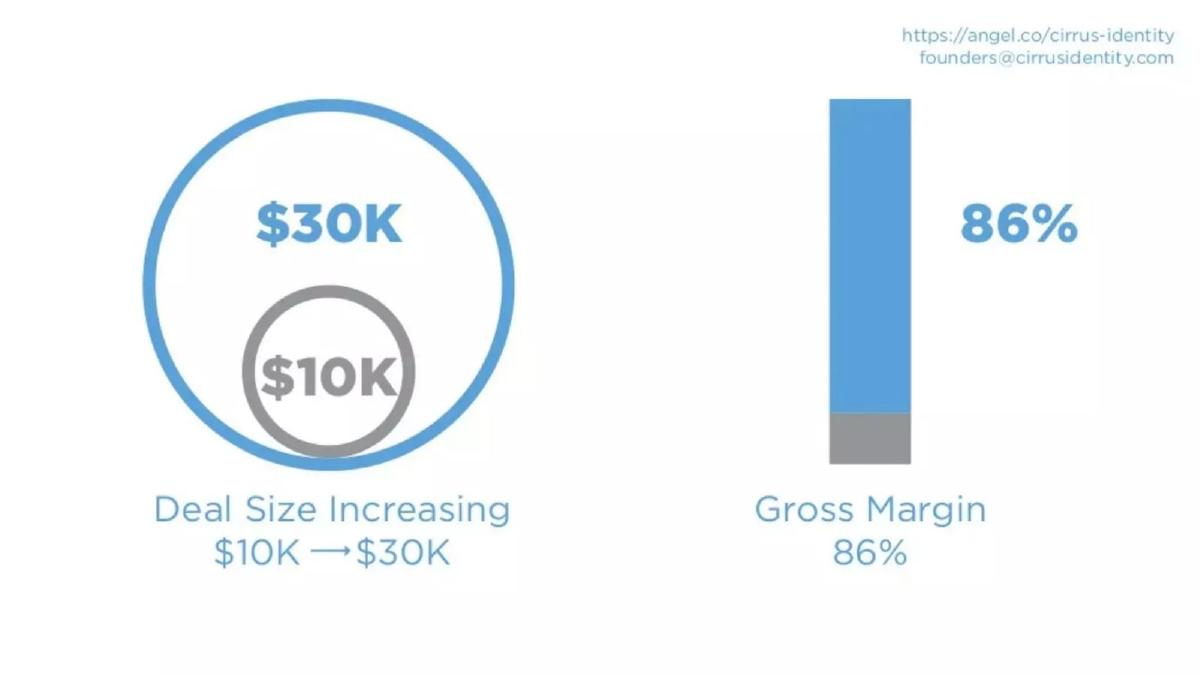
- Unit economics are a core highlight, with gross margins stated at 86% on slide 6.
- The deck demonstrates successful upselling, showing deal sizes increasing from $10K to $30K on slide 6.
- Negative churn is explicitly claimed on slide 5, driven by $50K in new revenue from existing customers.
- The total addressable market is segmented into a $1.3B US Higher Ed niche and a $9B Global Enterprise market on slide 7.
- Social proof is the primary persuasion tool, featuring logos from GE Global Research and multiple Ivy League universities on slide 2.
- The team slide (slide 8) emphasizes institutional pedigree with logos from Berkeley, Stanford, and Columbia.
- The deck completely omits a formal 'Ask' slide detailing the amount being raised or the intended use of funds.
The Power of Minimalist Traction
The Cirrus Identity pitch deck from 2013 is a masterclass in restraint. In an era where founders often feel compelled to produce 20-page manifestos on the future of technology, Cirrus Identity secured a $400,000 seed round using just nine slides. The strategy is clear: let the numbers do the talking. By the second slide, the investor already knows the company has nearly a quarter-million dollars in recurring revenue. This teardown examines how a lean, metrics-focused approach can be more effective than a high-production, narrative-heavy deck.
Slide 1: The Hook
The cover slide is functional and minimalist. It features the Cirrus Identity logo and a clear, concise tagline: "Online Guest Pass for Enterprise." This is a strong example of a 'what it is' tagline rather than a 'why it matters' tagline. It immediately categorizes the product for the investor: this is an identity and access management (IAM) tool for enterprise environments. The inclusion of the AngelList URL and a direct founder email in the top right corner signals that this deck was likely used for outbound investor relations or as a follow-up after a brief meeting.
Slide 2: Traction and Social Proof
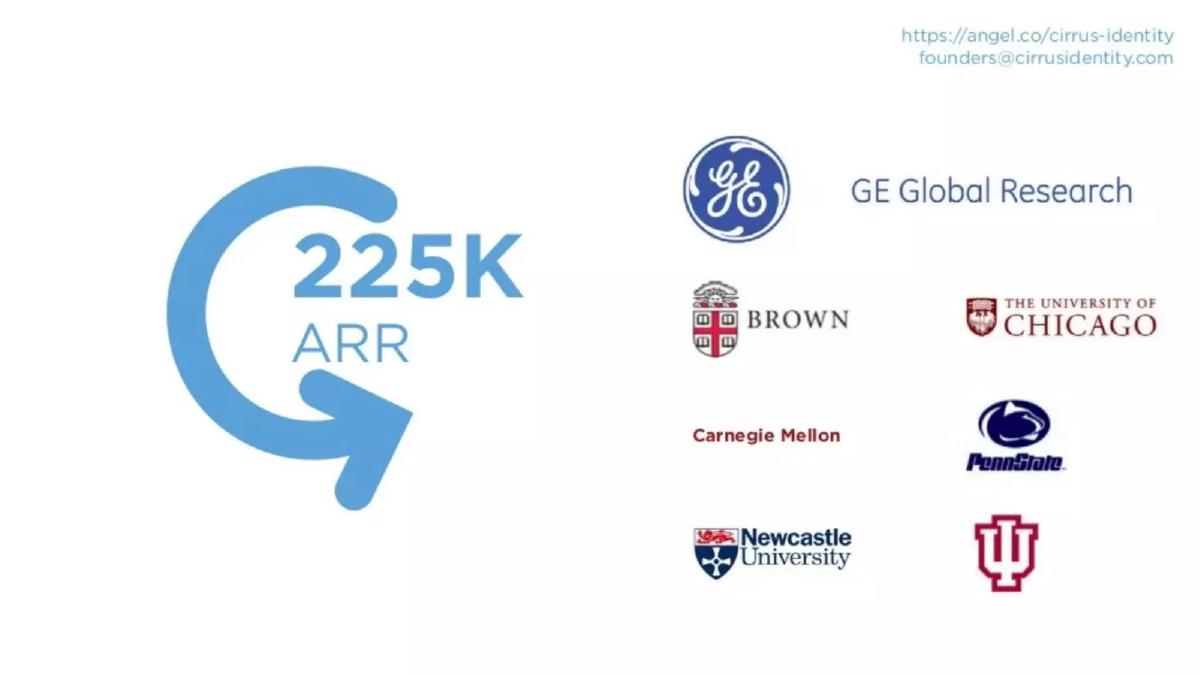
Most decks wait until slide 10 to show traction; Cirrus Identity puts it on slide 2. This is a bold move that immediately shifts the conversation from "Is this a good idea?" to "How big can this get?" The slide features a large "225K ARR" graphic. To the right, it displays a wall of high-authority logos, including GE Global Research, Brown, The University of Chicago, Carnegie Mellon, Penn State, Newcastle University, and Indiana University. For a seed-stage company in 2013, $225,000 in ARR with these specific institutional clients is an incredibly high-signal data point. It proves that the product is enterprise-ready and that the founders can navigate the complex procurement cycles of major universities and research institutions.
Slide 3: The Problem Visualized
Slide 3 is a wordless, full-bleed image of a laptop showing a standard login screen with the text "Don't have an account? Create now." This slide serves as a visual placeholder for a verbal pitch regarding the friction of traditional account creation. It represents the 'before' state: the frustration of contractors, alumni, or guests having to create yet another set of credentials to access institutional resources. While the slide contains no text, its position after the traction slide suggests it is meant to anchor the 'Problem' part of the narrative in a relatable, everyday experience.
Slide 4: The Value Proposition
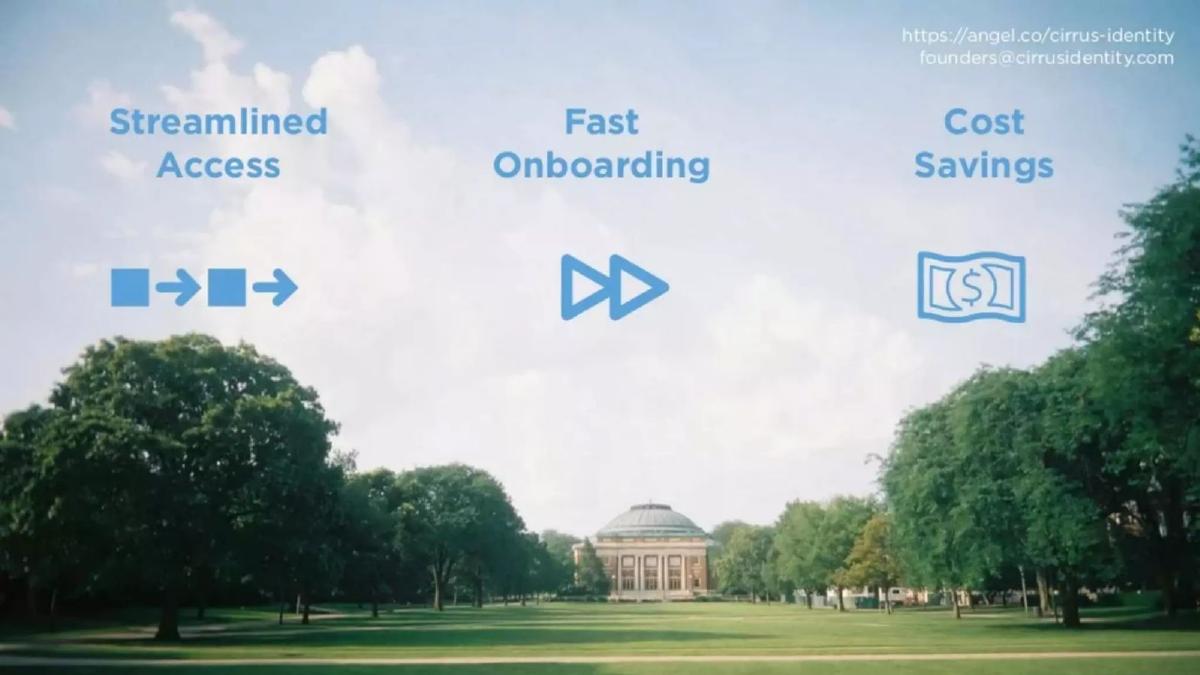
Slide 4 uses three simple icons to explain the 'After' state. The headers are "Streamlined Access," "Fast Onboarding," and "Cost Savings." Again, the company avoids technical jargon. There is no mention of SAML, OAuth, or specific API integrations here. Instead, they focus on the business outcomes that a CIO or a Dean would care about. The background image of a university campus reinforces their initial beachhead market: Higher Education. This slide is the bridge between the problem (friction) and the solution (Cirrus Identity).
Slide 5: The Growth Engine (Negative Churn)
Slide 5 is perhaps the most sophisticated slide in the deck from a financial perspective. It features a woman smiling in the snow, but the text is the real focus: "$50K New Revenue from Current Customers = Negative Churn." Negative churn is the 'holy grail' of SaaS metrics; it means that the expansion revenue from existing customers outweighs the revenue lost from departing customers. By highlighting this, Cirrus Identity is telling investors that their product is 'sticky' and that they have a proven 'land and expand' strategy. The phrase "Customers Love Us!" is backed up by the $50K expansion figure, making it a data-driven claim rather than a subjective one.
Slide 6: Unit Economics and Margins
This slide doubles down on the financial health of the business. It shows "Deal Size Increasing $10K -> $30K" and a "Gross Margin 86%." An 86% gross margin is exceptional for a seed-stage company, indicating that the software is highly scalable and requires minimal manual intervention or professional services to deploy. The increasing deal size suggests that as the product matures, the company is moving up-market or successfully bundling more features. For an investor, these two metrics combined with the ARR from slide 2 suggest a very efficient path to profitability.
Slide 7: Market Size
Slide 7 addresses the 'Why Now' and 'How Big' questions. It segments the market into two buckets: the "$1.3B US Higher Ed Identity" market (the beachhead) and the "$9B Global Enterprise Identity Market" (the expansion). By highlighting the US Higher Ed market in blue on a world map, they acknowledge their current focus while pointing to the massive grey area representing the total addressable market (TAM). This slide effectively argues that while they are currently winning in a niche, the technology is a horizontal solution applicable to the global enterprise sector.
Slide 8: The Team
The team slide features a photo of five team members wearing "Five Hundred Strong" t-shirts (likely a reference to the 500 Startups accelerator). Below the photo, they list the roles— Engineering, Product, CEO, Marketing, and CTO —paired with prestigious institutional logos: UC Berkeley, UCSF, Columbia University, Stanford University, and Jive. This slide establishes 'Founder-Market Fit.' The team has deep roots in the very institutions they are selling to, which explains their success in the higher education vertical. The CTO’s background at Jive adds a layer of commercial enterprise software experience to the academic pedigree of the rest of the team.
Slide 9: Momentum and Future Traction
The final slide, titled "TESTING NOW!" , serves as a closing momentum builder. It lists five more elite institutions: MIT, UC Berkeley, Cornell University, Stanford University, and Simon Fraser University. This is a clever way to end the deck. It tells the investor that the $225K ARR isn't a fluke or a ceiling; there is a pipeline of world-class customers currently in the pilot phase. It creates a sense of urgency—the company is growing, and the 'testing' phase is the last chance for an investor to get in before these names move to the 'Paid' column.
What Works in This Deck
The primary strength of this deck is its signal-to-noise ratio. Every slide provides a specific, high-value reason to invest. By leading with $225K ARR, the founders immediately earn the right to be heard. The focus on sophisticated SaaS metrics (Negative Churn, Gross Margin, Deal Size Expansion) demonstrates that the leadership team understands how to build and measure a scalable business, not just a piece of software. Furthermore, the heavy use of social proof —specifically from 'hard-to-close' academic institutions—creates a defensive moat. If MIT and Stanford are testing the software, it implies a level of security and reliability that is difficult for a competitor to replicate quickly.
What Is Missing
The most glaring omission is a formal 'Ask' slide. There is no mention of how much capital is being raised, the valuation, or the specific milestones the company intends to hit with the new funding. While this information is often omitted in decks shared publicly or used in specific pitch contexts, its absence makes the deck feel more like a company update than a fundraising tool. Additionally, there is no competitor analysis. The IAM space is crowded with giants (like Okta or Microsoft) and niche players. Failing to acknowledge the competitive landscape can sometimes be perceived as a lack of market awareness. Finally, the deck is technically opaque. While focusing on benefits is good, a single slide explaining the 'magic' of how they integrate social login with enterprise SSO would have helped technical investors understand the product's defensibility.
What a Founder Should Copy
Founders should emulate the traction-first structure of this deck. If you have revenue and high-profile customers, do not bury them on slide 12. Move them to the front to anchor the investor's interest. Also, copy the segmentation of the market shown on slide 7. Showing a clear path from a 'niche' beachhead ($1.3B) to a 'massive' global market ($9B) is a great way to prove you have a focused go-to-market strategy without sacrificing the 'venture-scale' dream. Lastly, the use of 'Testing Now' as a closing slide is an excellent way to demonstrate a forward-looking pipeline and create FOMO (fear of missing out) without using hype-filled language.
Final Thoughts
Cirrus Identity’s 2013 deck is a reminder that you don't need a 20-slide deck to raise a seed round if your business fundamentals are strong. With $225K ARR and 86% margins, the 'story' of the company is already written in the spreadsheets. The deck simply serves as a clean, professional delivery mechanism for those facts. It is a 'boring' business executed with clinical efficiency, which is exactly what many professional investors are looking for.
Frequently asked questions
- How much did Cirrus Identity raise with this deck?
- According to the catalogue facts, Cirrus Identity raised $400,000 in a Seed round in 2013. The deck itself does not actually state the 'Ask' or the valuation, which is unusual for a pitch deck but common in decks used for demo days or initial introductions where the specific terms are discussed in person.
- What was the company's revenue at the time of the pitch?
- The company reported $225,000 in Annual Recurring Revenue (ARR) on slide 2. This is a very high revenue figure for a 2013 seed round, suggesting the company had significant product-market fit within the higher education sector before seeking external capital.
- Who were the primary customers targeted in this deck?
- The deck focuses heavily on the 'US Higher Ed Identity' market, valued at $1.3B on slide 7. It lists specific prestigious customers including Brown, Carnegie Mellon, Penn State, and Newcastle University. The catalogue description also mentions Yale, UC Berkeley, and the University of Chicago.
- What are the key financial metrics highlighted?
- Beyond the $225K ARR, the deck highlights an 86% gross margin and a transition in deal size from $10K to $30K (slide 6). It also notes $50K in expansion revenue from current customers, leading to a 'Negative Churn' status on slide 5.
- Is there a technical explanation of how the product works?
- No. The deck stays at a very high level. Slide 4 mentions 'Streamlined Access' and 'Fast Onboarding,' while the catalogue description explains it integrates social logins (Google, Facebook) with enterprise Web Single Sign-On. The deck prioritizes business outcomes over technical architecture.