Yaydoo’s 2020 pitch deck is a concise, 9-slide presentation that prioritizes market validation and financial growth over technical jargon. Operating in the e-procurement and office management sector, the company uses its second slide to showcase $710,000 in annual sales and a dense wall of customer logos, including WeWork and Booking.com. The narrative moves quickly from a clearly defined problem—30% waste in manual procurement—to a product solution described as an 'office on autopilot.' The deck concludes with a transparent funding ask of $900,000, noting that $400,000 was already committed.…
Key takeaways
- The deck leads with a massive traction signal on slide 2, reporting $710k USD in annual sales achieved in less than two years.
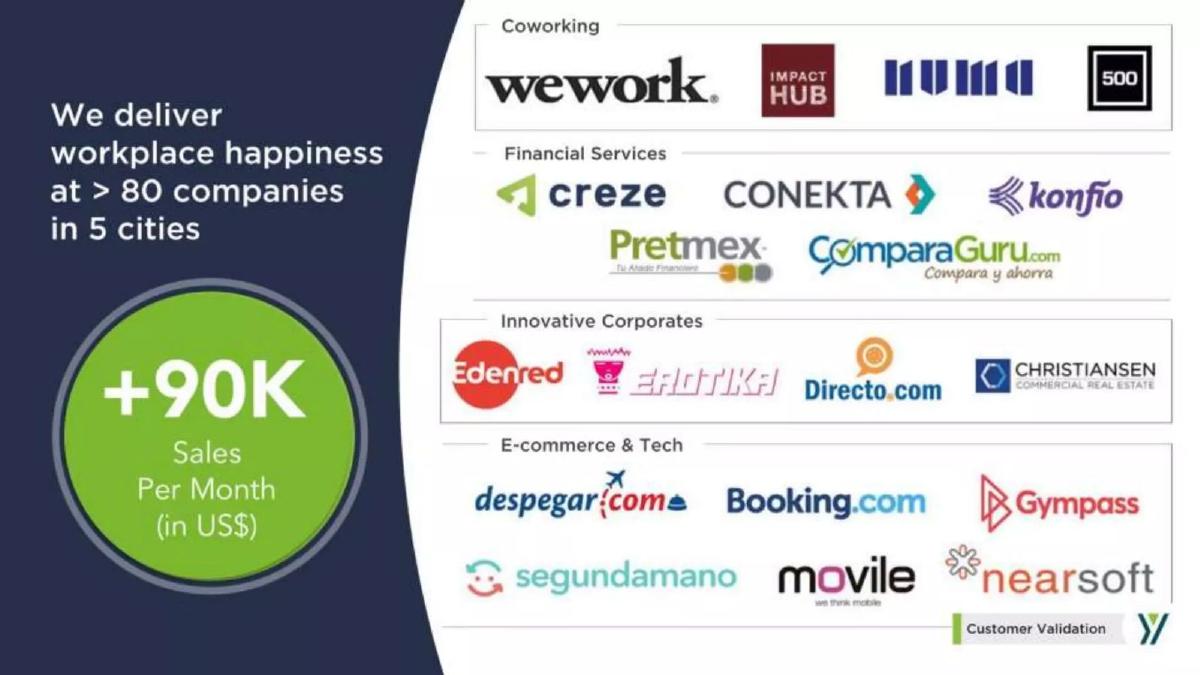
- Customer validation is a core theme, with over 20 logos displayed on slide 2 and a breakdown of 80+ companies across 5 cities on slide 6.
- The problem is quantified specifically on slide 3, stating that companies lose up to 30% in additional expenses due to poor procurement practices.
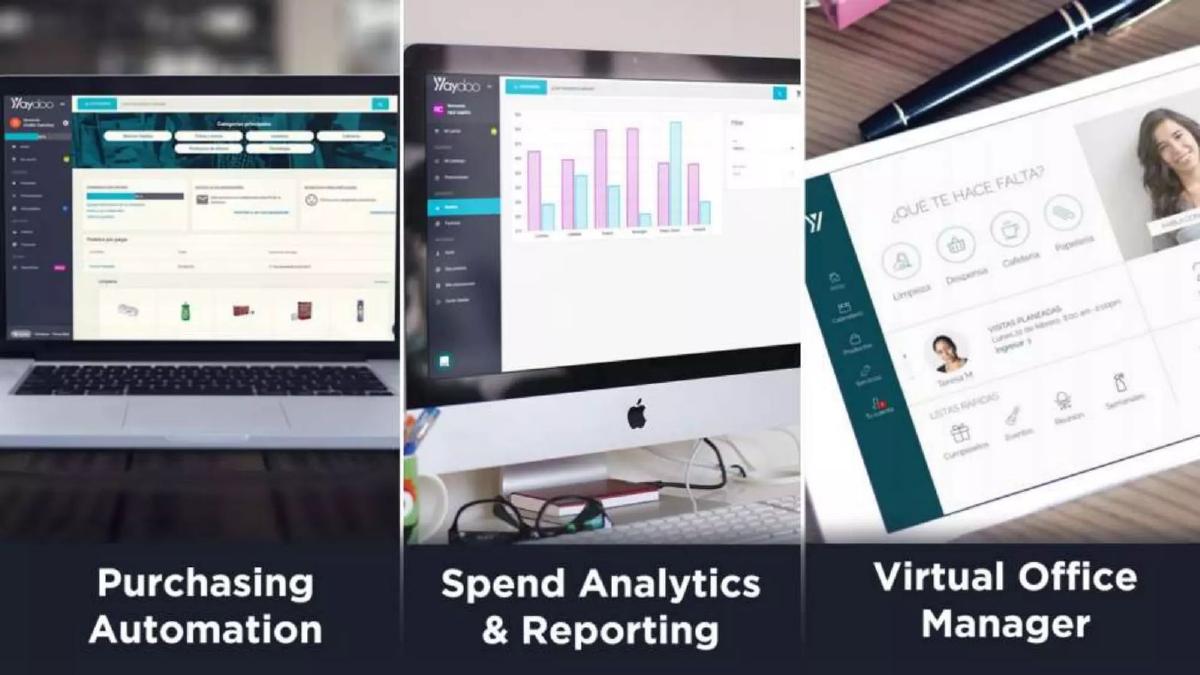
- The product is positioned as a three-pillar solution on slide 5: Purchasing Automation, Spend Analytics & Reporting, and a Virtual Office Manager.
- Growth is visualized through a bar chart on slide 7, showing a climb from near-zero in May 2016 to a $1M+ sales run rate by March 2018.
- The funding ask is explicit on slide 8, seeking $900,000 for a Seed Stage round with $400,000 already committed.
- The team slide (slide 8) emphasizes cross-functional expertise in Tech, Marketing, Procurement, and Logistics, backed by logos from BBVA, GE, Microsoft, and Scotiabank.
- The deck omits a traditional 'Market Size' (TAM/SAM/SOM) slide, relying instead on realized revenue to prove demand.
The Power of Leading with Traction
Yaydoo’s 2020 pitch deck is a lean, 9-slide document that serves as a textbook example of how to use momentum to overcome a lack of brand recognition. In the crowded B2B SaaS and procurement space, founders often get bogged down in the technical minutiae of their API integrations or AI models. Yaydoo takes the opposite approach. They lead with the money. By putting their $710k annual sales figure on the second slide, they immediately signal to investors that this isn't a science project—it is a functioning business with market fit.
Slide 1: The Hook
The cover slide is minimalist. It features the Yaydoo logo and a clear one-sentence value proposition: "The office management and procurement platform that enables companies to create productive workspaces." It identifies Sergio Almaguer as the CEO and provides direct contact information. This sets a professional, no-nonsense tone for the rest of the presentation.
Slide 2: Immediate Validation
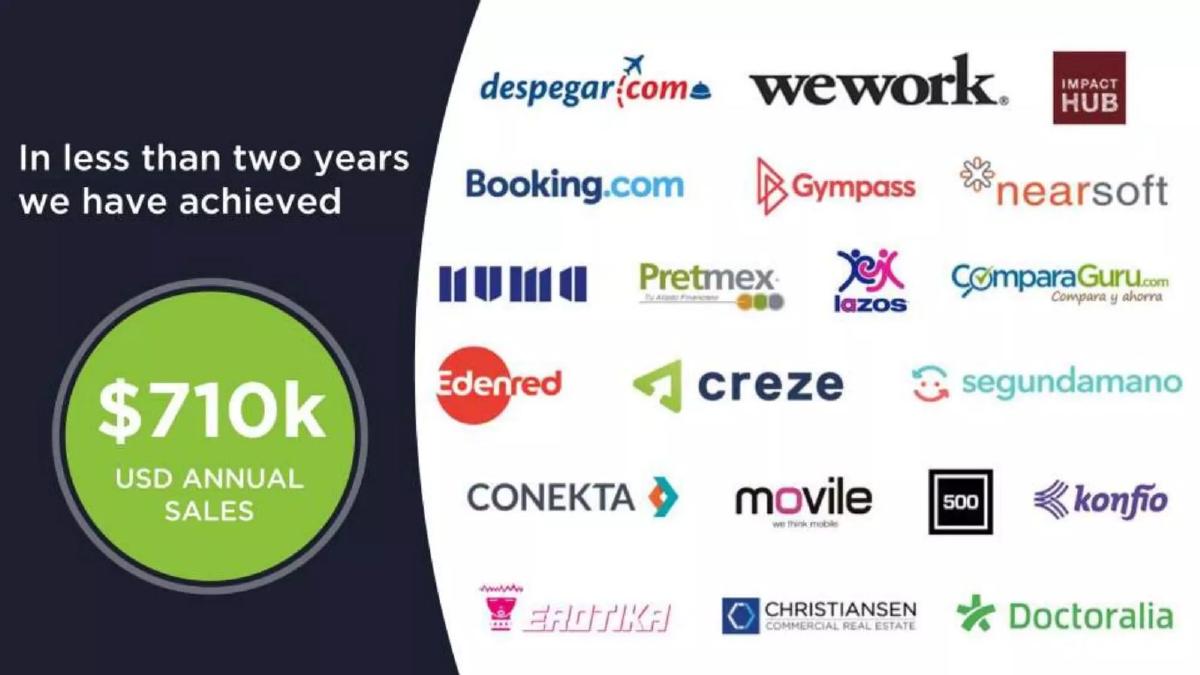
Slide 2 is arguably the most important slide in the deck. Titled "In less than two years we have achieved," it features a large green circle highlighting $710k USD Annual Sales . To the right, a wall of logos provides social proof. Seeing names like WeWork, Booking.com, and 500 Startups immediately answers the question of whether large enterprises trust this platform. For a seed-stage company, this level of revenue and logo density is an incredibly strong opening move.
Slide 3: Quantifying the Pain
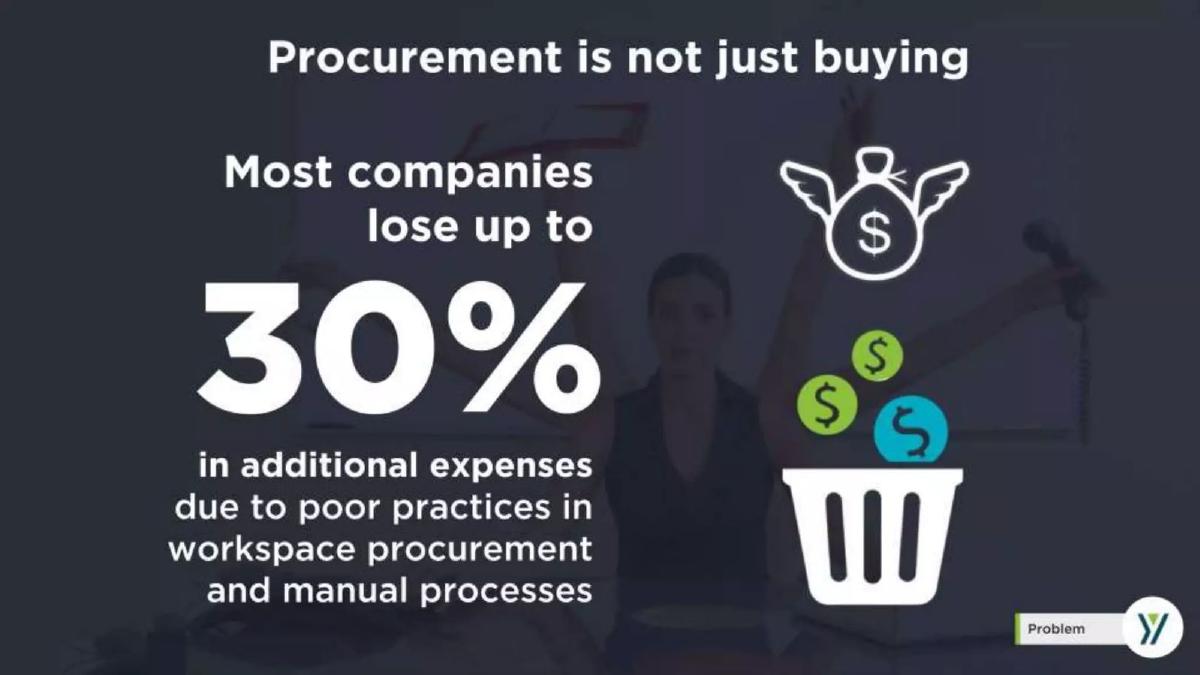
After establishing that they can sell, Yaydoo explains why they can sell. Slide 3 addresses the problem: "Procurement is not just buying." It claims that most companies lose up to 30% in additional expenses due to poor practices and manual processes. The use of a large, bold "30%" creates a sense of urgency. It frames procurement not as a back-office chore, but as a significant financial leak that needs to be plugged.
Slide 4 and 5: The Solution and Product
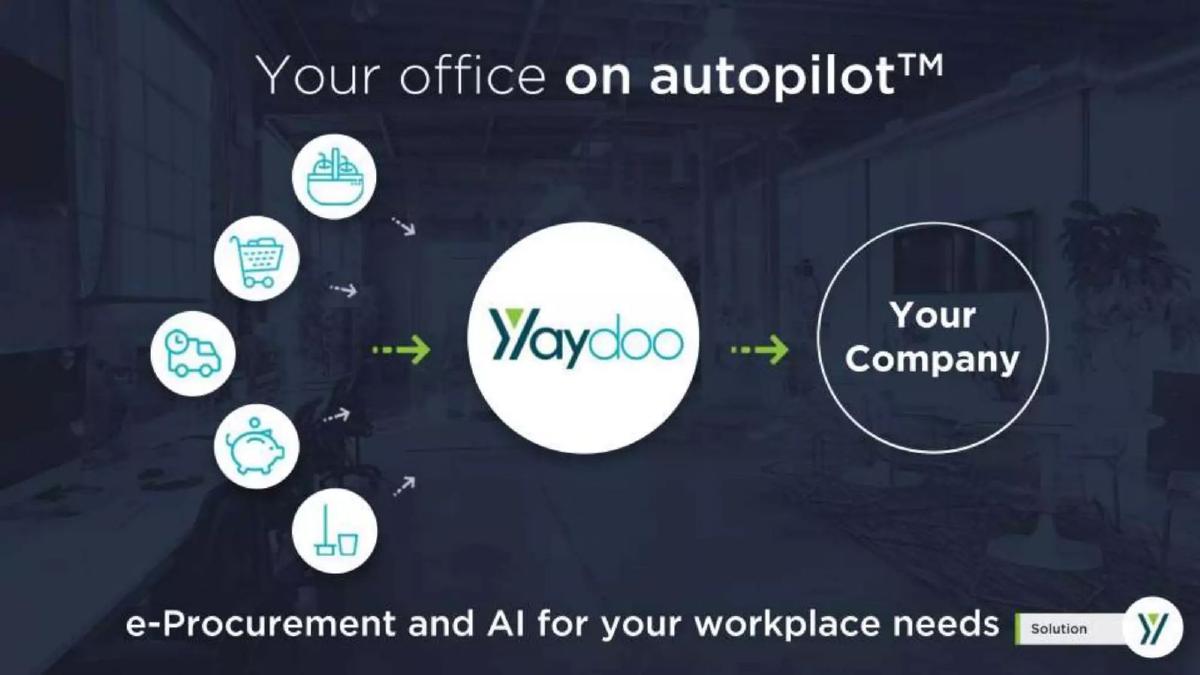
Slide 4 introduces the "Office on Autopilot" concept. It uses a simple flow diagram showing various inputs (supplies, logistics, savings) flowing through Yaydoo into "Your Company." Slide 5 goes deeper into the product features, dividing the platform into three distinct pillars: Purchasing Automation , Spend Analytics & Reporting , and a Virtual Office Manager . The inclusion of actual UI screenshots on laptops and monitors helps investors visualize the product as a tangible, ready-to-use tool rather than a conceptual mockup.
Slide 6 and 7: Market Depth and Growth Velocity
Slide 6 expands on the customer base, noting that they deliver "workplace happiness at > 80 companies in 5 cities." It categorizes these customers into segments like Coworking, Financial Services, and E-commerce & Tech. This demonstrates that the product is versatile across industries. Slide 7 provides the financial evidence of this growth. A bar chart shows gross sales in USD from May 2016 to March 2018. The chart shows a clear hockey-stick trajectory, ending with a +$1M 2018 Sales Run Rate . This slide is crucial because it shows that the $710k mentioned earlier wasn't a fluke; it was part of a consistent upward trend.
Slide 8: The Team and The Ask
The penultimate slide handles the logistics of the raise. It identifies the team's core competencies—Tech, Marketing, Procurement, and Logistics—and shows the founders in an office setting. Below them are logos of former employers or partners: BBVA Bancomer, GE, Microsoft, and Scotiabank. The right side of the slide is dedicated to the Seed Stage raise of $900,000 . It transparently notes that $400k is committed and $500k is available. It also lists high-profile investors like Social Capital and 500 Startups, which adds a final layer of institutional credibility.
Slide 9: Closing
The deck ends as it began, with the logo, the "Office on Autopilot" tagline, and the CEO's contact information. It is a clean, circular conclusion to a very focused pitch.
What Works in This Deck
The Traction-First Narrative: By placing revenue and logos on slide 2, Yaydoo eliminates the skepticism that usually accompanies seed-stage pitches. They prove the market exists before they even explain the product.
Clarity of the Problem: The "30% waste" metric is a powerful anchor. It gives the salesperson (and the investor) a specific number to use when calculating the potential ROI of the software.
Transparency: Being explicit about how much of the round is already committed ($400k of $900k) creates a sense of momentum and FOMO (fear of missing out) for the remaining $500k.
What Is Missing
Competitive Landscape: The deck does not mention competitors like Coupa or SAP Ariba. Investors would want to know how Yaydoo wins against established legacy players or other startups in the space.
Unit Economics: While we see gross sales, we don't see margins, Customer Acquisition Cost (CAC), or Lifetime Value (LTV). In procurement, where margins can be thin if the company is acting as a reseller, these numbers are vital.
Market Size: There is no mention of the Total Addressable Market (TAM). While the traction is great, investors need to know if this is a billion-dollar opportunity or a niche tool for mid-market offices.
What a Founder Should Copy
The "Customer Validation" Slide: Slide 6 is excellent. Instead of just a random pile of logos, they categorized them by industry. This tells a story of market versatility and shows a structured approach to sales.
The Growth Chart: The bar chart on slide 7 is clean and easy to read. It uses monthly data to show consistency, which is much more persuasive than just showing two annual data points.
The Concise Ask: Don't hide your funding needs. Yaydoo’s slide 8 is a perfect example of how to present a round: state the stage, the total amount, what is committed, and who is already on the cap table.
Frequently asked questions
- What is Yaydoo's primary value proposition?
- Yaydoo positions itself as an e-procurement and AI-driven platform that puts 'office management on autopilot.' According to slide 3 and 4, the goal is to eliminate the 30% in wasted expenses that companies incur through manual procurement processes. They achieve this through a combination of automated purchasing, spend analytics, and a virtual manager interface.
- How much revenue was Yaydoo generating at the time of this deck?
- The deck provides two specific revenue milestones. Slide 2 mentions $710k USD in annual sales achieved within the first two years. By slide 7, the company displays a monthly growth chart peaking in March 2018, which supported a sales run rate of over $1M USD.
- Who are Yaydoo's existing investors and customers?
- As of slide 8, the company listed several notable investors including 500 Startups, Social Capital, Leap Global Partners, and Hunt. Their customer base, shown on slide 6, includes over 80 companies such as WeWork, Booking.com, Gympass, and Konfio, spanning sectors like Coworking, Financial Services, and Tech.
- What is the specific funding ask in the deck?
- On slide 8, Yaydoo explicitly states they are raising a Seed Stage round of $900,000 USD. At the time the deck was finalized, $400,000 of that total was already committed, leaving $500,000 available for new investors.
- What critical information is missing from the Yaydoo pitch deck?
- The deck is notably missing a competitive analysis slide and a detailed breakdown of unit economics (such as CAC or LTV). It also lacks a 'Market Size' slide to show the total addressable market. Furthermore, while the founders are pictured on slide 8, their specific names and individual roles are not listed next to their photos, though the CEO is identified on the cover.