Yagibaze is a Rwandan startup attempting to build an all-in-one digital ecosystem. Their 9-slide deck, prepared for the Hanga Pitchfest, details a business model that spans three distinct verticals: web hosting (Yagibaze Hosting), education (Yagibaze Academy), and a gig economy platform (Yagibaze Jobs). The company identifies a significant gap in Rwanda's digital literacy, which stood at only 30% in January 2023. By offering affordable hosting starting at $10 per month and a marketplace where users can sell services for a 20% commission, Yagibaze aims to capture a youth-dominated market. Whil…
Key takeaways
- The startup addresses a digital literacy penetration rate in Rwanda of only 30% as of January 2023 (Slide 2).
- Yagibaze operates three distinct sub-brands: Yagibaze Hosting, Yagibaze Academy, and Yagibaze Jobs (Slide 3).
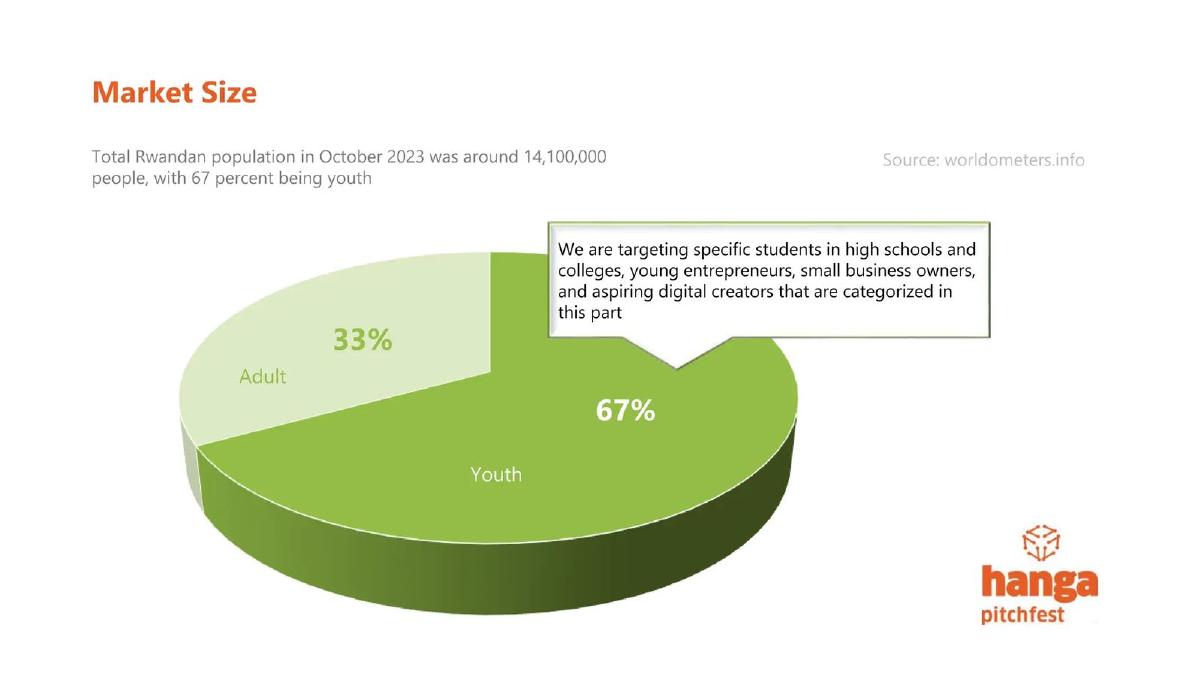
- The target market is heavily skewed toward youth, who represent 67% of Rwanda's 14.1 million population (Slide 4).
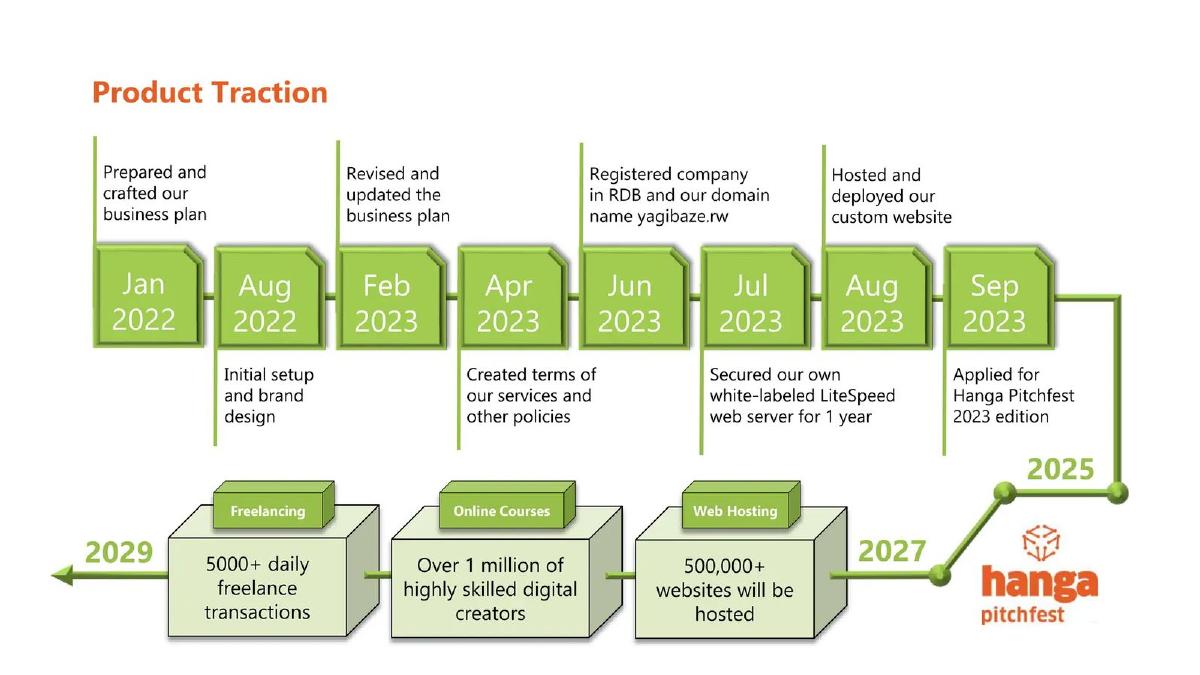
- Long-term traction goals include hosting 500,000+ websites and facilitating 5,000+ daily freelance transactions by 2029 (Slide 5).
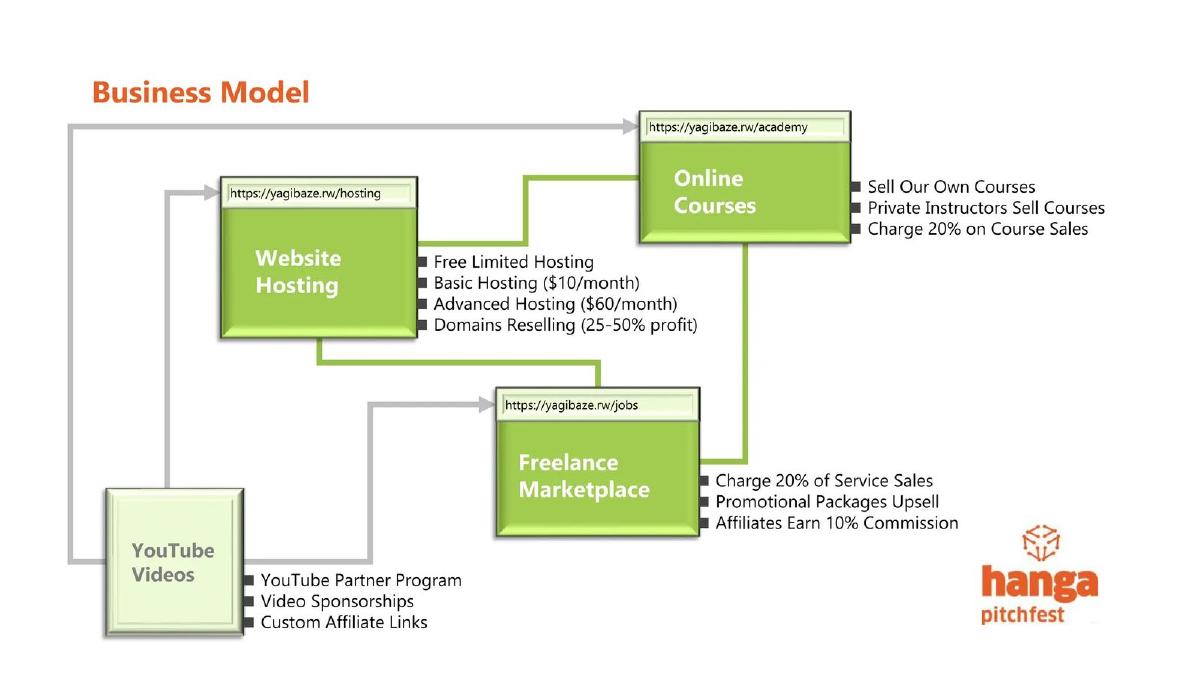
- Revenue streams include $10-$60 monthly hosting fees, 20% commission on course sales, and 20% commission on freelance service sales (Slide 6).
- The company claims uniqueness through a 'Free Generative AI-powered Chatbot' and a 'Free Website Hosting Option' not offered by local competitors (Slide 7).
- The financial ask is $50,000, with 30% allocated to office facilities and 30% to marketing and outreach (Slide 8).
- The founding team consists of a CEO/CTO with WordPress and NLP expertise and a General Secretary with inventory management experience (Slide 9).
Executive Summary
Yagibaze is a Rwandan-based startup that aims to become a central hub for the country's digital economy. The pitch deck, prepared for the Hanga Pitchfest, outlines a platform that integrates web hosting, an educational academy, and a freelance marketplace. By targeting the 67% of the Rwandan population that is under the age of 30, Yagibaze seeks to solve the dual problems of low digital literacy and high youth unemployment. The deck presents a clear, if highly ambitious, roadmap to scale three distinct business lines simultaneously with a lean initial investment of $50,000.
Slide 1: Title and Mission
The opening slide introduces the brand name, Yagibaze, and its association with the Hanga Pitchfest. The mission statement is explicit: providing affordable website hosting, independent course publishing, and a freelance marketplace in one place. The stated goal is to promote a "knowledge-based economy." The inclusion of the URL (yagibaze.rw) immediately establishes that the platform is live and focused on the Rwandan top-level domain.
Slide 2: Problem Definition
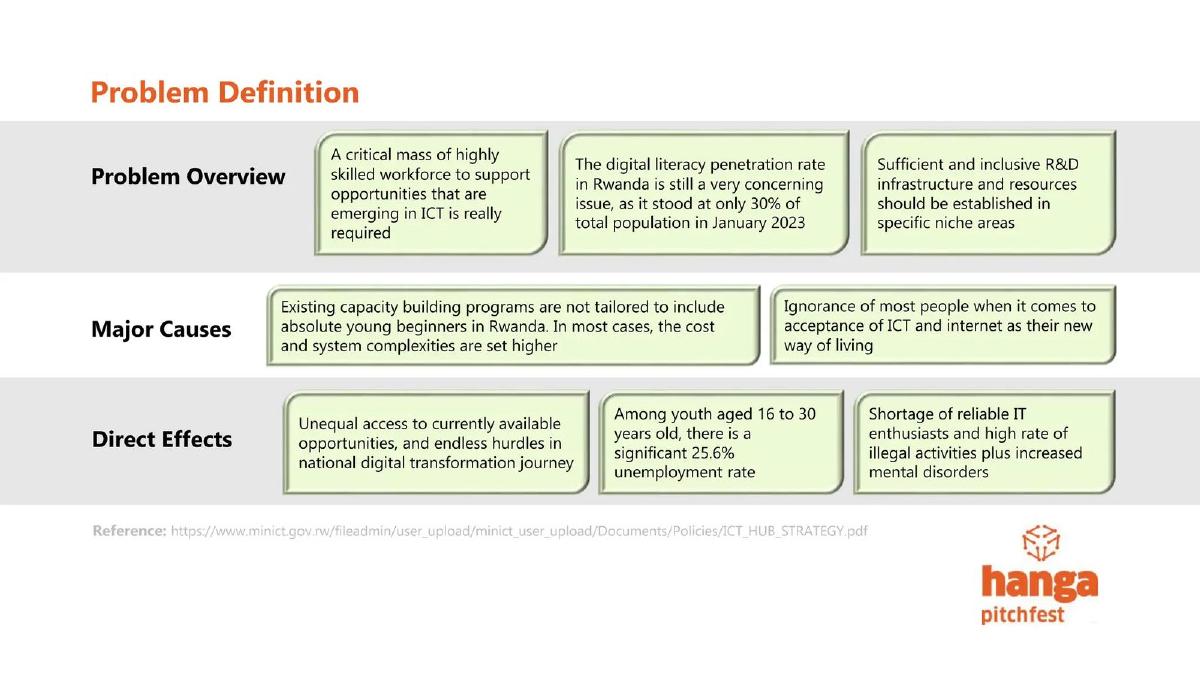
This slide uses a structured approach to define the market gap. It cites a specific statistic: the digital literacy penetration rate in Rwanda was only 30% in January 2023. It identifies "Major Causes" such as programs not being tailored for beginners and "Direct Effects" like a 25.6% unemployment rate among youth aged 16 to 30. By referencing a Ministry of ICT strategy document, the founders ground their problem statement in official national data, which adds significant credibility to their claims of a "shortage of reliable IT enthusiasts."
Slide 3: Solution Statement
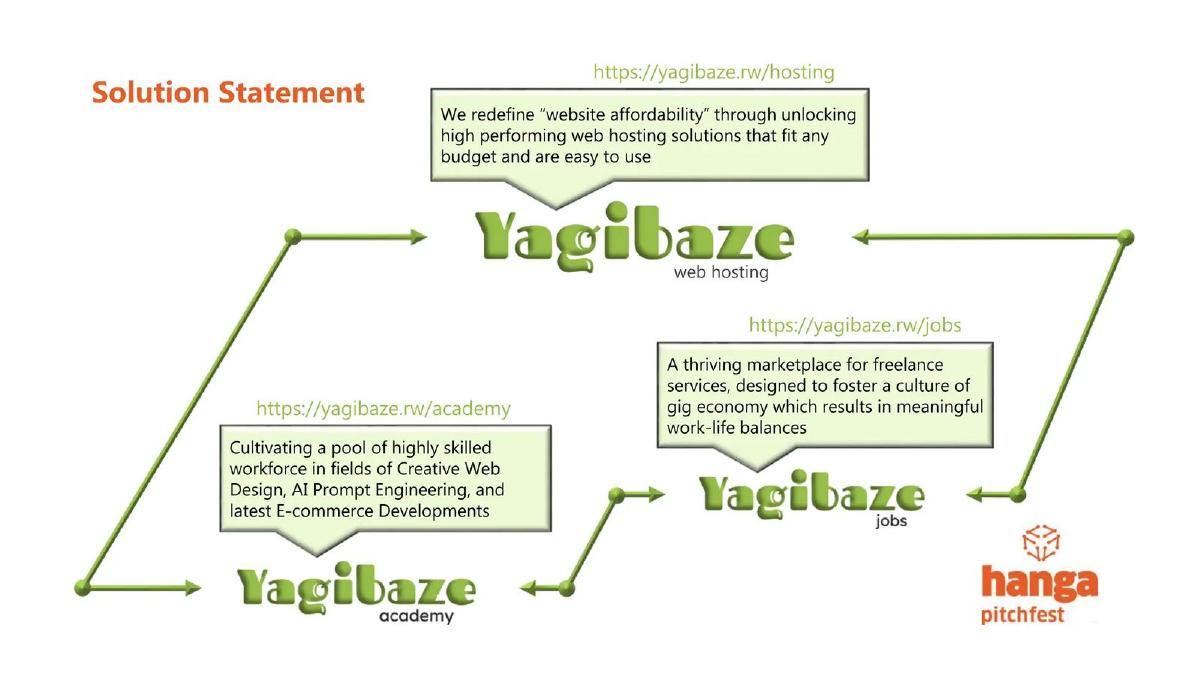
The solution is presented as a three-pronged ecosystem. Yagibaze Web Hosting focuses on affordability and ease of use. Yagibaze Academy aims to cultivate a skilled workforce in web design, AI prompt engineering, and e-commerce. Yagibaze Jobs is described as a marketplace for freelance services. The slide uses a circular flow diagram to suggest that these three services feed into one another, though it does not explicitly detail the mechanics of that synergy.
Slide 4: Market Size
The market size slide focuses on demographics rather than traditional TAM/SAM/SOM financial metrics. It notes a total Rwandan population of 14.1 million as of October 2023. The core of the slide is a pie chart showing that 67% of this population is "Youth." The text clarifies that they are targeting students in high schools and colleges, young entrepreneurs, and small business owners. While this identifies the audience, it lacks a calculation of the actual dollar value of the addressable market.
Slide 5: Product Traction and Roadmap
This slide combines a historical timeline with future projections. It shows the company was registered in June 2023 and deployed its custom website in August 2023. The roadmap is aggressive: reaching 500,000+ hosted websites by 2027 and 5,000+ daily freelance transactions by 2029. The jump from "Applied for Hanga Pitchfest" in late 2023 to hosting half a million websites within four years represents a massive scaling challenge that isn't fully explained in terms of infrastructure or acquisition strategy.
Slide 6: Business Model
The business model slide is one of the most detailed in the deck. It breaks down revenue by vertical:
Website Hosting: $10/month for basic, $60/month for advanced, and 25-50% profit on domain reselling. · Online Courses: 20% commission on sales from private instructors. · Freelance Marketplace: 20% commission on service sales and upsells on promotional packages.
The slide also mentions a YouTube channel as a top-of-funnel marketing and revenue tool, indicating a content-led growth strategy.
Slide 7: Competitive Landscape
Yagibaze uses a comparison table to stack itself against 16 competitors, ranging from local firms like AOS Ltd to global giants like GoDaddy and Upwork. The "Uniqueness" is defined by six features. Notably, Yagibaze claims to be the only provider offering a "Free Generative AI-powered Chatbot" and a "Free Website Hosting Option" alongside tailored training for beginners. This slide effectively shows that while many companies do one thing, Yagibaze is the only one attempting to bundle all these services for the local market.
Slide 8: Funding Status and Projections
The ask is $50,000. The allocation is balanced, with 30% ($15,000) for office facilities and 30% for marketing. The revenue growth chart is a standard "hockey stick" projection, starting at a "Launch" point and climbing to $500,000 by Year 5. The chart lacks specific Y-axis labels for the intervening years, making it difficult to track the exact expected growth rate between Year 1 and Year 4.
Slide 9: The Founders
The deck concludes with the two-person founding team. Patrick Ndahayo (CEO/CTO) is described as a webmaster with skills in WordPress, NLP models, and SEO. Ange Niyonkuru (General Secretary) brings three years of experience in inventory management and health services. The team appears lean for a project encompassing three major tech verticals, suggesting that the initial $50k will be critical for the "Hiring and Train" goal mentioned on the previous slide.
What Works Well
Hyper-Local Focus: The deck does an excellent job of rooting the business in the specific needs of Rwanda. By citing local unemployment rates and digital literacy stats, the founders make a compelling case for why a localized solution is necessary despite the presence of global competitors like GoDaddy or Fiverr.
Clear Monetization: Unlike many early-stage decks that are vague about revenue, Yagibaze provides specific price points ($10, $60) and commission percentages (20%). This allows investors to model potential returns based on the user growth targets provided in the roadmap.
Competitive Differentiation: The comparison table on Slide 7 is comprehensive. It doesn't just list competitors; it identifies specific feature gaps (like AI chatbots and free hosting tiers) that Yagibaze intends to fill to capture the lower end of the market.
What Is Missing
Unit Economics: While the revenue per user is clear, the cost to acquire a customer (CAC) and the cost to serve them (hosting infrastructure costs) are absent. With a $10/month hosting price point, margins could be thin if infrastructure isn't managed efficiently.
Technical Infrastructure Details: Slide 5 mentions a "white-labeled LiteSpeed web server." This suggests the company is currently reselling or white-labeling another provider's infrastructure. There is no mention of how they will scale to 500,000 websites technically or if they plan to build their own data centers.
Team Breadth: Building a hosting company, an EdTech platform, and a freelance marketplace simultaneously is a massive undertaking. The current team of two may struggle to manage the operational complexity of three different business models without a larger engineering and support staff.
Founders Should Copy
The Problem-Cause-Effect Framework: Slide 2 is a masterclass in structured thinking. By breaking the problem down into its root causes and its societal effects, the founders move beyond a simple "people need websites" argument and turn their startup into a solution for national economic development.
Integrated Ecosystem Visuals: Slide 3 and Slide 6 use arrows and boxes to show how different product lines interact. This helps the investor understand how a student in the "Academy" might become a seller in the "Marketplace" and a customer for the "Hosting" service, creating a virtuous cycle of user retention.
Demographic Targeting: Instead of just using a generic TAM (Total Addressable Market) figure, Slide 4 focuses on the "Youth" demographic. This is a smart move for a startup in a developing economy where the younger generation is the primary driver of digital adoption.
Frequently asked questions
- What is the primary problem Yagibaze is trying to solve?
- According to Slide 2, the company is tackling low digital literacy in Rwanda (30% penetration) and high youth unemployment (25.6% for ages 16-30). They argue that existing ICT programs are too complex and expensive for beginners, leading to a shortage of reliable IT enthusiasts and a lack of inclusive R&D infrastructure.
- How does Yagibaze plan to generate revenue?
- Slide 6 outlines a multi-channel revenue model. They charge $10/month for basic hosting and $60/month for advanced hosting, plus 25-50% profit on domain reselling. For their marketplace and academy, they take a 20% commission on all service and course sales. They also mention supplemental income from a YouTube Partner Program and affiliate links.
- What are the company's long-term growth targets?
- Slide 5 sets ambitious milestones. By 2027, they aim to host over 500,000 websites. By 2029, they project reaching over 1 million digital creators through their academy and facilitating more than 5,000 daily freelance transactions. Their revenue chart on Slide 8 shows a target of $500k in annual revenue by year five.
- Who are the main competitors identified in the deck?
- Slide 7 lists a wide range of competitors. Local Rwandan competitors include AOS Ltd, Esicia Ltd, and Umurava. International competitors include GoDaddy and Hostinger for web hosting, and Fiverr, Upwork, Udemy, and Skillshare for the marketplace and education sectors. Yagibaze differentiates itself by offering a 'free' tier across all these services.
- How will the $50,000 investment be utilized?
- The funding breakdown on Slide 8 allocates 30% ($15,000) to 'Office Facility' and another 30% ($15,000) to 'Marketing and Outreach.' The remaining 40% is split between 'Website Enhancement' (20%), 'Hiring and Train' (10%), and 'Operational Expenses' (10%).