Valholla Entertainment’s pitch deck is a lean, 8-slide presentation focused on transitioning a successful regional independent label into a global player. Founded in 2005 and based in Miami, the company leverages its track record—including RIAA Gold and Platinum plaques for its production team and high-selling independent R&B albums—to justify a $4 million funding request. The deck relies heavily on macro-industry trends from 2017-2018, such as the rise of streaming and high-profile music IPOs, to frame the opportunity. While it clearly outlines a revenue model spanning royalties, merchandise…
Key takeaways
- The company was founded in 2005 and claims to be a top independent label in the South Atlantic region based on Nielsen data (Slide 2).
- Valholla is seeking $4 million in funding to provide three years of runway for 2-4 major album releases per year (Slide 7).
- The deck cites 2017 global recorded music revenues of $17.3 billion as a primary market driver (Slide 3).
- Traction is demonstrated through RIAA Gold and Platinum plaques earned by the production team, The Track Burnaz, for work with Future and Big Sean (Slide 6).
- The revenue model is diversified across recorded music royalties, merchandise, publishing, and management fees (Slide 5).
- Founder Vinton 'Vince Valholla' Eyma claims over 15 years of experience and executive production of 80+ commercial projects (Slide 8).
- The company explicitly states it has operated on a 'shoestring budget' since its inception in 2005 (Slide 2).
- The deck promises a 100% ROI to investors within three years, though it lacks the financial modeling to support this claim (Slide 7).
Valholla Entertainment: The 8-Slide Regional-to-Global Strategy
Valholla Entertainment presents a deck that is remarkably concise, focusing on the transition from a bootstrapped regional independent label to a well-capitalized global entity. The deck is structured to show that the foundation has already been built over a decade of operation, and the requested $4 million is the fuel required for scale. However, the brevity of the deck means several critical investor questions regarding unit economics and team structure remain unanswered.
Slide 1: Title and Identity
The opening slide establishes the brand identity with a minimalist black-and-white aesthetic. It clearly defines the business as a "Music Label | Talent Management" firm. The logo, featuring a stylized 'VH' with a castle battlement motif, suggests a sense of established presence or 'fortress' in the industry. There are no taglines or mission statements here; it is a direct introduction to the brand.
Slide 2: About Us and the 'Shoestring' History
Slide 2 provides the company's origin story, noting a 2005 founding date in Miami, Florida. The most significant claim here is that Valholla is one of the top independent record labels in the South Atlantic region of the US, citing Nielsen data as the source. Crucially, the slide admits the company has operated on a "shoestring budget" since its inception. This is a double-edged sword: it demonstrates capital efficiency and survival skills, but it also highlights a lack of significant historical scaling. The slide concludes with the core thesis: seeking funding to compete on a worldwide scale.
Slide 3: The Macro Opportunity
To justify the investment, Valholla points to the broader music industry's health. Citing 2017 figures, the slide notes $17.3 billion in global recorded music revenues and three consecutive years of growth. It attributes this to the rise of streaming services like Spotify and Apple Music. The mention of the Spotify and Hipgnosis Songs Fund Limited (HSFL) IPOs serves to validate the sector as an attractive asset class for investors. This slide successfully frames the company within a growing, rather than stagnant, industry.
Slide 4: The Value Proposition
This slide attempts to answer "Why Valholla?" It highlights an existing roster of Hip Hop and R&B artists and producers. The team claims a collective 30+ years of experience in the music business. A key operational point mentioned is that "nearly everything needed on a day-to-day basis can be performed in-house." For an investor, this suggests lower overhead and higher margins compared to labels that must outsource every aspect of production and marketing.
Slide 5: Revenue Streams
Valholla outlines a standard but diversified music business model. The revenue sources listed are:
Recorded Music Revenue (Royalties/Masters) · Merchandise · Music Publishing · Management Revenue (Touring, Live Events, Endorsements)
By including management and publishing alongside master royalties, the company positions itself as a "360-degree" style partner for its artists, capturing value from multiple touchpoints of a creator's career.
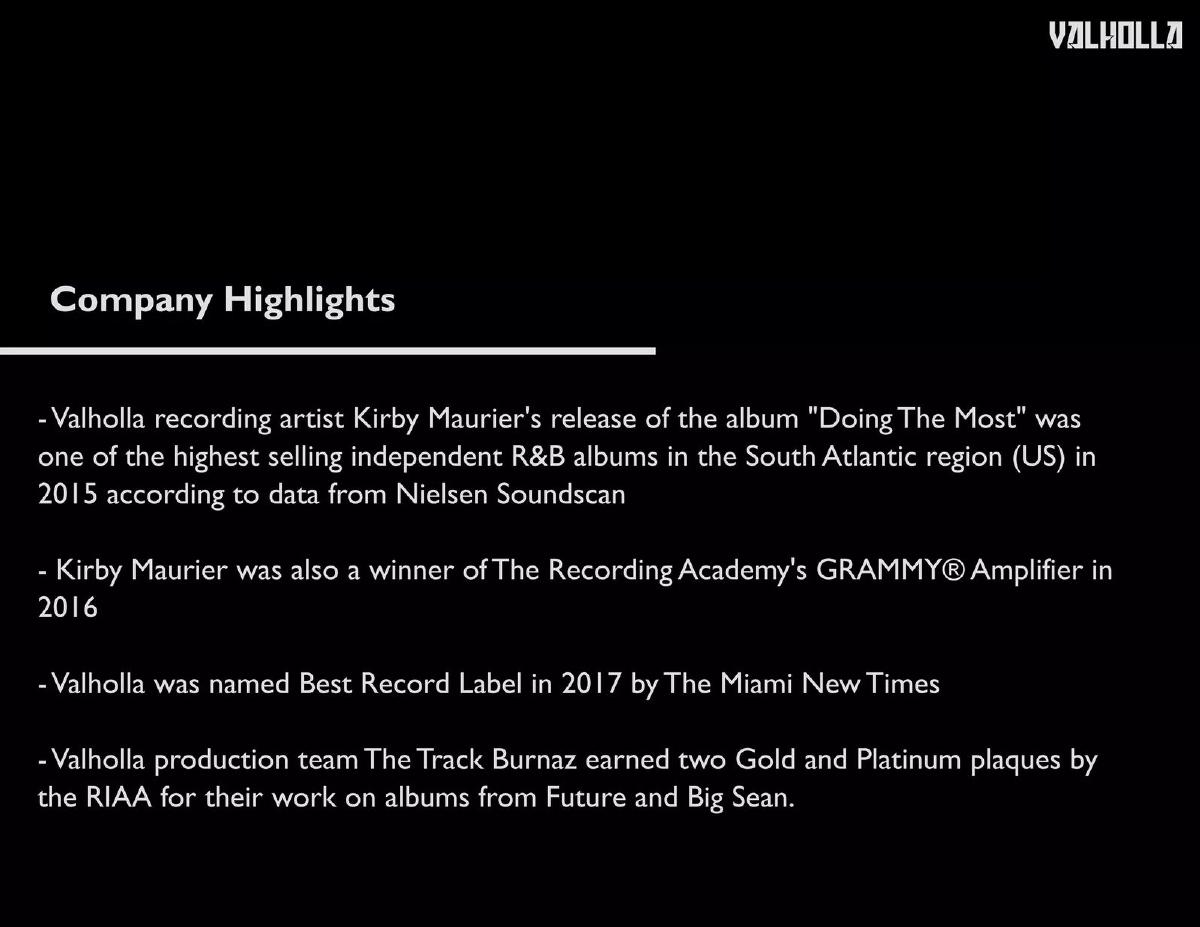
Slide 6: Traction and Company Highlights
This is the deck's strongest slide, providing concrete evidence of past performance. It lists four specific achievements:
Kirby Maurier's 2015 album "Doing The Most" was a top-selling independent R&B album in the South Atlantic region (Nielsen Soundscan). · Kirby Maurier won The Recording Academy's GRAMMY Amplifier in 2016. · Valholla was named Best Record Label in 2017 by The Miami New Times. · The production team, The Track Burnaz, earned RIAA Gold and Platinum plaques for work with Future and Big Sean.
These data points move the company beyond "aspirational" and prove they can identify and develop talent that reaches commercial and critical milestones.
Slide 7: The Ask and ROI Promise
The company is seeking $4 million to cover three years of runway. The plan is to produce 2-4 major album releases per year. The funding is earmarked for recording, production, promotion, marketing, and label services. The slide makes a bold claim: "We expect to be profitable in under 3 years giving investors 100% ROI within that time." While the goal is clear, the deck provides no financial tables, burn rate charts, or break-even analysis to explain how a 100% return is mathematically feasible in that timeframe.
Slide 8: Leadership
The final slide focuses on Founder and CEO Vinton "Vince Valholla" Eyma. His bio emphasizes 15 years of experience and the executive production of 80+ commercial projects. The slide also mentions a team of six other executives and interns working remotely across Miami, Los Angeles, Atlanta, and Hampton. However, the names, titles, and backgrounds of these six executives are omitted, leaving the leadership profile feeling somewhat thin for a $4 million ask.
What Valholla Entertainment Does Well
The deck excels at establishing industry credibility through specific accolades. Mentioning RIAA Gold and Platinum plaques (Slide 6) is a powerful signal in the music industry that the team understands the mechanics of a hit record. The use of third-party validation, such as Nielsen data and The Miami New Times, helps to mitigate the perceived risk of a smaller independent label.
The diversified revenue model (Slide 5) is also a plus. It shows the founders are thinking about the business as a platform rather than just a collection of individual song assets. By capturing management and publishing, they increase the LTV (Lifetime Value) of every artist they sign.
What is Missing from the Deck
The most glaring omission is detailed financial projections . A $4 million ask usually requires a granular breakdown of how that money will be spent month-over-month and what the specific revenue targets are for each of the 2-4 annual album releases. The promise of a "100% ROI" (Slide 7) feels like a placeholder without a supporting spreadsheet or waterfall chart.
Furthermore, the team slide (Slide 8) is insufficient. In a talent-based business, the "six other executives" are just as important as the CEO. Investors need to see who is handling the marketing, who is managing the legal/licensing aspects, and who is leading A&R. The lack of names and faces for the broader leadership team makes the company look more like a solo operation than a scalable organization.
Finally, there is no competitive analysis . The deck mentions competing on a "worldwide scale" but does not identify which other independent or major labels they are positioning themselves against, nor does it explain their unique edge in a crowded Hip Hop and R&B market.
Founder's Guide: What to Copy and What to Avoid
Copy the 'Highlights' approach: If you have won awards or earned industry certifications (like RIAA plaques), feature them prominently as Valholla did on Slide 6. These are "hard" metrics that are difficult to fake and immediately build trust.
Avoid the 'Shoestring' trap: While being proud of bootstrapping is fine, avoid framing it as a limitation in a way that suggests you don't know how to manage larger sums of capital. Instead of saying you operated on a "shoestring budget" (Slide 2), frame it as "achieving [X] revenue and [Y] accolades with zero outside capital," which sounds more like a feat of management than a struggle.
Avoid vague ROI promises: Never promise a specific percentage return (like the 100% ROI on Slide 7) in a pitch deck. It can lead to legal complications and often signals to sophisticated investors that the founders may not fully understand the complexities of equity exits or dividend structures. Focus on the growth of the business's valuation instead.
Ensure your team slide is robust: If you claim to have a team of six executives, list them. A $4 million investment is an investment in people. Hiding the team behind a bullet point suggests the company lacks depth or that the "executives" may not be full-time committed partners.
Frequently asked questions
- What is the specific funding ask and its intended use?
- Valholla Entertainment is seeking $4 million. According to slide 7, this capital is intended to provide three years of runway. The primary use of funds includes recording, production, promotion, marketing, and label service costs for 2-4 major album releases per year. The company aims to reach profitability within this three-year window.
- How does Valholla Entertainment generate revenue?
- The business model, detailed on slide 5, is multi-faceted. It includes recorded music revenue from royalties and masters, merchandise sales, and music publishing. Additionally, they generate management revenue from their roster, which encompasses touring, live events, and artist endorsements.
- What evidence of past success does the deck provide?
- Slide 6 lists several 'Company Highlights,' including artist Kirby Maurier’s 2015 album being a top-selling independent R&B release in the South Atlantic region. It also notes that their production team, The Track Burnaz, earned RIAA Gold and Platinum plaques for work with major artists Future and Big Sean, and the label was named Best Record Label in 2017 by The Miami New Times.
- Who leads the company and what is their background?
- The company is led by Vinton 'Vince Valholla' Eyma, who serves as Founder, Chairman, and CEO. Slide 8 credits him with over 15 years of music industry experience and the executive production of more than 80 commercial albums and singles. The team also includes six other executives and interns working remotely across the US.
- What market trends is the company capitalizing on?
- Slide 3 identifies the growth of global recorded music revenues, which reached $17.3 billion in 2017, driven by streaming platforms like Spotify and Apple Music. The deck also points to the IPOs of Spotify and Hipgnosis Songs Fund Limited as indicators of the increasing value of recorded music assets.