Valuecase, a Hamburg-based enterprise software startup, successfully raised $3.5M in a 2022 pre-seed round led by Picus Capital and HV Capital. Their 12-slide deck focuses heavily on the shift from seller-centric to buyer-centric B2B sales. By leveraging Gartner research and a clear 'blue ocean' competitive matrix, the founders positioned their Digital Sales Room (DSR) platform as an end-to-end solution for the entire customer lifecycle, rather than a mere point solution like e-signatures or calling tools. The deck is notable for its clean aesthetic and strong emphasis on founder-market fit,…
Key takeaways
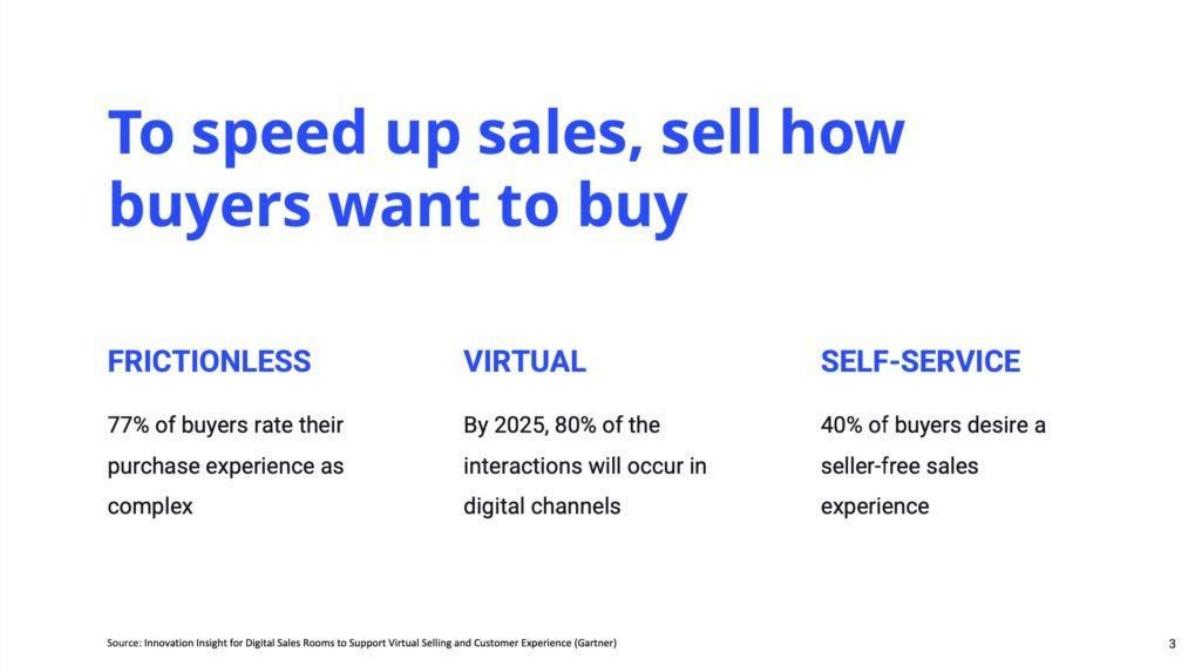
- The deck leans on third-party validation, citing Gartner research on Slide 3 to claim 80% of sales interactions will be digital by 2025.
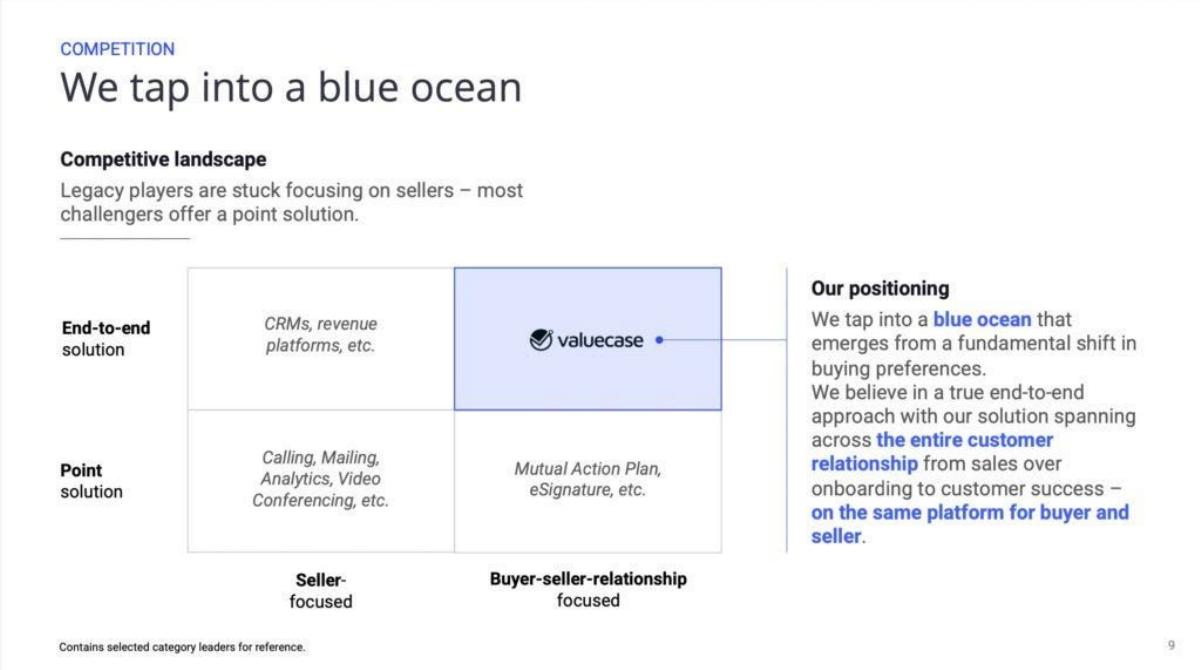
- Valuecase positions itself as a 'blue ocean' player on Slide 9, contrasting their end-to-end buyer-seller relationship focus against legacy 'seller-focused' CRMs.
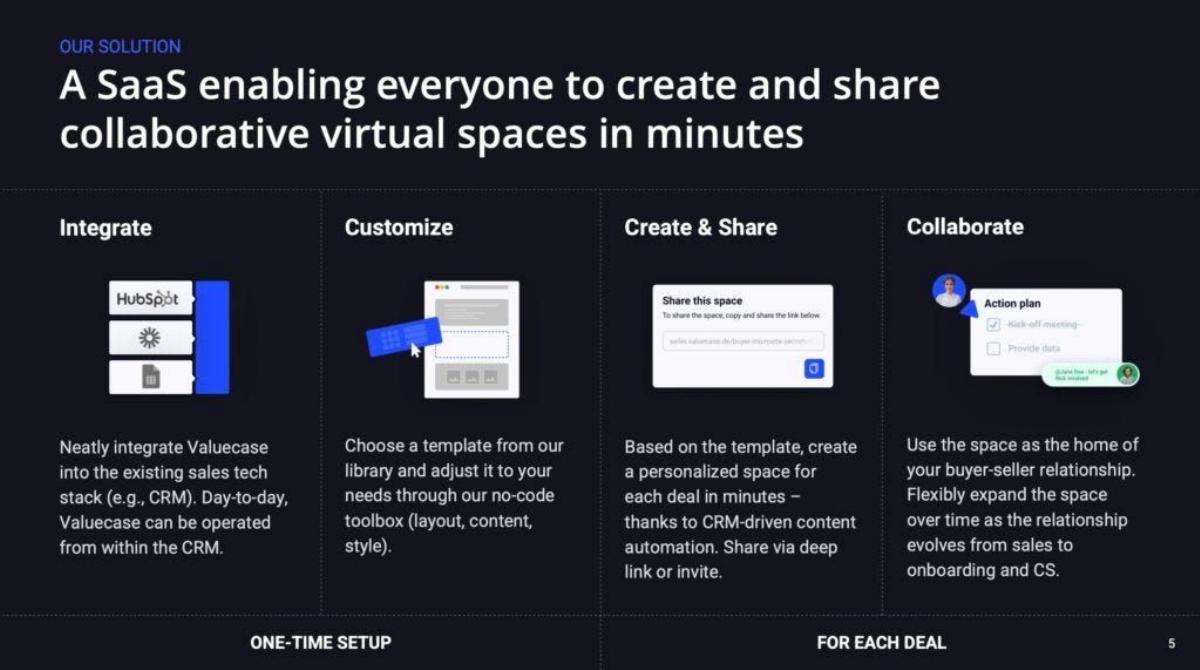
- The solution is framed as a four-step process—Integrate, Customize, Create & Share, and Collaborate—as detailed on Slide 5.
- Founder-market fit is a core pillar, with Slide 11 highlighting experience developing AI models for sales at McKinsey and building corporate SaaS at Oliver Wyman.
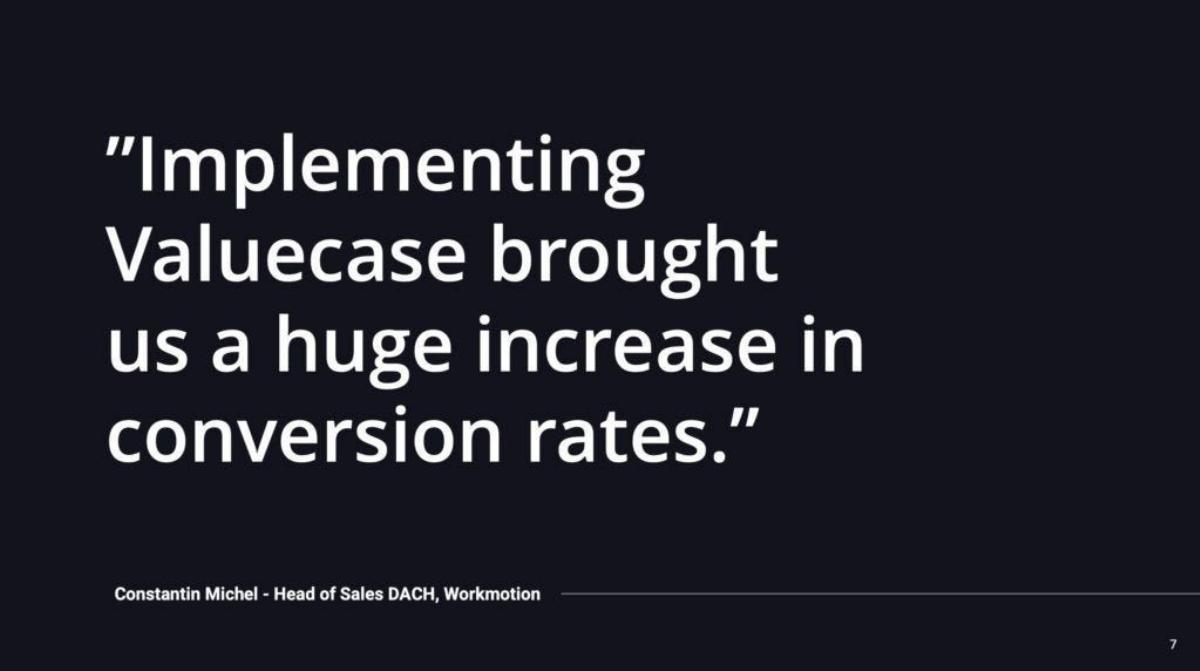
- Social proof is established early through a testimonial from the Head of Sales DACH at Workmotion on Slide 7, claiming a 'huge increase in conversion rates.'
- The product narrative emphasizes longevity, stating on Slide 9 that the platform spans from sales to onboarding and customer success.
- The deck omits a specific 'Ask' slide and detailed unit economics, which is common for early pre-seed rounds focused on vision and team.
- Technical integration is highlighted as a 'one-time setup' with HubSpot and other CRMs on Slide 5 to lower the perceived barrier to entry.
The Narrative Shift: From Selling to Enabling Buying
Valuecase entered the market in 2022, a time when the 'Digital Sales Room' (DSR) category was beginning to gain significant venture capital attention. Their pre-seed deck is a study in narrative positioning. Instead of leading with features, they lead with a fundamental shift in buyer behavior. The deck is structured to make the investor feel that the old way of selling is dying, and Valuecase is the only logical successor. As reported by Business Insider, this approach secured $3.5M in funding, a substantial sum for a pre-seed round in the European enterprise software sector.
Slide 1-2: The Vision and Branding
The deck opens with a minimalist dark theme. Slide 1 features the company logo and the bold tagline: "THE FUTURE OF B2B SALES." It establishes the company's origin in Hamburg and dates the deck to July 2022. Slide 2 is a duplicate or transition slide, maintaining the visual consistency. The choice of a dark background with high-contrast white text signals a modern, sophisticated enterprise software brand.
Slide 3: The Market Thesis
Slide 3 is the 'Why Now' slide, and it is one of the strongest in the deck. It uses three pillars to justify the product's existence: Frictionless , Virtual , and Self-Service . The slide cites Gartner research to provide authority, noting that 77% of buyers find their purchase experience complex and 80% of interactions will be digital by 2025. By framing the problem through the buyer's eyes, Valuecase makes their solution feel inevitable rather than just 'nice to have.'
Slide 4: The Transition
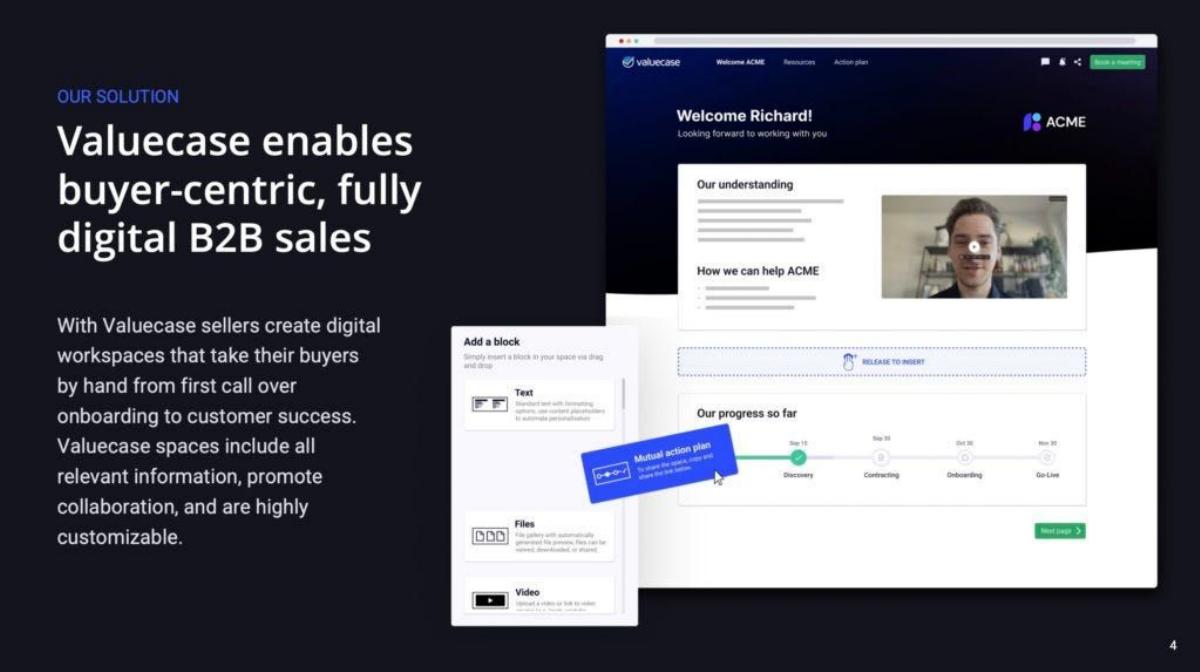
While the text for Slide 4 is repetitive in the provided transcript, in the context of the deck's flow, it serves as the bridge between the macro-problem (the market shift) and the micro-solution (Valuecase). It sets the stage for the product reveal by implying that to speed up sales, one must sell how buyers want to buy.
Slide 5: The Product Mechanics
Slide 5 provides the first look at the software. It breaks the user journey into four distinct phases: Integrate , Customize , Create & Share , and Collaborate . The slide explicitly mentions a 'one-time setup' involving integrations with HubSpot and other CRMs, which addresses a common investor concern regarding implementation friction. The visual shows a 'no-code toolbox' and 'CRM-driven content automation,' suggesting that the product is designed for scale and ease of use by non-technical sales reps.
Slide 6: Visualizing the Workspace
Continuing the product deep-dive, Slide 6 (represented in the transcript as a continuation of the pitch) likely showcases the actual 'virtual space' interface. The emphasis here is on the 'collaborative' nature of the tool, moving beyond a static PDF or email thread to a living document where both buyer and seller interact.
Slide 7: Social Proof
Slide 7 is a high-impact testimonial slide. It features a large quote from Constantin Michel, Head of Sales DACH at Workmotion: "Implementing Valuecase brought us a huge increase in conversion rates." In a pre-seed deck where hard revenue numbers might be thin, a quote like this from a reputable enterprise customer serves as a proxy for product-market fit.
Slide 8: Market Opportunity
Slide 8 likely expands on the total addressable market or the specific pain points of the current B2B sales stack. It reinforces the idea that the current 'seller-focused' tools are failing to meet the 'virtual-first' demands of modern buyers.
Slide 9: The Blue Ocean Strategy
Slide 9 is the competitive landscape, and it uses a classic 2x2 matrix. The axes are Point solution vs. End-to-end solution and Seller-focused vs. Buyer-seller-relationship focused . Valuecase places itself in the top-right quadrant (the 'Blue Ocean'). They categorize CRMs and revenue platforms as legacy, seller-focused tools, while placing Mutual Action Plans and e-signature tools as limited point solutions. This positioning is clever because it doesn't claim to replace the CRM; it claims to sit on top of it to manage the actual relationship.
Slide 10: The Roadmap
Slide 10 likely outlines the future vision. The text mentions that the solution spans the "entire customer relationship from sales over onboarding to customer success." This is a crucial point for investors, as it suggests the product has a high 'stickiness' factor and can expand its footprint within a customer's organization over time, increasing Lifetime Value (LTV).
Slide 11: The Team
Slide 11 focuses on the founders, Dr. Jan Niklas Wick and Lennart Prange. The slide is heavy on 'pedigree'—mentioning McKinsey & Company , Oliver Wyman , LSE , and HEC Paris . Dr. Wick is credited with developing AI models for sales organizations, while Prange is noted for building corporate SaaS and having a background as a web developer. This combination of high-level strategic consulting and hands-on technical/product experience is a strong signal for pre-seed investors.
Slide 12: The Closing
The final slide serves as a call to action or a contact slide. While the transcript doesn't show a specific 'Ask' (e.g., 'We are raising $Xm'), the publisher-reported facts confirm the round was successful at $3.5M. The deck ends as it began—clean, professional, and focused on the brand.
What Works in the Valuecase Deck
1. Buyer-Centric Narrative: Most sales tech decks focus on how to help the salesperson close more deals. Valuecase flips this by focusing on how to help the buyer buy. This is a more modern and defensible narrative in a crowded SaaS market.
2. Strategic Use of Third-Party Data: By citing Gartner on Slide 3, the founders don't have to prove the market is changing; they let the industry experts do it for them. This builds immediate credibility.
3. Clear Positioning: The 'Blue Ocean' matrix on Slide 9 is a textbook example of how to differentiate a new product category. It clearly defines what they are NOT (a CRM) and what they ARE (an end-to-end relationship platform).
4. Founder-Market Fit: The team slide is exceptionally strong. For an enterprise sales tool, having founders who have consulted for 'world-leading organizations' on sales strategy is a massive advantage.
What is Missing from the Valuecase Deck
1. The Financial Ask: There is no slide detailing how much capital is being raised or how it will be spent. While this is sometimes omitted in 'teaser' decks, a full pitch deck usually includes a use-of-funds breakdown.
2. Unit Economics: There is no mention of Customer Acquisition Cost (CAC), Payback Period, or Churn. At the pre-seed stage, these numbers are often speculative, but even early indications can help investors understand the business model's viability.
3. Detailed Roadmap: While they mention expanding into onboarding and customer success, a visual timeline of product milestones would have added more weight to their 'end-to-end' claim.
Lessons for Founders
Founders should copy the way Valuecase buckets their product functionality on Slide 5. By breaking a complex software product into four simple steps (Integrate, Customize, Create, Collaborate), they make the solution feel manageable and easy to adopt. Additionally, the use of a high-authority testimonial early in the deck (Slide 7) is a great way to build trust before diving into the competitive landscape. Finally, if you are entering a crowded market, use a 2x2 matrix to redefine the categories so that you are the only occupant of your chosen quadrant.
Frequently asked questions
- What is the core problem Valuecase addresses?
- Valuecase addresses the friction in B2B buying processes. According to Slide 3, 77% of buyers rate their purchase experience as complex, and 40% desire a seller-free experience. The deck argues that current sales tools are too focused on the seller's needs rather than the buyer's journey.
- How does Valuecase differentiate itself from competitors like Salesforce or HubSpot?
- On Slide 9, Valuecase categorizes CRMs and revenue platforms as 'seller-focused' legacy players. They position their platform as 'buyer-seller-relationship focused,' providing a collaborative space for both parties rather than just a database for the sales team to track leads.
- What evidence of product-market fit is provided?
- The deck relies on qualitative social proof rather than a data-heavy traction slide. Slide 7 features a quote from Constantin Michel at Workmotion, stating that Valuecase led to a 'huge increase in conversion rates.' This suggests early successful pilots with enterprise customers.
- What is the background of the founding team?
- The founders, Dr. Jan Niklas Wick and Lennart Prange, have backgrounds in top-tier consulting and finance. Slide 11 notes experience at McKinsey, Oliver Wyman, and academic credentials from LSE, HEC Paris, and TU Hamburg, emphasizing their ability to build for 'world-leading organizations.'
- What is missing from this pitch deck?
- The 12-slide deck is missing a financial roadmap, a specific breakdown of the $3.5M use of funds, and a detailed go-to-market strategy. It functions more as a vision and product-concept deck than a comprehensive business plan.