Falco Resources (TSXV: FPC) uses this 2015 presentation to position itself as a high-potential gold developer in the Abitibi Greenstone Belt. The deck focuses heavily on the Horne 5 deposit, utilizing 100 years of mining history and extensive historical data—including 4,386 drill holes—to de-risk the project. By highlighting discovery costs of less than $0.25 per ounce and a $3.7 million confirmatory drill program, Falco builds a narrative of low-cost resource expansion. The presentation is highly technical, relying on geological cross-sections and regional depth comparables to prove that the…
Key takeaways
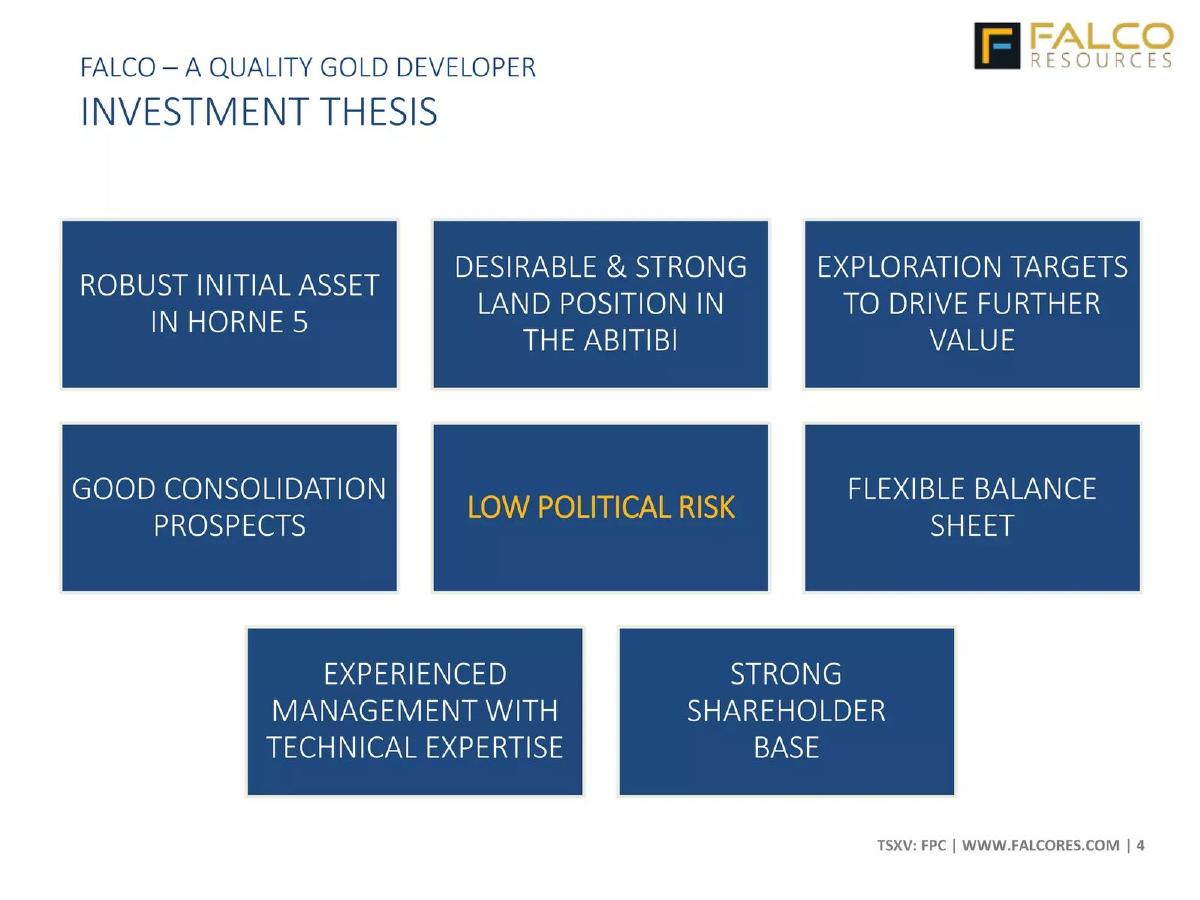
- The investment thesis is built on a 'robust initial asset' at Horne 5 and a strong land position in a low political risk jurisdiction (Slide 4).
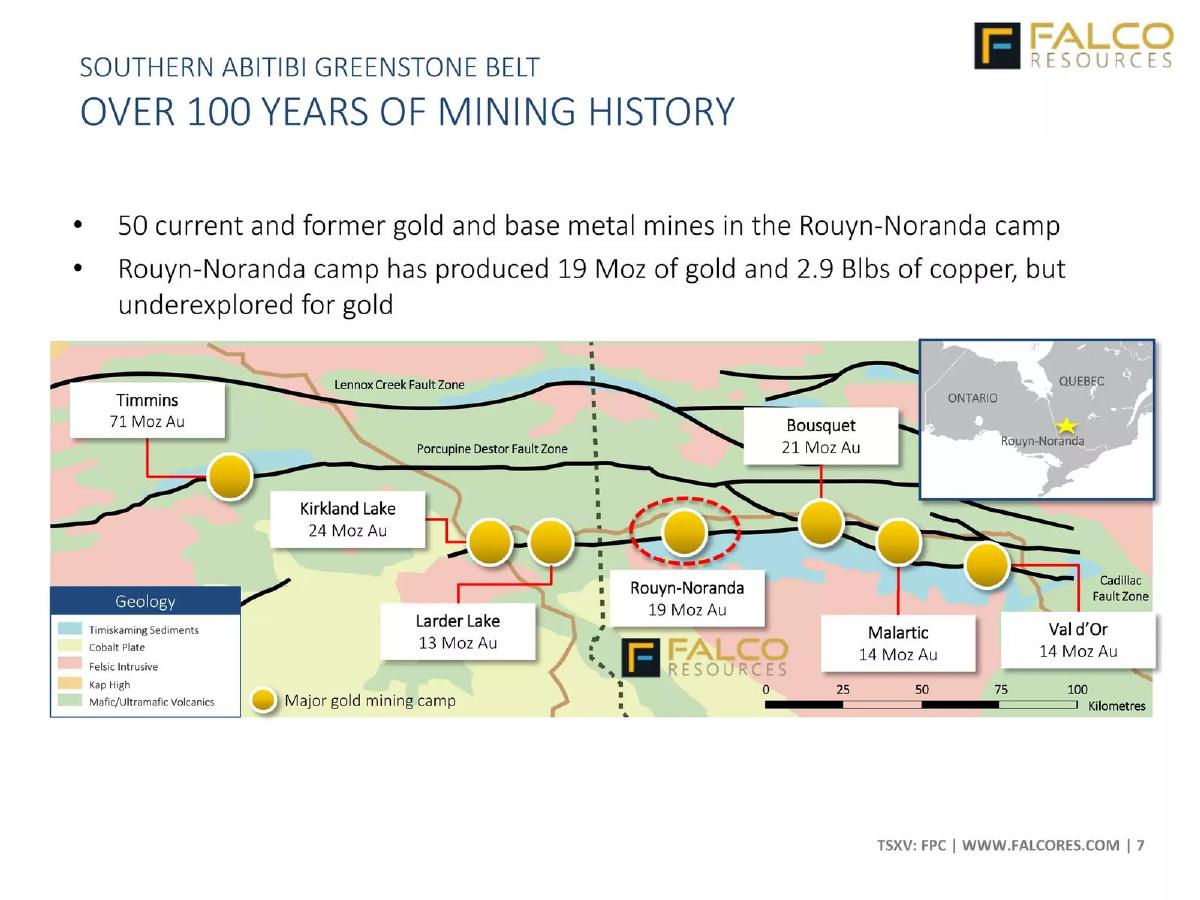
- Regional context is established by citing 19 million ounces of gold produced historically in the Rouyn-Noranda camp (Slide 7).
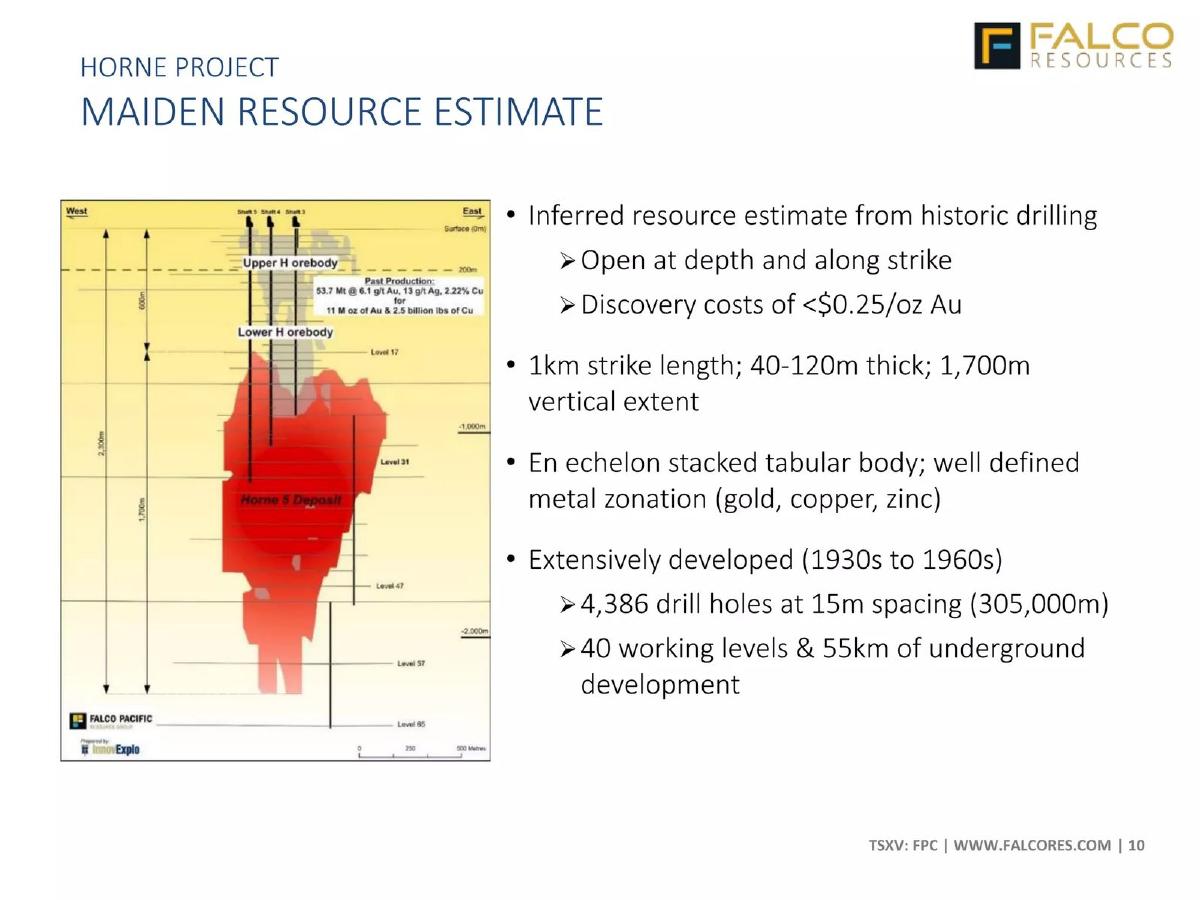
- Historical data is a primary asset, with 305,000 meters of drilling and 55km of underground development already in place (Slide 10).
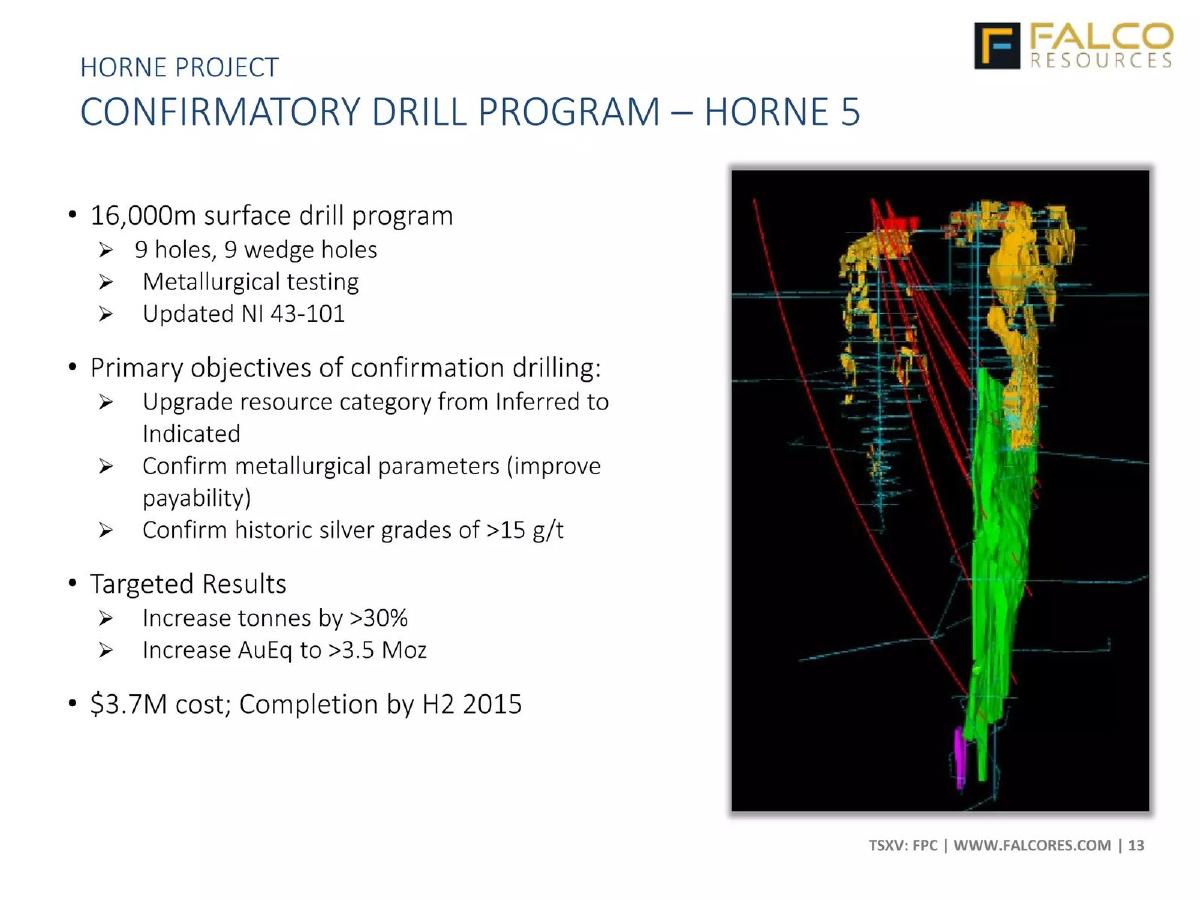
- The 2015 confirmatory drill program aimed to upgrade resources from Inferred to Indicated for a cost of $3.7 million (Slide 13).
- Discovery costs are cited as being exceptionally low at less than $0.25 per ounce of gold (Slide 10).
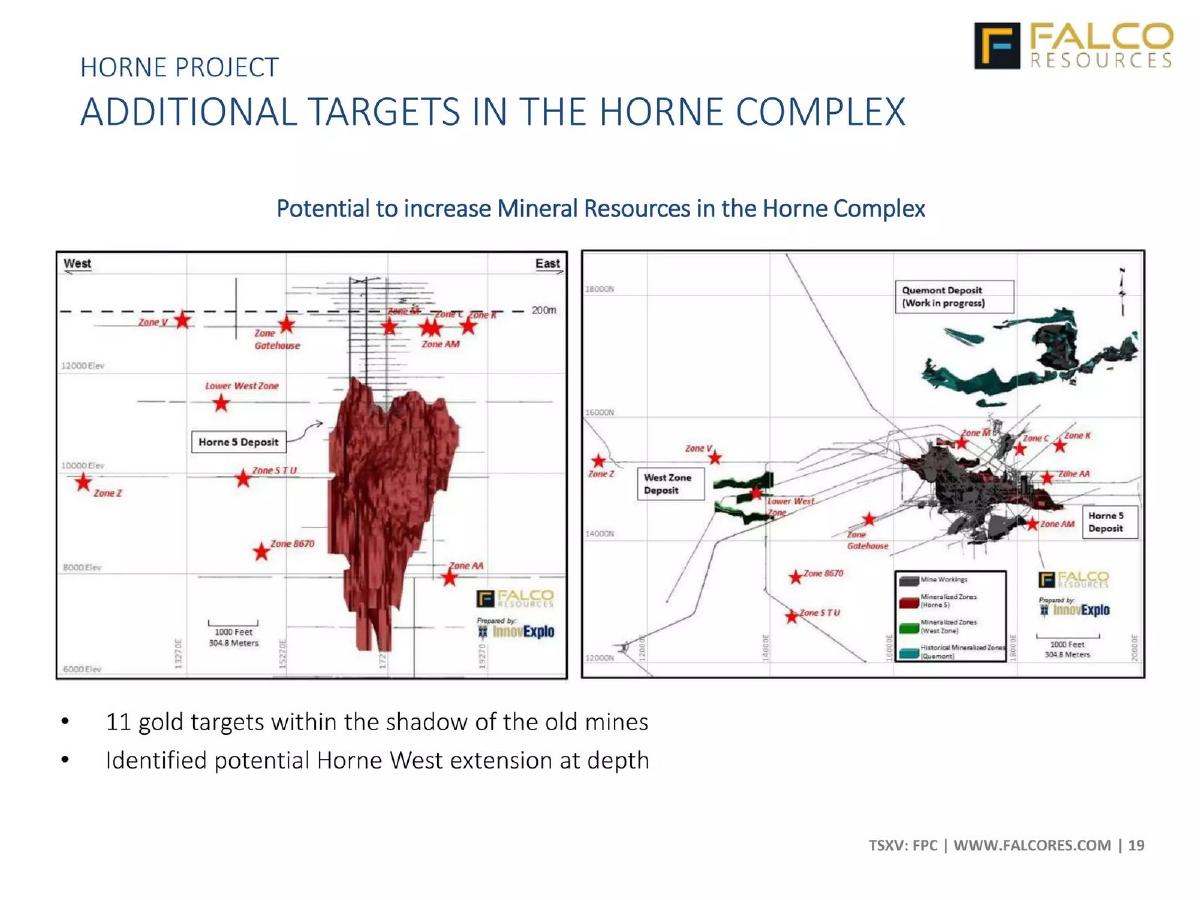
- The deck identifies 11 additional gold targets within the 'shadow of the old mines,' suggesting significant upside beyond the primary deposit (Slide 19).
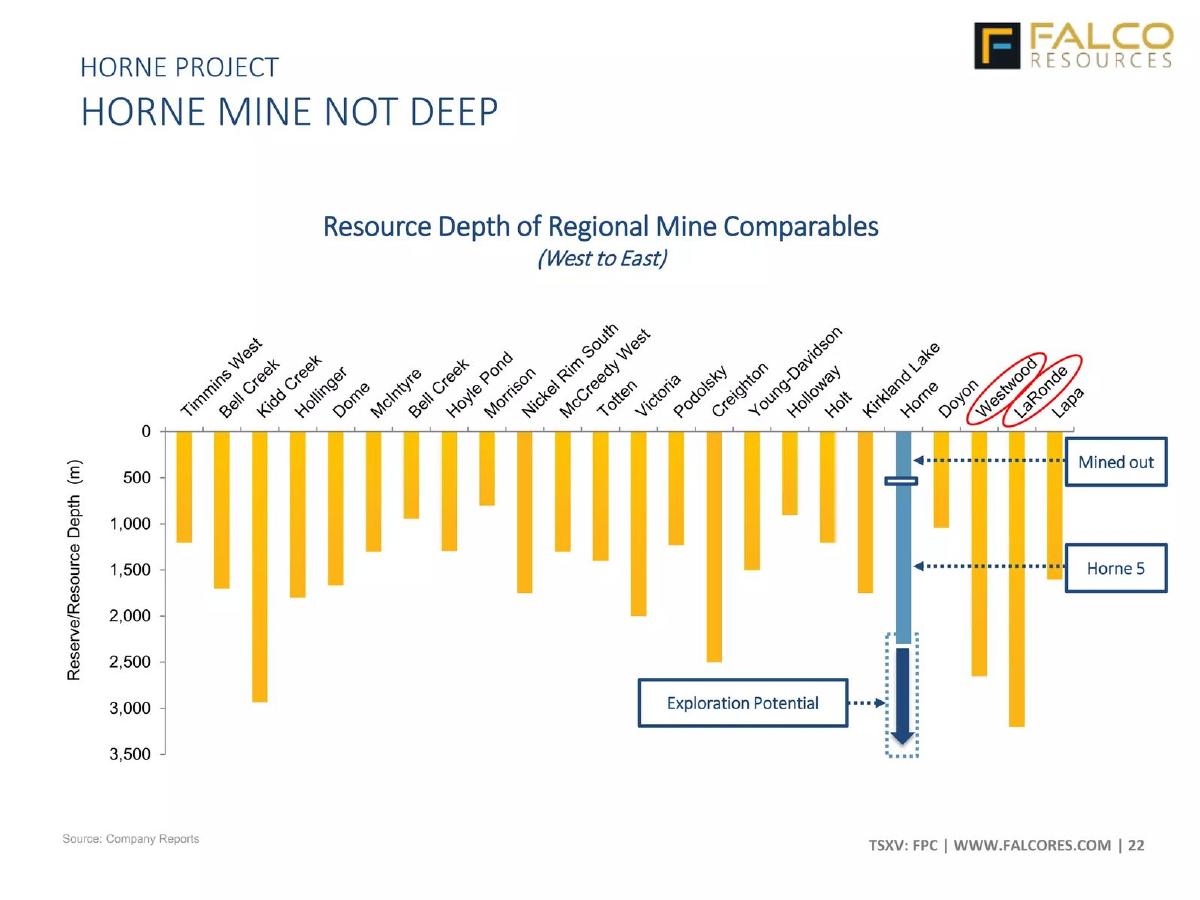
- A depth comparison chart shows that Horne 5 is relatively shallow compared to regional peers like LaRonde and Westwood, which reach depths of 3,000 meters (Slide 22).
- The presentation lacks a specific 'Ask' slide or a detailed breakdown of the management team's individual track records within the provided slides.
Introduction: The Rebirth of a Mining Giant
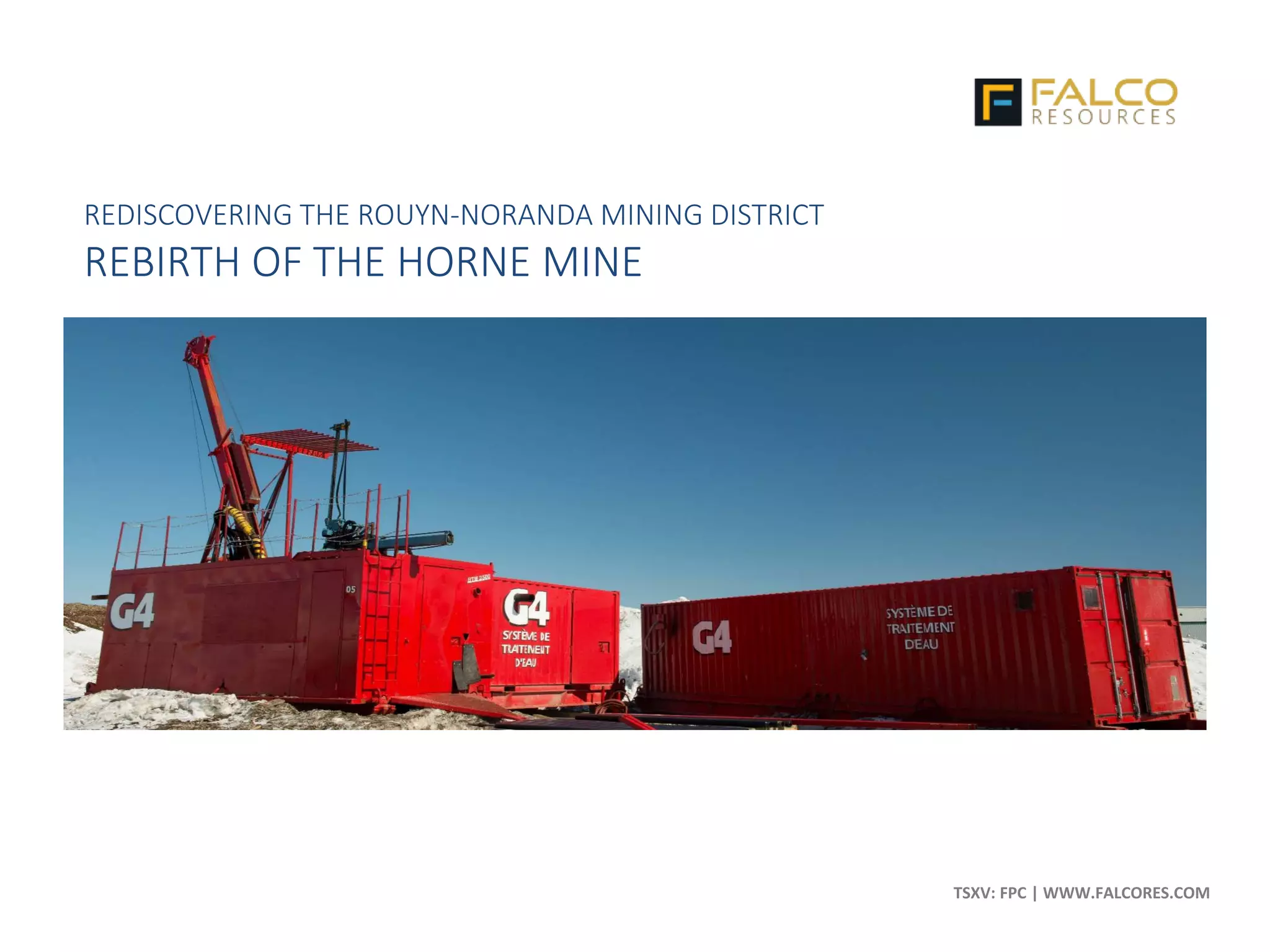
Falco Resources presents a highly specialized investor deck focused on the resource sector. Unlike a SaaS or consumer tech deck, this presentation is built on geological certainty, historical data, and regional benchmarking. The title slide (Slide 1) sets a clear theme: "Rediscovering the Rouyn-Noranda Mining District" and the "Rebirth of the Horne Mine." This immediately signals to investors that this is a brownfield project—one with existing infrastructure and data—rather than a high-risk greenfield exploration.
Slide 4: The Investment Thesis
Slide 4 outlines the core reasons to invest in Falco. The company highlights a "Robust Initial Asset in Horne 5" and a "Desirable & Strong Land Position in the Abitibi." For mining investors, the mention of "Low Political Risk" is a critical differentiator, as many high-grade deposits are located in unstable jurisdictions. The slide also mentions a "Flexible Balance Sheet" and a "Strong Shareholder Base," though specific names and figures are omitted on this high-level summary. This slide serves as the executive summary, touching on asset quality, management expertise, and regional potential.
Slide 7: Regional Context and History
Mining is a business of location. Slide 7 uses a map of the Southern Abitibi Greenstone Belt to show that Falco is operating in a proven neighborhood. The slide notes that the Rouyn-Noranda camp has produced 19 million ounces of gold and 2.9 billion pounds of copper over 100 years. By placing their project alongside famous camps like Timmins (71 Moz Au) and Kirkland Lake (24 Moz Au), Falco uses the "near-mine" exploration logic: the best place to find a new mine is next to an old one. The map clearly delineates the Cadillac Fault Zone, a major geological feature that gives the project technical credibility.
Slide 10: The Maiden Resource Estimate
This is the most data-dense slide in the deck. It details the Horne 5 deposit, citing an inferred resource estimate derived from 4,386 historical drill holes. The key metric here is the "Discovery costs of <$0.25/oz Au," which is remarkably low for the industry. The slide also highlights the existing infrastructure: 40 working levels and 55km of underground development. For an investor, this represents hundreds of millions of dollars in "sunk costs" from previous operators that Falco can now leverage for a fraction of the price.
Slide 13: The 2015 Confirmatory Drill Program
Slide 13 moves from history to current action. It outlines a $3.7 million confirmatory drill program consisting of 16,000 meters. The goals are specific and measurable: upgrade the resource from "Inferred" to "Indicated" (a necessary step for bankable feasibility studies) and increase the gold equivalent (AuEq) to over 3.5 million ounces. This slide provides the "Use of Proceeds" narrative, showing exactly what the company intends to do with its capital and what milestones investors should expect by H2 2015.
Slide 16: Visual Evidence of Mineralization
Slide 16 provides "core porn"—a common feature in mining decks where photos of drill cores are shown to prove the presence of mineralization. The slide shows Hole H5-15-01, specifically highlighting "pyrite massive" zones and mineralized sections at a depth of 1110.4 meters. While these photos are qualitative, they serve to ground the abstract geological data in physical reality for the investor.
Slide 19: Additional Targets and Upside
A single deposit is a project; a district is a company. Slide 19 identifies 11 additional gold targets within the Horne Complex. By showing cross-sections of the "Quemont Deposit" and "Horne West extension," Falco is signaling that Horne 5 is just the beginning. This slide is designed to counter the fear that the company is a "one-trick pony" and suggests a long-term pipeline of exploration targets that could drive share price appreciation over several years.
Slide 22: The Depth Comparison
One of the most effective slides in the deck is Slide 22, which compares the depth of Horne 5 to other regional mines. It shows that while Horne 5 is currently defined to about 2,000 meters, neighboring mines like LaRonde and Westwood are producing from depths of 3,000 meters or more. The blue arrow pointing down labeled "Exploration Potential" visually represents the opportunity: if Horne 5 follows the geological pattern of its neighbors, there is a massive amount of gold yet to be discovered at depth.
Slide 25: Contact and Corporate Information
The final slide provides contact information for the executive office in Montreal and investor inquiries for Vincent Metcalfe. It includes the TSXV ticker (FPC), which is essential for a publicly traded junior miner. The branding is consistent throughout, using the Falco logo and a professional, if somewhat dated, blue-and-gold color scheme.
What Works in This Deck
Leveraging History: The deck does an excellent job of turning old data into a modern asset. Citing 4,386 historical drill holes makes the project feel "de-risked" compared to a company starting from scratch. · Visual Benchmarking: The depth comparison chart on Slide 22 is a masterclass in simple, effective communication of complex geological potential. · Specific Milestones: Slide 13 gives investors a clear timeline and set of goals (H2 2015 completion, 30% tonnage increase), which allows for accountability. · Regional Authority: By mapping the Abitibi belt and citing specific production figures for neighboring camps, Falco establishes itself as a serious player in a world-class district.
What is Missing
Management Biographies: While Slide 4 mentions "Experienced Management," the provided slides do not include individual bios or track records. In junior mining, the "jockey" is often as important as the "horse." · Detailed Financials: The deck mentions a "Flexible Balance Sheet" but does not show current cash positions, burn rate, or a capitalization table. · The Ask: There is no slide explicitly stating how much money the company is seeking to raise in this specific round, though the $3.7 million program cost provides a hint. · Environmental and Social Governance (ESG): For a project in Quebec, modern decks would typically include a slide on community relations and environmental permitting, which is absent here.
Founder Takeaways
Use historical data as a moat. If your company is working in a space with a long history (whether mining, manufacturing, or retail), use that history to prove your starting point is further ahead than competitors. Falco’s use of "discovery costs" based on historical data is a powerful way to show efficiency.
Benchmark against the best. Slide 22’s comparison to regional giants is a great way to show "what success looks like." If you are a startup, don't just say you are big; show a chart comparing your metrics to the industry leaders to illustrate the gap you intend to fill.
Quantify the technical path. Falco doesn't just say they will "drill more." They specify the number of meters, the number of holes, the cost, and the expected outcome in terms of resource classification. This level of granularity builds trust with sophisticated investors who understand the technical risks of the industry.
Frequently asked questions
- What is the primary project discussed in the Falco Resources deck?
- The primary focus is the Horne 5 deposit located in the Rouyn-Noranda mining district of Quebec. The deck describes this as the 'Rebirth of the Horne Mine,' leveraging a site that saw extensive development between the 1930s and 1960s. Falco aims to use modern technology and confirmatory drilling to prove the value of the remaining mineral resources.
- How does Falco Resources justify the potential of the Horne 5 site?
- Falco justifies the potential through historical production data and a massive existing dataset. Slide 10 notes that the site has 4,386 historical drill holes and 55km of underground development. They also highlight that the deposit is open at depth and along strike, with discovery costs significantly lower than industry averages at under $0.25/oz Au.
- What were the specific goals of their 2015 drilling program?
- According to Slide 13, the $3.7 million program aimed to complete 16,000 meters of surface drilling. The primary objectives were to upgrade the resource category from 'Inferred' to 'Indicated,' confirm metallurgical parameters, and verify historical silver grades of over 15 g/t. They targeted a 30% increase in tonnage.
- How does the company address regional competition or comparison?
- Slide 22 provides a 'Resource Depth of Regional Mine Comparables' chart. It shows that while many mines in the Abitibi belt, such as LaRonde and Westwood, operate at depths between 2,500 and 3,000 meters, the Horne 5 deposit is currently situated much higher (around 1,000 to 2,000 meters), suggesting significant 'Exploration Potential' at deeper levels.
- Is there a clear financial 'Ask' in the presentation?
- In the provided slides, there is no specific 'Ask' slide detailing how much capital is being raised or the valuation of the company. However, Slide 13 mentions a $3.7 million cost for the confirmatory drill program, which serves as a proxy for the immediate capital requirement for their operational milestones.