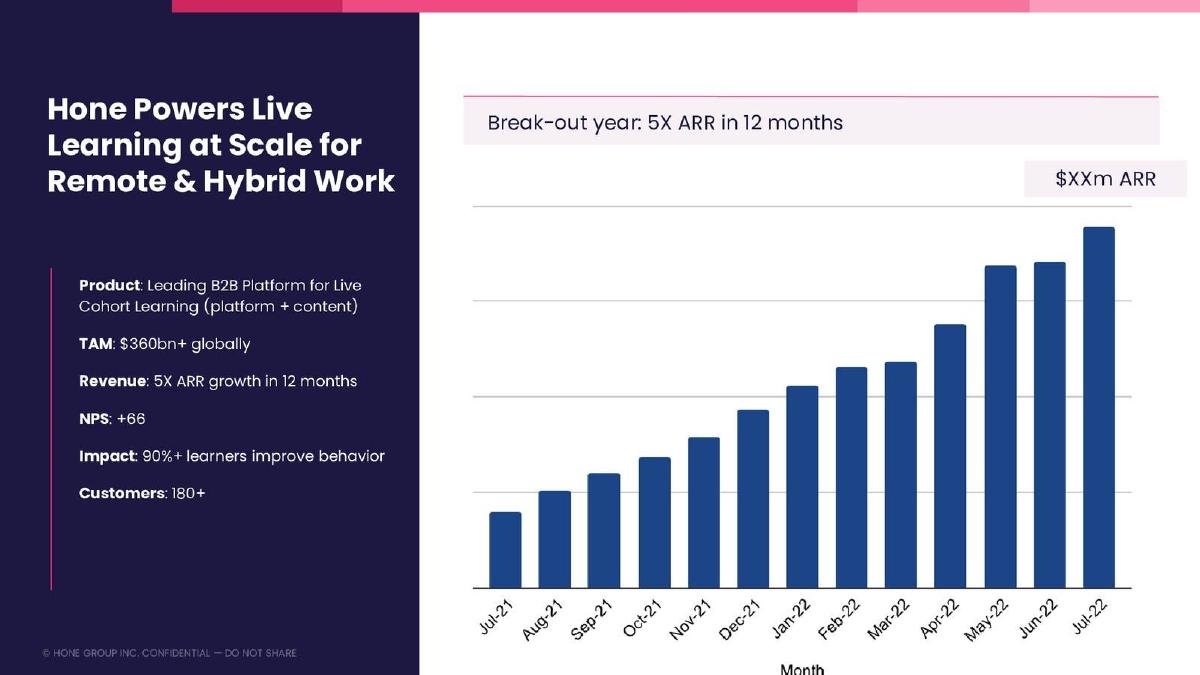
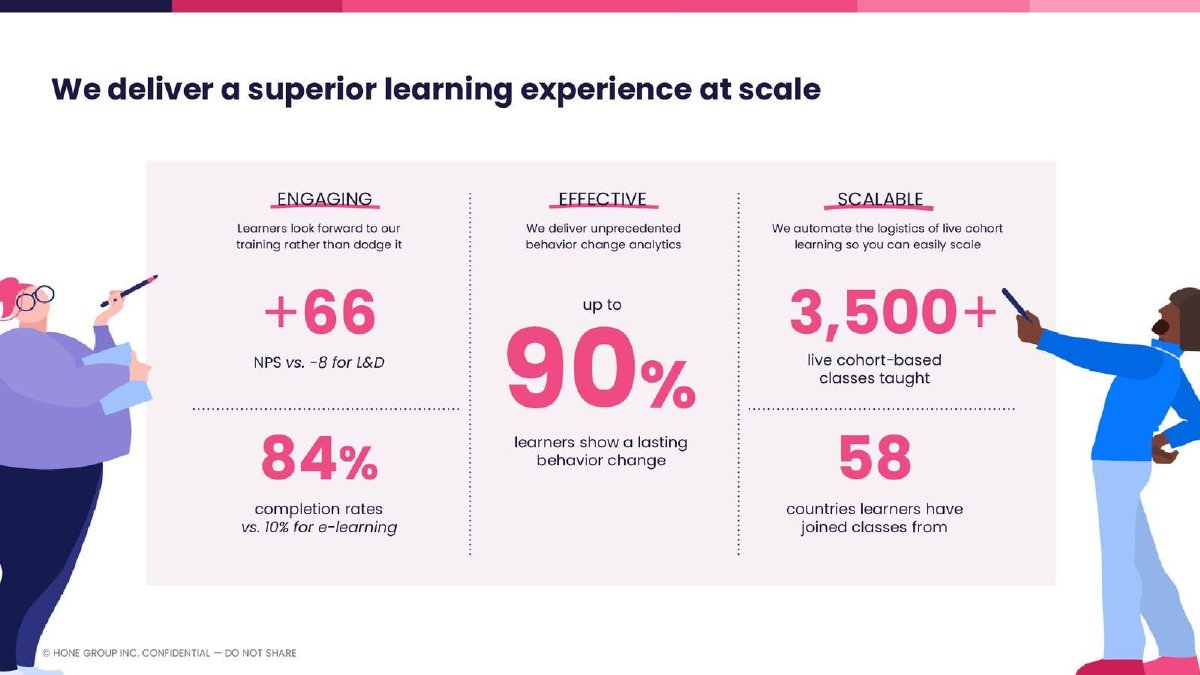
Hone’s Series B deck is a masterclass in market positioning. Rather than competing directly with established e-learning giants or boutique coaching firms, Hone identifies a '$130bn+ Missing Middle' on Slide 4, defined by live, interactive learning at scale. The deck leverages significant social proof, listing over 180 customers including Sony Music and Indeed on Slide 6. While the deck is visually polished and emphasizes a 'world-class' team with deep pedigree from FanDuel, Glint, and Coursera (Slide 2), it is notably light on internal financial metrics. There are no slides dedicated to ARR g…
Key takeaways
- Hone identifies a $130bn US market opportunity by targeting 100m knowledge workers with a $1,300 per-head training budget (Slide 4).
- The 'Missing Middle' strategy positions the company between low-engagement libraries like Udemy and high-cost 1-1 coaching like BetterUp (Slide 4).
- The team slide highlights significant industry experience, featuring a CEO who co-founded FanDuel and a Head of Learning from Coursera (Slide 2).
- Social proof is a core pillar of the pitch, showcasing logos from 180+ companies across Enterprise and Mid-Market segments (Slide 6).
- The deck addresses the 'Great Resignation' and remote work as primary tailwinds, noting that 70% of employees would leave for a company that invests in L&D (Slide 3).
- Product breadth is demonstrated through 60+ classes across five content pillars, including Leadership, DEI, and Wellness (Slide 5).
- The deck lacks a specific 'Ask' slide, omitting the target raise amount and planned use of funds within the 13-slide sequence.
- There is no detailed financial performance slide, leaving out specific revenue figures or growth percentages.
The Narrative Strategy: Positioning Against the Status Quo
Hone’s Series B pitch deck, as reported by Business Insider for their 2023 $30M round, is a study in clear market positioning. In a crowded EdTech and HRTech landscape, the most difficult task is explaining why a new platform is necessary when giants like LinkedIn Learning and BetterUp already exist. Hone solves this by visually mapping the market on Slide 4 , creating a 'Missing Middle' category that they alone occupy. This teardown examines how they used a 13-slide narrative to justify a significant capital injection during a tightening venture market.
Slide 1: Title and Visual Identity
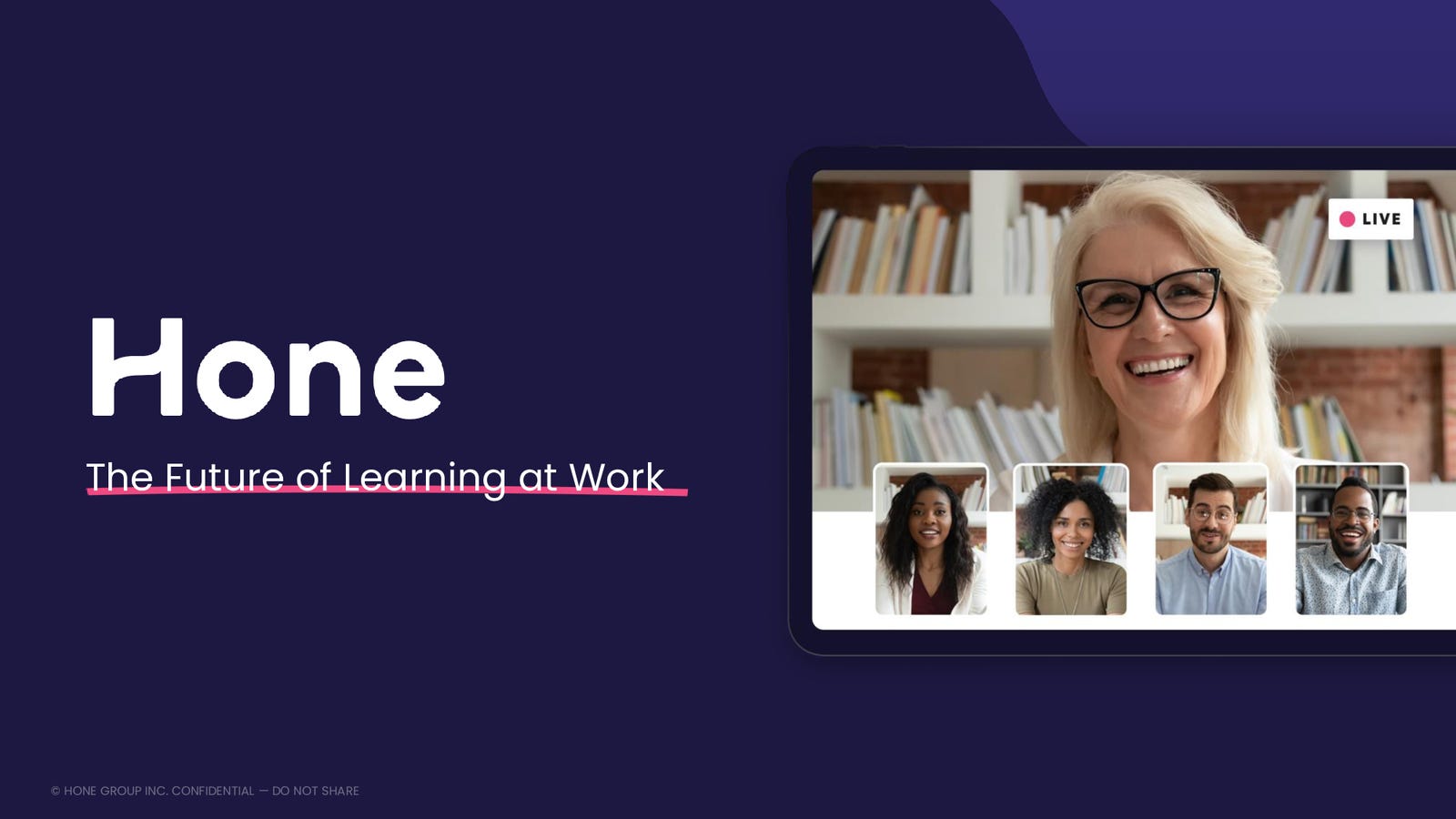
The deck opens with a clean, high-contrast title slide. The tagline, 'The Future of Learning at Work,' is standard for the industry, but the accompanying imagery is specific. It shows a tablet displaying a live video call with a diverse group of participants and a 'LIVE' indicator. This immediately signals the product's core differentiator: it is not a library of pre-recorded videos, but a synchronous, human-led experience.
Slide 2: The Pedigree Slide
Hone places its team slide early, which is a common tactic for Series B companies where the leadership's ability to scale is a primary concern for investors. Slide 2 highlights CEO Tom Griffiths’ background as a co-founder of FanDuel, a multi-billion dollar enterprise. The rest of the team is built from 'world-class' companies including LinkedIn, Coursera, and Zendesk. Notably, the slide includes a diversity breakdown (50% female & non-binary; 38% non-white), which aligns with their product offering in the DEI space. The inclusion of 'Inc. Best Workplaces 2022' and 'Great Place to Work' badges serves as early social proof that the company practices what it preaches.
Slide 3: The Problem Statement
Slide 3 frames the problem through the lens of a 'changed world.' It uses the shift to remote and hybrid work as the primary catalyst for why traditional learning is 'broken.' The slide provides two heavy-hitting statistics: 70% of employees would leave for a company that invests in L&D, yet only 26% rate their current tools as delivering development well. This creates a clear 'value gap' that the subsequent slides aim to fill.
Slide 4: The 'Missing Middle' Market Map
This is the most important slide in the deck. Slide 4 categorizes the competition into two poles. On the 'Low End,' they place e-learning libraries like Udemy and Coursera, noting they suffer from 'low engagement' and 'low impact.' On the 'High End,' they place 1-1 coaching platforms like BetterUp and Torch, noting they are 'expensive' and 'difficult to scale.' Hone positions itself in the center: 'Live, interactive learning at scale.' By doing this, they aren't just another learning platform; they are a new category. They calculate the US market for this 'middle' at $130bn, based on 100m knowledge workers and a $1,300 per-head training budget.
Slide 5: Product and Content Pillars
Slide 5 moves from the theoretical to the practical. It lists 60+ classes organized into five pillars: Leadership & Management, DEI, Individual Performance, Wellness, and Team Dynamics. By listing specific class titles like 'Delegate Like a Pro' and 'Lead with Grit,' Hone demonstrates that their platform is ready for immediate enterprise deployment. The slide also mentions the intent to 'expand content verticals over time,' suggesting a roadmap for horizontal growth.
Slide 6: Social Proof and Traction
Slide 6 is a 'wall of logos' that effectively signals market acceptance. With 180+ companies listed, including major names like Indeed, Sony Music, and ServiceNow, Hone proves they can sell to both the Fortune 500 and high-growth mid-market firms (e.g., Airtable, Casper). The right side of the slide features three testimonials that highlight specific product benefits: measurement of leader growth, the 'Assessment' piece as a differentiator, and the availability of resources outside of live classes.
Slide 7: Closing and Visual Branding
The final slide in the provided set is a 'Thank You' slide that maintains the brand's visual language—dark purples and abstract geometric shapes representing data and connectivity. While aesthetically pleasing, it marks the end of the narrative without a visible 'Ask' or 'Financials' slide in this specific sequence.
What Hone Does Exceptionally Well
Category Creation: The 'Missing Middle' framework is a brilliant piece of cognitive reframing. It allows Hone to acknowledge the existence of massive competitors while simultaneously dismissing them as inadequate for the specific needs of the modern workforce. Investors love 'white space,' and Slide 4 creates it effectively.
Social Proof Density: Many decks include a few logos, but Hone categorizes their 180+ customers by segment (Enterprise vs. Mid-Market). This tells a story of a versatile sales engine that isn't reliant on a single type of buyer. The inclusion of specific quotes from VP-level and Director-level roles adds a layer of qualitative validation that logos alone cannot provide.
Team-Market Fit: The team slide isn't just a list of impressive names; it’s a list of names from the exact industries Hone is disrupting. Having a Head of Learning from Coursera and a Head of Product from Glint (a leader in employee engagement) provides immediate credibility to their claim that they understand why current L&D is 'broken.'
What is Missing from the Deck
The Financial Engine: For a Series B deck, the absence of a growth chart is striking. There is no mention of Annual Recurring Revenue (ARR), Net Revenue Retention (NRR), or Customer Acquisition Cost (CAC). While these were likely in a separate data room or a supplemental deck, their absence here makes it difficult to judge the business's actual momentum beyond '180+ companies.'
The 'How it Works' Slide: While we know the classes are 'live' and 'instructor-led,' the deck doesn't explain the underlying technology. Is there a proprietary platform? Does it integrate with Slack or Microsoft Teams? How does the 'Assessment' piece mentioned in the testimonials actually function? A product walkthrough slide would have grounded the high-level strategy in reality.
The Competitive Moat: Beyond being 'live,' what stops a competitor like Coursera from simply launching a live cohort-based wing? The deck doesn't explicitly address defensibility or the 'moat'—whether that be proprietary content, a network of exclusive instructors, or deep integration into the HR tech stack.
Founder's Guide: What to Copy
Use the 'Three-Tier' Market Map: If you are entering a crowded market, do not just list your competitors. Group them into 'Low End' and 'High End' (or similar polarities) and place yourself in the middle as the balanced solution. This makes your existence feel like a logical necessity rather than a marginal improvement.
Quantify the 'Why Now': Hone didn't just say 'people need training.' They used Slide 3 to link their product to the 'Great Resignation' and the shift to remote work. By tying your startup to a massive, undeniable macro trend, you make your success seem inevitable.
Lead with Pedigree: If your team has 'been there, done that,' put them at the front. For a Series B, investors are betting on the team's ability to execute a complex scale-up. Highlighting previous exits (like FanDuel) or leadership roles at industry incumbents (like Coursera) reduces the perceived risk of the investment.
Final Verdict: Hone’s deck is a masterclass in narrative and positioning. It successfully moves the conversation away from 'features' and toward 'category leadership.' While it lacks the raw data usually expected at this stage, its clarity of vision and strong social proof clearly resonated with investors, resulting in a successful $30M raise.
Frequently asked questions
- What is the primary market gap Hone is trying to fill?
- Hone identifies the 'Missing Middle' of talent development. On Slide 4, they contrast their 'live, interactive learning at scale' against the 'Low End' (e-learning libraries like LinkedIn Learning which have low engagement) and the 'High End' (1-1 coaching like BetterUp which is expensive and difficult to scale). They value this middle segment at $130bn in the US alone.
- How does Hone validate its product-market fit in this deck?
- Validation is primarily shown through customer logos and testimonials on Slide 6. They claim to be 'Trusted by 180+ Companies,' categorized into Enterprise (e.g., ServiceNow, WarnerMedia) and Mid-Market (e.g., Airtable, Casper). They also include three detailed testimonials from HR and L&D leaders at Health Verity, Tom Tom, and Course Hero.
- What specific training categories does Hone cover?
- Slide 5 outlines five content pillars: Leadership & Management, Diversity Equity & Inclusion, Individual Performance, Wellness & Mental Health, and Team Dynamics. They currently offer 60+ high-impact classes, such as 'Give Feedback that Lands' and 'Manage Bias in the Workplace,' with plans to expand verticals over time.
- Who are the key people behind Hone?
- The leadership team, shown on Slide 2, includes CEO Tom Griffiths (formerly co-founder/CPO at FanDuel) and CCO Savina Perez (formerly at CultureIQ). Other key hires bring experience from Glint, LinkedIn, Mind Gym, Zenefits, Zendesk, and Coursera, signaling a mix of B2B SaaS and education expertise.
- What macro trends is Hone leveraging for its growth?
- Slide 3 points to four global shifts: the rise of remote and hybrid work, the 'Great Resignation,' increased competition for talent, and global economic/social pressures. They cite a statistic that 70% of US employees are likely to join a company known for investing in L&D, framing their solution as a retention tool.