Home Solution is a professional platform for home service providers in Latin America, designed to bypass traditional 'middleman' marketplace models. The deck, likely from late 2016, outlines a strategy where handymen maintain business control and direct customer communication. The company reports aggressive growth between February and August 2016, including a 528% increase in its handyman base and 50% month-over-month revenue growth. While the deck successfully identifies the friction in existing lead-gen platforms—such as opaque fee structures and lack of direct contact—it lacks a team slide…
Key takeaways
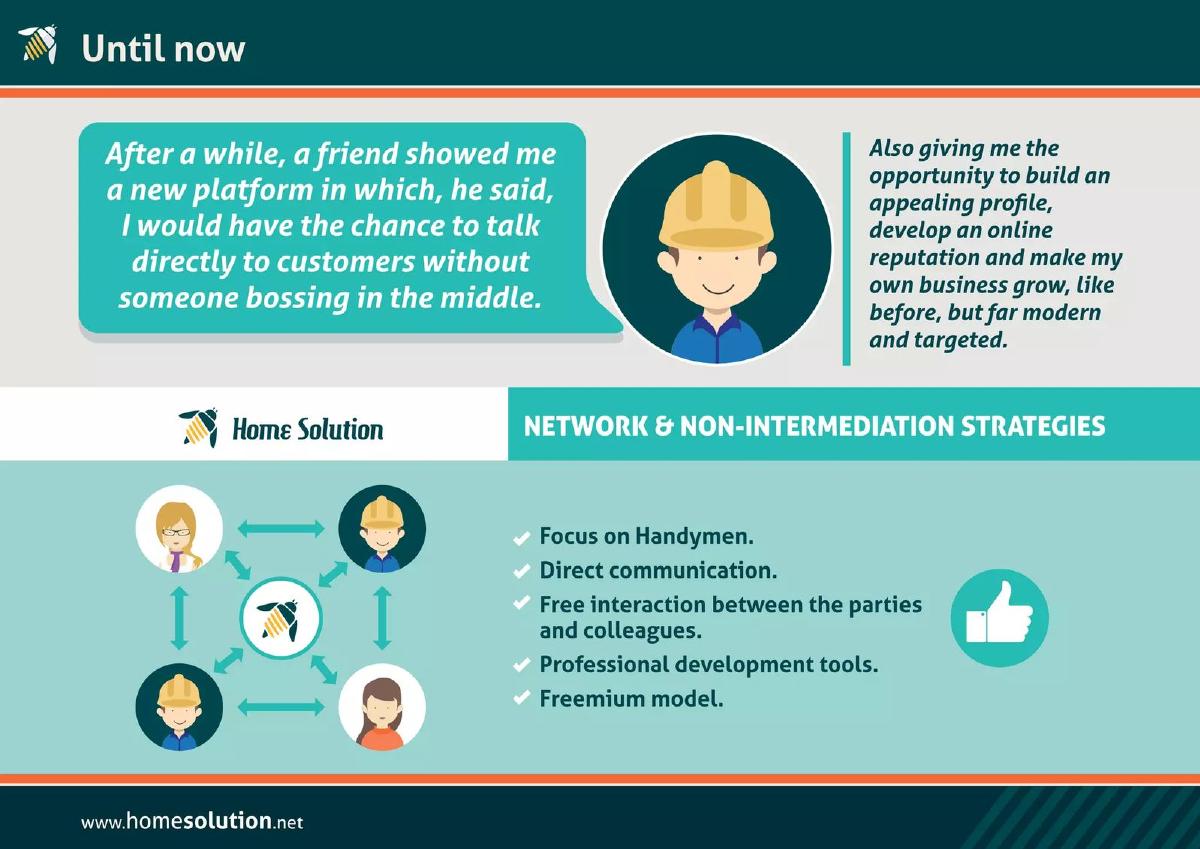
- The platform differentiates itself through a 'non-intermediation' strategy, allowing direct communication between handymen and clients (Slide 4).
- Reported a 528% growth in the handyman base and 301% growth in the user base over a six-month period in 2016 (Slide 9).
- Identifies a $571 billion U.S. dollar market opportunity across 20 Latin American countries (Slide 8).
- Monetization is driven by a freemium model and 'Nitro Pack' subscription upgrades, which began in 2016 (Slide 6).
- The deck omits a team slide, failing to identify the founders or their specific expertise in the LatAm market.
- There is no specific funding ask or valuation mentioned; the deck directs investors to request a separate 'Financial pitch' (Slide 11).
- Operations spanned 19 cities across 5 countries as of August 2016, including Argentina, Uruguay, Chile, Peru, and Ecuador (Slide 6, 9).
- The value proposition focuses on 'empowering' handymen by providing professional development tools and a digital reputation system (Slide 5).
Home Solution Pitch Deck: The 'Anti-Middleman' Marketplace
Home Solution presents a vision for a decentralized home services marketplace in Latin America. The deck is structured as a narrative, following the journey of a hypothetical handyman who is frustrated by existing digital platforms. By positioning itself against the 'black box' nature of traditional lead-generation sites, Home Solution attempts to build a brand based on transparency and professional empowerment. However, as a fundraising tool, the deck leaves significant gaps regarding the leadership team and the specifics of the investment opportunity.
Slide 1: Title and Branding
The cover slide introduces the logo—a stylized bee—and the tagline "THE RIGHT TOOL." The visual language uses a dark teal and orange palette. Below the main logo, a grid of icons represents various trades, including plumbing, electrical work, carpentry, and gardening. This immediately establishes the company as a multi-category service platform.
Slide 2: The Problem Statement
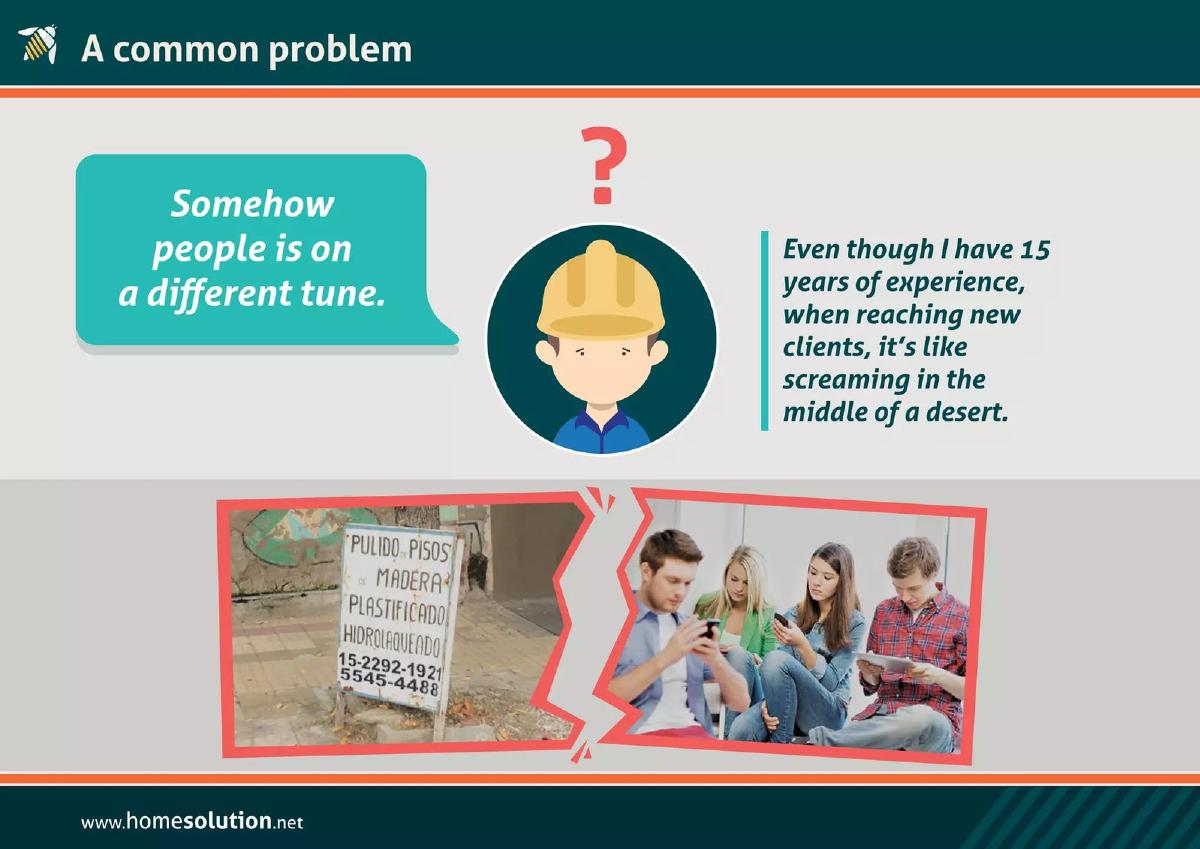
Slide 2 uses a persona-based approach to define the problem. It features an illustration of a handyman stating that despite 15 years of experience, reaching new clients feels like "screaming in the middle of a desert." The slide uses a split-image graphic to show the disconnect between traditional physical signage (a 'Pulido de Pisos' sign on a street) and modern consumers who are glued to their mobile devices. The core problem identified is a communication gap between skilled labor and a digital-first audience.
Slide 3: Critique of Existing Solutions
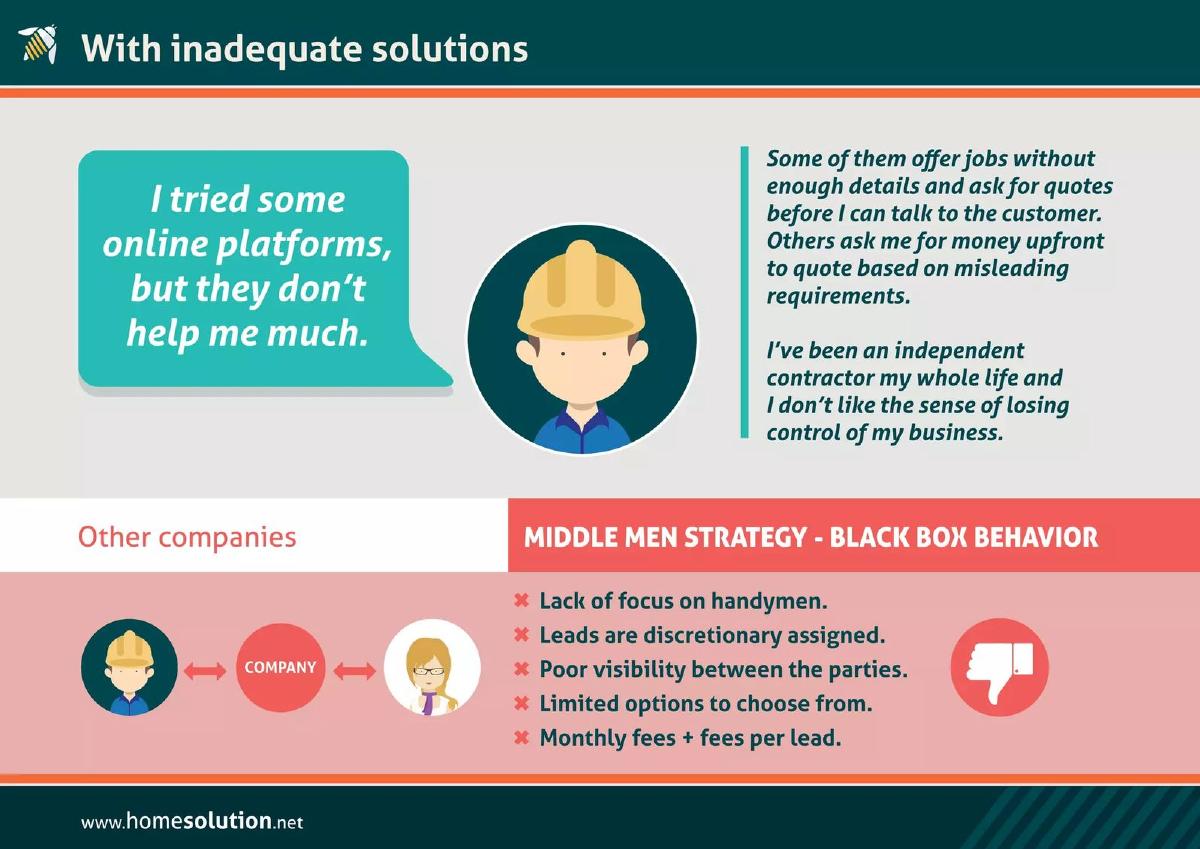
This slide is a direct attack on incumbent platforms. It labels them as having a "MIDDLE MEN STRATEGY - BLACK BOX BEHAVIOR." The handyman persona complains about platforms that ask for quotes without providing job details or require upfront money for misleading leads. The slide lists five specific pain points: lack of focus on handymen, discretionary lead assignment, poor visibility, limited options, and a double-dipping fee structure (monthly fees plus per-lead fees). This sets the stage for Home Solution's 'non-intermediation' model.
Slide 4: The Home Solution Value Proposition
Slide 4 introduces the solution under the heading "Until now." It highlights "NETWORK & NON-INTERMEDIATION STRATEGIES." The graphic shows a decentralized network where handymen, customers, and colleagues all interact directly. Key features listed include direct communication, free interaction, professional development tools, and a freemium model. The goal is to allow the handyman to build an "appealing profile" and an "online reputation" without a middleman "bossing in the middle."
Slide 5: Product and User Experience
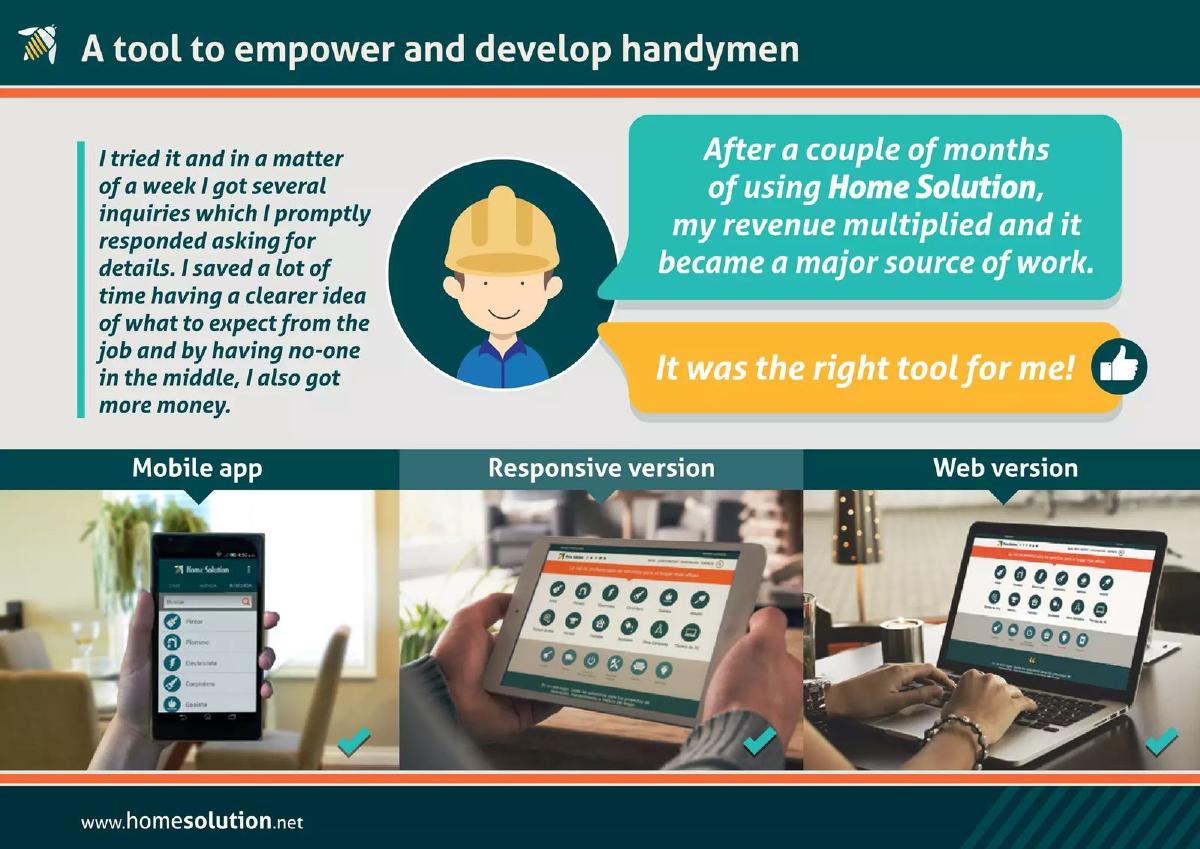
Titled "A tool to empower and develop handymen," this slide showcases the platform across three formats: Mobile app, Responsive version (tablet), and Web version (laptop). The handyman persona claims that within a week, he received several inquiries and that his revenue multiplied after a couple of months. The focus here is on efficiency—saving time by having clearer job expectations and making more money by removing the intermediary's cut.
Slide 6: Roadmap and History
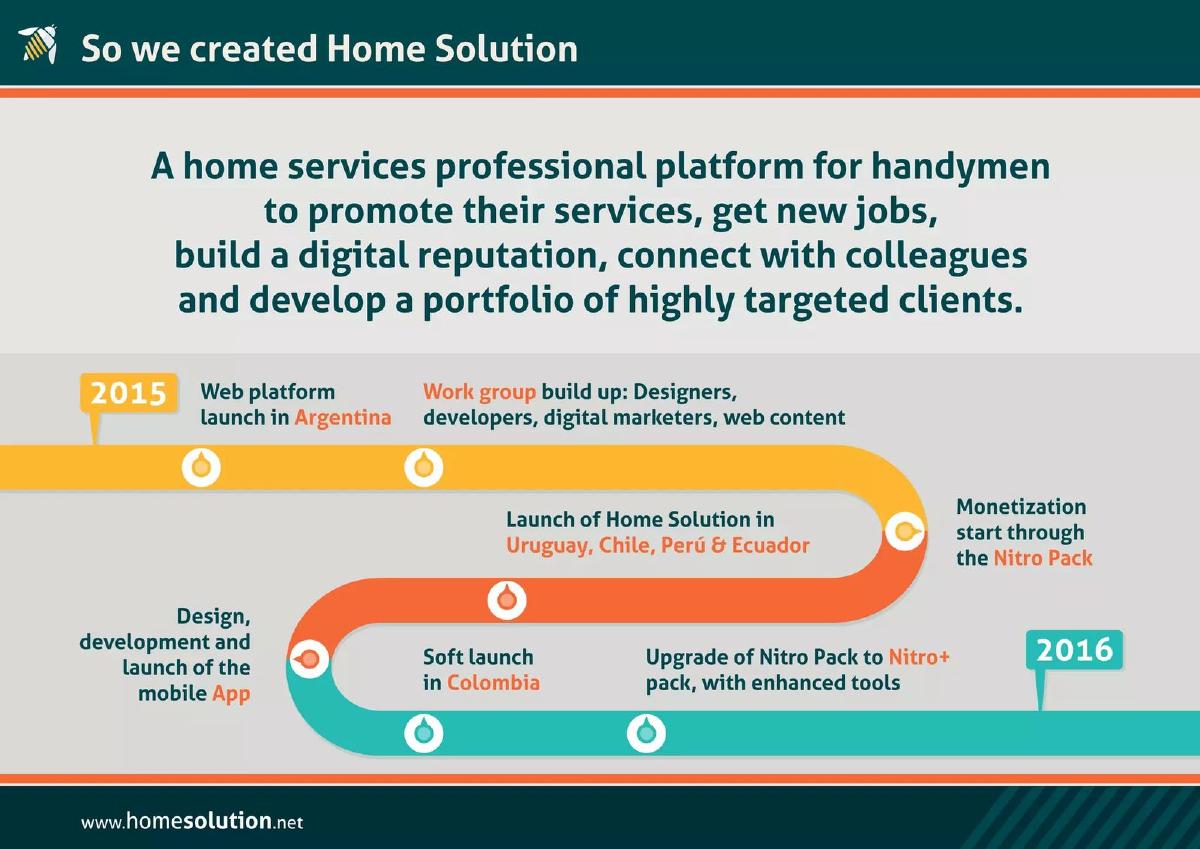
This slide provides a timeline of the company's evolution. It notes the 2015 launch of the web platform in Argentina and the subsequent build-up of a work group including designers and digital marketers. It tracks the expansion into Uruguay, Chile, Peru, and Ecuador, as well as the launch of the mobile app. The timeline concludes in 2016 with the start of monetization through the "Nitro Pack" and a soft launch in Colombia. This slide establishes that the company is not just an idea but an active, multi-national operation.
Slide 7: Core Principles
Slide 7 outlines the "Home Solution guidelines" through eight colored blocks: Non-Intermediation, Independence, Responsibility, Professionalism, Commitment, Transparency, Sustainable Growth, and Networking. While these are largely philosophical, they reinforce the brand's positioning as a partner to the handyman rather than a mere vendor of leads. The mention of "courses and seminars" under Professionalism suggests a broader vision for a professional community.
Slide 8: Market Size
The market slide provides four key figures: 20 Latin American countries, a $571 billion U.S. dollar market, 254 million mid-to-high income people in targeted cities, and 17 million handymen and construction workers. The $571 billion figure is exceptionally large and likely represents the total construction and home improvement spend for the entire region, rather than the addressable market for a lead-gen platform. The slide uses a generic cityscape background to emphasize the urban focus of the service.
Slide 9: Traction and Growth Data
This is the most data-dense slide in the deck, covering the period from February 1st to August 1st, 2016. It reports:
Handymen base growth: 528% · Users base growth: 301% · Activity within the system growth: 490% · Handymen engagement growth: 186% · Revenue growth month to month: 50% · Operating in 19 cities from 5 countries
These percentages indicate a period of rapid scaling, though the lack of absolute numbers (e.g., total number of users or total revenue) makes it difficult to assess the actual scale of the business.
Slide 10: Future Vision
Slide 10 expresses the company's two-year goal: "To reach all Latin American countries within 2 years as the leading handymen improvement platform." It reiterates the themes of equal opportunity and personal responsibility. The imagery of a worker measuring wood reinforces the hands-on nature of the industry they serve.
Slide 11: The Call to Action
The final slide provides contact information, including social media handles for Pinterest, Instagram, Facebook, Twitter, and Google+. Notably, it does not include a funding ask. Instead, it invites the reader to "Ask us for the Financial pitch or for our Product Details pitch." This indicates that the current deck is intended as a 'teaser' or a high-level overview rather than a full investment proposal.
What Home Solution Does Well
The deck excels at identifying a specific cultural and economic friction point in the Latin American labor market. By focusing on the 'handyman' as the primary customer, Home Solution addresses the supply side of the marketplace, which is often the harder side to retain. The use of a persona to narrate the problem and solution makes the deck accessible and easy to follow. Furthermore, the traction slide (Slide 9) uses aggressive growth percentages to create a sense of momentum and market fit.
What is Missing from the Deck
The most glaring omission is the Team Slide . Investors back people, especially in emerging markets where execution is everything. Without knowing who is running the company, it is impossible to judge their ability to navigate 20 different regulatory and economic environments. Additionally, the Competition Slide is generic. While it attacks the "Middle Men Strategy," it fails to name specific local or international competitors like IguanaFix or Habitissimo, which were active in the region during the same period. Finally, the Financial Ask is missing. A pitch deck should clearly state how much money is being raised and what that capital will achieve.
Lessons for Founders
Founders can learn from Home Solution's clear positioning. They didn't just build another marketplace; they built an "anti-middleman" platform. This clear 'enemy' (the black-box lead-gen site) makes their value proposition much stronger. However, founders should avoid the mistake of omitting the team. Even in a teaser deck, a brief mention of the founders' backgrounds is essential to build credibility. Furthermore, when presenting market size, it is better to provide a realistic Serviceable Addressable Market (SAM) rather than a massive, $500B+ Total Addressable Market (TAM) that includes costs like raw materials and land, which the platform does not touch.
Final Analysis
The Home Solution deck is a strong example of narrative-driven storytelling. It effectively communicates a 'movement' rather than just a software product. The reported 50% month-over-month revenue growth in 2016 suggests a business that found early traction. However, the deck functions more as a marketing brochure for potential partners or a very early-stage teaser for investors. To secure a term sheet, the founders would need to provide the 'Financial pitch' mentioned on the final slide, detailing their unit economics, burn rate, and the specific expertise of the leadership team.
Frequently asked questions
- What is Home Solution's primary business model?
- Home Solution operates on a freemium model. According to slide 4 and slide 6, the platform focuses on 'non-intermediation,' allowing free interaction between service providers and customers. Revenue is generated through the 'Nitro Pack' and 'Nitro+ pack,' which are described as monetization tools that provide enhanced features for handymen to promote their services and manage their digital reputation.
- Which geographic markets does Home Solution target?
- The deck focuses exclusively on Latin America. Slide 6 notes a 2015 launch in Argentina, followed by expansions into Uruguay, Chile, Peru, Ecuador, and a soft launch in Colombia. Slide 8 identifies a total market of 20 Latin American countries, with a specific focus on 254 million mid-to-high income people in targeted cities.
- How does Home Solution compare itself to competitors?
- On slide 3, the company criticizes 'Other companies' for using a 'Middle Men Strategy' or 'Black Box Behavior.' It specifically cites issues like lack of focus on handymen, discretionary lead assignment, poor visibility between parties, and high costs involving both monthly fees and fees per lead. Home Solution positions itself as the transparent, direct-communication alternative.
- What traction metrics are shared in the deck?
- Slide 9 provides 'Evolution Data' from February 1st to August 1st, 2016. During this window, the company claims 528% growth in handymen, 301% growth in users, 490% growth in system activity, and 186% growth in engagement. Crucially, it claims revenue grew by 50% month-over-month during this period while operating in 19 cities.
- What is missing from this pitch deck?
- The deck is missing several critical components for a standard venture capital pitch. There is no 'Team' slide identifying the founders or advisors. It lacks a 'Competition' slide naming specific rivals. Most importantly, it does not state a funding goal, use of proceeds, or current valuation, instead asking investors to request a separate financial pitch on the final slide.