Code Four’s 8-slide deck is a masterclass in brevity and high-signal information. Targeting the massive administrative overhead in law enforcement, the company positions itself as an 'AI Co-Pilot' that automates report writing, warrants, and redactions. The deck leans heavily on the founders' technical pedigree as MIT dropouts and their early traction, citing 8 pilots and 17 active leads within just two months. By quantifying the problem—$13 billion spent annually on paperwork—and offering a vendor-agnostic, extension-based solution, they present a low-friction entry into a traditionally slow…
Key takeaways
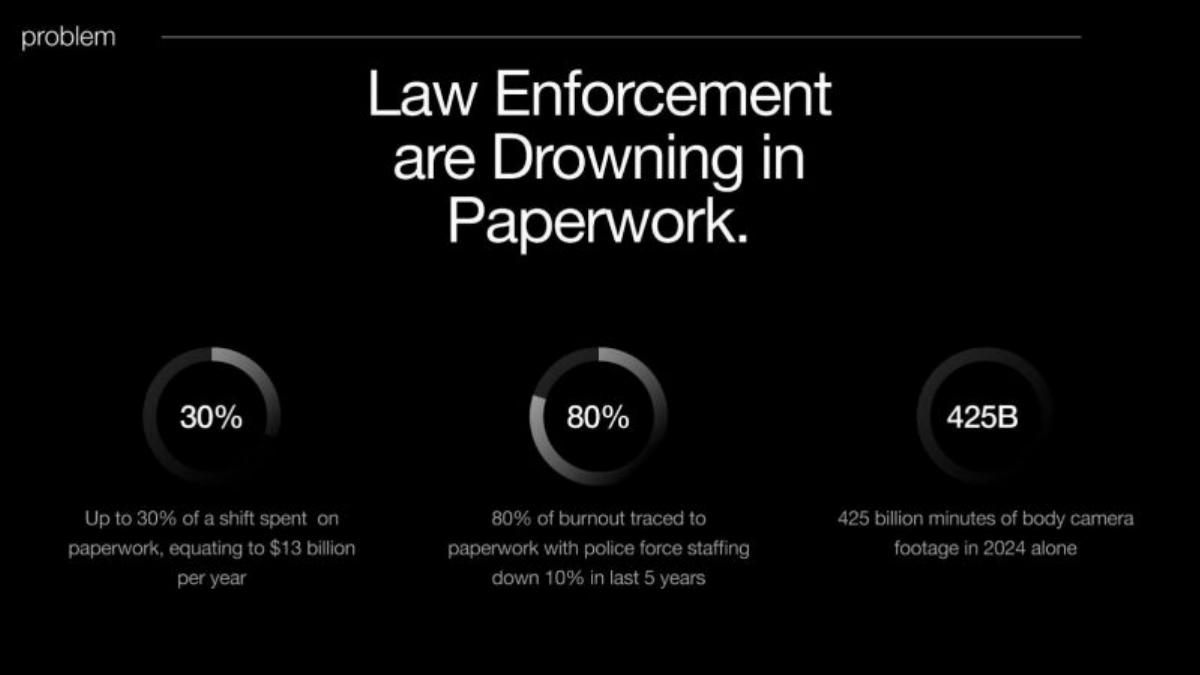
- The company identifies a massive efficiency gap, noting that up to 30% of a police shift is spent on paperwork, costing $13 billion annually (Slide 3).
- Founders George Cheng and Dylan Nguyen emphasize their technical background as MIT CS & AI dropouts with significant research experience at age 17 and 18 (Slide 2).
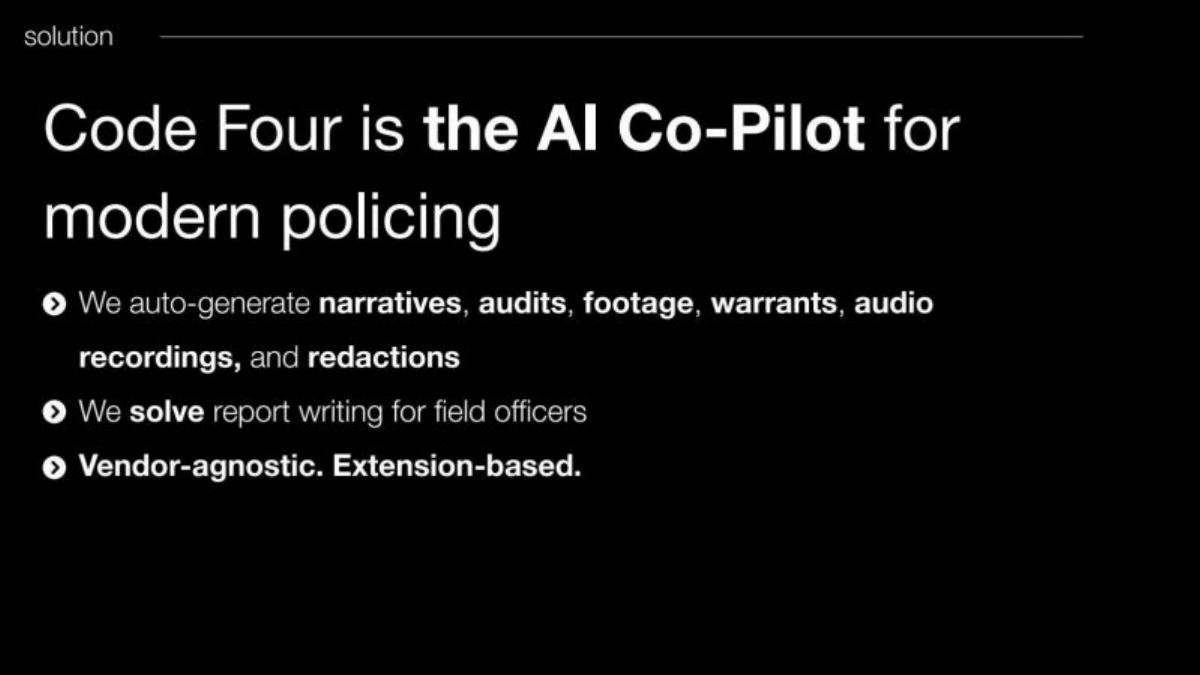
- The product is positioned as vendor-agnostic and extension-based, allowing it to integrate with existing law enforcement systems without requiring a full rip-and-replace (Slide 4).
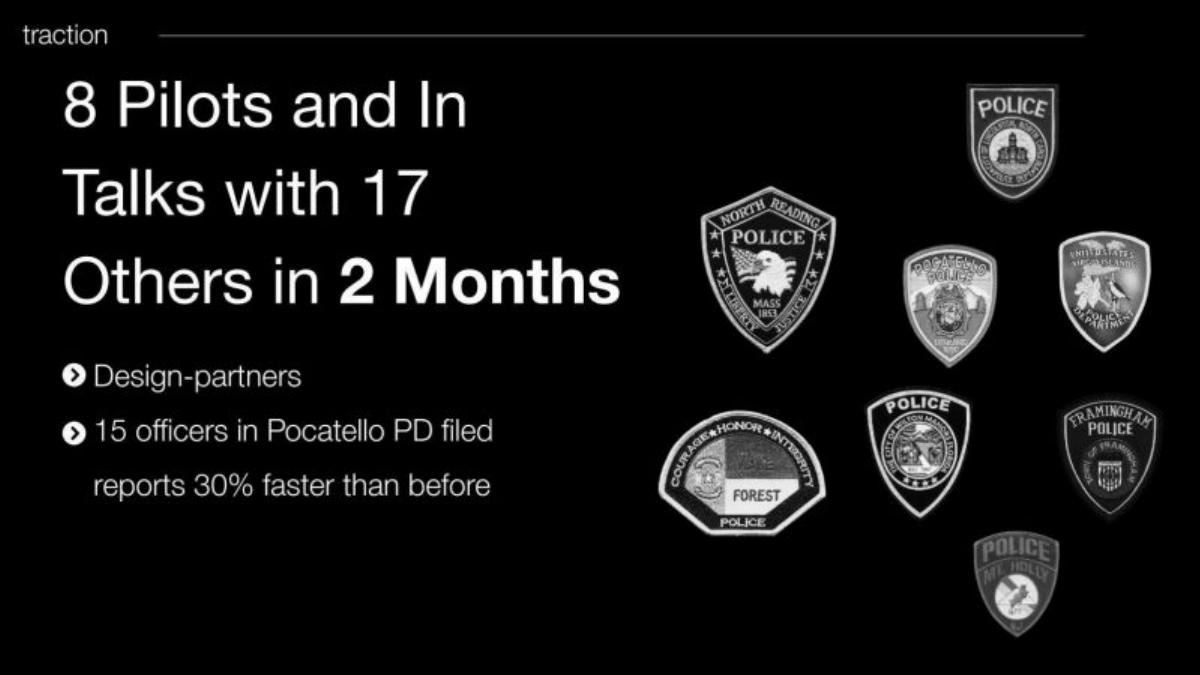
- Early traction is strong, with 8 pilots secured and 17 more in discussion within a two-month window (Slide 5).
- A specific case study from Pocatello PD shows that 15 officers filed reports 30% faster using the tool (Slide 5).
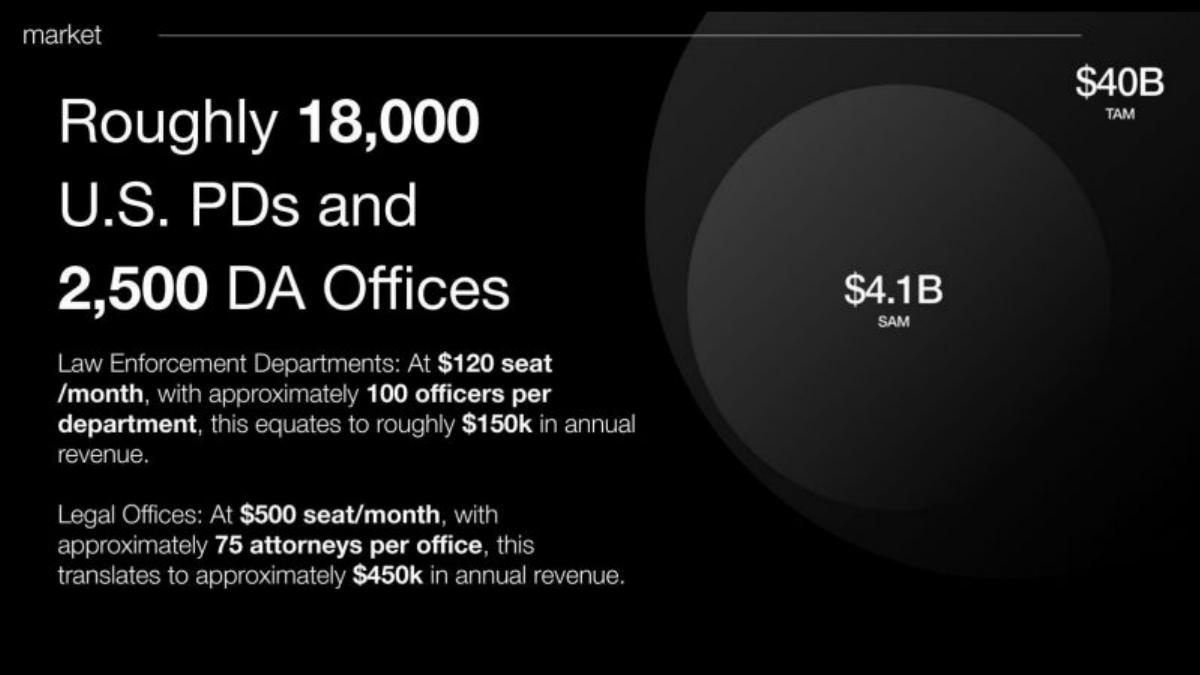
- The market sizing targets 18,000 U.S. Police Departments and 2,500 DA Offices, with a total addressable market (TAM) of $40 billion (Slide 6).
- The business model is clearly defined with seat-based pricing: $120/month for law enforcement and $500/month for legal offices (Slide 6).
- The round was significantly oversubscribed, raising $2.7 million against an initial $2 million target (Slide 7).
The 8-Slide Efficiency Play
Code Four’s pitch deck is a lean, high-impact presentation that focuses on a single, massive pain point: the administrative strangulation of American law enforcement. With only eight slides, the founders managed to raise $2.7 million by proving they have the technical chops to build the solution and the sales velocity to penetrate a notoriously difficult market. The deck avoids fluff, focusing instead on hard numbers and pedigree.
Slide 1: Title and Vision
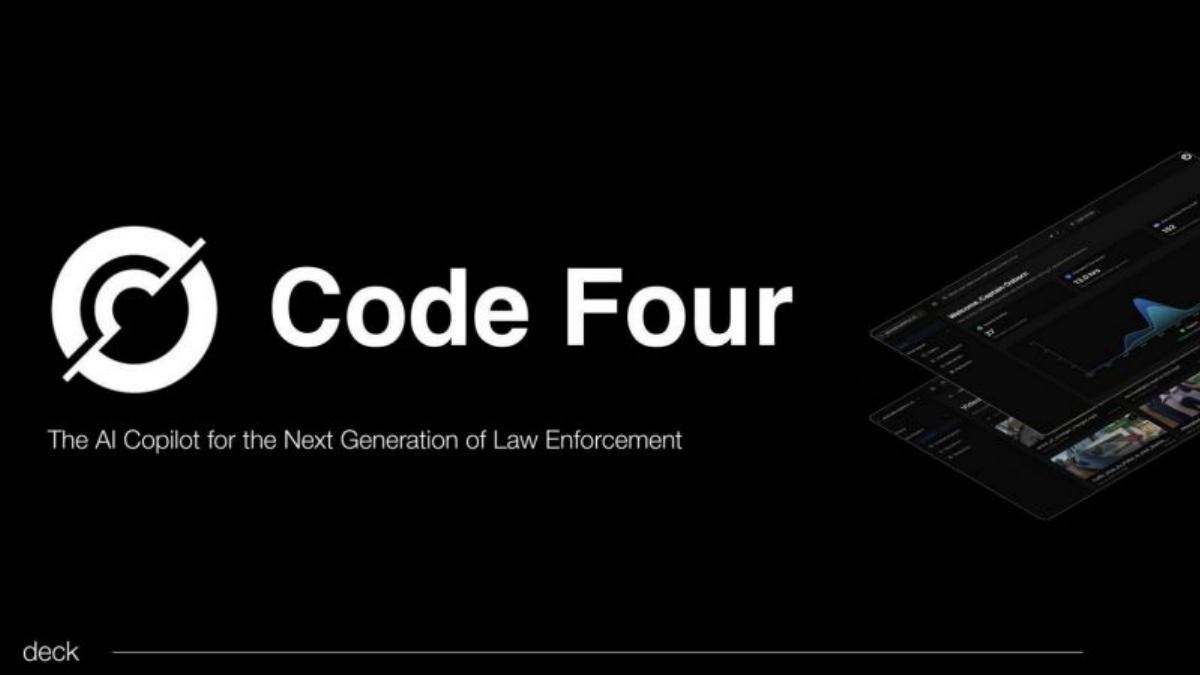
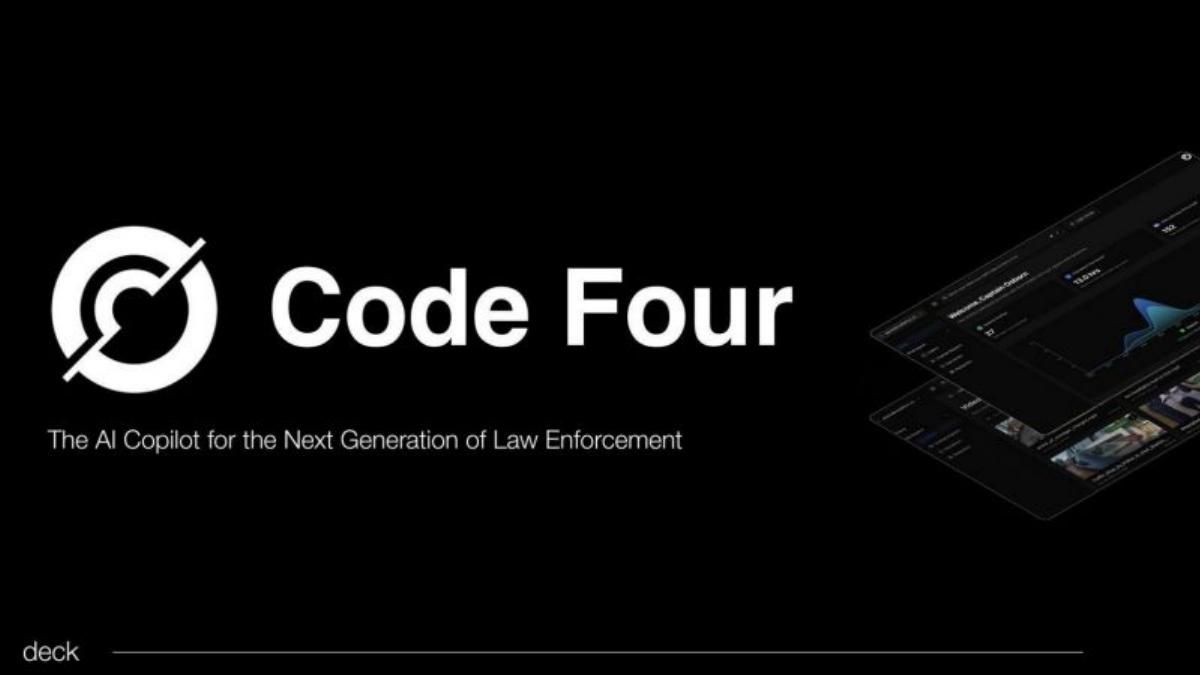
The cover slide introduces Code Four as "The AI Copilot for the Next Generation of Law Enforcement." The visual features a dark, professional aesthetic with a clean logo and a UI mockup showing a dashboard with data visualizations and video feeds. It immediately establishes the company as a modern software layer for a traditionally legacy-heavy industry.
Slide 2: The Team
The team slide is titled "MIT CS & AI Dropouts," a bold heading designed to signal high technical intelligence and urgency. George Cheng (CEO) is noted as an Eagle Scout with over 2,000 hours of volunteering at police departments, providing the necessary domain empathy. Dylan Nguyen (CTO) is highlighted for neuroinformatics research at Max Planck at age 17. The slide uses logos from MIT, the Department of Defense, and Max Planck to anchor their credibility despite their young age.
Slide 3: The Problem
Slide 3 quantifies the crisis in policing. It lists three key statistics: 30% of a shift is spent on paperwork (costing $13 billion annually), 80% of burnout is traced to paperwork while staffing is down 10%, and a staggering 425 billion minutes of body camera footage will be produced in 2024. This slide successfully frames the problem not just as an inconvenience, but as a multi-billion dollar economic and labor crisis.
Slide 4: The Solution
The solution slide defines Code Four as an "AI Co-Pilot." It lists specific outputs: narratives, audits, footage, warrants, audio recordings, and redactions. The most important technical detail is at the bottom: "Vendor-agnostic. Extension-based." This tells investors that Code Four doesn't need to replace the massive, entrenched databases police already use; it can sit on top of them, dramatically lowering the barrier to adoption.
Slide 5: Traction
Traction is shown through volume and a specific case study. In just two months, the company secured 8 pilots and is in talks with 17 other departments. They include a list of police department patches (North Reading, Pocatello, Mt. Holly, etc.) for visual proof. The standout metric is from Pocatello PD, where 15 officers filed reports 30% faster using the platform. This provides the "proof of value" necessary for a seed round.
Slide 6: Market Opportunity
The market slide breaks down the TAM ($40B) and SAM ($4.1B). It identifies 18,000 U.S. Police Departments and 2,500 DA Offices as the primary targets. The business model is transparent: $120/seat/month for police and $500/seat/month for attorneys. By providing the estimated annual revenue per department ($150k to $450k), they make the path to $100M ARR look mathematically plausible.
Slide 7: The Ask and Strategic Backing
The final content slide reveals the raise: $2 million (later updated to $2.7 million). It highlights the backing of Todd Basche, the ex-CPO at Axon. This is a critical inclusion; Axon is the dominant player in the space, and having their former product lead as a backer provides massive validation for Code Four’s product-market fit. The slide also lists high-profile VCs like AME Cloud Ventures and Webb Investment Network.
Slide 8: Closing
The final slide is a standard call to action to browse more decks at the source website, serving as a placeholder for the end of the presentation.
What Works in This Deck
1. Extreme Focus: The deck doesn't try to solve all of public safety. It focuses entirely on the "paperwork" bottleneck. By narrowing the scope, the founders make the AI application feel tangible and immediately useful rather than speculative.
2. Domain Empathy + Technical Prowess: The combination of "MIT AI Dropouts" and "2,000 hours volunteering at Police Depts" is a powerful narrative. It suggests they have the brains to build the tech and the cultural understanding to get cops to actually use it.
3. Low-Friction Entry: Mentioning that the tool is "extension-based" is a brilliant move for the GovTech sector. Selling to government agencies is usually a nightmare due to integration hurdles. An extension-based model suggests a much faster sales cycle.
What is Missing
1. Competitive Landscape: The deck does not mention competitors. While Axon is mentioned via an investor, there is no discussion of how Code Four differentiates from Axon’s own emerging AI features or other startups like JusticeText or Truleo.
2. Product Deep Dive: There are no detailed screenshots of the actual report-generation process. While the high-level list of features is good, seeing the "before and after" of an AI-generated police narrative would have been a compelling addition.
3. Roadmap: The deck focuses heavily on the current state (pilots and current features). It doesn't explicitly state what the $2.7M will be used for in terms of future product development or geographic expansion.
What a Founder Should Copy
1. The Traction Slide: Use visual logos (like the police patches) to make your progress feel real. Don't just say "we have pilots"; show who they are and provide one specific efficiency metric (like the 30% time savings) to anchor the value proposition.
2. Quantified Problem Statements: Code Four didn't just say "police are busy." They cited the $13 billion cost and the 425 billion minutes of footage. Founders should always find the macro-stat that makes their micro-solution feel like a necessity.
3. Transparent Pricing: Many seed decks hide their pricing. Code Four puts it front and center, along with the estimated contract value. This allows investors to do the math on the market size instantly without asking follow-up questions.
4. Strategic Advisor Placement: If you have an investor or advisor who is a titan in your specific niche (like the ex-CPO of the industry leader), give them their own headshot and callout. It acts as a shortcut for due diligence.
Frequently asked questions
- What exactly does Code Four automate for police officers?
- According to slide 4, Code Four auto-generates narratives, audits, footage summaries, warrants, audio recordings, and redactions. The primary goal is to solve the 'report writing' bottleneck that field officers face, which currently accounts for a significant portion of their shift time and contributes to high burnout rates.
- How does Code Four integrate with existing police software?
- The deck specifies on slide 4 that the solution is 'vendor-agnostic' and 'extension-based.' This suggests the software likely operates as a browser extension or a lightweight overlay that can work on top of various Record Management Systems (RMS) used by different departments, rather than requiring a complex backend integration.
- What is the pricing model for the software?
- Slide 6 outlines two distinct pricing tiers. For Law Enforcement Departments, the cost is $120 per seat per month. For Legal Offices (District Attorneys), the price increases to $500 per seat per month. The deck estimates an average annual revenue of $150k per police department and $450k per DA office.
- Who are the key investors in this round?
- The round was co-led by AME Cloud Ventures and Webb Investment Network. Other notable participants include Y Combinator, CRV, and Pathlight Ventures. Crucially, the deck highlights the backing of Todd Basche, the former Chief Product Officer at Axon, who led the creation of industry-standard body cameras (Slide 7).
- Is there a competitive analysis included in the deck?
- No. The 8-slide deck omits a traditional competitor matrix or 'magic quadrant' slide. Instead, it focuses on the unique 'extension-based' delivery model and the specific pain point of the 425 billion minutes of body camera footage generated annually that requires processing (Slide 3).