Cogxio, formerly known as DateIITians, presented this 23-slide deck in 2015 to pivot from a niche community to a broad 'Uber for Discover, Meet and Plan' platform. The startup identifies core friction in the dating market—specifically low female participation and the 'dead profile' issue at eHarmony, which they claim has 96.25% inactive profiles (Slide 6). Their solution integrates dating with transactional event planning, aiming to monetize via a 10-15% commission on bookings (Slide 23). While the deck shows strong early traction, reaching 500,000 projected registered users by late 2015 (Sli…
Key takeaways
- The company rebranded from DateIITians to Cogxio to appeal to a broader market beyond elite university alumni (Slide 1).
- Cogxio claims a significant data validation point with 50,000 registered users from its MVP phase, with 90% under age 30 (Slide 15).
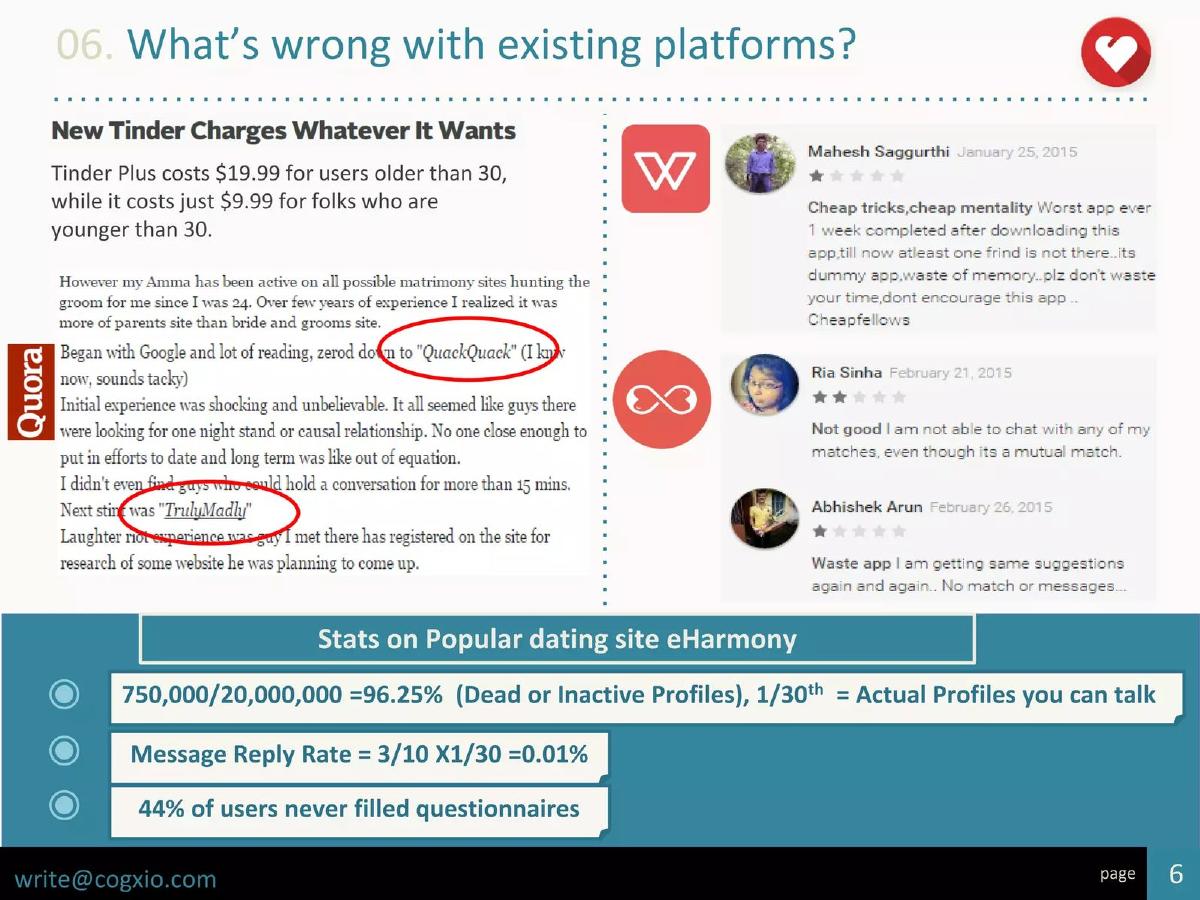
- The platform targets the 'dead profile' problem, citing that eHarmony has a message reply rate of only 0.01% (Slide 6).
- The business model shifts from subscriptions to a transactional 'pay-as-you-go' model involving in-app bookings for dates (Slide 9).
- Revenue is generated through a 10-15% commission on bookings for dinner, movies, and travel (Slide 23).
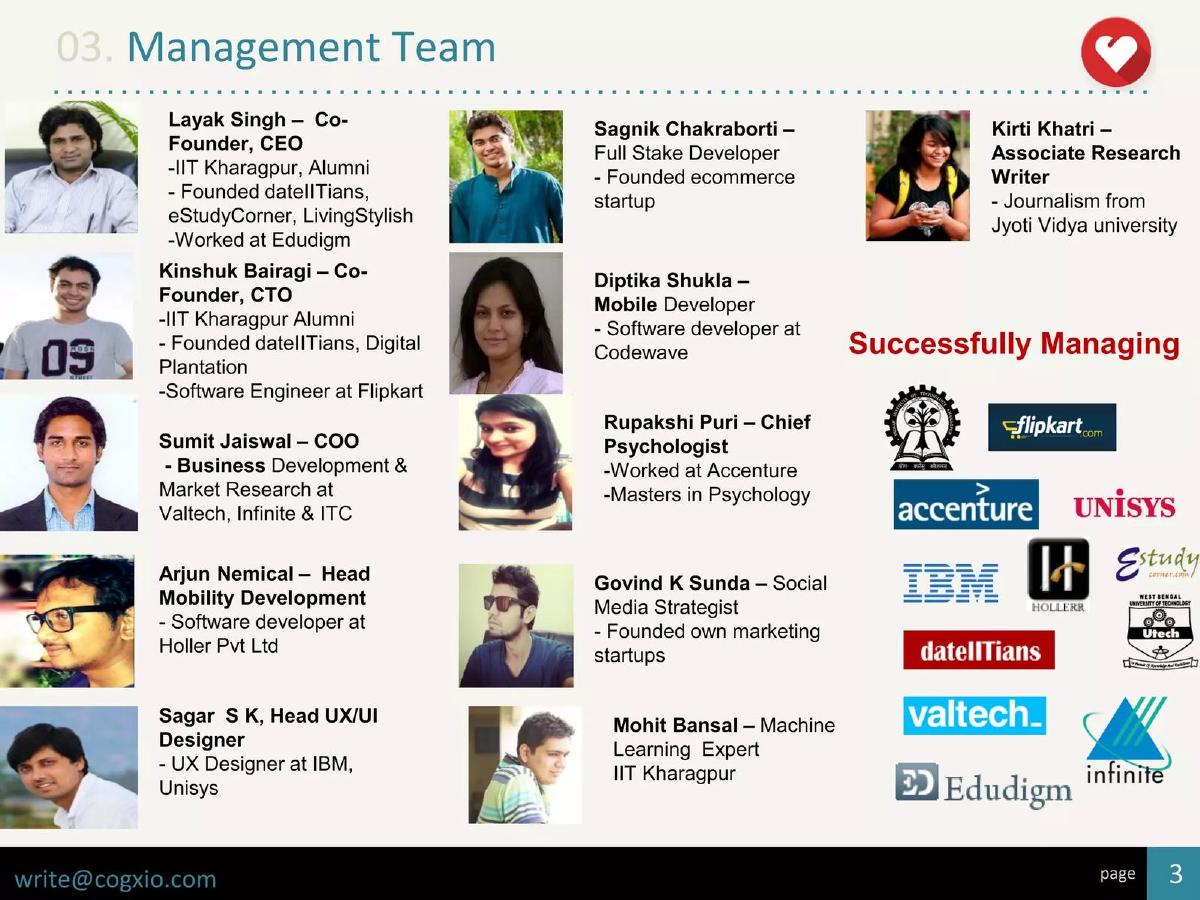
- The team includes founders from IIT Kharagpur with prior experience at Flipkart and IBM (Slide 3).
- Traction data shows a growth trajectory from 10,000 users in late 2014 to a projected 500,000 by late 2015 (Slide 22).
- The deck completely omits a specific funding ask, valuation, or use-of-funds breakdown.
Cogxio Pitch Deck Analysis: The Pivot to Transactional Social Discovery
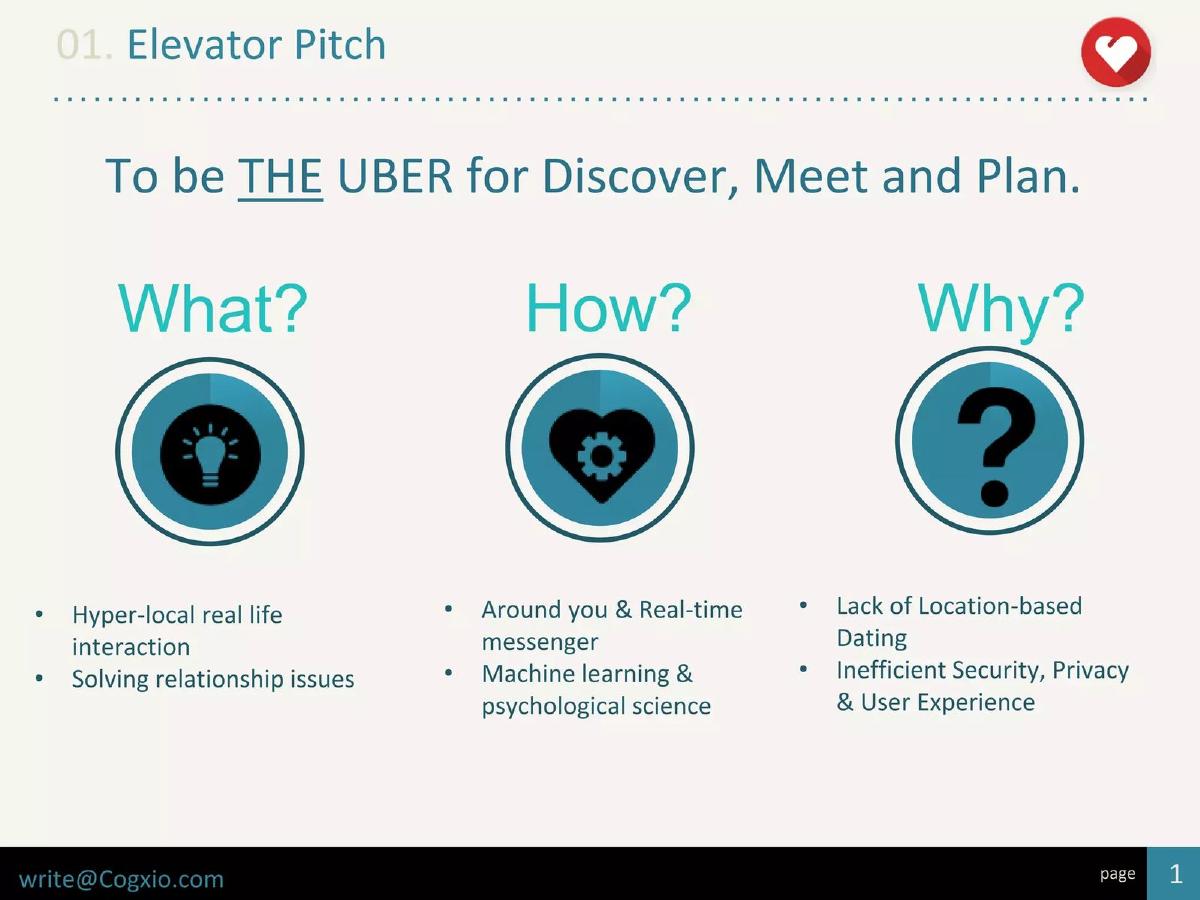
The Cogxio pitch deck from 2015 represents a specific moment in the evolution of the Indian startup ecosystem. Moving away from the niche 'DateIITians' brand, the company sought to capitalize on the massive growth of smartphone penetration in India by combining dating with local commerce. This teardown examines how the team presented their vision of an 'Uber for Discover, Meet and Plan.'
Slide 1-2: The Rebrand and The Proposition
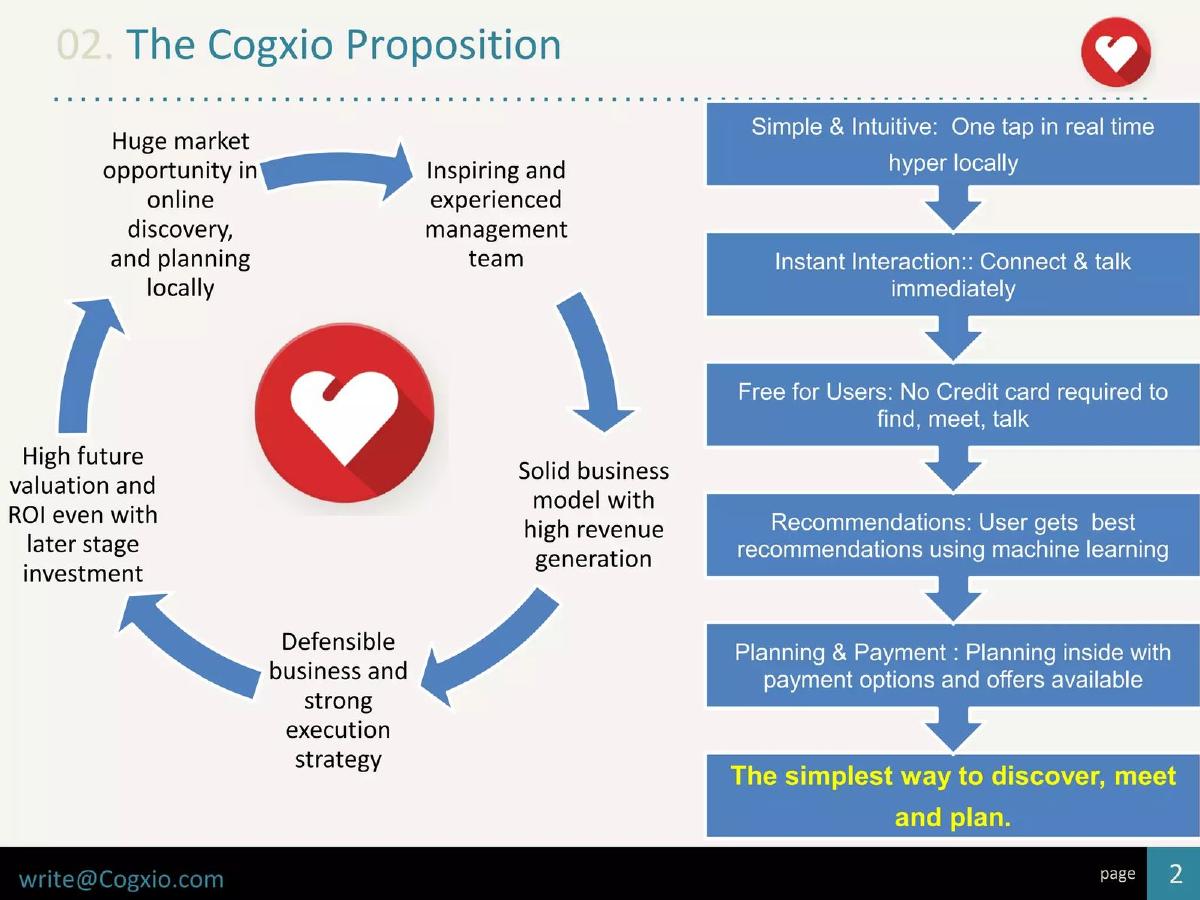
The deck opens by acknowledging its roots: 'Earlier Known as DateIITians.com.' This is a strategic move to leverage existing credibility while signaling a shift toward a broader market. Slide 2 introduces the 'Cogxio Proposition,' a circular flow that links a 'huge market opportunity' to a 'defensible business.' The right side of Slide 2 lists the core product pillars: simple and intuitive, instant interaction, free for users, and planning/payment integration. The phrase 'The simplest way to discover, meet and plan' serves as the primary anchor for the entire presentation.
Slide 3: Management Team
Slide 3 is a standard but effective team slide. It highlights the 'IIT Kharagpur' pedigree of the founders, Layak Singh and Kinshuk Bairagi. The inclusion of logos like Flipkart, IBM, and Accenture provides social proof of the team's professional background. Notably, they include a 'Chief Psychologist' (Rupakshi Puri), which supports their later claims about using 'psychological science' for matchmaking.
Slide 6-7: The Problem Space
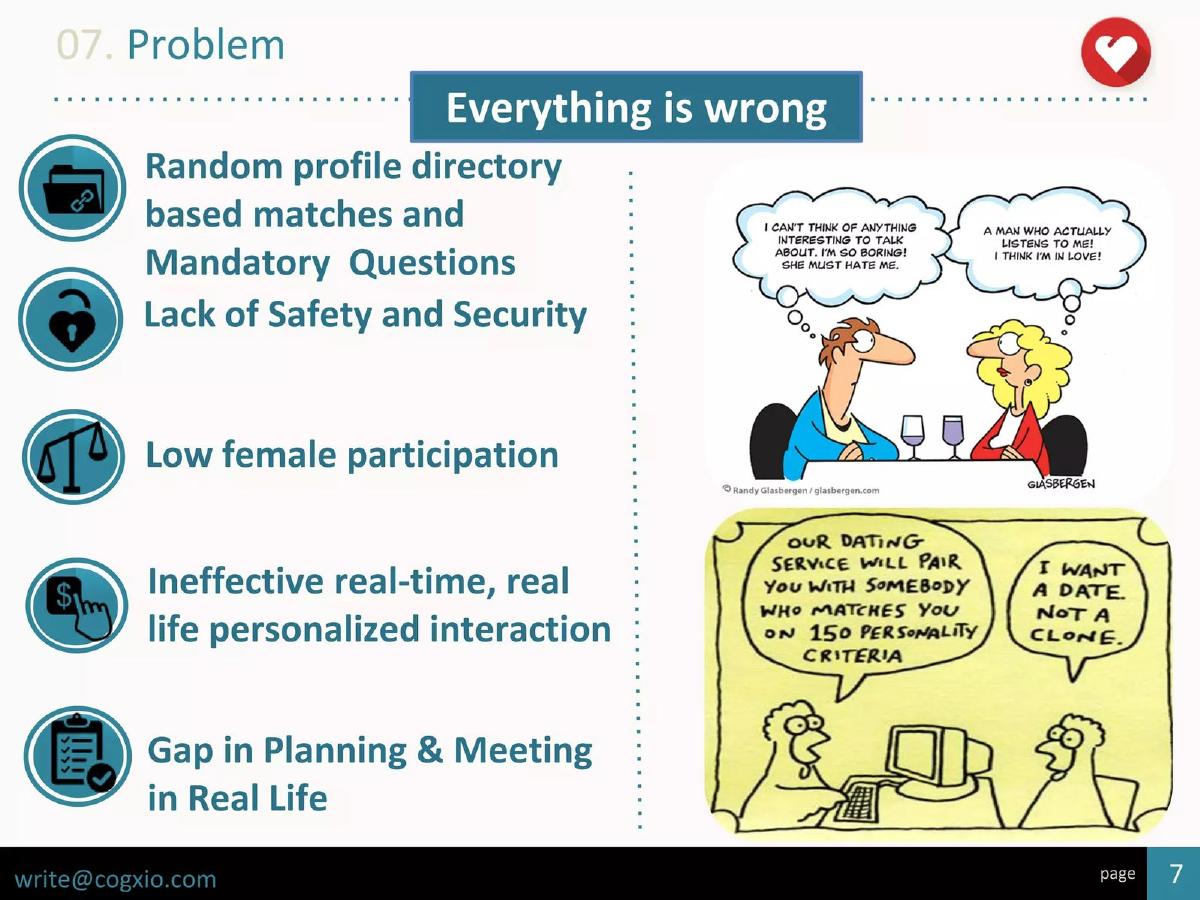
Cogxio takes a direct shot at established players. Slide 6 uses a 'What’s wrong with existing platforms?' heading to critique Tinder's pricing and eHarmony's engagement. They claim eHarmony has 96.25% dead or inactive profiles and a message reply rate of just 0.01%. Slide 7 summarizes the problem as 'Everything is wrong,' citing random profile directories, lack of safety, and low female participation as the primary pain points of the 2015 dating landscape.
Slide 8-11: The Solution and Technology
The solution is presented across four slides. Slide 8 focuses on 'Real Identity' and 'Data Safety,' promising a 4-step ID verification process to attract female users. Slide 9 introduces the 'Pay-as-you-go' model, which is a significant departure from the subscription-heavy dating industry. Slide 10 and 11 dive into the 'Predictive Analytics' and the 'Plan Out' feature. The deck shows a 'Demo Design' for the planning screen, which looks like a hybrid of a dating app and a restaurant discovery tool like Zomato.
Slide 12-14: Market Opportunity
The market slides provide a global and local context. Slide 12 notes the global online dating spend was $4.0 billion through 2014. Slide 13 narrows the focus to India, highlighting a 91% CAGR in smartphone users and a $48 billion 'Eating Out' market. This is a classic 'market expansion' argument: Cogxio isn't just a dating app; it's a gateway to the massive offline hospitality and wellness industries.
Slide 15-17: Data Validation and Product
Slide 15 provides the most concrete evidence of the team's ability to execute. It shows data from the DateIITians MVP: 50,000 registered users, 12% female, and 90% under age 30. Slide 16 and 17 showcase the app interface and the underlying technology stack, including GPS, Bluetooth, and machine learning for data mining from social media.
Slide 18-21: Competitive Landscape
Slide 18 uses a comparison table to contrast Cogxio with 'Traditional Online Dating' and 'Traditional Matrimony.' It positions Cogxio as the only 'Safe & Reliable' option with 'No profile directory.' Slides 20 and 21 map the competitive landscape, placing Cogxio in the 'Freemium Model' and 'Global' quadrant, distinct from subscription-based Indian competitors like Floh or Shaadi.com.
Slide 22-24: Traction and Business Model
The deck concludes with traction and the business model. Slide 22 shows a projected growth curve, aiming for 500,000 registered users and 300,000 active users by the end of 2015. Slide 23 clarifies the revenue streams: a 10-15% commission on bookings, transactional costs, and strategic advertising fees. Slide 24 outlines the growth strategy, which leans heavily on college events and 'campus representatives'—a nod to their original DateIITians user base.
What Cogxio Does Well
The deck excels at identifying a specific, relatable friction point: the 'dead-end' match where a conversation never turns into a meeting. By integrating the 'Plan Out' feature, Cogxio offers a clear utility that goes beyond the dopamine hit of a swipe. The use of actual data from their MVP (Slide 15) gives the founders immediate credibility, proving they can attract a young, tech-savvy demographic in the Indian market. Furthermore, the shift from a subscription model to a transactional commission model (Slide 23) is a sophisticated way to align their business success with user satisfaction.
What is Missing from the Cogxio Deck
The most glaring omission is the lack of a financial 'Ask' and a 'Use of Funds' slide. An investor finishing this deck would have no idea how much capital the company is raising or what the valuation expectations are. Additionally, while the deck mentions 'Machine Learning' and 'Psychological Science' multiple times, it lacks a deep dive into how their algorithm actually works to improve match quality compared to competitors. There is also no mention of unit economics—specifically Customer Acquisition Cost (CAC) versus Lifetime Value (LTV)—which is critical for a platform planning to scale through high-touch college events and 'campus representatives.'
Founder Takeaways: Lessons from Cogxio
Founders should look at Slide 13 as a masterclass in 'Market Adjacent' thinking. By showing the 'Eating Out' market alongside the 'Dating' market, Cogxio effectively 10x-ed their perceived TAM. Another takeaway is the importance of rebranding; the transition from DateIITians to Cogxio shows a team that understands when a niche brand becomes a ceiling rather than a floor. However, founders must ensure they don't forget the 'Ask.' A pitch deck is a sales document, and every sales document needs a clear call to action. Finally, if you are claiming a '96.25% failure rate' for a competitor (Slide 6), be prepared to back that up with rigorous data during due diligence, as such aggressive claims will always be scrutinized.
Frequently asked questions
- What is Cogxio's primary value proposition compared to Tinder?
- Cogxio positions itself as a 'real-time' discovery and planning tool rather than just a profile directory. According to Slide 7 and 8, the platform focuses on 'Real Identity' through a 4-step verification process and 'Inbuilt Activities' that allow users to book dates (dinner, movies) directly within the app, addressing the gap between matching and actually meeting in real life.
- How does Cogxio plan to monetize its user base?
- Unlike traditional dating apps that rely on monthly subscriptions, Cogxio utilizes a transactional model. Slide 23 details a 10-15% commission on bookings made through the app, alongside strategic advertising fees for businesses and premium expert services (like beauty or relationship consulting). This aligns their revenue with successful real-world interactions.
- What market data does the deck use to justify the opportunity in India?
- Slide 13 highlights that the Indian dating industry was projected to be worth $550 million by 2015, while the 'Eating Out' market was valued at $48 billion. By positioning itself at the intersection of these two markets, Cogxio argues for a much larger TAM than a standalone dating app.
- Who are the key members of the management team?
- The team is led by Co-Founders Layak Singh (CEO) and Kinshuk Bairagi (CTO), both alumni of IIT Kharagpur. The deck emphasizes their technical pedigree and previous experience at major Indian firms like Flipkart, as well as their history of founding the predecessor site, DateIITians (Slide 3).
- Is there a specific funding request in this deck?
- No. The deck is notably missing a 'The Ask' slide. While it details the 'Value to Investor' (Slide 19) in terms of human capital and intellectual property, it does not specify how much capital the company is seeking, the intended valuation, or the specific milestones that the funding would enable.