Squareboat's 2021 deck is a company/capabilities deck for a 70-person Indian dev agency, not a fundraising deck. It excels at named client outcomes, attributed testimonials and early proof numbers, but has no market size, business model, growth curve or ask — the four things investors need. Its strongest asset, Hackr.io (2M+ monthly users), is buried on slide 12.
Key takeaways
- A company deck answers 'can you deliver?'; an investor deck answers 'can this get very large, very fast?' — the two are not interchangeable.
- Squareboat puts three proof numbers on slide two (2013, 70+ employees, 50+ projects) before any adjectives — copy this discipline.
- Every case study names a client and a measurable outcome, e.g. nearly 2x credit-card conversion for Paisabazaar.
- All four testimonials are named, titled and company-attributed, which is far stronger than anonymous praise.
- The deck has no market sizing, no unit economics, no growth curve, no retention data and no ask — all fatal in a fundraising context.
- The most fundable asset in the deck, Hackr.io with 2M+ monthly users, appears on slide 12 as a side project.
- Six service lines signal capability to a client and lack of focus to an investor; breadth sells services, depth sells equity.
What this deck actually is (and why that matters)
Before you copy a single slide, be clear about what you are looking at. The Squareboat 2021 deck is not a venture fundraising deck. It is a company deck — also called a credentials deck, capabilities deck, or corporate profile — used by a services business to win clients.
Squareboat Solutions Private Limited is a web and mobile development agency founded in 2013 in Gurugram, India, by Gaurav Gupta, a former SlideShare and Naukri.com engineer. By the time this deck was produced, the company described itself as 70+ employees with 50+ projects delivered, working for clients including PVR Cinemas, Dunzo, Paisabazaar, Tripoto and Jubilant Consumer.
That distinction matters, because the two document types optimise for opposite things. A company deck answers "can I trust you to deliver?" An investor deck answers "can this become a very large business, quickly, and is this the team to do it?" Most founders who fail their first fundraise fail because they built the first document and walked into a meeting expecting it to do the second job.
This teardown does two things: it grades the deck honestly on its own terms, then rebuilds it as an investor deck slide by slide.
Slide-by-slide walkthrough
Slide 1 — Cover
Logo, company name, URL. Clean and unremarkable, which is correct for a cover. No tagline, though, and that is the first missed opportunity: a cover slide is a free line of positioning that most decks waste.
Slide 2 — Introduction: "Great products for great ideas"
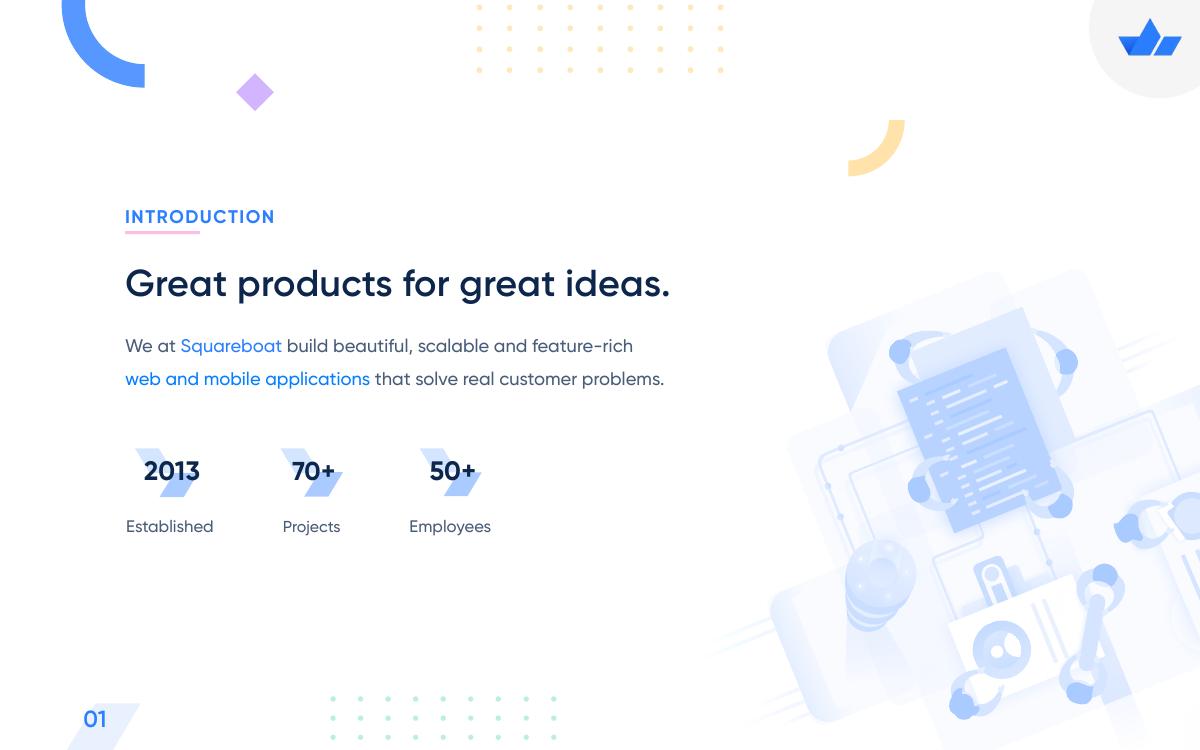
One sentence of positioning ("we build beautiful, scalable and feature-rich web and mobile applications that solve real customer problems") plus three proof numbers: established 2013, 70+ employees, 50+ projects.
This is the strongest slide in the deck. Three numbers, no adjectives required, immediate scale calibration. Notice the discipline: a founder reading this in ten seconds knows the company''s age, size and volume of delivery. Most startup decks reach slide five before the reader knows anything numeric.
Slide 3 — Founder
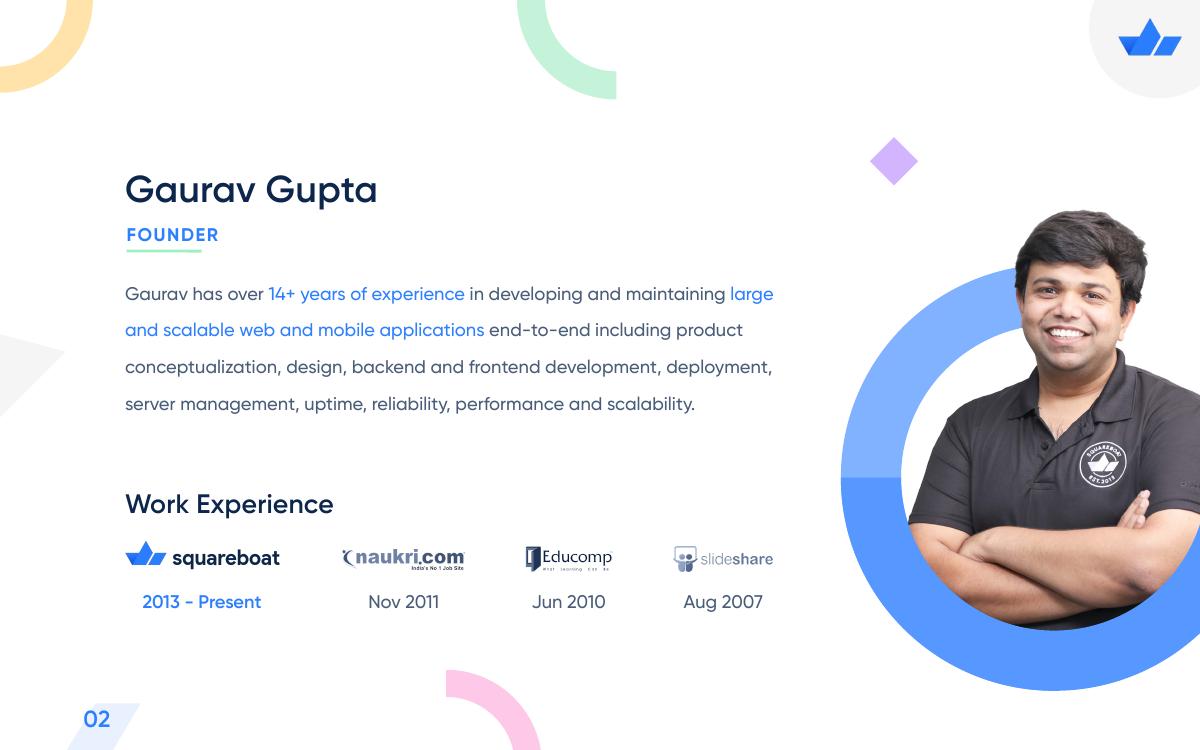
Gaurav Gupta, 14+ years building and running large-scale web and mobile applications end-to-end, with a career timeline: Educomp (2007), SlideShare (2010), Naukri.com (2011), Squareboat (2013 – present).
The timeline device works. Rather than claiming credibility, it shows a legible progression through recognisable companies. For a services buyer, "the person leading this shipped at Naukri and SlideShare" is the entire risk assessment.
Slide 4 — Services suite
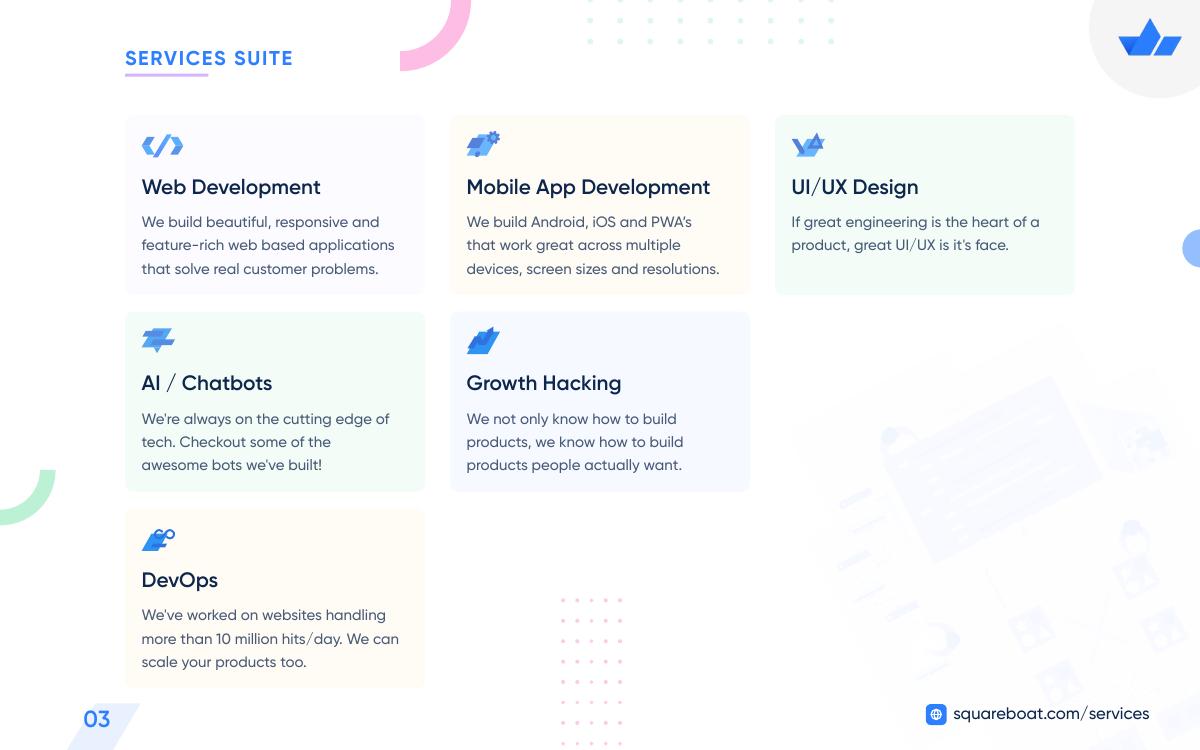
Six service lines: web development, mobile app development, UI/UX design, AI/chatbots, growth hacking, and DevOps. Each gets one line of copy. The DevOps line carries the only real proof point on the slide — "we''ve worked on websites handling more than 10 million hits/day."
This is where a capabilities deck starts to fight itself. Six service lines reads as capability to a client and as a lack of focus to an investor. Breadth sells services; depth sells equity.
Slides 5–7 — Key clients, with outcomes
Three slides of named work, each with a specific outcome rather than a logo alone:
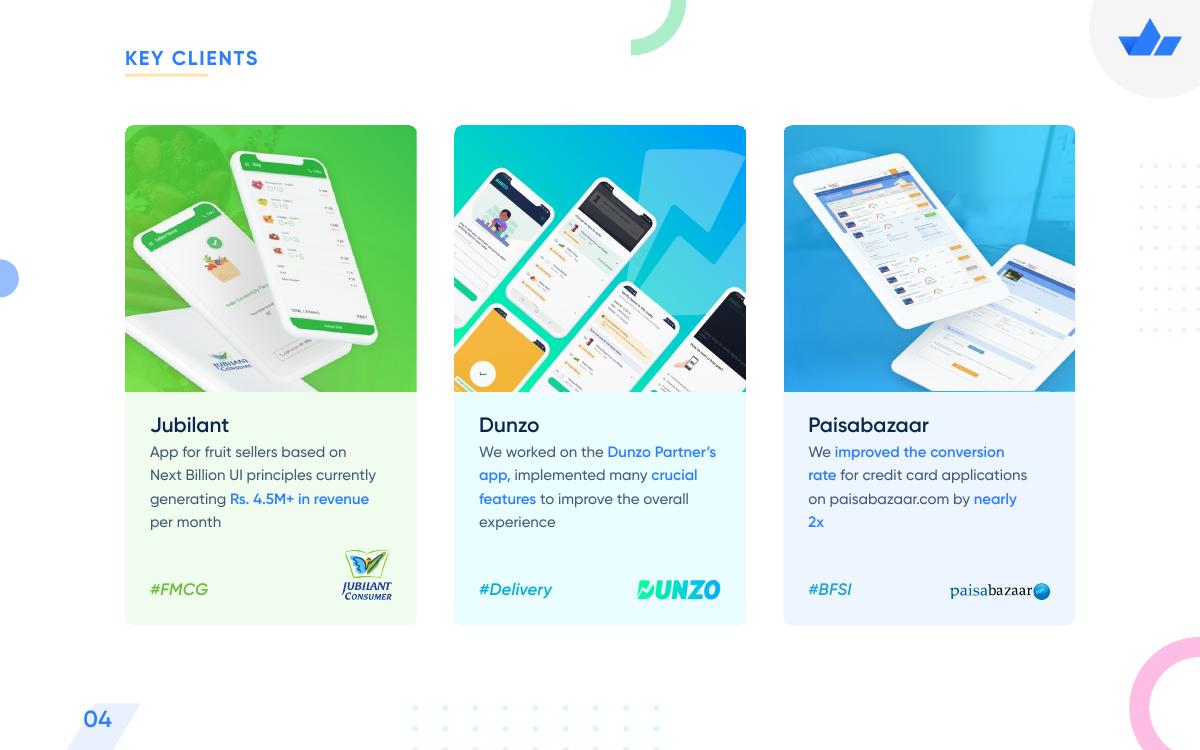
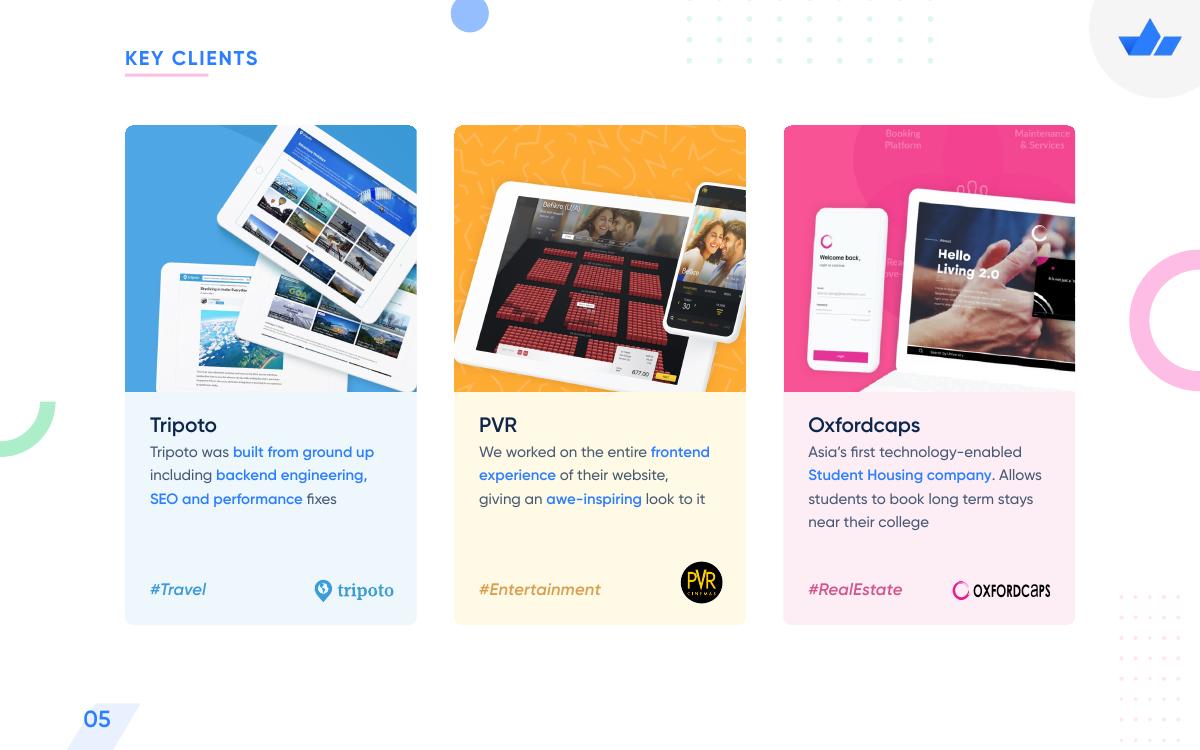
Jubilant — an app for fruit sellers built on Next Billion UI principles, described as generating Rs. 4.5M+ in revenue per month. · Dunzo — work on the Dunzo Partner app, adding features to improve the delivery partner experience. · Paisabazaar — credit card application conversion rate improved by nearly 2x. · Tripoto — built ground-up, including backend engineering, SEO and performance. · PVR — the entire frontend experience of the cinema chain''s website. · Oxfordcaps , iDreamCareer , Inlingua , Jamboree — student housing, career assessment at government-school scale, and test-prep platforms.
These are the best slides in the deck and the ones most startup founders should steal. Every claim is attached to a named counterparty and a measurable result. "Improved conversion by nearly 2x for Paisabazaar" is verifiable, falsifiable and specific — the three properties that make a claim persuasive rather than decorative.
Slide 8 — Client wall
Roughly forty logos in a grid: PVR Cinemas, Dunzo, Jubilant Consumer, Max Estates, Tripoto, Inlingua, LBB, Paisabazaar, Analytics Vidhya, Instamojo, Awfis, Oxfordcaps, E-Meditek, Emoha, Loco, Jamboree, Plaksha University and more.
Logo walls are the classic credibility shortcut. They work in a sales context and they are close to worthless in a fundraising context, because an investor reads a logo wall as "these are other people''s brands, not your revenue."
Slide 9 — Partners
Truecaller, Razorpay, Freshworks, Mixpanel, MSG91, Exotel, PayU, framed as partnerships that give clients exclusive commercial terms. This is a genuinely good client-side differentiator: it converts an abstract relationship into a customer benefit.
Slides 10–11 — Design services and branding
UI/UX and animation work, followed by a branding menu — logo design, business cards, letterheads, brochures, brand books, social covers, even mugs and T-shirts.
This is the weakest sequence. It moves down-market fast. A deck that opened with 10M hits/day and a 2x conversion lift ends up offering laptop stickers. The instinct — show everything we can sell — is exactly the instinct that dilutes a positioning.
Slide 12 — Squareboat Labs
Three internal products: Hackr.io (a programming course discovery community serving 2M+ users monthly), Spectrum (a real-time dashboard and mobile app for monitoring multiple AWS accounts), and Navigator (an HRMS).
This is the most commercially interesting slide in the entire document and it appears twelfth. Hackr.io alone — a product with millions of monthly users, spun out of an agency — is the single asset in this deck that could support a venture conversation. It is buried between branding collateral and an open-source list.
Slide 13 — Open source
Sneaker (exception-to-email alerting), a production-ready NestJS boilerplate, a serverless media worker, API spec best practices, a community growth-hacking guide, and NestJS Storage. Framed as a moral position rather than a marketing tactic.
For a technical buyer, this is high-signal: public code is the cheapest possible proof of engineering standards.
Slide 14 — Tech and design stack
Backend: Node.js, Python, Laravel. Frontend: React, Angular, Vue. Mobile: Android, iOS, React Native, PWA, Flutter. DevOps: AWS, Google Cloud. Design: Photoshop, Sketch, XD, After Effects, InVision.
Necessary in a services deck (procurement teams check for stack overlap), irrelevant in an investor deck.
Slide 15 — Team
Photographs of the team at work plus a line about hand-picked developers and designers. Warm, but zero information density: no named leads, no seniority mix, no retention data.
Slide 16 — Client testimonials
Four named, attributed quotes: the VP of Tech at MakeMyTrip, the Chief Product Officer at Paisabazaar, a director at Kyor / E-Meditek, and a co-founder of Tripoto.
Named, titled, company-attributed testimonials are dramatically stronger than anonymous praise. This is another slide startup founders under-use.
Slide 17 — In the press
The Economic Times, YourStory, Product Hunt and Entrepreneur coverage, largely centred on Hackr.io and the AWS monitoring tool.
Slide 18 — Contact
Entity name, website, founder email, phone, Gurugram address, Dribbble, Behance, GitHub, YouTube. Complete and unambiguous — more than many startup decks manage.
What this deck does better than most startup pitch decks
Numbers arrive on slide two. Age, headcount, project count. No warm-up. · Claims are attached to counterparties. "2x conversion for Paisabazaar" beats "we drive results" in every possible way. · Social proof is attributable. Every testimonial has a name, title and company behind it. · The founder is positioned with a timeline, not adjectives. Four employers, four dates, one arc. · Proof of engineering standards is public. Open-source repositories are checkable at zero cost to the reader. · The ask is frictionless. Every plausible contact channel is on the final slide.
Where this deck would fail in an investor meeting
None of the following are criticisms of the deck's actual job. They are the gap you have to close if you ever repurpose a document like this for fundraising.
No market sizing. An investor cannot underwrite an outcome without an addressable market. · No business model or unit economics. Nothing on pricing, blended rate, gross margin, project size or contract length. · No company revenue. The one revenue figure on the deck (Rs. 4.5M+/month) belongs to a client's app, not to Squareboat. · No growth curve. "70+ employees" is a level, not a trajectory. Investors buy slope. · No retention or concentration data. For a services business the key questions are repeat-revenue share and top-client concentration. Both are absent. · Linear scaling. A headcount-bound services model has revenue that scales with people. Venture capital prices non-linear scaling. · No competition slide. Development agencies operate in an extremely crowded market and the deck never addresses why a buyer chooses this one over the alternatives. · No ask. No round size, no use of funds, no milestones. · The best asset is buried. Hackr.io — millions of monthly users — sits on slide twelve as a side project.
Company deck vs investor pitch deck
Reader question Can you deliver for me? Can this become very large, very fast?
Proof unit Client logos, testimonials, case studies Revenue, growth rate, retention, margins
Breadth Show every service you offer Show one wedge and its expansion path
Team slide Capacity and craft Founder-market fit and why-you-win
How you would rebuild this as an investor deck
The rebuild is not a redesign — it is a change of subject. Concretely:
Lead with the product, not the agency. If Hackr.io serves 2M+ monthly users, that is the company. The services business becomes the funding mechanism that built it, mentioned in one line. · Replace the services suite with a problem slide. One specific, expensive, recurring problem for one specific buyer. · Convert the client wall into a traction chart. Monthly revenue or monthly active users over 24 months, with the actual axis labelled. · Add a business model slide. Price, gross margin, payback period, and how revenue stops being a function of headcount. · Add market sizing with a bottom-up build. Number of buyers multiplied by realistic annual contract value, not a top-down analyst number. · Add retention. For services: repeat-revenue percentage and client concentration. For product: cohort retention curves. · Compress the founder slide into founder-market fit. Not fourteen years of experience — fourteen years of experience with this exact problem . · Close with the ask. Amount, runway purchased, and the two or three milestones that money buys.
Keep three things exactly as they are: the numbers-on-slide-two discipline, the named-outcome case studies, and the attributed testimonials. Those translate to any audience.
The transferable lesson
Squareboat's deck is a good document doing an honest job. The failure mode it illustrates is not bad design — it is audience drift : a deck built for buyers being handed to investors, or the reverse. Before you send any deck, write down in one sentence who is reading it and what decision they are about to make. If the slides do not serve that one decision, they are decoration.
The original deck is embedded above so you can page through all 18 slides yourself and judge the sequencing.
Frequently asked questions
- Is the Squareboat deck a pitch deck for investors?
- No. It is a company or capabilities deck used to win development clients. It contains services, case studies, client logos, testimonials, tech stack and contact details — but no market sizing, business model, financials or funding ask, which is why it would not function as an investor pitch deck.
- What is Squareboat?
- Squareboat Solutions Private Limited is a web and mobile application development company founded in 2013 and based in Gurugram, India. The 2021 deck describes 70+ employees and 50+ projects delivered, with clients including PVR Cinemas, Dunzo, Paisabazaar, Tripoto and Jubilant Consumer.
- What does this deck do better than most startup pitch decks?
- Three things. It puts concrete numbers on the second slide before any adjectives. It attaches every case study to a named client and a measurable outcome. And every testimonial carries a name, title and company, which makes the social proof verifiable rather than decorative.
- What is the difference between a company deck and an investor pitch deck?
- A company deck proves delivery capability to a buyer and shows breadth of services, logos and testimonials. An investor pitch deck proves the potential for a large, fast-growing business and shows problem, market size, traction, business model, competition, team and a specific funding ask. Different reader, different decision, different document.
- Could an agency like Squareboat raise venture capital?
- A pure services business rarely fits the venture model because revenue scales linearly with headcount. The realistic venture path is to lead with a product built inside the agency — in this case Hackr.io, reported at 2M+ monthly users — and present the services business as the mechanism that funded it.
- Which slides should founders copy from this deck?
- The slide-two proof numbers, the client case studies with named outcomes, and the attributed testimonial slide. Skip the branding services menu, the tech stack grid and the forty-logo wall — those serve procurement, not investors.