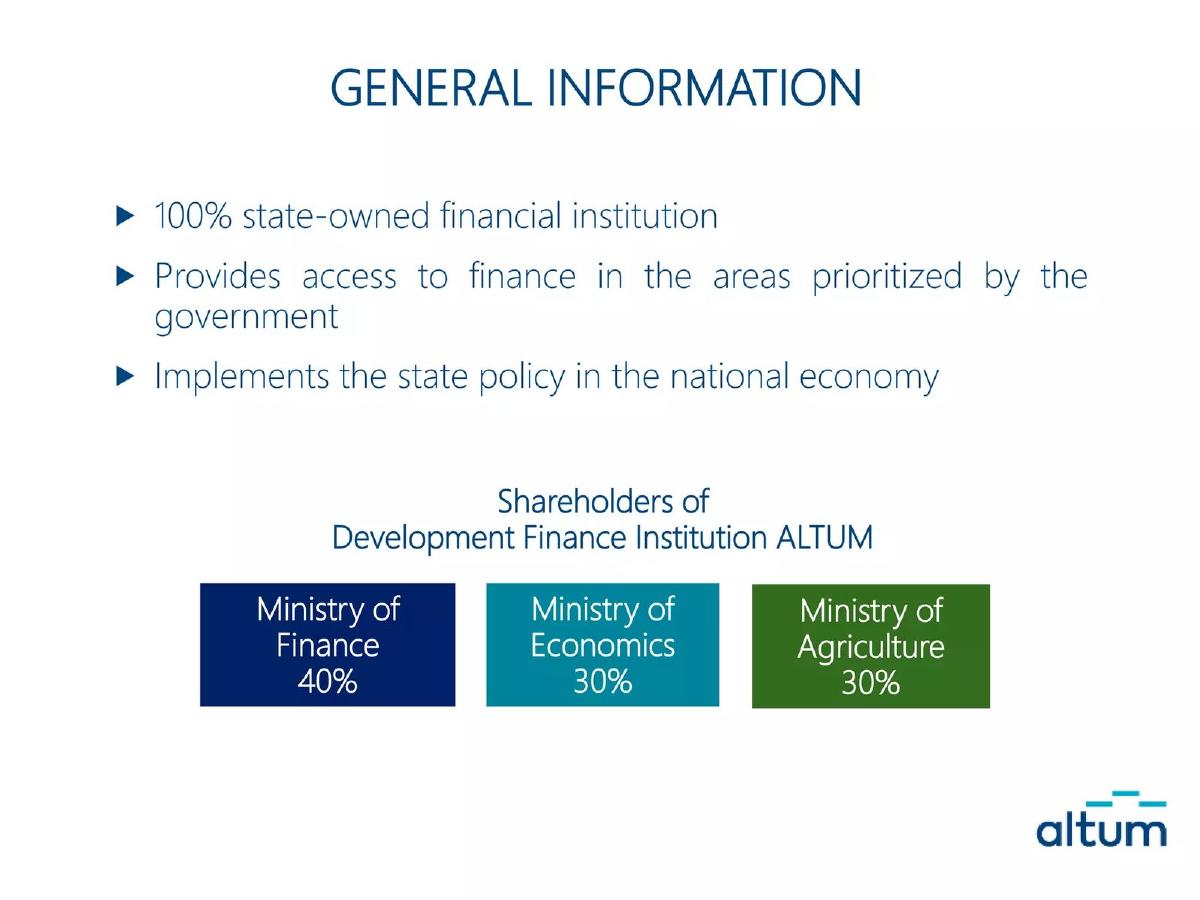
ALTUM’s 2018 investor presentation serves as a comprehensive overview of a state-owned development finance institution (DFI) rather than a traditional startup pitch. The deck emphasizes institutional stability, citing a Baa1 credit rating from Moody’s and 100% ownership by the Republic of Latvia. With a portfolio that grew by 18.1 MEUR in 2017, the institution focuses on SMEs, agriculture, and individuals, utilizing a mix of loans, guarantees, and venture capital investments. The presentation highlights a transition toward operational efficiency, including a strategic shift in funding sources…
Key takeaways
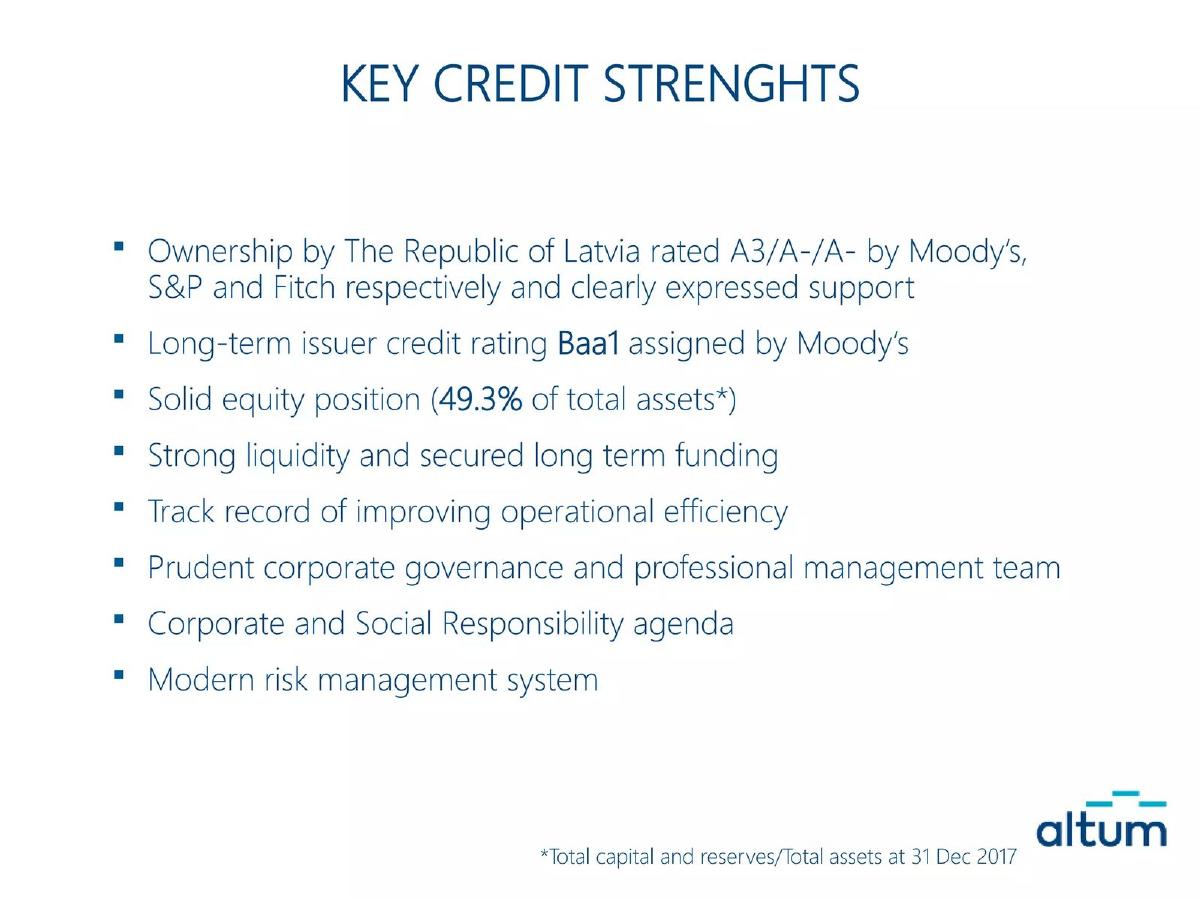
- The institution is 100% owned by the Republic of Latvia, which holds A3/A-/A- ratings from Moody’s, S&P, and Fitch (Slide 2).
- ALTUM maintains a long-term issuer credit rating of Baa1 assigned by Moody’s (Slide 2).
- The equity position is significant, representing 49.3% of total assets as of December 31, 2017 (Slide 2).
- The total portfolio increased by 18.1 MEUR in 2017, with total volumes reaching 123.1 MEUR (Slide 4).
- Guarantees make up the largest portion of 2017 volumes at 56%, followed by loans at 42% and venture capital at 2% (Slide 4).
- The loan portfolio is heavily weighted toward Agriculture (47%) and SMEs/Midcaps (46%) (Slide 6).
- ALTUM manages a venture capital portfolio of 51.3 MEUR across 11 funds and 189 projects (Slide 7).
- Operational efficiency is a core focus, with a planned IT infrastructure upgrade in 2018 intended to substantially decrease costs (Slide 5).
ALTUM Investor Presentation: Institutional Stability and State-Backed Finance
The ALTUM investor presentation from April 2018 is not a typical startup pitch deck. It is a sophisticated institutional briefing for a state-owned development finance institution (DFI). The deck focuses on creditworthiness, regulatory compliance, and macroeconomic impact rather than disruptive technology or viral growth. For founders, this deck provides a clear example of how to present a business that relies on stability, risk mitigation, and large-scale asset management.
Slide 1: Title Slide
The title slide is minimalist, featuring the brand name "ALTUM," the subtitle "INVESTOR PRESENTATION," and the date "April 2018." The logo, located in the bottom right, uses a clean, sans-serif typeface with a stylized graphic above the name. The use of a solid teal background establishes a professional, corporate tone immediately.
Slide 2: Key Credit Strengths
This slide is the core value proposition for an institutional investor or lender. It lists eight bullet points that define the institution's stability. Key figures include:
Ownership: 100% ownership by The Republic of Latvia, citing sovereign ratings of A3/A-/A- from Moody’s, S&P, and Fitch. · Credit Rating: A long-term issuer credit rating of Baa1 from Moody’s. · Equity Position: A solid equity position defined as 49.3% of total assets as of 31 Dec 2017. · Operational Focus: Mentions of strong liquidity, professional management, and a modern risk management system.
Slide 3: History and Legal Background
Slide 3 explains the institutional evolution of ALTUM. It shows a merger of three entities: the Latvian Guarantee Agency, the Rural Development Fund, and the original Altum, into the "JSC Development Finance Institution Altum." The slide highlights the legal framework supporting the entity, including:
Decisions by the Cabinet of Ministers. · A "Special Law on the Single Development Institution." · Approval via a European Commission decision.
This slide serves to reassure investors that the company is a permanent fixture of the national financial infrastructure, backed by specific legislation.
Slide 4: Business Overview: Client Segments
This slide provides the first deep dive into the numbers, using bar charts to show portfolio growth and volume distribution from 2015 to 2017. Data points include:
Portfolio Growth: An increase of 18.1 MEUR in 2017. · Total Volumes: 123.1 MEUR in 2017, composed of 56% guarantees, 42% loans, and 2% venture capital. · Segment Performance: SMEs & Midcaps grew by 9% in 2017. · Project Count: 4,697 projects supported in total, including 3,219 for individuals and 751 for SMEs & Midcaps.
The slide also notes a decrease in the financial intermediaries segment due to the end of a venture capital fund investment period, showing transparency regarding fluctuating metrics.
Slide 5: New Products & Efficiency
This slide outlines the strategic roadmap for operational improvement. It uses a circular "Focus Areas" graphic highlighting New Products, Funding, Core Business, Improve Customer Service, and Operational Efficiency. Specific initiatives mentioned include:
New Products: Delegated guarantees, export credit guarantees to EU countries up to EUR 2 mln , and Land Fund’s reverse rent. · Efficiency Gains: Increasing guarantee maximum limits from EUR 1.5 mln to EUR 3 mln . · Cost Reduction: The installation of new IT infrastructure in 2018 is projected to lead to a "substantial decrease of IT costs." · Divestment: Sales of investment properties in 2017-2018 to limit non-core activities.
Slide 6: Well Diversified Portfolios
Diversification is a key theme for risk management. This slide uses pie charts to break down the loan and guarantee portfolios by industry.
Loan Portfolio: Dominated by Agriculture (47%) and SME/Midcap (46%). Within the SME/Midcap segment, Manufacturing (23%) and Trade (7%) are the largest sub-sectors. · Guarantee Portfolio: More heavily weighted toward SME/Midcap (68%) and Individuals (26%). Manufacturing (23%) and Construction (14%) are the primary industries here.
The text explicitly states that this diversification allows the institution to "withstand macro-level risk events."
Slide 7: Venture Capital: Professional Selection and Balanced Risks
This slide details ALTUM's role in the venture capital ecosystem. It uses a staircase graphic to show the progression from Acceleration Funds to Expansion Capital Funds.
Total VC Portfolio: 51.3 M EUR across 189 projects and 11 funds. · Expansion Capital: The largest segment with 36.6 MEUR and 76 projects. · Seed Capital: 4.5 MEUR across 91 projects. · Governance: The slide notes that investment decisions are made by "publicly procured" professional fund managers and ticket sizes are limited to 11% for diversification.
Slide 8: Contact Slide
The final slide is a simple teal screen with the website address "www.altum.lv" and the company logo. It lacks specific names, phone numbers, or email addresses for the management team, which is a common omission in high-level institutional decks intended for broad distribution.
What ALTUM Does Well
The deck excels at communicating institutional credibility . By leading with sovereign credit ratings and a Baa1 issuer rating, ALTUM immediately addresses the primary concern of any institutional lender: the risk of default. The use of audited 2017 figures (as noted in the footer of slide 2) adds a layer of reliability that many early-stage decks lack.
The segmentation of data is also a strength. By breaking down the portfolio not just by volume, but by client type (SME, Agriculture, Individuals) and by instrument (Loans, Guarantees, VC), ALTUM demonstrates a granular understanding of its own business. This level of detail suggests a sophisticated internal reporting system, which further builds investor confidence.
What is Missing from the ALTUM Deck
The most notable omission is a detailed team slide . While slide 2 mentions a "professional management team," there are no bios, photos, or names of the executives leading the institution. In the context of a state-owned entity, the specific individuals may be seen as less critical than the legal and sovereign backing, but for a private investor, the lack of leadership transparency is a gap.
There is also a lack of forward-looking financial projections . The deck focuses heavily on 2017 performance and 2018 strategic initiatives, but it does not provide a 3-to-5-year financial forecast. While DFIs often operate on different timelines than private equity, a projection of portfolio growth and expected returns would be standard in a fundraising context.
Finally, the "Ask" is undefined . The deck is titled an "Investor Presentation," but it does not specify if they are looking to issue new bonds, seek equity partners, or simply provide an annual update. Without a clear call to action or a specific funding requirement, the deck functions more as a corporate brochure than a fundraising tool.
Lessons for Founders
Founders can learn a great deal from ALTUM's approach to risk communication . Most startups focus entirely on the upside; ALTUM focuses on the downside protection . By showing how their portfolio is diversified across industries (Slide 6) and how they limit ticket sizes in venture capital (Slide 7), they demonstrate a "prudent" approach that appeals to conservative capital.
Another lesson is the effective use of legal and regulatory status as a competitive moat. ALTUM doesn't just say they are stable; they cite the specific "Special Law" and "European Commission decision" that guarantees their existence. If your startup has a unique regulatory advantage or a specific patent, it should be presented with this level of formal authority.
Lastly, the deck shows how to quantify operational efficiency . Rather than saying "we are getting better," ALTUM points to specific actions: selling non-core investment properties and installing new IT infrastructure to "substantially decrease IT costs." This turns a vague promise into a measurable business objective.
Frequently asked questions
- What is ALTUM's primary business model?
- ALTUM operates as a state-owned development finance institution. Its model involves providing financial instruments such as loans, guarantees, and venture capital investments to segments that the private market may underserved. According to slide 4, their 2017 volume was split between guarantees (56%), loans (42%), and venture capital (2%), focusing on SMEs, agriculture, and individual projects aligned with Latvian government priorities.
- How does ALTUM manage its risk and credit profile?
- ALTUM leverages its status as a state-owned entity, citing the Republic of Latvia's sovereign ratings as a primary credit strength. Slide 2 notes a Baa1 rating from Moody's and a solid equity position of 49.3% of total assets. They also utilize a 'modern risk management system' and professional fund managers for venture capital decisions to maintain a balanced risk profile across their diversified portfolios.
- What are the key growth drivers mentioned in the deck?
- Growth is driven by state aid implementation priorities and specific sector expansion. Slide 4 identifies SMEs and Midcaps as the fastest-growing segment, increasing by 9% in 2017. Additionally, slide 5 outlines 'Focus Areas' for growth, including new products like delegated guarantees, export credit guarantees up to EUR 2 million, and Land Fund reverse rent, alongside streamlined internal processes.
- Who are ALTUM's main clients?
- The client base is divided into four primary segments: SMEs and Midcaps, Agriculture, Individuals, and Financial Intermediaries. Slide 4 shows that in 2017, they supported 4,697 projects, with the highest number of projects (3,219) belonging to individuals, though SMEs and Agriculture represent the largest portions of the portfolio by volume.
- What is the structure of ALTUM's venture capital operations?
- ALTUM acts as a fund-of-funds or direct investor across the business lifecycle. Slide 7 illustrates a 51.3 MEUR portfolio covering Acceleration Funds, Seed Capital Funds, Venture Capital Funds, and Expansion Capital Funds. They emphasize that investment decisions are made by publicly procured professional fund managers, with ticket sizes kept within a diversified range of up to 11%.