Amagi’s 18-slide deck from their 2022 Series F round is a highly technical, product-centric document designed for investors who already understand the shift from linear broadcast to cloud-based OTT. Rather than focusing on a problem/solution narrative, the deck leads with massive scale: 100+ platforms, 2,000+ channels, and 25 billion ad opportunities. It meticulously maps out a complex value chain—from content creation (Cloudport) to monetization (Thunderstorm). While it lacks traditional venture deck elements like a team slide, financial projections, or a specific 'ask,' it succeeds by showc…
Key takeaways
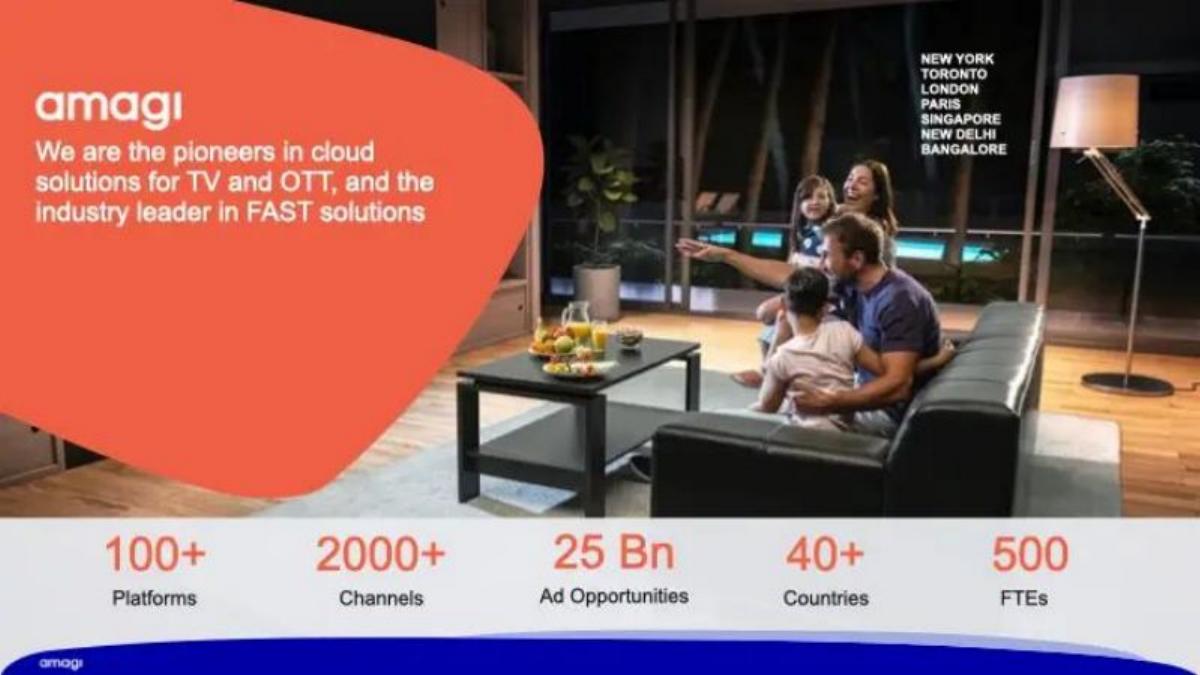
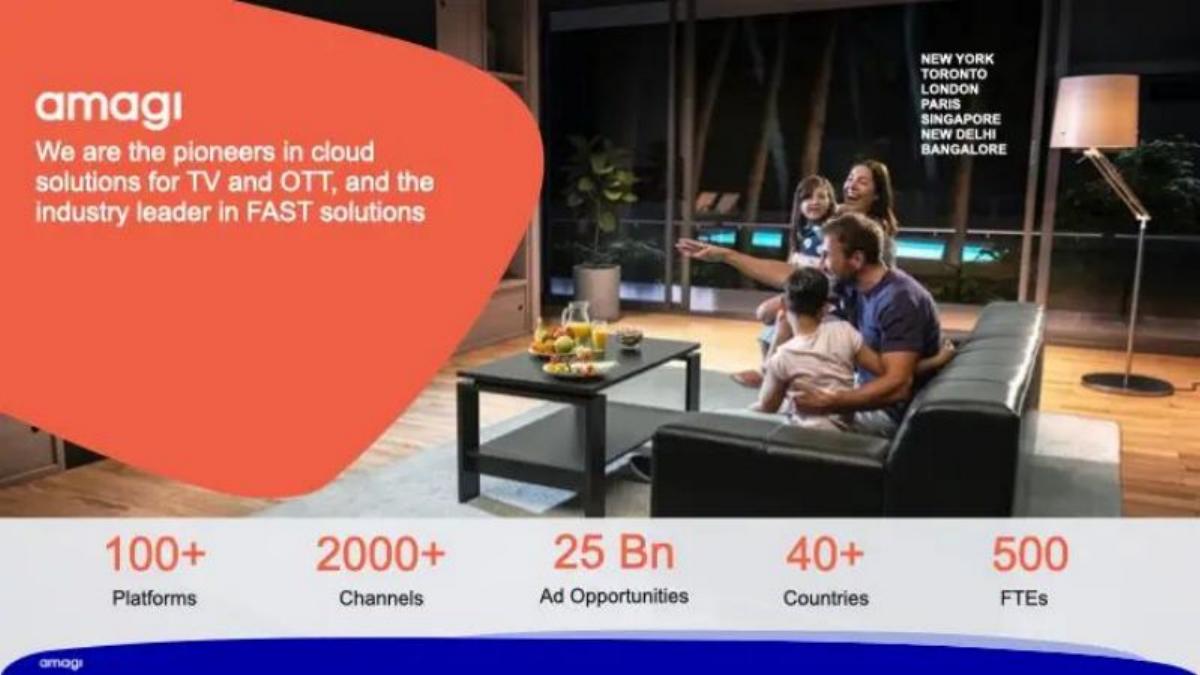
- The deck leads with massive scale metrics, citing 2,000+ channels and 25 billion ad opportunities on Slide 1.
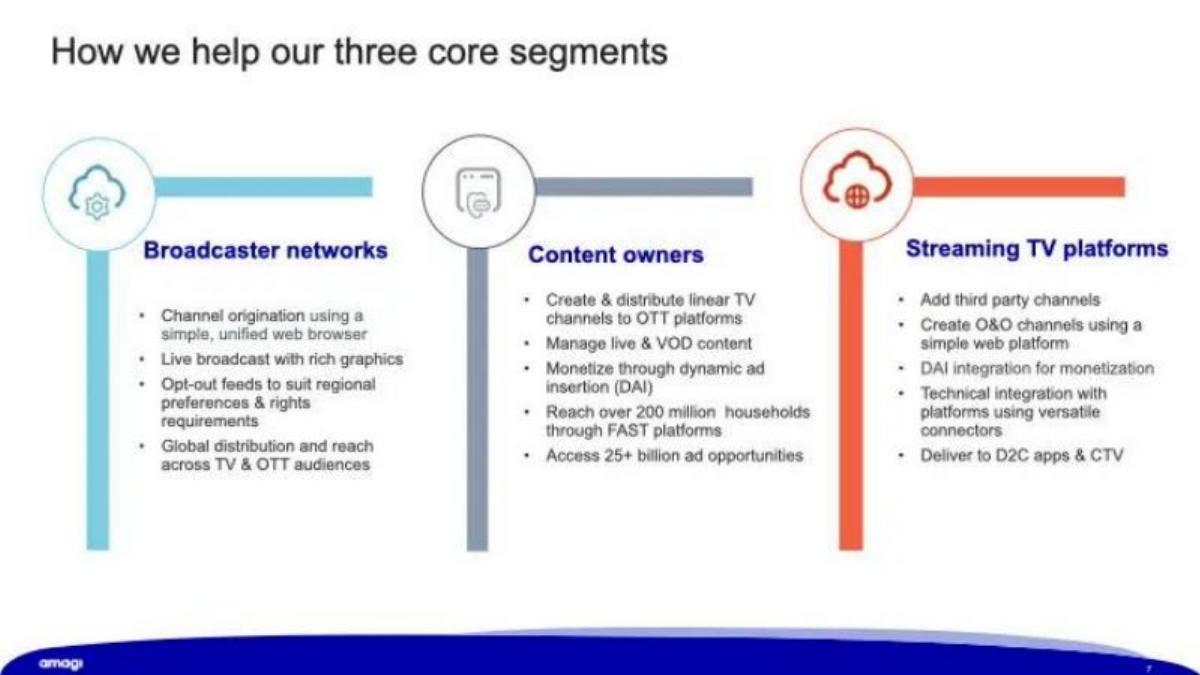
- Amagi positions itself as a 'B2B2C' infrastructure play, connecting content owners to over 200 million households (Slide 7).
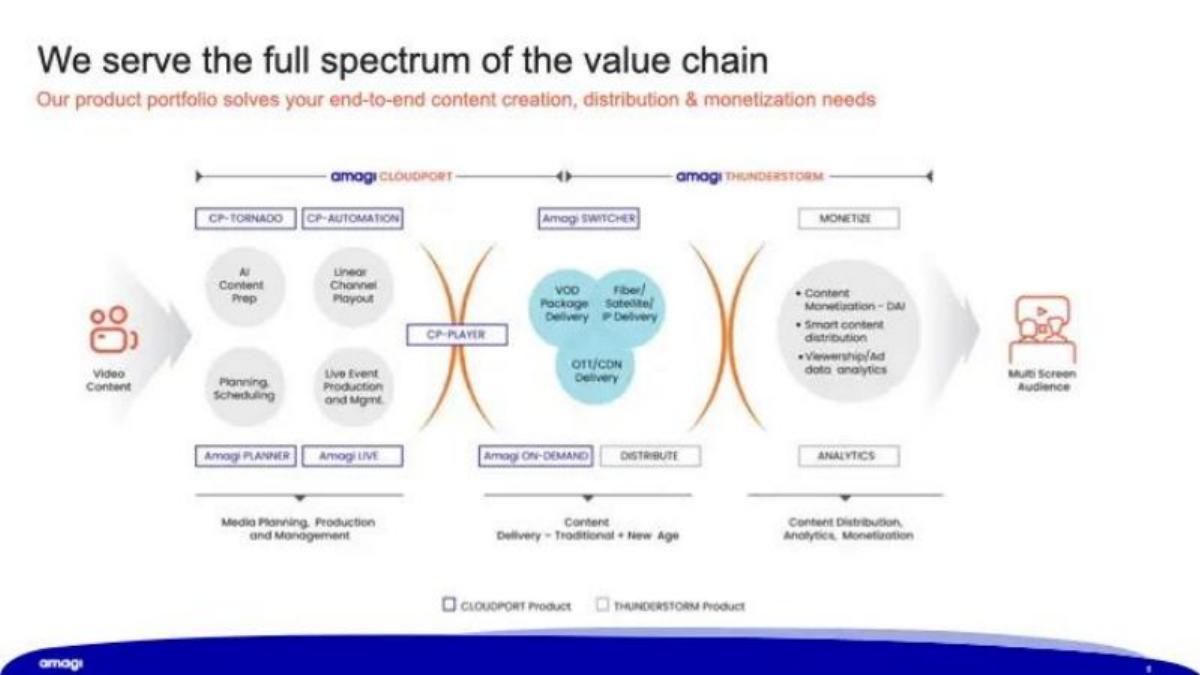
- The company demonstrates a comprehensive product suite covering the entire media value chain: creation, distribution, and monetization (Slide 6).
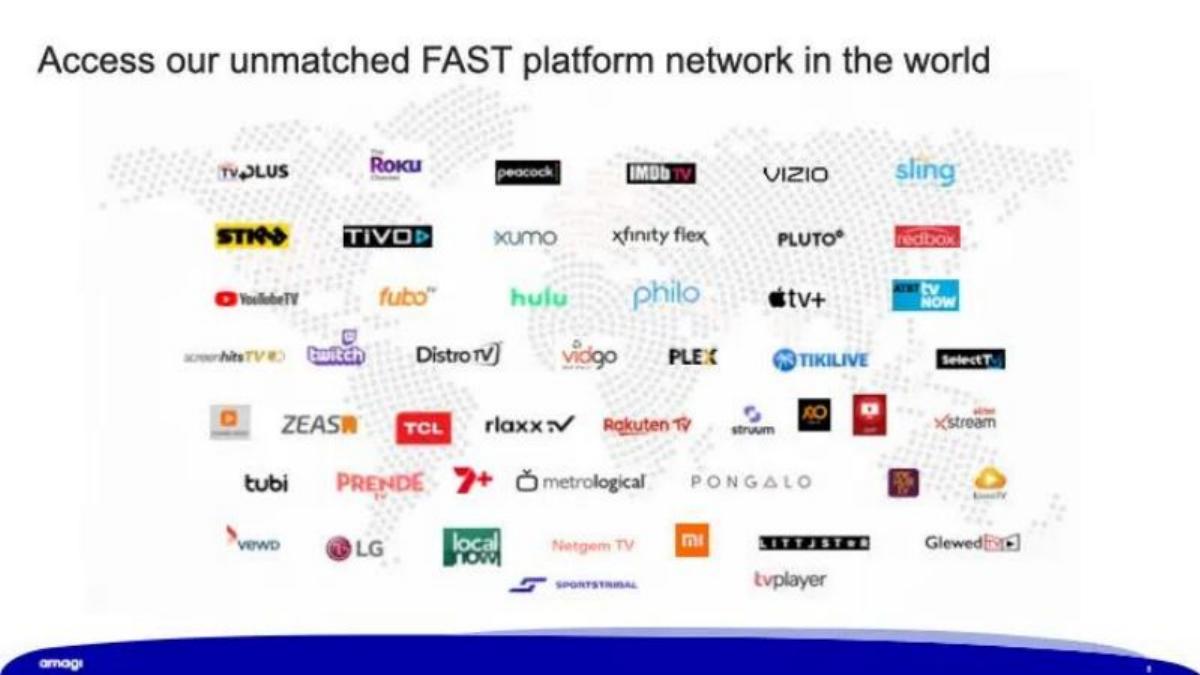
- A powerful 'logo wall' on Slide 8 showcases an 'unmatched FAST platform network' including global giants like Hulu, Peacock, and YouTube TV.
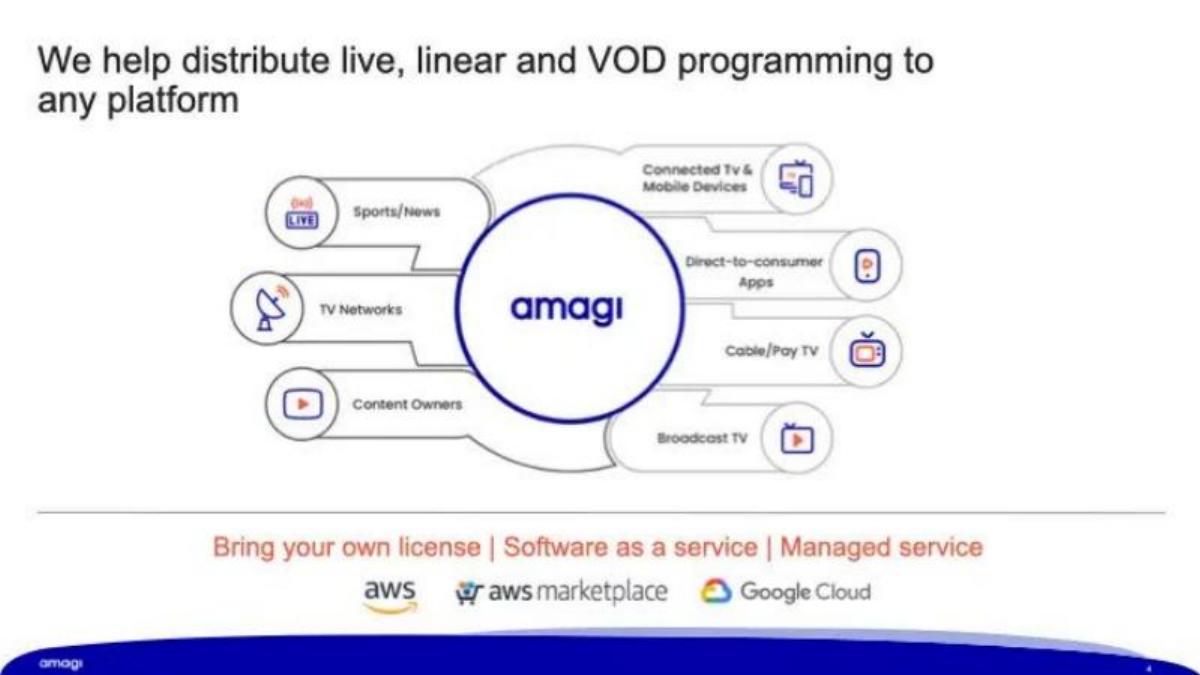
- The deck emphasizes technical versatility, supporting live, linear, and VOD programming across AWS and Google Cloud (Slide 4).
- Monetization is a core pillar, with the 'Thunderstorm' product offering server-side ad insertion (SSAI) and ML-based ad-point detection (Slide 18).
- Specific vertical solutions for Sports and News automation are highlighted to show depth in high-value live broadcasting (Slides 13-16).
- The deck completely omits a team slide, financial history, competition analysis, and the specific funding ask.
Executive Summary and Market Scale
Slide 1: Title and Global Presence
Amagi opens with a bold claim: "We are the pioneers in cloud solutions for TV and OTT, and the industry leader in FAST solutions." The slide establishes immediate credibility through five key metrics: 100+ Platforms, 2000+ Channels, 25 Billion Ad Opportunities, 40+ Countries, and 500 FTEs (Full-Time Employees). It also lists global office locations including New York, London, Paris, Singapore, and New Delhi, signaling a mature, international operation.
Slide 4: Distribution Capabilities
This slide illustrates Amagi's role as a central hub. It shows content flowing from Sports/News, TV Networks, and Content Owners through the Amagi core into various endpoints: Connected TV, D2C Apps, Cable/Pay TV, and Broadcast TV. Crucially, it notes their cloud-agnostic nature, highlighting partnerships with AWS, AWS Marketplace, and Google Cloud, and defining their service models as SaaS and Managed Services.
The Value Proposition and Value Chain
Slide 5: Our Value Proposition
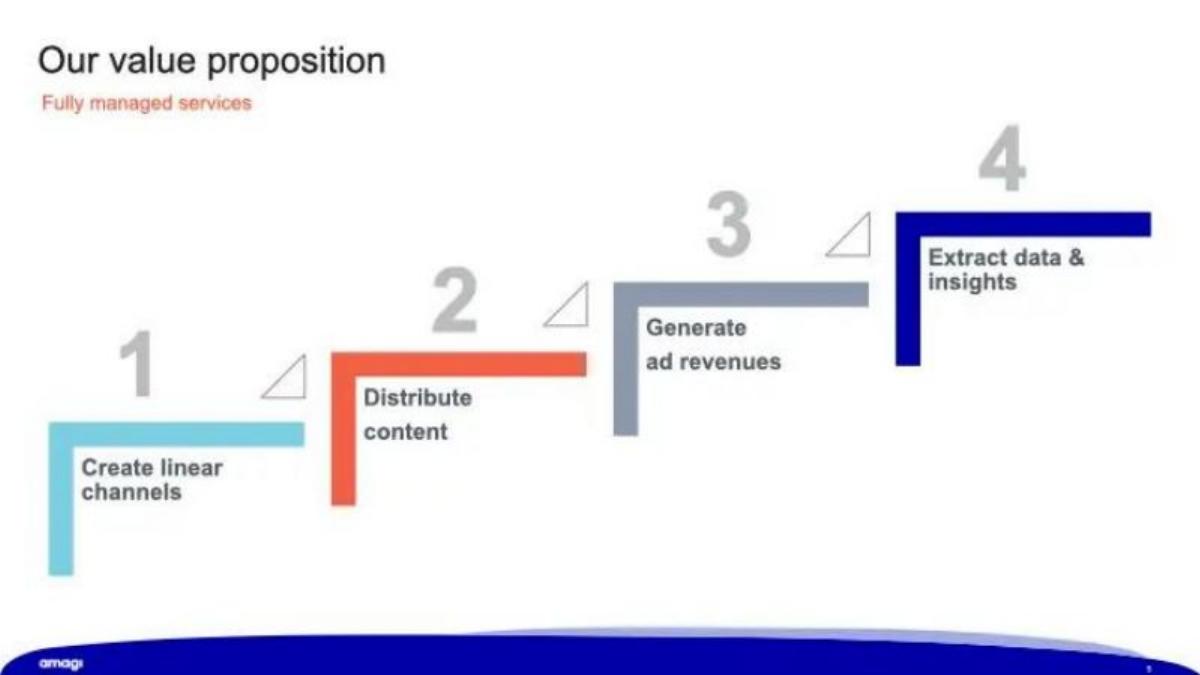
Amagi breaks down its value into a four-step linear process: 1. Create linear channels, 2. Distribute content, 3. Generate ad revenues, and 4. Extract data & insights. This simplicity is intended to demystify a highly technical backend process for investors.
Slide 6: The Full Spectrum Value Chain
This is one of the most complex slides in the deck, mapping the product portfolio to the content lifecycle. It introduces the "Cloudport" and "Thunderstorm" product lines. The chain moves from Video Content through Media Planning (Amagi Planner/Live), to Content Delivery (Amagi On-Demand), and finally to Distribution and Analytics (Thunderstorm). It positions Amagi as an end-to-end solution rather than a point product.
Slide 7: Core Segments
The deck identifies three primary customer personas: Broadcaster Networks (focusing on regionalization and cloud origination), Content Owners (focusing on reaching 200 million households via FAST), and Streaming TV Platforms (focusing on adding third-party channels and DAI integration). This slide defines the "B2B2C" nature of the business.
The Partner Ecosystem
Slide 8: The FAST Platform Network
This slide is a visual proof point of market dominance. It features a "logo wall" of dozens of partners, including high-profile names like Roku, Peacock, Hulu, YouTube TV, Samsung TV Plus, Vizio, and Sling. By labeling this network as "unmatched," Amagi suggests that any content owner wanting global scale must go through their pipes.
Product Deep Dives: Cloudport and Live Orchestration
Slide 10: Amagi CLOUDPORT
The deck transitions into specific product features. CLOUDPORT is described as the "World’s most advanced Cloud-based channel automation & playout platform." Key features listed include multichannel playout, template-based dynamic graphics, and support for 4K UHD. The stated benefits are speed to market and high reliability.
Slide 11: Amagi PLANNER
Focusing on the operational side, this product aims at "making scheduling simpler & quicker." It features a monthly calendar view, automatic break insertion, and repeat content wheels. The benefit claim is that it allows users to "schedule in minutes not hours."
Slide 12: Amagi LIVE
This slide highlights the platform's capability for "broadcast grade live sports/news orchestration." It emphasizes low latency, frame-accurate live controls, and "Automated Live to VOD" capabilities, which are critical for time-sensitive media.
Vertical Specialization: Sports and News
Slides 13-14: Sports Automation and Graphics
Amagi targets the high-value sports vertical by showcasing features like regional blackouts, live recording, and SCTE (Society of Cable Telecommunications Engineers) standards support. Slide 14 demonstrates "Sports graphics at its best," showing picture-in-picture commercials and live source overlays, proving the software can handle the visual complexity of modern sports broadcasts.
Slides 15-16: News Automation and Graphics
Similar to the sports section, these slides focus on efficiency in news production. Features include hub-and-spoke operations, live news tickers, and weather widgets. Slide 15 includes logos from Tegna, Yahoo Finance, and NBC LX, showing existing traction in the news sector.
Monetization and Advanced Ad Tech
Slide 17: Amagi ON-DEMAND
This slide covers the VOD (Video on Demand) asset processing workflow. It highlights an integrated workflow engine for "hot deployment" and transcoding capabilities for multiple output formats, ensuring content is ready for any platform's specific requirements.
Slide 18: Amagi THUNDERSTORM
This is the monetization engine. It is described as a "Fully managed ad-monetization-as-a-service." Technical features include Server-Side Ad Insertion (SSAI), ML-based mid-roll detection, and real-time analytics. It claims to help clients "Access 25+ billion ad opportunities."
Slide 19: Support for New Ad Formats
Amagi demonstrates its forward-looking tech by showing Dynamic Brand Insertion (DBI). This allows for 2D or 3D products to be composited into a scene after filming for a "natural look & feel." It also covers graphic overlay ads and contextual targeting, showing how they increase the value of a content library without interrupting the viewer experience.
Data and Managed Services
Slide 20: Amagi ANALYTICS
The final product slide focuses on viewership and ad analytics. It promises metrics for any region, device, or channel, and a "CCU graph" for concurrent users. The goal is to provide foresight into revenue planning and viewership patterns.
Slide 21: Amagi Managed Services Platform
The deck concludes with the human element of their SaaS offering: 24x7 tech support and monitoring. It shows "Cloud smart video pods" used by Amagi operators to ensure "error-free monitoring with the highest SLA."
What Amagi Does Well
Scale as a Moat: By leading with 2,000+ channels and 25 billion ad opportunities, the deck immediately signals that Amagi is the infrastructure of the FAST movement, not just a participant. · Granular Product Detail: For a Series F round, investors need to see the "how." The detailed feature lists for Cloudport, Thunderstorm, and Live show a deeply entrenched product that would be difficult for a competitor to replicate overnight. · Vertical Expertise: Dedicating four slides specifically to Sports and News (Slides 13-16) shows they understand the unique technical requirements of the most profitable segments of television. · Visual Proof: The use of actual UI screenshots (Slides 10, 11, 12, 17, 20, 21) gives the product a sense of reality and maturity.
What is Missing from the Amagi Deck
The Team: There is no mention of the founders or the executive leadership team. At Series F, while the business is the star, the people scaling it still matter. · Financials: The deck is entirely devoid of revenue figures, ARR growth, burn rate, or unit economics. While these were likely in a separate data room, their absence in the main deck is notable. · Competition: There is no competitive landscape slide. Amagi presents itself as the "industry leader" without acknowledging other cloud playout or SSAI providers. · The Ask: The deck does not state how much they are raising (though the catalogue facts state $95M) or what the specific use of proceeds will be.
What Other Founders Should Copy
The "Logo Wall" Strategy: Slide 8 is a masterclass in using partner logos to prove market fit. If you have a platform play, showing the breadth of your ecosystem is more powerful than any growth chart. · Value Chain Mapping: Slide 6 is an excellent way to show how multiple products fit together to solve a complex, multi-stage problem for a customer. · Feature-Benefit Pairing: Throughout the product slides (10, 11, 12, 17, 18), Amagi consistently lists technical features on the left and business benefits on the right. This ensures that both the CTO and the CFO of a potential investor understand the value. · Metric-Driven Intro: Starting with hard numbers (Slide 1) sets a high-bar tone for the rest of the presentation. It forces the investor to take the company seriously from the first five seconds.
Frequently asked questions
- What is the primary business model described in the Amagi deck?
- Amagi operates as a SaaS and managed services provider for the media industry. According to Slide 4, they offer 'Bring your own license,' 'Software as a service,' and 'Managed service' models. They facilitate the distribution and monetization of live, linear, and VOD content for broadcaster networks, content owners, and streaming platforms.
- How does Amagi demonstrate market dominance?
- Amagi uses high-volume metrics and a massive partner ecosystem. Slide 1 lists 100+ platforms, 2,000+ channels, and 500 FTEs. Slide 8 provides a visual 'unmatched' network of FAST platforms, featuring nearly every major global streaming player, which serves as a proxy for market share and reliability.
- What are the core products mentioned in the deck?
- The deck highlights several key products: Amagi CLOUDPORT for channel automation (Slide 10), Amagi PLANNER for scheduling (Slide 11), Amagi LIVE for sports/news orchestration (Slide 12), Amagi ON-DEMAND for VOD processing (Slide 17), and Amagi THUNDERSTORM for OTT ad monetization (Slide 18).
- Does the deck explain how Amagi makes money for its clients?
- Yes, monetization is a recurring theme. Slide 18 details the 'Thunderstorm' service, which uses Server-Side Ad Insertion (SSAI) and ML-based mid-roll detection to monetize content. Slide 19 further explains 'New ad formats' like dynamic brand insertion (2D/3D product placement) and graphic overlay ads.
- What is missing from this Series F pitch deck?
- This is a product-heavy deck that omits several standard fundraising elements. There is no slide dedicated to the founding team or leadership, no financial performance data (revenue, ARR, or growth rates), no competitive landscape analysis, and no 'The Ask' slide detailing how the $95M will be spent.