This teardown analyzes MySQL's legendary 2003 Series B pitch deck, which secured $16 million despite its massive 185-page length. It highlights how MySQL leveraged a dual-licensing model and a community of 4 million users to disrupt the database oligopoly held by Oracle and IBM. The deck serves as a masterclass in turning open-source ubiquity into a bankable enterprise asset through strategic market framing and a phased land-and-expand sales strategy.
Key takeaways
- Weaponize your community as a GTM engine to build a bottom-up adoption model that requires minimal sales spend.
- Solve for distribution first and monetization second by focusing on ubiquity before aggressively harvesting revenue.
- A 'good enough' product with a 10x cost advantage can successfully unseat complex, expensive, and bloated incumbents.
- Frame your competition as the overpriced, slow-moving old guard to create a compelling narrative of market disruption.
- Commercial open source requires a clear licensing firewall, like dual-licensing, to convert free users into paying customers.
Executive Summary: The Cathedral, The Bazaar, and The Bank
The 2003 MySQL pitch deck is a seminal document in the history of startups, not just for its success but for the model it championed. This wasn't a pitch for an app; it was a pitch for a fundamental disruption of the enterprise software business model. In a world still reeling from the dot-com bust, Mårten Mickos and the MySQL team walked into Benchmark and Index Ventures with a 185-page tome and a wild proposition: we give our core product away for free, have a tiny fraction of the market's revenue, and we're going to take on Oracle. They walked out with $16 million.
This deck is a masterclass in weaving a narrative of inevitability. It leverages the burgeoning power of open-source as an economic force, positioning MySQL not as a scrappy startup, but as the commercial entity bringing order and monetization to a massive, existing grassroots movement. The strategy rested on a brilliant dual-licensing model that turned a community into a go-to-market engine and a free product into a billion-dollar asset. While the deck itself is a relic of a different era—bloated, repetitive, and more business plan than pitch—the strategic thinking inside is timeless. It's the story of how to weaponize a community, commoditize your competitor's core value, and build a cathedral of commercial enterprise on the foundation of a bustling bazaar.
Historical Context: A Post-Bubble World Hungry for Disruption
To understand why this deck worked, you must transport yourself to 2003. The air was thick with the smoke of the dot-com crash. Lavish IT budgets were a thing of the past. CIOs were under immense pressure to cut costs, not to experiment with unproven, expensive technology. The database market was an oligopoly controlled by three giants: Oracle, IBM (with DB2), and Microsoft (with SQL Server). These were the undisputed kings, commanding over 80% of the market with high-margin software licenses that cost fortunes and locked customers into their ecosystems. They were powerful, profitable, and complacent.
Simultaneously, a paradigm shift was occurring in the server room. Linux was gaining serious enterprise credibility, proving that open-source software could be robust, secure, and reliable for mission-critical applications. This created a Trojan horse for other open-source technologies. The 'LAMP' stack (Linux, Apache, MySQL, PHP/Perl/Python) was becoming the de facto standard for building dynamic websites, powering a new generation of web companies like Yahoo! and Google. MySQL wasn't an unknown quantity; it was the silent engine of the recovering internet economy. The market didn't need to be convinced that MySQL worked. It needed to be convinced that MySQL AB, the company, was a viable, bankable vendor capable of supporting enterprise needs.
Slide-by-Slide Analysis: Deconstructing the 185-Page Tome
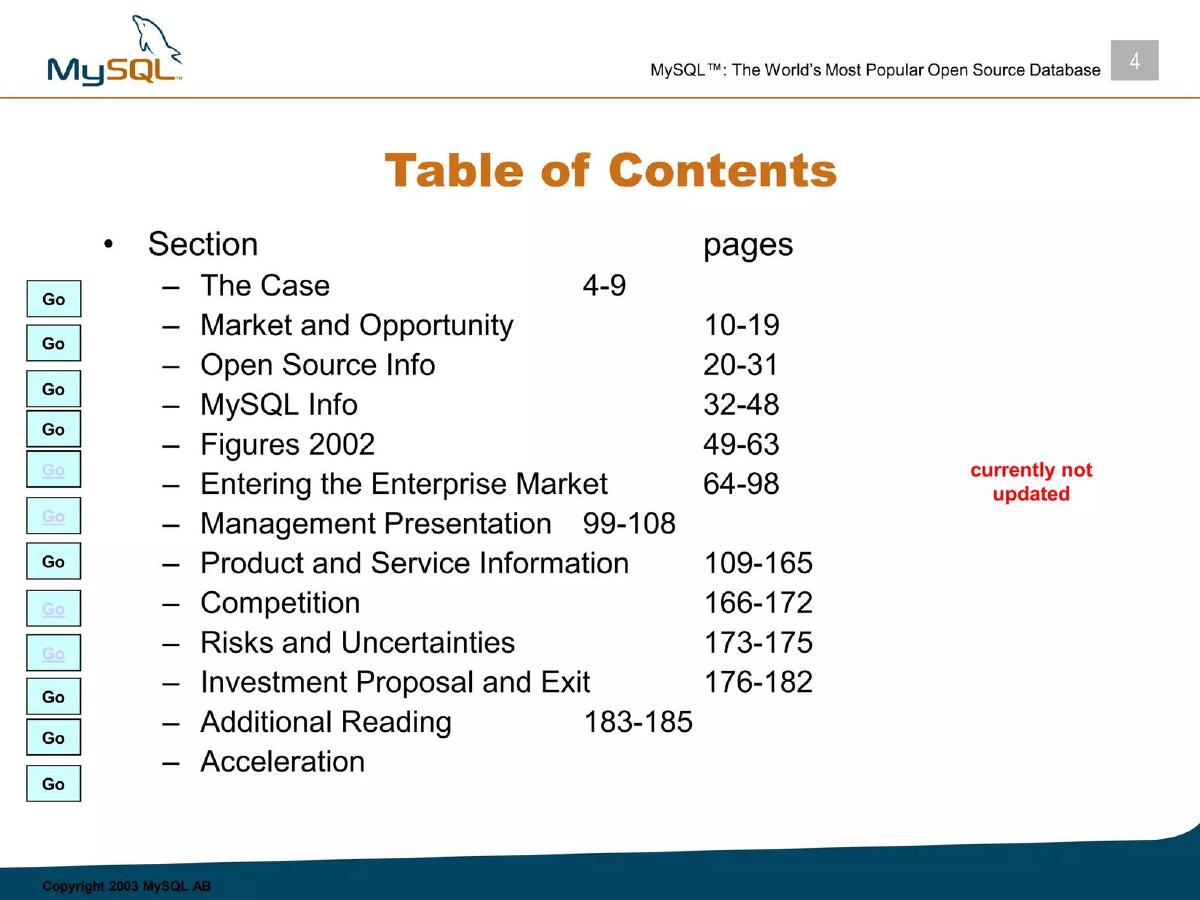
Calling this a 'slide-by-slide' analysis is a misnomer; no one can sanely analyze all 185 slides. The deck is structured more like a detailed business plan or a book, with a table of contents spanning multiple sections. We will focus on the core narrative threads that made the investment case compelling.
The Case (Slides 5-10): Framing the Inevitable
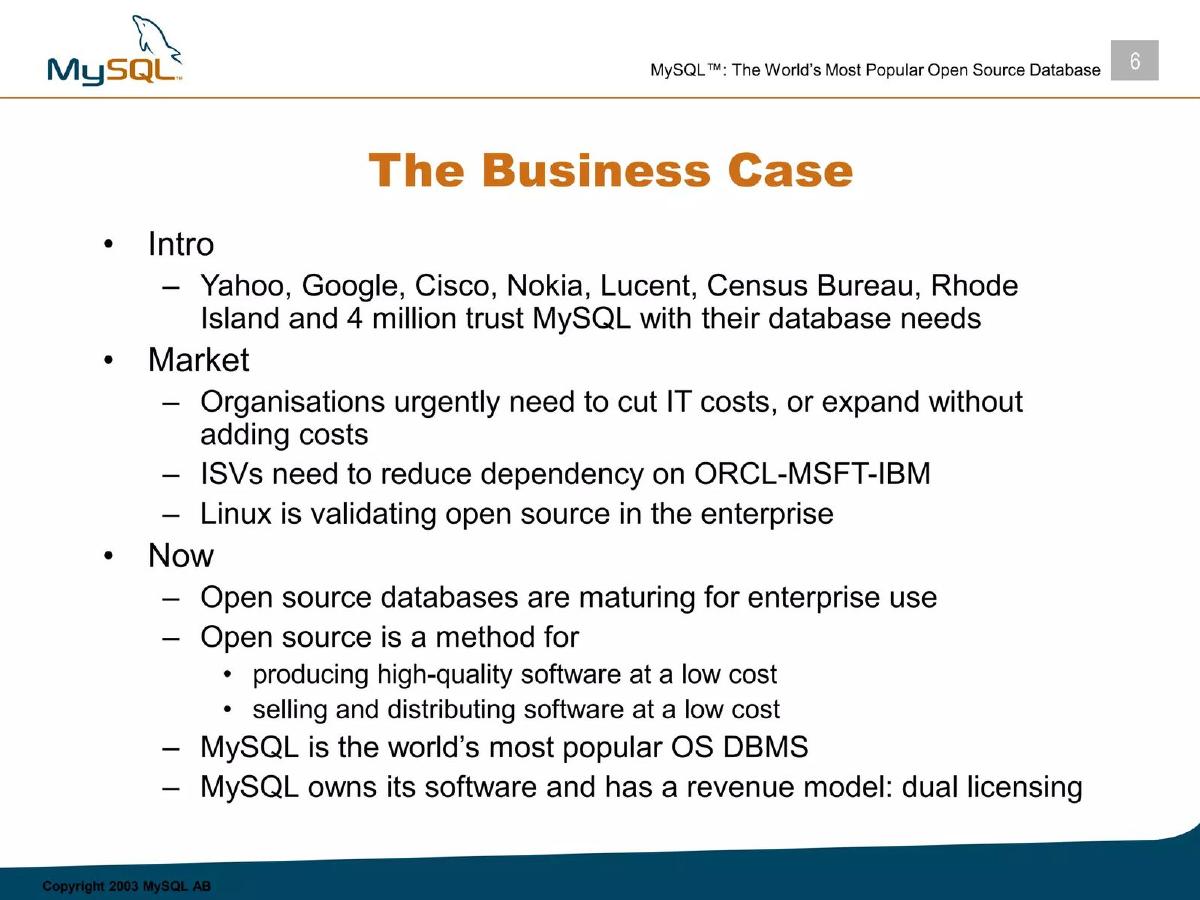
The deck opens not with a product feature, but with a powerful statement of market reality. The 'Business Case' section is a concise argument for why MySQL's time has come. It hits three key points:
Social Proof: It immediately name-drops tech giants like Yahoo, Google, and Cisco. This isn't just logo-dropping; it's a strategic move to preemptively answer the question, "Is this a toy database?" By showing that the world's most demanding tech companies trust MySQL, they establish enterprise-grade credibility from the outset. · Macro Tailwinds: The deck highlights a universal pain point: "Organisations urgently need to cut IT costs." This wasn't a niche problem; it was the defining business challenge of the era. It also cleverly aligns MySQL with the rising tide of Linux, effectively borrowing credibility and momentum from the entire open-source movement. · The Unique Position: Slide 6 crystalizes the thesis. Open-source databases are maturing. Open-source is a better way to build and distribute software. MySQL is the most popular. And crucially, "MySQL owns its software and has a revenue model: dual licensing." This is the hook. They are not just another open-source project; they are a business with a proprietary advantage built on an open platform.
The argument culminates in a simple but powerful declaration on slide 8: "We are the only ones who can meet the economic desires of the market while being profitable." This is the core of a disruptive innovation pitch: the incumbent's business model makes it impossible for them to compete on price without destroying their own margins, leaving the field wide open for a new entrant.
Market & Opportunity (Slides 11-21): The $9B Whale Hunt
This section is a brilliant piece of market framing. Rather than presenting a generic TAM slide, MySQL dissects the market in a way that perfectly suits its go-to-market strategy. Slide 15 is the money shot: "MySQL owns 0.02% of the market by revenue... MySQL commands an estimated 20% by installed base."
This single data point flips the script. To the incumbents, MySQL is an irrelevant rounding error on their P&L. To an investor, it's a massively de-risked market entry. The hard part—getting the product into the hands of millions of users and developers—is already done. The challenge is no longer distribution, but monetization.
The deck's segmentation of the market into Web ($2B), Embedded ($1B), and Enterprise ($6B) is a strategic masterstroke. It's a phased battle plan. They already dominate the 'Web' database market. The funding is to help them 'Acquire Leadership' in Embedded and 'Enter Select Segments' of the lucrative Enterprise market. This shows investors a clear, pragmatic path to capturing a piece of the $6B prize, starting from a position of strength. The use of quotes from Bloomberg, ComputerWorld (Scott McNealy of Sun Microsystems!), and the San Francisco Chronicle serves as validation from the market itself. It's not just MySQL saying this; the world is waking up to the trend.
Open Source & Business Model (Slides 22-40): The Dual-Licensing Masterstroke
Here, the deck dives into its secret weapon. Many investors in 2003 were still skeptical of open-source as a business. How do you make money when you give the product away? MySQL's answer was elegant and defensible.
Cathedral and Bazaar (Slide 23): This is a nod to Eric S. Raymond's famous essay, but MySQL gives it a commercial twist. The 'Bazaar' is the global community of millions of users who download, test, and debug the software for free, creating a "massively parallel testing" environment (Slide 40) that no proprietary vendor could afford. The 'Cathedral' is MySQL AB, the company that owns the copyright and trademark. They are the architects who control the core codebase and, most importantly, the commercial license. · Dual Licensing (Slide 30): This is the monetization engine. If you are building an open-source application and can abide by the terms of the GNU General Public License (GPL), you can use MySQL for free. However, if you are an ISV or enterprise that wants to embed MySQL into your proprietary, closed-source application without open-sourcing your own code, you must buy a commercial license from MySQL AB. This brilliant legal firewall forces commercial players to pay, creating a direct revenue stream from the product's popularity. · Sustainable Business Model (Slide 38): This slide ties it all together. They own the software and trademark. They use the free GPL version to achieve mass distribution ("find its way into every organisation"). Then they monetize that ubiquity by selling commercial licenses to those who need them and support/services to those who want them. It's a virtuous cycle: revenue from commercial licenses funds development, which improves the free product, which increases distribution, which in turn drives more commercial demand.
Product & Traction (Slides 33-55): From 4 Million Installations to Real Revenue
The deck pounds the traction drum relentlessly. Slide 35 presents staggering numbers for the time: 4 million installations, 29,000 downloads per day, and as many Google hits as "Oracle." This isn't vanity; it's evidence of an unstoppable bottom-up adoption curve. Developers loved the product because it was fast, easy, and free. They brought it into their organizations without asking for permission or a budget, a phenomenon later termed "shadow IT."
The financial slides (47-53) are honest about the company's position. They show revenue of €4.7M in 2002 but a net loss of €1.5M. This might seem weak, but in the context of their massive user growth, it told investors a different story. The company was investing in growth and had already achieved significant revenue with a lean team. The 'Deal Size Study' (Slide 53) is particularly insightful, showing that while most customers were small, just 7% of the deals accounted for 61% of the revenue. This demonstrated the potential for high-value enterprise contracts and provided a clear mandate for the Series B funds: build a sales team to go after more of these large deals.
Go-to-Market: Entering the Enterprise (Slides 56-75): The 'Batteries Included' Trojan Horse
This section outlines exactly how MySQL plans to use the new capital. It's a sophisticated, multi-pronged sales strategy that leverages their unique open-source advantage. Instead of a costly head-on assault on Oracle's enterprise accounts, they plan a more subtle infiltration.
The killer strategy is the "batteries included" approach (Slide 63). They would first sell commercial licenses to Independent Software Vendors (ISVs). These ISVs would then embed MySQL as the default database in their own applications. When an enterprise buys that ISV's application, they get MySQL as part of the package. This gets MySQL inside the enterprise firewall with zero direct sales effort. Once inside, and once developers and DBAs see how well it works, it becomes much easier to sell them on using MySQL for new, in-house projects—the second priority. This is a classic land-and-expand strategy, perfectly tailored to their business model.
What Worked and Why Investors Said Yes
Despite its length and unconventional format, the deck was overwhelmingly successful. Investors saw a rare confluence of factors that pointed toward a massive outcome.
A Disruptive Model for a Ripe Market
The timing was perfect. The market was desperate for cost savings, and the incumbents' high-margin business models made them unable to compete with MySQL on price. MySQL wasn't just cheaper; it was a fundamentally more efficient way to produce and distribute software, making its cost advantage sustainable.
Community as an Unfair Advantage
The 4 million+ user base was not just a vanity metric; it was a strategic moat. It represented a massive, free QA and debugging team, a global marketing engine, and a deep talent pool of developers and DBAs. No competitor could replicate this community-driven advantage.
Pragmatic and Defensible Monetization
The dual-licensing model was the key that unlocked the commercial potential of open source. It was a clear, logical, and legally-sound way to convert free users into paying customers at the point where commercial value was being created. The addition of support and services revenue provided a stable, recurring revenue stream.
A Clear, Phased Plan for Growth
Investors weren't funding a vague dream. They were funding a concrete plan: dominate the web, use that dominance to penetrate the embedded market, and leverage that footprint to launch a targeted assault on the lucrative enterprise segment. The 'batteries included' strategy was a particularly clever and capital-efficient way to crack the enterprise nut.
What Was Weak or Missing
No deck is perfect, and MySQL's had its flaws, primarily stemming from its nature as a comprehensive business plan.
Information Overload: At 185 slides, the deck is a sprawling epic. Key messages are repeated, and the core narrative is diluted by excessive detail. A modern founder would be told to cut it down to 20 slides. It worked because the investors were highly sophisticated and willing to do the deep diligence this document enabled. · Unclear Enterprise Product-Market Fit: While the GTM strategy was clever, the deck is light on the specific product features required to truly compete with Oracle in high-end transactional systems. It talks about an 'Enterprise' version but doesn't detail the roadmap for features like stored procedures, triggers, and other enterprise-grade functionalities that were still nascent in 2003. · Financials Show a Burn: The company was not profitable, burning through €1.5M in the prior year. For investors in a post-crash world, funding a money-losing business was a significant risk, but one they were willing to take given the scale of the market capture and the clear path to profitability.
5 Key Lessons for Today's Founders
Weaponize Your Community as a GTM Engine: MySQL proved that a vibrant community is the most powerful marketing and distribution channel in the world. They turned users into advocates and built a bottom-up adoption engine that required minimal sales spend to generate massive reach. · Solve for Distribution First, Monetization Second: The company focused on becoming ubiquitous before aggressively monetizing. By getting 4 million free installations, they de-risked the biggest challenge for any new platform: adoption. The subsequent monetization felt like harvesting a field that had already been planted. · A "Good Enough" Product Can Win a High-End Market: MySQL didn't have every feature Oracle did. It didn't need to. It was fast, reliable, and easy for 80% of the use cases. This "good enough" positioning, combined with a 10x cost advantage, was enough to unseat the complex, expensive incumbents. · Frame Your Competition as the Overpriced, Bloated Incumbent: The deck masterfully paints a picture of Oracle, IBM, and Microsoft as the greedy, slow-moving old guard. MySQL is the nimble, economical, and modern alternative. This narrative of disruption is incredibly compelling to investors. · Commercial Open Source Requires a Clear Licensing Firewall: The magic of the model was the dual license. Giving the product away for free is not a business model. MySQL's success hinged on its legal right (via ownership of the copyright) to charge commercial users who couldn't or wouldn't comply with the GPL. This created the commercial tension necessary for revenue generation.
Epilogue: MySQL From 2003 to Today
The 2003 fundraise was an inflection point. MySQL used the capital to build out its enterprise sales force and product capabilities, successfully executing the plan laid out in the deck. The growth was explosive. In 2008, Sun Microsystems—whose own executive was quoted in the pitch deck evangelizing MySQL—acquired the company for a stunning $1 billion.
The story took an ironic twist just a year later when Oracle, the primary antagonist in MySQL's disruptive narrative, acquired Sun Microsystems. The world's most popular open-source database was now owned by the world's most dominant proprietary database vendor. Many feared Oracle would kill or neglect MySQL. However, the power of its open-source roots and massive installed base has ensured its survival and continued relevance. Today, MySQL remains a cornerstone of the web, running under the hood of countless applications, a testament to the powerful, disruptive vision laid out in this legendary 2003 pitch deck.
Frequently asked questions
- Why would VCs in 2003 fund a company that gave its core product away for free?
- Because MySQL had a brilliant monetization strategy. The free GPL license drove massive, low-cost distribution. The dual-license model then forced commercial companies who wanted to embed MySQL in their proprietary products to purchase a commercial license. This, combined with high-margin support contracts, created a clear and scalable revenue model directly tied to the product's popularity.
- This deck is 185 slides. Would that ever work today?
- Almost certainly not. Today's fundraising process is standardized around a concise 15-20 slide narrative deck sent via email to gauge interest. A 185-page document would be seen as a data room appendix, not an introductory pitch. However, it worked for MySQL because the model was novel and required deep explanation, and the investors (Benchmark, Index) were willing to do the heavy lifting to understand a potentially category-defining opportunity.
- What's the key difference between MySQL's model and other open-source projects like Linux?
- Ownership. MySQL AB, the company, owned the copyright to the MySQL codebase and the trademark. This gave them the exclusive right to sell a commercial license. They built a 'Cathedral' (the company) that controlled the core, which was supported by the 'Bazaar' (the community). Purely community-driven projects like Linux lack this central commercial entity, making direct monetization via licensing impossible.
- How did their GTM strategy of 'batteries included' work?
- It was a Trojan Horse strategy. Instead of a costly direct assault on enterprise CIOs, they sold cheap licenses to other software companies (ISVs). These ISVs embedded MySQL into their applications. When an enterprise bought the application, MySQL came along with it, establishing a beachhead inside the company. This 'land-and-expand' approach was highly capital-efficient and leveraged their product's strength among developers.
- How did the $1B acquisition by Oracle's competitor (Sun) ultimately play out?
- It had a deeply ironic outcome. Sun Microsystems acquired MySQL in 2008 for $1 billion, validating the commercial open-source model. But just one year later, Oracle acquired Sun. This meant MySQL, the ultimate disruptor, ended up being owned by Oracle, the very incumbent it set out to disrupt. Despite initial fears, Oracle has continued to develop and support MySQL, which remains a dominant force in the database market due to its massive open-source community.