Mynt’s 12-slide Seed deck is a highly polished presentation that successfully bridges the gap between a traditional chemical industry and modern e-commerce. The deck excels at identifying a visceral problem—toxic ingredients and microplastics—and positioning a tech-enabled solution through digital color matching and D2C distribution. With a team boasting significant experience from Zalando and a former CEO of a major paint manufacturer (DAW SE) as an advisor, the credibility is high. However, the deck is notably protective of its financials, using placeholders for all revenue and EBIT figures…
Key takeaways
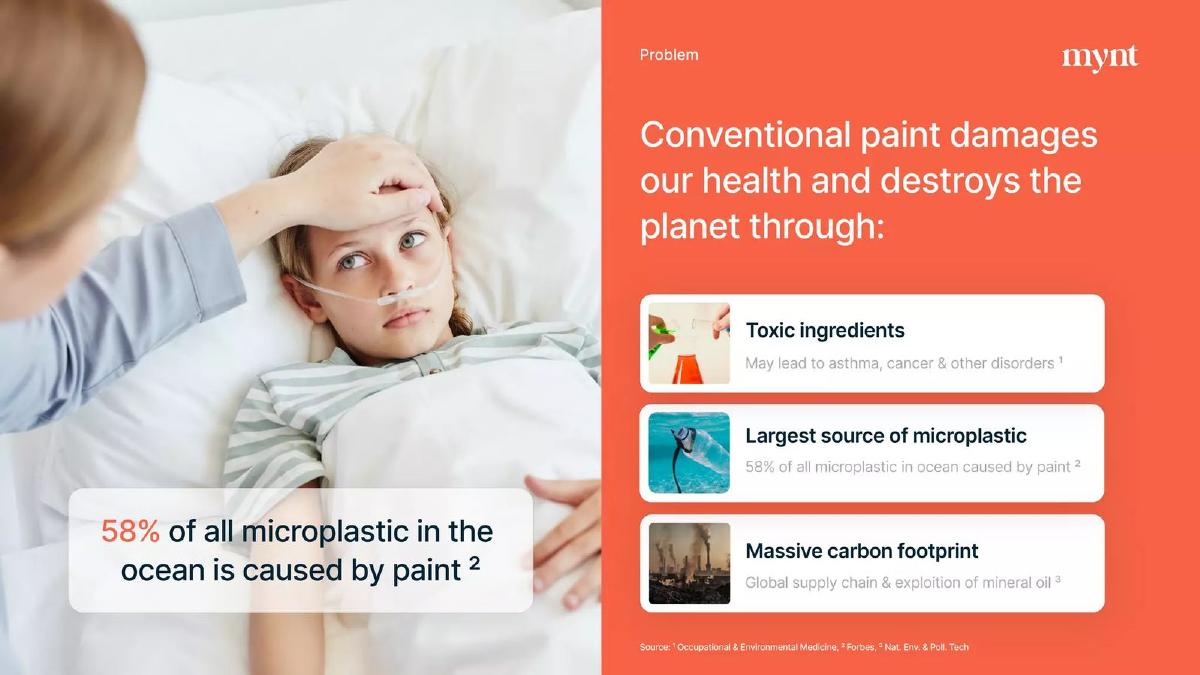
- The problem slide uses a visceral emotional hook, citing that 58% of all microplastic in the ocean is caused by paint (Slide 3).
- The founders leverage their background at Zalando to pitch a 'tech-driven D2C & D2B solution' for a traditionally offline industry (Slide 2).
- Mynt identifies a massive market inefficiency, noting that 48% of paint is still sold through hardware stores with a price oligopoly (Slide 4).
- The product differentiation includes a digital 'Myx+Match' algorithm capable of matching 100K+ custom colors (Slide 7).
- The market opportunity is tiered, starting with a €250M B2C core target group and expanding to a €22.7B total EU paint market (Slide 9).
- The deck omits all specific financial data, using '€XXXK' placeholders for revenue, EBIT, and funding across 2022-2025 (Slide 11).
- The go-to-market strategy for D2B is already in motion, with 15 image paint companies onboarded as of the pitch (Slide 10).
- The deck does not state a specific fundraising target or valuation, ending instead with founder contact information (Slide 12).
The Mynt Pitch Deck: A Clean Coat on a Dirty Industry
Mynt’s Seed deck, produced in early 2023, is a masterclass in modern D2C branding. It takes a commodity product—wall paint—and recontextualizes it as a high-tech, sustainable lifestyle choice. The deck consists of 12 slides that move logically from an emotional problem to a tech-enabled solution, backed by a team with significant e-commerce pedigree. However, as a fundraising document, it functions more as a brand manifesto than a financial prospectus, as it omits nearly all hard numbers regarding revenue and the specific investment ask.
Slide 1: The Cover and Value Proposition
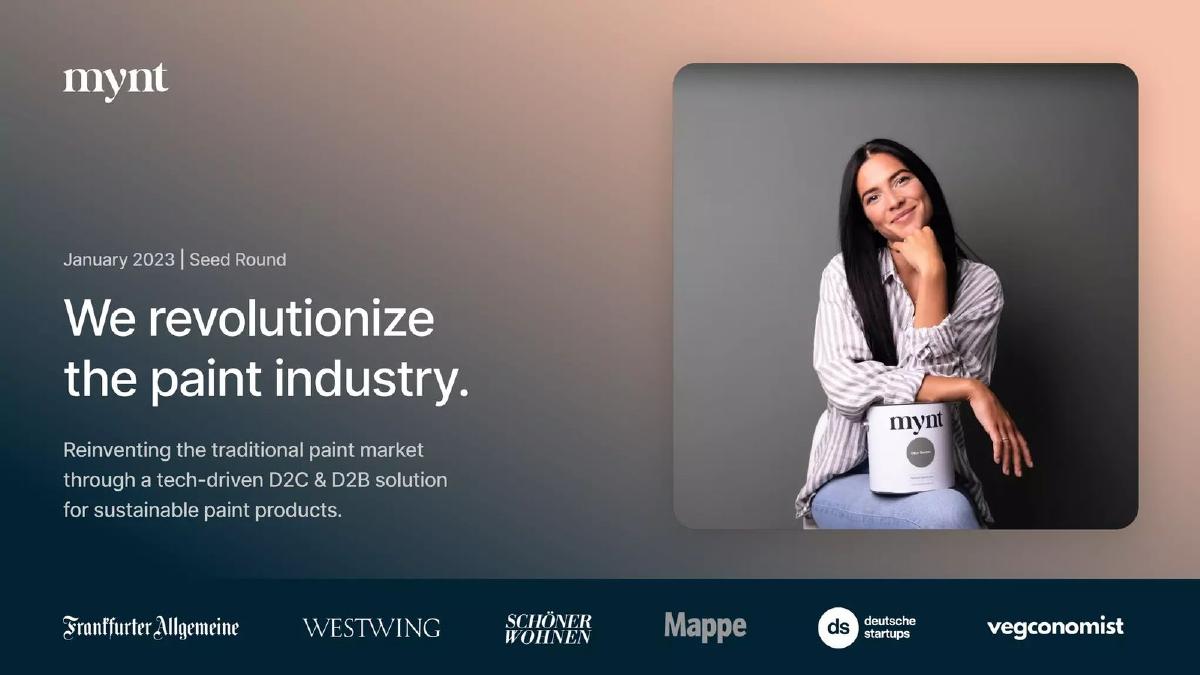
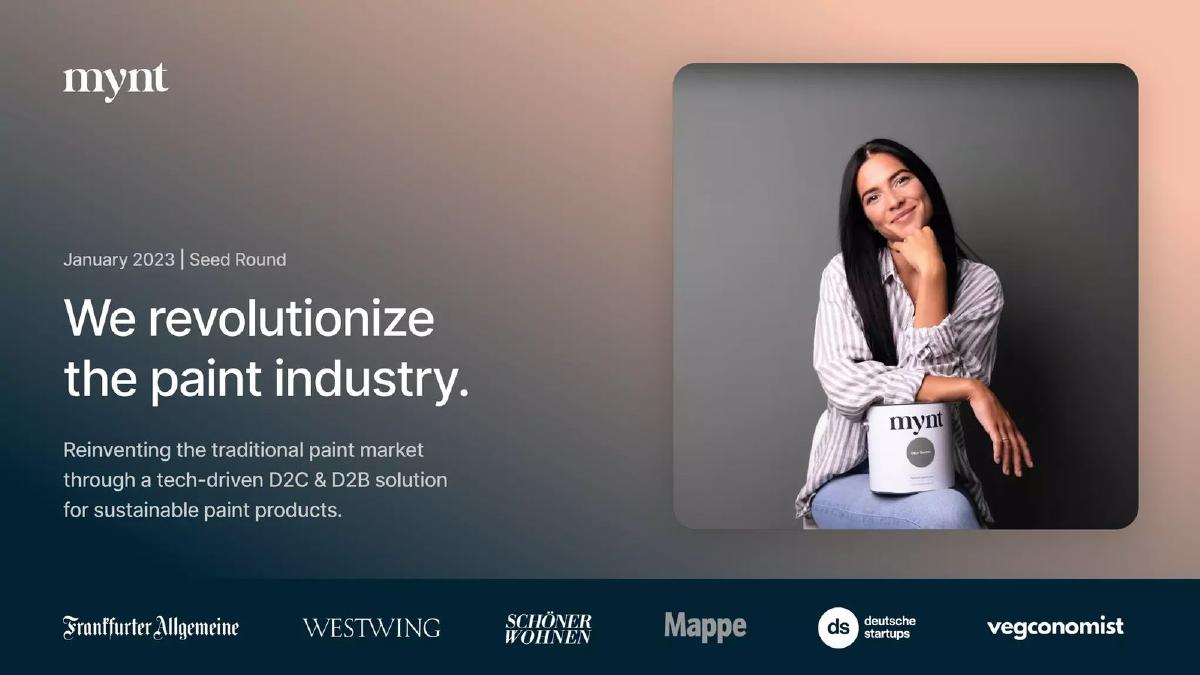
The deck opens with a high-production-value cover slide. The headline, "We revolutionize the paint industry," is bold, but the sub-headline is more specific: "Reinventing the traditional paint market through a tech-driven D2C & D2B solution for sustainable paint products." The inclusion of media and partner logos like Westwing and Frankfurter Allgemeine at the bottom immediately establishes third-party credibility before a single claim is made.
Slide 2: Team and Credibility
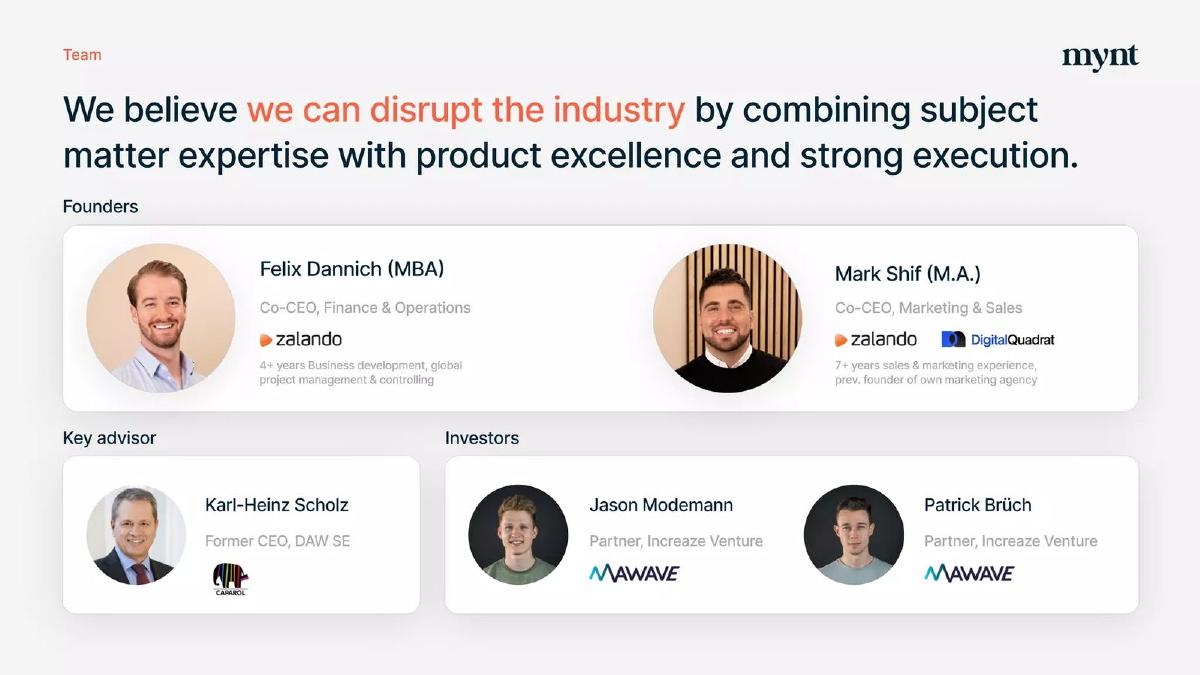
Placing the team slide second is a strategic move for a Seed-stage company. Founders Felix Dannich and Mark Shif both highlight their tenure at Zalando , signaling to investors that they understand how to scale digital logistics and marketing. The most important figure on this slide, however, is likely Karl-Heinz Scholz . As the former CEO of DAW SE (the parent company of Caparol, a major industry player), his presence as a Key Advisor mitigates the risk that these are just 'tech guys' who don't understand the chemistry or regulatory hurdles of the paint business.
Slide 3: The Emotional and Environmental Problem
Slide 3 is the 'hook.' It features a visceral image of a sick child, paired with a staggering statistic: "58% of all microplastic in the ocean is caused by paint." By citing sources like Forbes and Occupational & Environmental Medicine , Mynt elevates the problem from a simple lack of color choice to a global health and environmental crisis. They categorize the damage into three buckets: Toxic ingredients, Microplastics, and a Massive carbon footprint.
Slide 4: The Market Status Quo
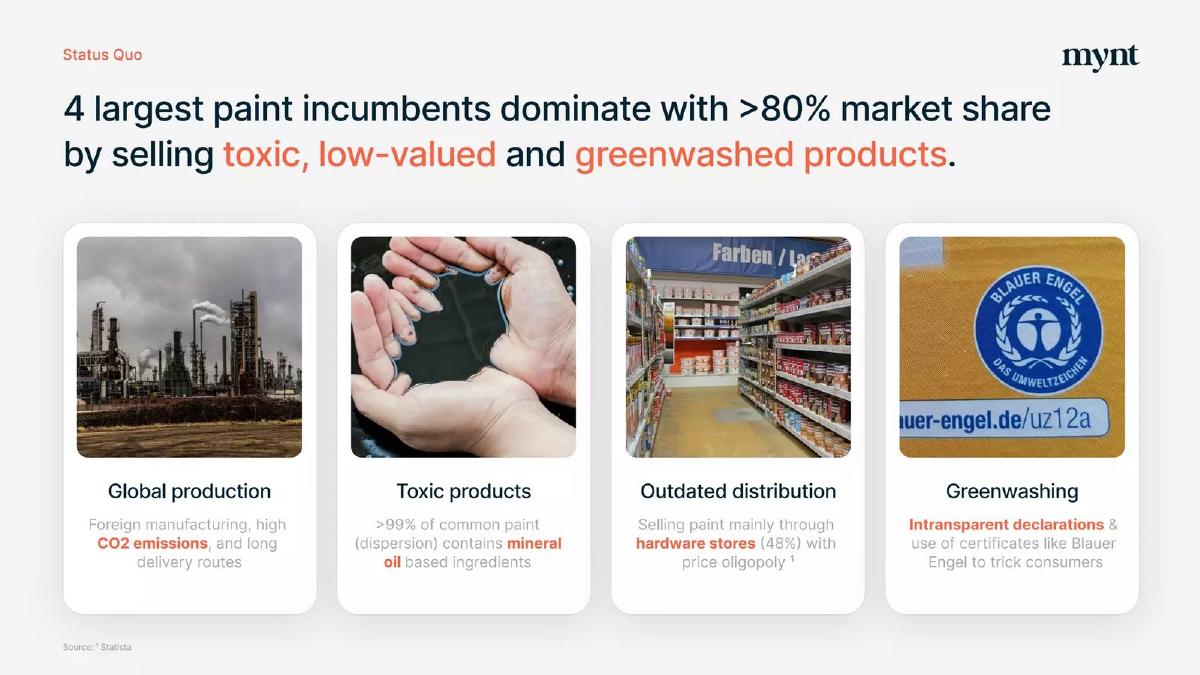
This slide attacks the incumbents. It states that "4 largest paint incumbents dominate with >80% market share." The slide uses the term "greenwashed" to describe current sustainable efforts, specifically calling out the Blauer Engel certificate as a tool used to "trick consumers." This positioning is vital; it frames Mynt not just as a new competitor, but as the only honest actor in a deceptive market. They also note that 48% of paint is sold through hardware stores , which they label as an "outdated distribution" model with a "price oligopoly."
Slide 5: The Solution Overview
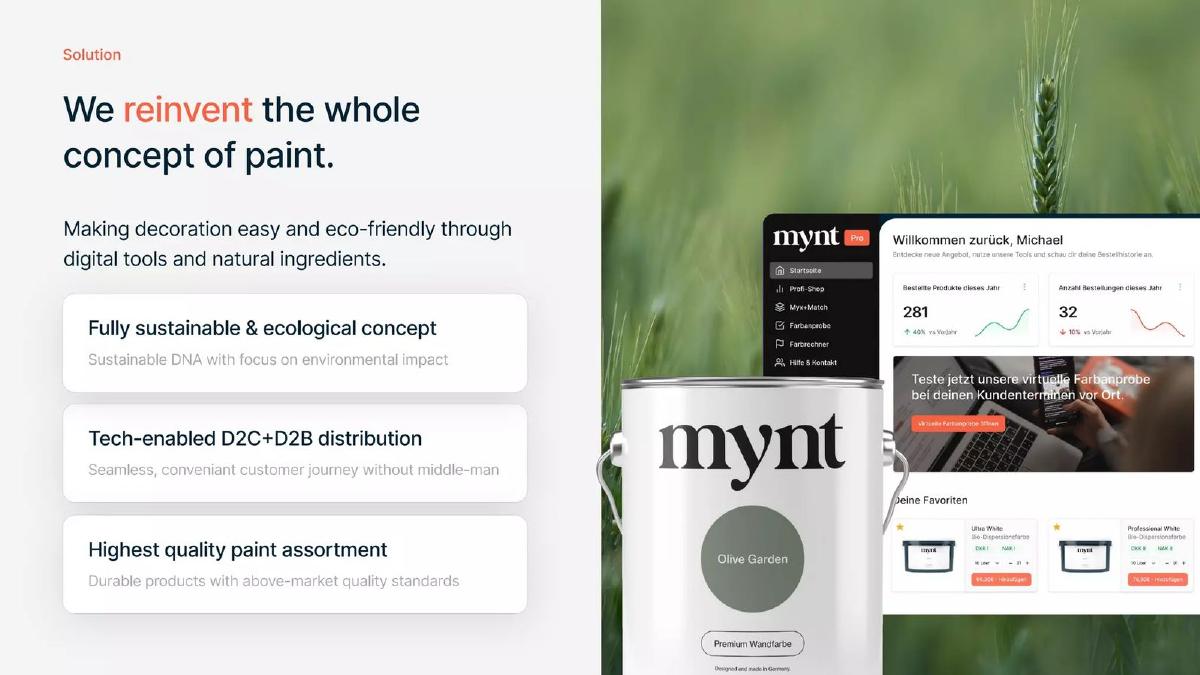
Mynt introduces its "fully sustainable & ecological concept." The slide shows a mockup of the "Mynt Pro" dashboard, signaling that their solution isn't just the liquid in the can, but the software surrounding the purchase. They promise a "seamless, convenient customer journey without middle-man" and "above-market quality standards."
Slide 6 & 7: Product and Technology
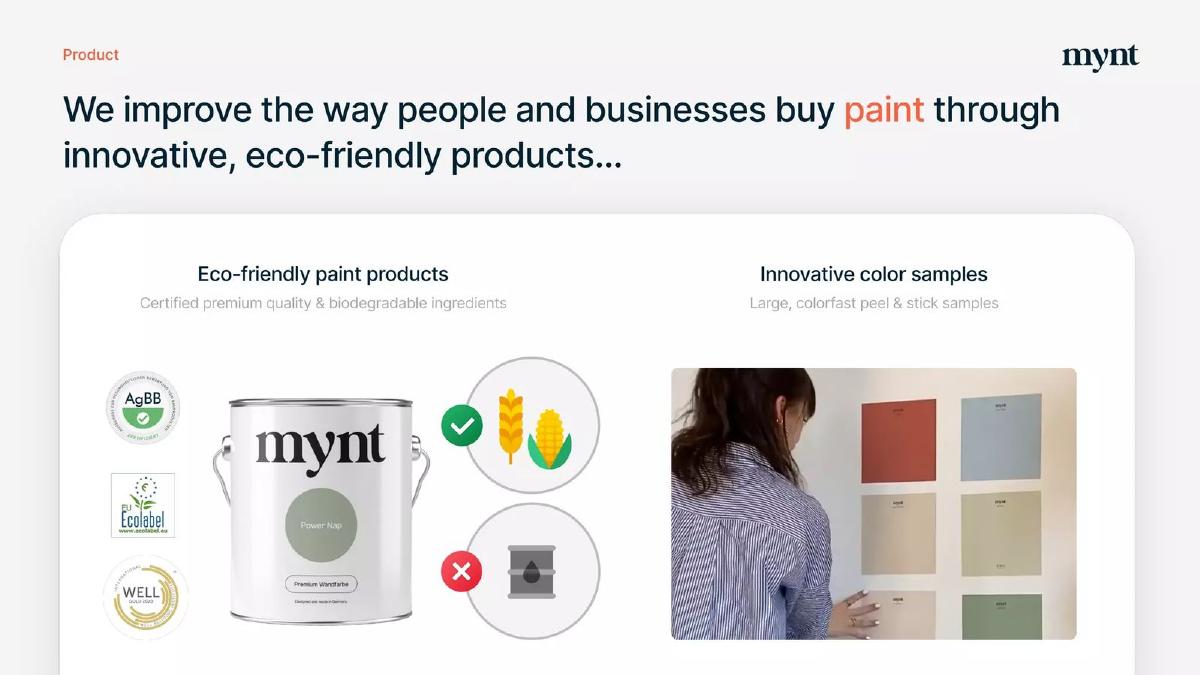
These slides detail the physical and digital product. Slide 6 highlights "large, colorfast peel & stick samples," a direct solution to the messy, traditional method of painting test patches on walls. Slide 7 introduces the "first digital paint mixing solution in Europe with more than 100K available colors." The "Myx+Match" algorithm is the core IP presented here, allowing users to match colors from photos or other brands, effectively commoditizing the color palettes of their larger competitors.
Slide 8: Timing and Mega Trends
The "Timing" slide justifies why now is the moment for Mynt. They cite two "mega trends" : Sustainable consumption (57% of consumers plan to change buying habits) and Digital adoption. They reiterate that online paint sales are currently at only ~5% in Europe , suggesting a massive headroom for growth as the category follows the path of furniture and apparel.
Slide 9: Market Potential
Mynt provides a clear TAM/SAM/SOM breakdown using a nested circle diagram. They identify a "€2.8bn opportunity at a CAGR of 4.2%" in the DACH region. The slide breaks this down into:
€250M: B2C core target group (5M households). · €1.2B: B2B core target group (44K painting companies). · €22.7B: Total EU paint market.
This slide is effective because it shows a logical progression from a niche 'young family' demographic to a broad continental market.
Slide 10: Go-to-Market D2B
The D2B strategy is presented as the "engine of growth." Mynt claims to be "acquiring first 100 customers now." They have already "onboarded 15 image paint companies" and are using a dropshipping model from suppliers to keep operational effort minimal. This demonstrates execution and validates that professional painters are willing to move away from traditional hardware store relationships.
Slide 11: Vision and Redacted Financials
The penultimate slide sets the long-term vision: "Europe's largest go-to destination for sustainable and healthy home decoration — paint is only the beginning." They plan to expand into "tapestry, panels & co." However, the "Business outlook" table is entirely redacted. Every figure for Net Revenue, EBIT, and Funding from 2022 to 2025 is listed as "€XXXK." While this protects sensitive data in a public-facing deck, it leaves the investor with no sense of the company's current scale, burn rate, or capital efficiency.
Slide 12: The Close
The deck ends with a simple contact slide. Notably, there is no "Ask" slide . There is no mention of how much money is being raised, what the valuation is, or specifically what the funds will be used for (e.g., inventory, marketing, R&D). It invites the investor to "disrupt an outdated industry together" by contacting the founders directly.
What Works in the Mynt Deck
1. Visual Cohesion: The deck is beautiful. The color palette, typography, and high-quality product photography mirror the 'premium' nature of the brand they are building. For a D2C company, the deck itself is a proof of concept for their marketing ability.
2. The 'Zalando' Narrative: The founders lean heavily into their background. By framing paint as a logistics and digital discovery problem rather than a chemical manufacturing problem, they play to their strengths and make a compelling case for why they can win in a stagnant market.
3. Clear Competitive Moat: The Myx+Match algorithm and the peel-and-stick samples are tangible differentiators. They aren't just selling 'better' paint; they are selling a better way to buy and choose paint.
What is Missing from the Mynt Deck
1. Unit Economics: For a D2C/D2B hybrid, investors need to see Customer Acquisition Cost (CAC), Lifetime Value (LTV), and contribution margins. Because the paint is 'premium' and 'natural,' the COGS (Cost of Goods Sold) is likely higher than traditional paint. The deck does not address how they maintain margins while competing with hardware store prices.
2. The Ask: A pitch deck without an 'Ask' slide is a brochure. Investors need to know if the company is looking for €500k or €5M. Without this, it's impossible to evaluate the roadmap on Slide 11.
3. Actual Traction Data: While they mention 15 B2B companies, there are no charts showing month-over-month growth, retention rates, or B2C sales volume. The use of placeholders (€XXXK) makes the deck feel theoretical rather than operational.
What a Founder Should Copy
1. The Problem Slide: Mynt’s use of a single, powerful statistic (58% of microplastics) to anchor their entire mission is excellent. It turns a boring product into a moral imperative.
2. The Advisor Strategy: If you are disrupting a legacy industry, finding a 'Key Advisor' who used to run a major incumbent is the fastest way to build trust. It signals that you have 'insider' knowledge even if the founders are 'outsiders.'
3. The 'Step-by-Step' Go-To-Market: Slide 10 does a great job of showing that the founders aren't trying to do everything at once. They have a clear sequence: build credibility, acquire 100 customers via dropshipping, then expand distribution and product range. This makes a massive vision feel achievable.
Final Verdict: Mynt has built a compelling brand and identified a genuine market weakness. The deck is an excellent example of storytelling and brand positioning. However, to close a round, the founders would need a secondary 'Data Room' deck that replaces the €XXXK placeholders with hard, defensible numbers and a clear financial ask.
Frequently asked questions
- What is the primary problem Mynt is solving?
- Mynt addresses the environmental and health hazards of the traditional paint industry. According to slide 3, conventional paint is the largest source of microplastics, accounting for 58% of all microplastics in the ocean. They also highlight the toxicity of mineral-oil-based ingredients in 99% of common paints and the 'greenwashing' prevalent among the four largest incumbents who control 80% of the market.
- How does Mynt use technology to differentiate a physical product?
- The company positions itself as a tech-enabled distributor. Slide 7 showcases a 'Color Visualizer' for live testing on walls and a 'Myx+Match' algorithm that matches over 100,000 custom colors. This digital-first approach allows them to bypass traditional hardware store distribution, which currently accounts for 48% of sales in an 'outdated' market (Slide 8).
- Who are the key people behind Mynt?
- The company is led by Co-CEOs Felix Dannich (Finance & Operations) and Mark Shif (Marketing & Sales), both of whom have backgrounds at Zalando. Crucially, they are supported by advisor Karl-Heinz Scholz, the former CEO of DAW SE (Caparol), providing deep industry-specific manufacturing and regulatory expertise to complement the founders' e-commerce experience (Slide 2).
- What is the company's growth strategy?
- Mynt employs a hybrid D2C (Direct-to-Consumer) and D2B (Direct-to-Business) model. Slide 10 outlines a three-step D2B engine: building credibility with 15 initial partners, acquiring the first 100 painting companies via dropshipping, and eventually expanding to over 500 companies with a dedicated Pro shop. Their long-term vision is to expand beyond paint into a broader 'sustainable home decoration' category (Slide 11).
- What financial information is disclosed in the deck?
- The deck is extremely light on financial specifics. Slide 11 provides a 'Business outlook' table for 2022 through 2025, but every single cell for Net Revenue, EBIT, and Funding is redacted with '€XXXK'. This suggests the deck was intended for broad circulation or as a teaser, requiring a non-disclosure agreement or a follow-up meeting to view the actual performance metrics.