Qunomedical's Series A deck is a masterclass in the 'Trojan Horse' strategy, showing how a successful B2C marketplace can evolve into a high-margin B2B SaaS platform. By leveraging their proprietary 'Qunoscore' and patient management expertise, the company introduced Qunosuite, a Patient Relationship Management (PRM) tool. The deck emphasizes operational efficiency, showing a decrease in full-time employees (FTEs) alongside rising Gross Merchandise Volume (GMV). While the deck lacks a traditional competition slide and specific financial tables, it relies heavily on social proof—boasting an 84…
Key takeaways
- The deck highlights a significant business model expansion from a curated marketplace to a white-label SaaS solution called Qunosuite (Slide 5).
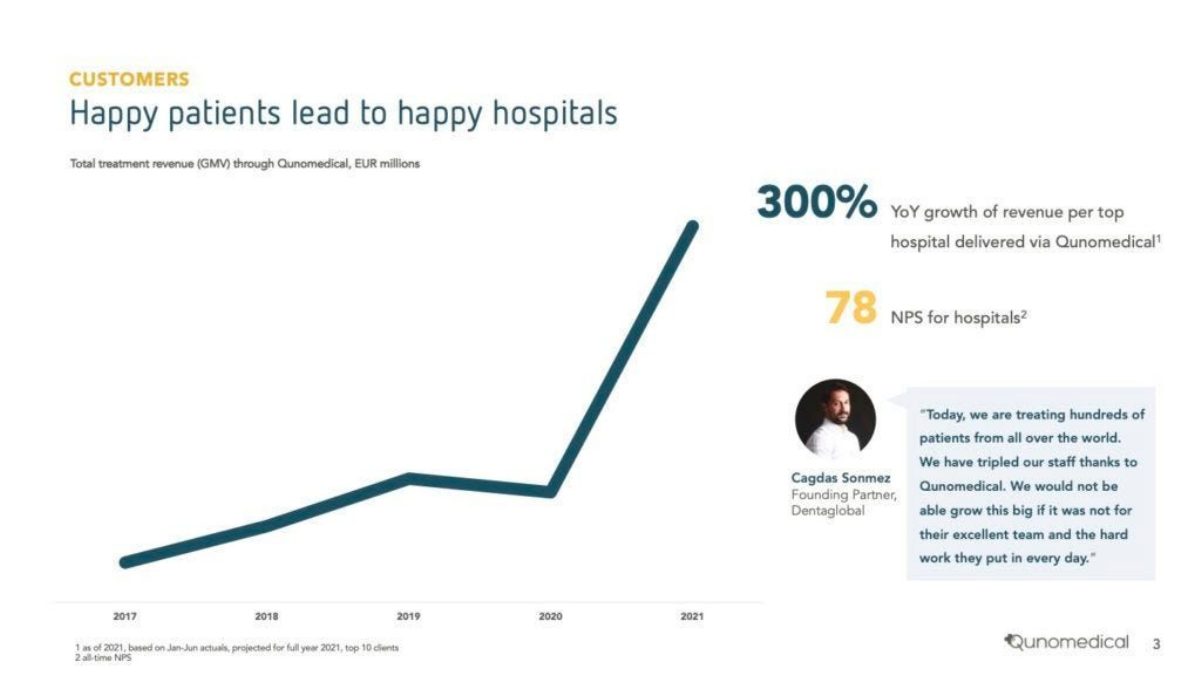
- Qunomedical reports a 300% YoY growth in revenue per top hospital, indicating strong monetization of existing B2B relationships (Slide 4).
- The company maintains high satisfaction scores across both sides of the market, with an 84 NPS for patients and a 78 NPS for hospitals (Slides 3 and 4).
- Operational efficiency is a core theme, with Slide 7 visualizing GMV growth occurring while the number of FTEs decreases.
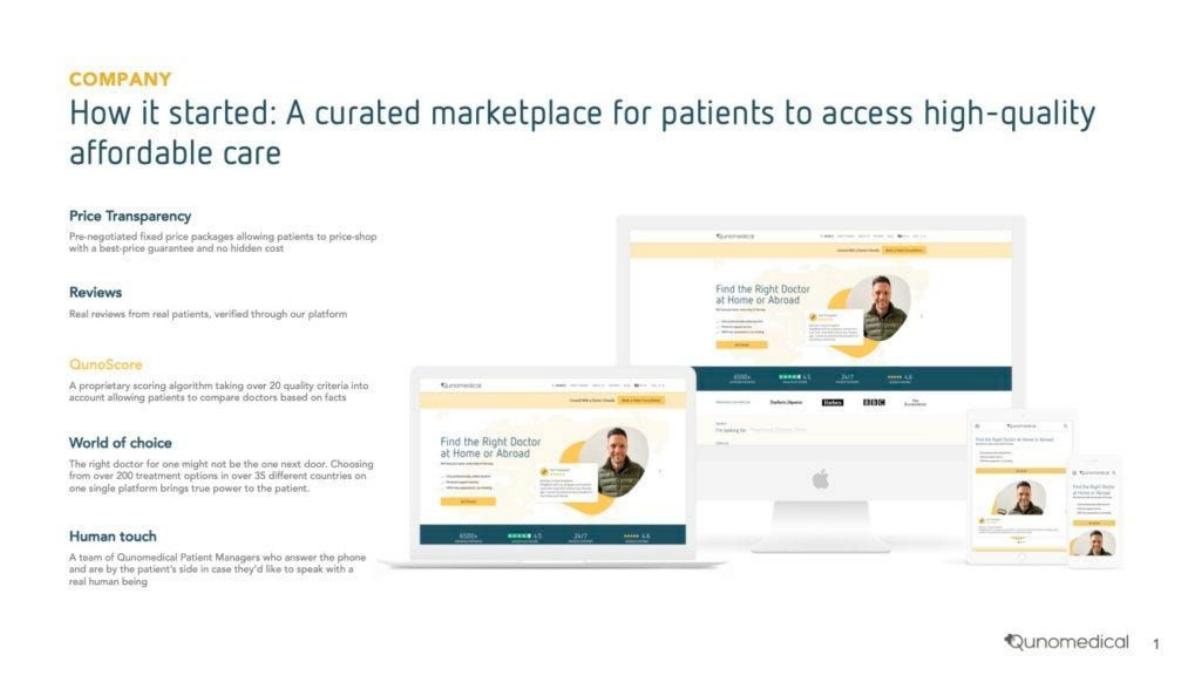
- The marketplace offers significant breadth, featuring over 200 treatment options across more than 35 different countries (Slide 2).
- The proprietary 'Qunoscore' algorithm uses over 20 quality criteria to help patients compare doctors based on objective data (Slide 2).
- The leadership team features deep domain expertise, including a founder who is a Medical Doctor and former McKinsey Engagement Manager (Slide 9).
- The deck omits a traditional market size (TAM/SAM/SOM) slide and a specific competitive landscape analysis.
Introduction: The Pivot to Healthcare SaaS
Qunomedical’s Series A deck, used to raise $10.5M in 2022 as reported by Business Insider, represents a strategic transition. While the company began as a consumer-facing marketplace for medical travel, this deck focuses heavily on their B2B software offering, Qunosuite. The narrative is built around the idea that the company has mastered the patient journey and is now selling that expertise back to the hospitals themselves. This teardown examines how they presented this evolution to investors.
Slide 1: Title and Positioning
The opening slide sets a dual tone. The headline, "Re-defining the patient experience," appeals to the mission-driven nature of healthcare investing. However, the sub-headline is purely functional: "A SaaS solution for Patient Relationship Management." This immediately signals to the investor that this is not just a lead-generation marketplace, but a scalable software play. The imagery of a doctor and patient emphasizes the 'human touch' that becomes a recurring theme throughout the deck.
Slide 2: The Marketplace Foundation
Slide 2 explains "How it started." It describes a curated marketplace focused on price transparency, verified reviews, and a proprietary "Qunoscore" algorithm. The slide notes that the platform offers "over 200 treatment options in over 35 different countries." By labeling this as 'how it started,' the founders are effectively de-risking the new SaaS product by showing it was built on top of a successful, high-volume consumer business. The mention of a "human touch" team of Patient Managers suggests that the company understands the complexities of healthcare conversion better than a pure software competitor might.
Slide 3: Patient Social Proof
This slide is dedicated to customer validation. It features three specific testimonials from Germany, Romania, and the United States, covering neurology, heart surgery, and dentistry. The metrics on the right are the most important elements: an "84 NPS Patient rating," a "4.7/5" Trustpilot score based on over 700 reviews, and a "4.6/5" Google rating. High NPS in healthcare is notoriously difficult to achieve, making these figures a strong indicator of product-market fit.
Slide 4: Hospital Traction and B2B Growth
Slide 4 shifts the focus from patients to providers. The headline "Happy patients lead to happy hospitals" bridges the two sides of their business model. The slide claims "300% YoY growth of revenue per top hospital delivered via Qunomedical." It also introduces a "78 NPS for hospitals," showing that the providers value the service as much as the patients do. A quote from a founding partner at Dentaglobal supports the claim that Qunomedical helps hospitals scale their operations significantly.
Slide 5: Qunosuite Product Deep Dive
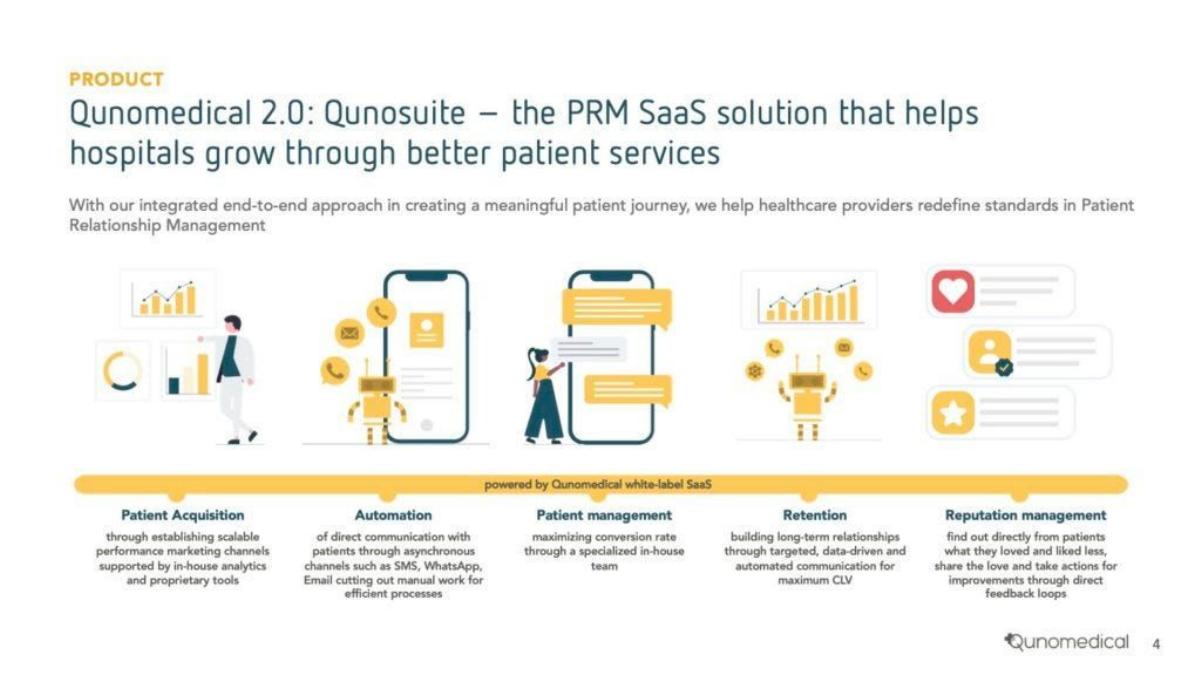
This slide introduces "Qunomedical 2.0: Qunosuite." It defines the product as a PRM (Patient Relationship Management) SaaS solution. The slide breaks the product down into five modules: Patient Acquisition, Automation (SMS, WhatsApp, Email), Patient Management, Retention, and Reputation Management. By framing the product as a "white-label SaaS," Qunomedical shows its intent to move deeper into the hospital's tech stack, moving from a third-party lead source to an essential operational tool.
Slide 6: The B2B Pipeline
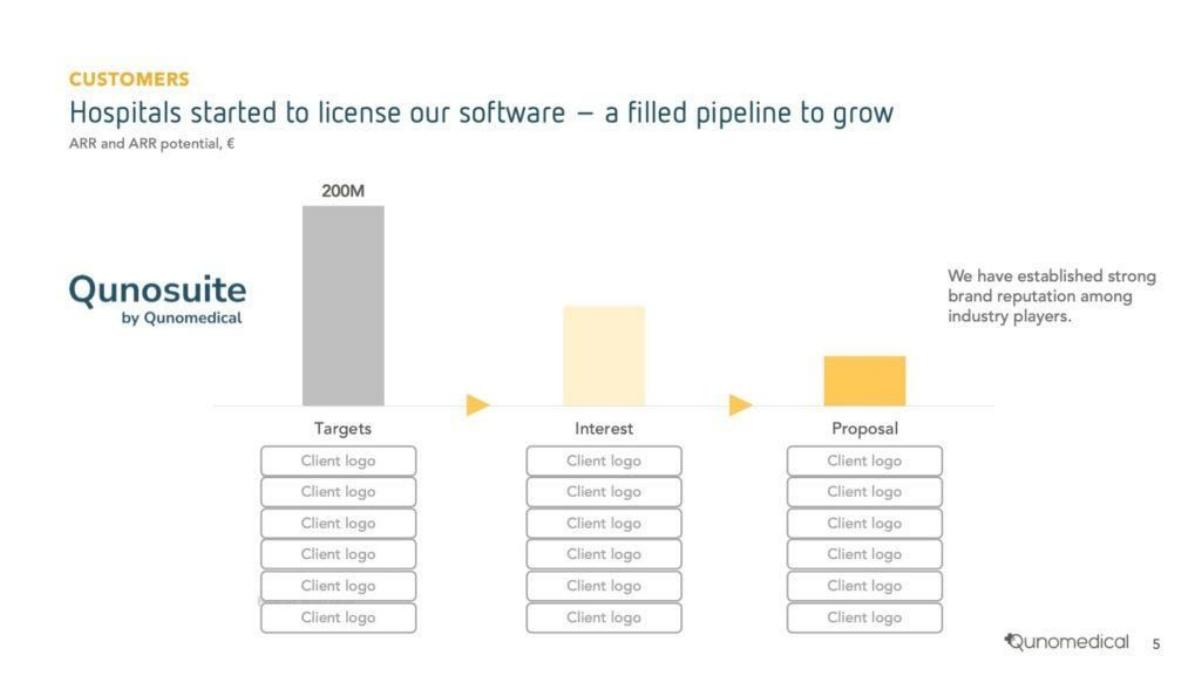
Slide 6 visualizes the sales funnel for Qunosuite. It shows a progression from "Targets" to "Interest" to "Proposal." While the specific client logos are obscured in this version of the deck, the bar chart above the funnel indicates an "ARR and ARR potential" reaching toward 200M Euro . This is a bold projection intended to show the massive upside of the SaaS pivot compared to the transactional marketplace model.
Slide 7: Efficiency and Unit Economics
This is perhaps the most critical slide for a Series A investor. Titled "Executional excellence," it shows three bar charts: GMV actuals, FTE actuals, and Net revenue actuals. The charts show GMV and Net Revenue increasing significantly while the number of "FTE actuals" (Full-Time Employees) decreases. This is the 'holy grail' of startup scaling—proving that the business is becoming more automated and efficient, rather than just growing by adding more manual labor.
Slide 8: The Ask and Use of Funds
The fundraise slide is relatively standard but clear. It states they are raising capital to "realize client pipeline globally." The three pillars for the funds are Product & Tech, BizDev & Sales (specifically mentioning Europe and the US), and Revenue Growth. The slide uses "$xxM ARR" as a placeholder for their next milestone, indicating they have a specific, time-bound target for the 18 months following the raise.
Slide 9: The Leadership Team
The team slide emphasizes pedigree and domain expertise. Dr. Sophie Chung is positioned as a founder with both medical and strategic credentials (MD, McKinsey, ZocDoc). Jochen Michaelis (CCO) brings B2B sales experience. The bottom of the slide features a 'logo cloud' of previous employers, including McKinsey, Rocket Internet, Audi, and WebMD. This builds confidence that the team has the professional maturity to handle a $10M+ round and a global expansion.
Slide 10: Vision and Mission
The deck closes with a high-level vision: "to create a better, more humane healthcare experience." The mission statement clarifies their technological approach: "to enable healthcare providers to maximise human touch where it matters by leveraging technology in areas where it doesn't." This brings the narrative full circle, connecting the SaaS product back to the patient experience mentioned on Slide 1.
What Qunomedical Does Well
The deck excels at storytelling through evolution. By framing the SaaS product as 'Qunomedical 2.0,' they make the new business model feel like an inevitable and informed next step rather than a desperate pivot. They use the data from their 1.0 marketplace to prove they understand the customer, which gives them the authority to sell software to hospitals.
The inclusion of the 'Efficiency' slide (Slide 7) is a brilliant move. Most marketplace decks show headcount growing in lockstep with revenue. By showing that headcount is actually decreasing while revenue climbs, Qunomedical proves they have built a scalable technology platform, not just a tech-enabled service business. This justifies a higher SaaS-style valuation.
What is Missing from the Deck
Despite its strengths, the deck has several notable omissions. There is no Competition Slide . In the crowded healthcare CRM and medical tourism space, investors would want to know how Qunosuite stacks up against incumbents like Salesforce Health Cloud or specialized patient engagement platforms. The absence of this slide suggests they are relying on their unique 'marketplace-first' data as their primary moat.
There is also a lack of Market Size (TAM) data. While Slide 6 hints at a 200M Euro potential, it doesn't define the broader global market for PRM software. Furthermore, the Financials are presented only as trend lines without absolute numbers for revenue or burn rate. While this is common in teaser decks, a Series A investor would eventually require a much deeper dive into the underlying cohorts and CAC/LTV ratios which are not present here.
Founder Takeaways: The 'Trojan Horse' Strategy
Founders should study how Qunomedical uses its B2C success to sell a B2B vision. If you are building a marketplace, consider if there is a 'white-label' version of your internal tools that your suppliers (in this case, hospitals) would pay for. This 'Trojan Horse' strategy allows you to enter a market as a lead provider and eventually become the operating system for your partners.
Additionally, the use of NPS scores for both sides of the marketplace is a high-impact way to show health. If you have a two-sided platform, don't just report on the buyer; showing that the sellers (hospitals) are also highly satisfied (78 NPS) proves that your platform is creating value for the entire ecosystem, which reduces churn and increases defensibility.
Frequently asked questions
- What is Qunomedical's primary product?
- Qunomedical operates two distinct but connected products. First is a curated marketplace that allows patients to find and book high-quality, affordable healthcare globally. Second is 'Qunosuite,' a B2B Patient Relationship Management (PRM) SaaS solution that hospitals license to manage patient acquisition, automation, and retention. The deck positions Qunosuite as the primary growth driver for the Series A round.
- How does Qunomedical differentiate itself from other medical tourism sites?
- The company differentiates through its proprietary 'Qunoscore' system, which evaluates doctors based on 20+ quality criteria. Unlike generic directories, Qunomedical emphasizes 'human touch' via a team of Patient Managers and provides pre-negotiated fixed-price packages to ensure price transparency. The transition into a white-label SaaS provider also separates them from purely consumer-facing competitors.
- What traction metrics are emphasized in the deck?
- The deck focuses on three main traction areas: growth, satisfaction, and efficiency. It cites 300% YoY revenue growth per top hospital, an 84 patient NPS, and a 78 hospital NPS. Most notably, it highlights 'executional excellence' by showing that Gross Merchandise Volume (GMV) and net revenue have increased even as the company reduced its total headcount (FTEs).
- Who are the key members of the leadership team?
- The team is led by Dr. Sophie Chung, MD, who previously served as a Director of Healthcare Strategy at ZocDoc and an Engagement Manager at McKinsey. She is joined by CCO Jochen Michaelis, who brought experience from WOW Tech Group and eGym. The deck also highlights a broader leadership team with backgrounds from Rocket Internet, WebMD, and McKinsey.
- What are the primary goals for the $10.5M Series A raise?
- According to Slide 8, the capital is earmarked for three areas: Product & Tech (investing in the scalable platform and feature set), BizDev & Sales (scaling acquisition and onboarding in Europe and the US), and Revenue Growth (reaching a specific ARR threshold within 18 months). The ultimate goal is to realize their global client pipeline for the Qunosuite software.