The Rain (RackTop Systems) pitch deck is a 10-slide presentation that leans heavily on the 'CyberConverged' narrative. Rather than focusing on the mechanics of ad placement mentioned in its early description, this specific deck focuses on its BrickStor product—a software-defined storage solution. The company leverages an immense amount of social proof, featuring over 40 logos of government and enterprise clients on a single slide. The narrative is built around the 'Perfect Storm' of data growth, regulatory costs, and cyber threats. While the deck is visually dense and lacks a specific 'Ask' o…
Key takeaways
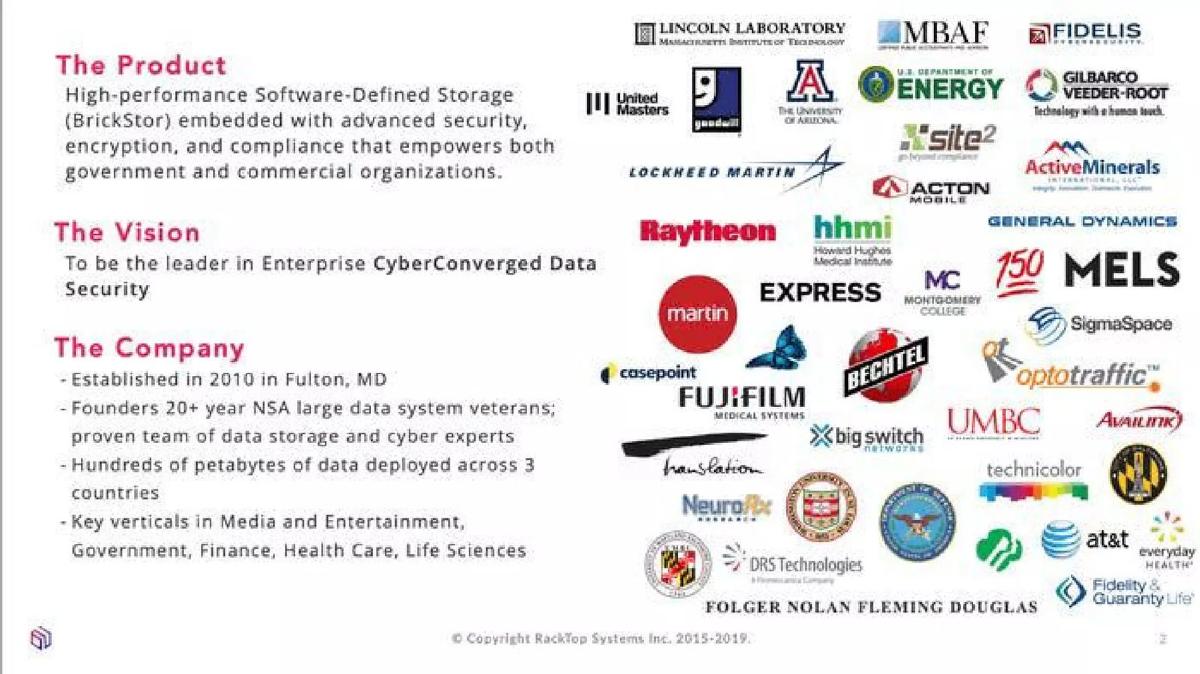
- The company establishes immediate authority by stating the founders are 20+ year NSA large data system veterans on Slide 2.
- Social proof is the deck's strongest asset, with Slide 2 displaying dozens of high-profile logos including Lockheed Martin, Raytheon, and the U.S. Department of Energy.
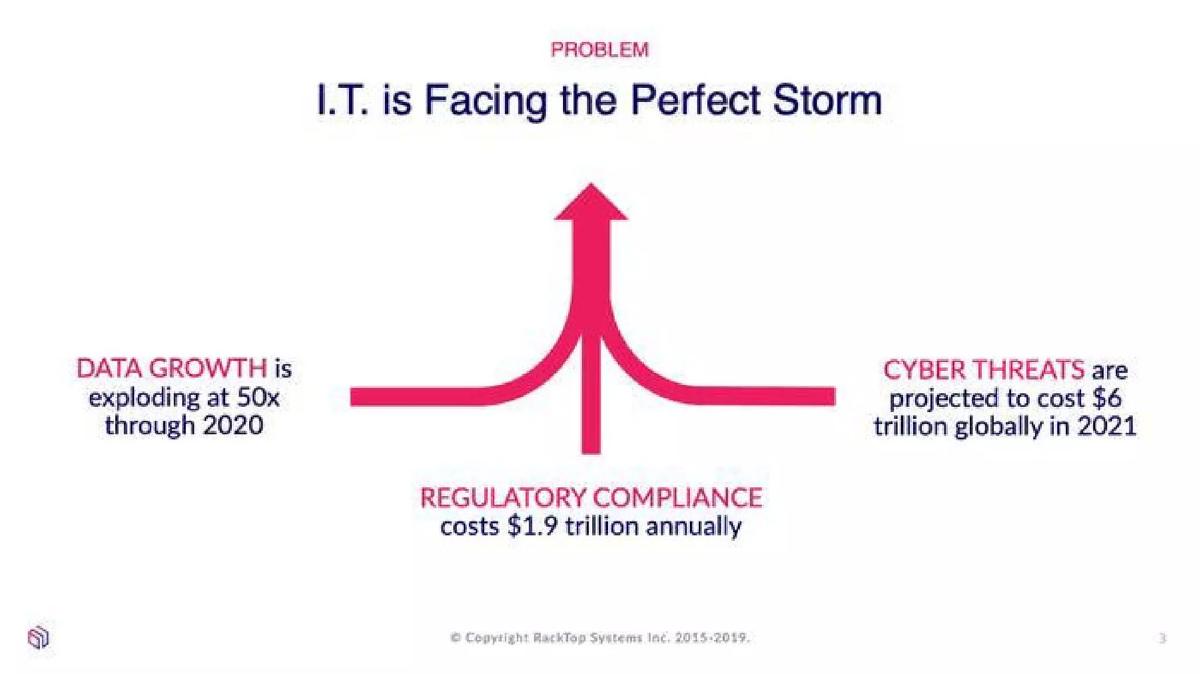
- The problem is framed as a 'Perfect Storm' on Slide 3, citing data growth at 50x and cyber threats costing $6 trillion by 2021.
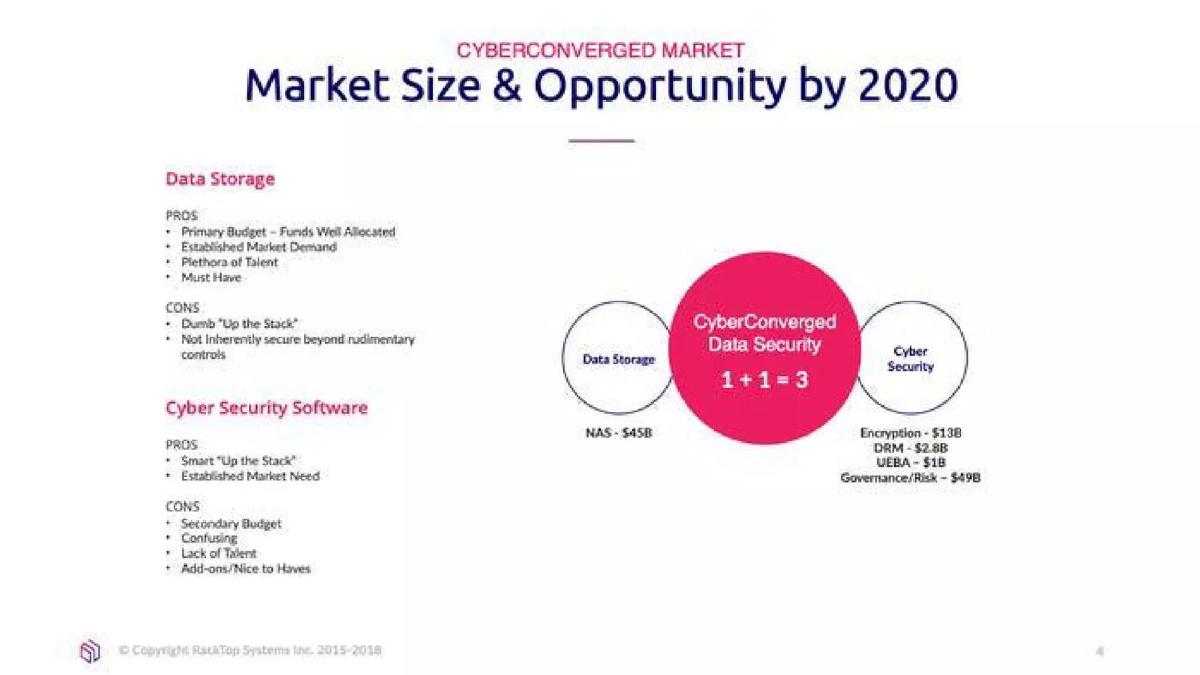
- The deck introduces a proprietary category, 'CyberConverged Data Security,' to differentiate from standard NAS storage on Slide 4.
- A 'Bolt-on vs. Built-in' comparison on Slide 7 claims a 50-90% lower Total Cost of Ownership (TCO) for their integrated solution.
- The product, BrickStor, is positioned as the world's first storage that maps to the NIST Cyber Security Framework on Slide 9.
- The deck completely omits a financial 'Ask' slide, revenue projections, or a specific breakdown of how the $100,000 investment would be used.
- The presentation lacks a traditional competitor matrix, choosing instead to list 'Bolt-on' categories like Vormetric and Cisco as inferior alternatives on Slide 7.
The RackTop Systems (Rain) Teardown: Selling Security Through Authority
The pitch deck for Rain (operating as RackTop Systems) is a 10-slide masterclass in enterprise positioning. While the catalogue listing suggests a Seed stage company raising $100,000 in 2013, the deck itself feels like a high-level corporate briefing. It is designed to solve one specific problem: trust. In the world of enterprise storage and national security, nobody buys from a startup unless they are convinced the startup won't disappear and the technology is bulletproof. RackTop uses its founders' NSA pedigree and a massive wall of logos to bridge that trust gap.
The Opening: Credibility and Social Proof
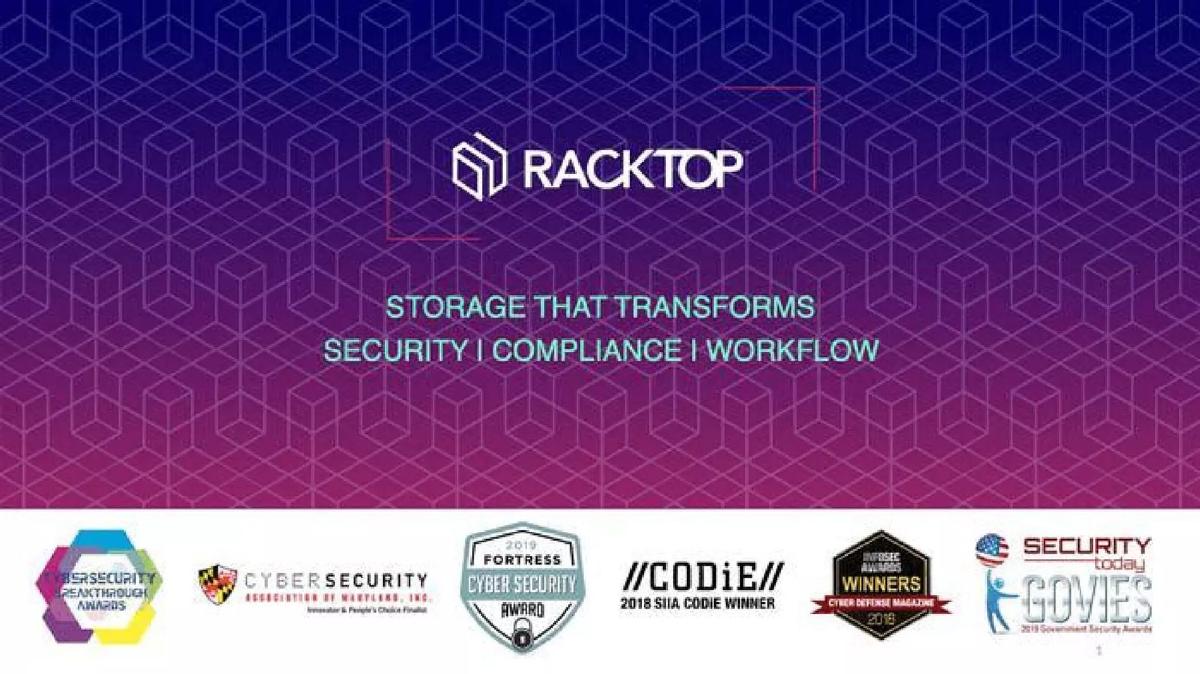
Slide 1: Title Slide The deck opens with the RackTop logo and a tagline: "Storage that transforms Security | Compliance | Workflow." It also features six award badges at the bottom, including the 2018 SIIA CODiE Winner and various Cyber Security awards. Note: The copyright dates on the slides (2015-2019) suggest this deck was updated well after the initial 2013 seed round mentioned in the catalogue.
Slide 2: The Company Overview This is the most important slide in the deck. It defines the product as "BrickStor," a high-performance Software-Defined Storage. It establishes the founders as "20+ year NSA large data system veterans." Most importantly, the right side of the slide is a "Logo Wall" featuring over 40 organizations, including Lockheed Martin, Raytheon, the U.S. Department of Energy, and AT&T. This level of social proof for a Seed-stage company is extraordinary and suggests significant early traction in government and defense sectors.
The Market Problem: The Perfect Storm
Slide 3: Problem The deck frames the market need as a "Perfect Storm." It cites three converging pressures: Data growth (exploding at 50x through 2020), Regulatory Compliance costs ($1.9 trillion annually), and Cyber Threats (projected to cost $6 trillion globally by 2021). This slide uses a simple three-into-one arrow graphic to show that these three problems are now inseparable.
Slide 4: Market Size & Opportunity RackTop introduces the concept of the "CyberConverged Market." They argue that Data Storage (a $45B NAS market) is "Dumb up the stack," while Cyber Security Software is "Confusing" and often a "Secondary Budget." They position their solution at the intersection, using the equation "1 + 1 = 3" to suggest that combining storage and security creates exponential value.
The Solution: Built-In vs. Bolt-On
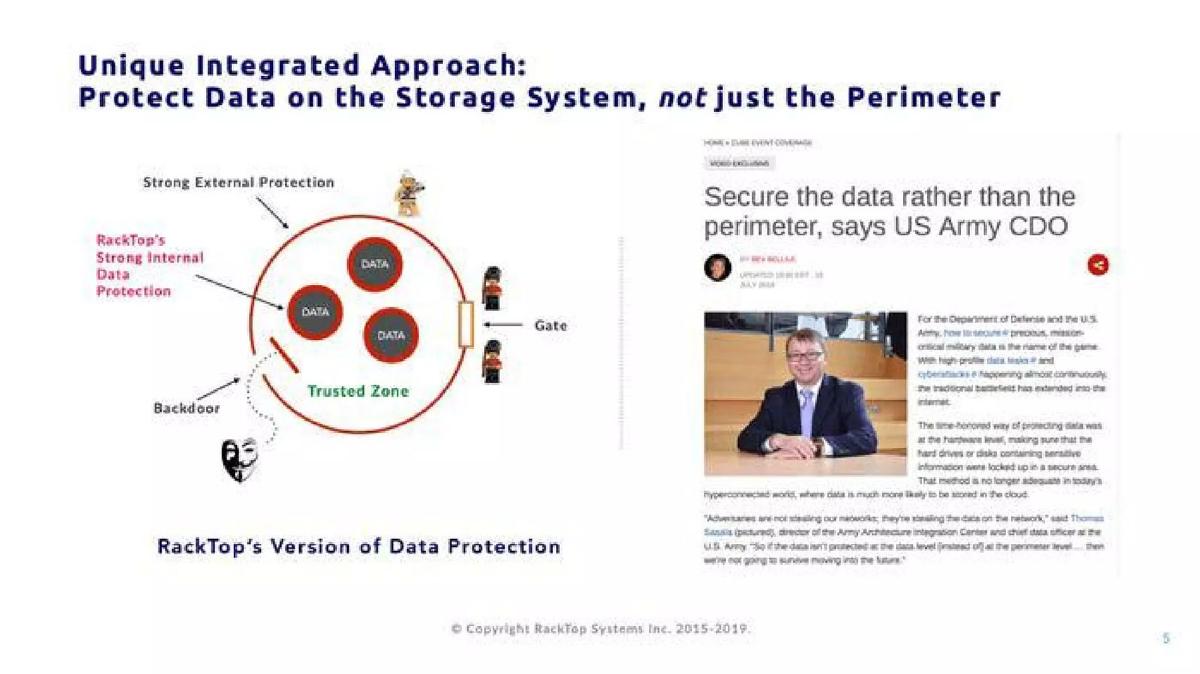
Slide 5: Unique Integrated Approach This slide contrasts "Strong External Protection" (the perimeter) with "RackTop's Strong Internal Data Protection." It features a quote from a US Army CDO: "Secure the data rather than the perimeter." The visual uses a simple diagram to show that even if a "Backdoor" or "Gate" is compromised, the data remains in a "Trusted Zone."
Slide 6: Unified Approach - Bolt-on vs. Built-in This is the competitive differentiation slide. On the left, it shows a fragmented stack where users must "bolt on" products from Vormetric, Cisco, Securonix, and others. On the right, the RackTop stack has all these features (Encryption, Compliance, User Behavior, Active Defense) built directly into the storage. The slide claims this results in a "50-90% Lower TCO" and makes the system "Easier to Maintain."
Product Deep Dive: BrickStor
Slide 7: BrickStor Product Pillars The deck breaks BrickStor down into three functional areas: Data Management (single pane of glass), Data Security & Compliance (multi-layer encryption), and High Performance Storage (Hybrid NAS with SSD + HDD & NVMe). This slide is technical, mentioning specific protocols like NFS, SMB, AFP, and iSCSI, signaling to IT buyers that the product is enterprise-ready.
Slide 8: NIST Framework Mapping To further cement its compliance credentials, RackTop claims to be the "World's First Storage That Maps to the NIST Cyber Security Framework." It lists how BrickStor handles the five NIST pillars: Identify, Protect, Detect, Respond, and Recover. This is a strategic move to align the product with the primary language used by government and enterprise CSOs.
Conclusion and Contact
Slide 9: Thank You / Contact The deck concludes with a standard contact slide. It provides the company's address in Fulton, MD, a phone number, and social media links. There is no call to action regarding an investment round, which is consistent with a deck used for general business development or a late-stage pitch where the terms are already known.
What Works in This Deck
Unassailable Founder-Market Fit: Mentioning 20 years at the NSA is the ultimate "unfair advantage" in the security space. It immediately answers the question "Why you?"
Extreme Social Proof: The logo wall on Slide 2 is overwhelming. For an enterprise buyer or an investor, seeing that the U.S. Army and major defense contractors are already using the tech removes the majority of the perceived risk.
Clear Category Creation: By naming their space "CyberConverged," they avoid being compared directly to cheap commodity storage providers. They are selling a security solution that happens to store data, which commands higher margins.
What is Missing from This Deck
The Ask: There is no mention of how much capital is being raised or what the terms are. This suggests the deck was likely used as a supporting document rather than a standalone fundraising tool.
Financial Traction: While the logos are impressive, the deck does not disclose revenue, growth rates, or contract values. We see where they are deployed, but not how much they are being paid.
The Team: While the NSA background is mentioned, there are no names, faces, or bios for the leadership team. In a Seed round, investors usually want to see the specific individuals they are backing.
What a Founder Should Copy
The 'Bolt-on vs. Built-in' Visual: Slide 6 is a perfect way to visualize why an integrated platform is better than a collection of point solutions. It’s a compelling argument for any SaaS founder building a multi-feature platform.
Mapping to Industry Standards: If your industry has a gold-standard framework (like NIST for security or HIPAA for health), explicitly showing how your product maps to that framework—as seen on Slide 8—is a shortcut to enterprise credibility.
The 'Perfect Storm' Problem Slide: Slide 3 effectively uses three massive, undeniable macro trends to justify why the company's existence is inevitable. Founders should look for their own "three arrows" that make their solution a necessity rather than a luxury.
Frequently asked questions
- What is the core product being pitched in this deck?
- The core product is 'BrickStor,' described on Slide 2 as a high-performance Software-Defined Storage solution. It integrates security, encryption, and compliance directly into the storage layer. The deck positions this as 'CyberConverged' technology, moving away from traditional perimeter-based security to protect data at the storage level itself.
- How does the company handle the competitive landscape?
- Rather than a standard grid, Slide 7 uses a 'Bolt-on vs. Built-in' visual. It lists competitors by category—such as Vormetric for encryption, Cisco for active defense, and CommVault for data protection—and argues that these fragmented solutions are harder to maintain and have a higher TCO compared to RackTop’s unified stack.
- What is the significance of the founder backgrounds mentioned?
- The founders are described on Slide 2 as '20+ year NSA large data system veterans.' In the context of cyber security and government contracting, this is a top-tier credibility marker. It suggests the team has handled data at a scale and security level that exceeds standard commercial requirements, justifying their 'CyberConverged' vision.
- Is there a clear business model or pricing strategy included?
- No. The deck focuses almost entirely on the technical value proposition and market need. There are no slides detailing subscription costs, licensing fees, or sales cycles. While it mentions a '50-90% Lower TCO' on Slide 7, it does not provide the raw figures or pricing tiers to support how that is achieved.
- What are the most notable omissions in this pitch deck?
- The deck is missing several standard venture components: a specific 'Ask' (how much money they want), a 'Use of Funds' slide, a detailed 'Team' slide with names and photos, and any financial traction or revenue growth charts. It functions more as a high-level capabilities briefing than a traditional investment pitch.