Rally Rd. entered the market in 2017 with a clear value proposition: allowing retail investors to buy shares in high-value collector cars. Their seed deck leverages the massive performance gap between collector cars (+400% over a decade) and traditional assets like the S&P 500 (+50%). The deck outlines a four-step operational loop—acquire, securitize, educate, and trade—supported by a team with backgrounds in venture capital, UX design, and investment banking. While the deck successfully establishes the 'why now' through market participation gaps (25 million viewers vs. 5,000 bidders), it lac…
Key takeaways
- Collector cars as an asset class outperformed the S&P 500 by 8x over the decade preceding the deck (Slide 3).
- The addressable market is defined by 25,000,000 unique viewers of car auctions who currently lack a participation method (Slide 5).
- The business model relies on turning individual assets into 'mini-companies' and issuing shares via an Initial Offering (Slide 7).
- Secondary market trading is facilitated through partner registered broker-dealers (Slide 7).
- The company is seeking $2.5 million to scale from a beta app to 50k-100k active members (Slide 9).
- Capital will be used to securitize between 50 and 75 blue-chip assets (Slide 9).
- The founding team combines experience from Barclays, Village Ventures, and KeyMe (Slide 11).
- A 'long-form deck' is mentioned as available upon request, suggesting this 13-slide version is a teaser (Slide 13).
Introduction: The Democratization of Alternative Assets
Rally Rd. (now known simply as Rally) produced this seed deck in March 2017. At the time, the concept of fractionalizing physical assets was relatively novel. The deck is a masterclass in minimalist design, using high-quality photography and stark typography to mirror the luxury nature of the assets they are securitizing. It positions the company at the 'Intersection of People, Passion, and Profit,' a tagline that immediately identifies their target demographic: the enthusiast investor.
Slide 1: Title and Positioning
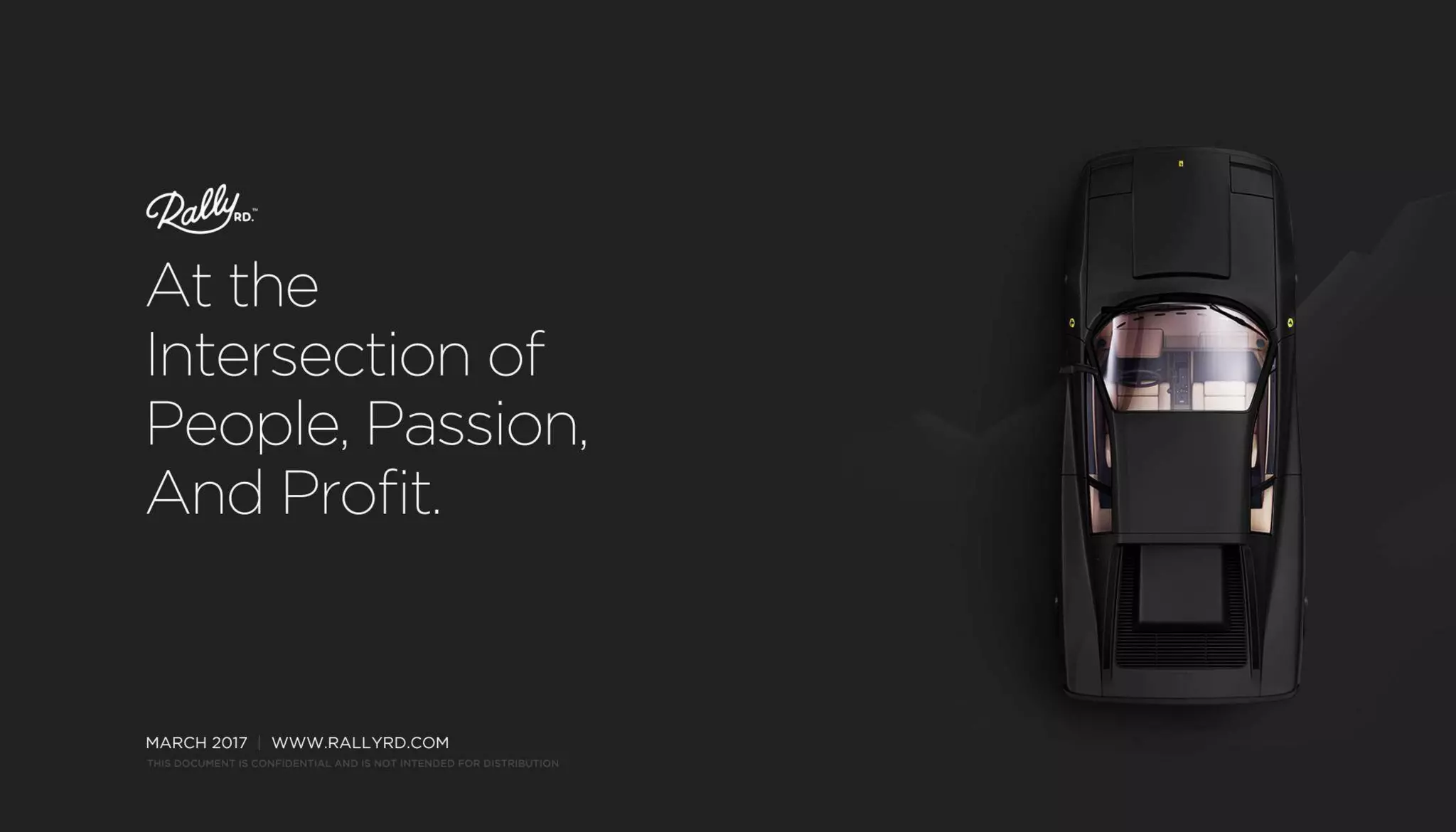
The cover slide is clean, featuring a top-down view of a black Ferrari. The branding is prominent, and the date (March 2017) establishes the timeline. The subtitle, "At the Intersection of People, Passion, And Profit," serves as a concise mission statement. It suggests that the company isn't just a financial tool, but a lifestyle platform that taps into the emotional connection people have with rare objects.
Slide 3: The Asset Class Thesis
Slide 3, titled "Our Starting Point," provides the financial justification for the business. It notes that blue-chip Collector Cars have seen +400% returns over the last decade. To provide context, the slide compares this to other common investments: Gold (+65%), the S&P 500 (+50%), and U.S. home prices (+20%). By showing that cars outperformed the stock market by a factor of eight, Rally Rd. makes a compelling case for why this specific asset class was chosen for their launch. The background features a subtle line graph reinforcing this upward trajectory.
Slide 5: The Addressable Market
This slide identifies a massive gap between interest and participation. It states that the largest collector car auction in the U.S. has only 5,000 registered bidders , yet it attracts 25,000,000 unique viewers via TV and digital platforms. The slide explicitly states these viewers "lack a meaningful participation method." This is a classic 'democratization' play—identifying a large group of fans and providing them with the financial tools to become owners. The visual uses a grid of icons to represent the 25 million, with a tiny red subset representing the 5,000 bidders, effectively illustrating the exclusivity of the current market.
Slide 7: The Operational Loop
Titled "How Rally Rd. Works," this slide breaks the business model down into four distinct steps arranged in a circular flow around a vintage car. Step 1: We Acquire the Asset (expert vetting and rating). Step 2: We Turn It Into a Stock (securitizing the asset into a 'mini-company'). Step 3: We Educate Users (using AR, photos, and historical data). Step 4: We Sell Shares (via an 'invest' button in the app). Crucially, it mentions that "Post-Offering, shares trade in an active marketplace maintained by registered broker-dealers," which addresses the critical question of liquidity for investors.
Slide 9: The $2.5 Million Ask
Slide 9, "Where We Are," provides the status of the company and the funding requirement. They mention a previous "small pre-seed round" used to build the beta iPhone app. The current ask is $2.5 Million . The founders are specific about what this money will buy: a public marketing campaign, 50k-100k active members , the securitization of 50-75 blue-chip assets , and the launch of secondary market support. This level of specificity is excellent for a seed deck, as it allows investors to hold the team accountable to measurable milestones.
Slide 11: The Founding Team
The "Founding Team" slide lists three principals. Christopher Bruno (CEO) is noted as a co-founder of Network of One and Health Guru, with a background at Village Ventures. Rob Petrozzo (CPO) brings design and product experience from KeyMe and ScrollMotion. Max Niederste-Ostholt (CFO) provides the necessary financial pedigree, having served as a Director of Healthcare Investment Banking at Barclays. This trio covers the three pillars of the business: venture/entrepreneurship, product/UX, and high-level finance. A note at the bottom mentions that board members and advisors are available on request.
Slide 13: Contact and Confidentiality
The final slide provides social handles and a contact email. It includes a map of New York City in the background, locating the company's HQ. A significant detail here is the text: "Long-form deck available upon request." This confirms that the 13-slide deck is intended as a 'teaser' or 'intro' deck, designed to pique interest rather than provide a deep dive into legal structures or detailed financial projections.
What Works in This Deck
Visual Storytelling: The deck uses high-end imagery that matches the 'blue-chip' nature of the assets. It feels like a luxury brand, which is essential for a platform selling shares in Ferraris and Porsches. The dark theme and gold accents convey a sense of premium value.
The 'Why Now' Logic: By contrasting 25 million viewers with only 5,000 bidders, Rally Rd. creates a sense of urgency and opportunity. They aren't just creating a new market; they are unlocking an existing, massive audience that is currently sidelined.
Clear Milestones: The use of funds slide is exceptionally clear. Instead of saying 'hiring and marketing,' they give specific numbers: 50k members and 50-75 assets. This makes the $2.5M ask feel calculated rather than estimated.
What Is Missing
Unit Economics: The deck does not explain how Rally Rd. makes money. Does the company take a percentage of the initial offering? Do they charge a management fee for storing and maintaining the cars? Is there a transaction fee on the secondary market? These are vital questions for an investor that are left unanswered in this version.
Regulatory Detail: Securitizing physical assets and offering shares to retail investors is a regulatory minefield involving the SEC. While they mention 'registered broker-dealers,' a seed deck for a fintech company usually needs to touch upon the specific regulatory exemptions (like Reg A+) they are utilizing to prove the model is legal.
Competition: There is no mention of other fractional ownership platforms or traditional alternative investment funds. A slide addressing why Rally Rd. is better than a traditional car fund or a competing platform would strengthen the case.
Founder Takeaways
Lead with the Asset Performance: If your startup deals with a specific asset class, show how it outperforms the standard benchmarks (S&P 500, Gold) to prove the investment thesis immediately. · Identify the 'Sidelined' Audience: Rally Rd. didn't just say 'people like cars.' They quantified the audience (25M viewers) and the barrier to entry (only 5k can bid). Find the data that shows a massive audience is waiting for your solution. · Design for the Product: If you are selling luxury, your deck must look luxurious. If you are selling efficiency, your deck must look streamlined. The aesthetic of the Rally Rd. deck is perfectly aligned with the assets they sell. · Be Specific with the Ask: Don't just ask for money; tell the investor exactly what that money buys in terms of users and inventory. It demonstrates a high level of operational planning.
Frequently asked questions
- What is the primary problem Rally Rd. is solving?
- Rally Rd. addresses the lack of accessibility in high-performing alternative asset classes. Slide 5 points out that while 25 million people watch collector car auctions, only 5,000 are actually able to bid. By fractionalizing these assets, Rally Rd. allows the 'viewer' to become an 'investor' with a much lower barrier to entry.
- How does the company generate liquidity for investors?
- Liquidity is provided through a secondary market. Slide 7 explains that after an Initial Offering, shares trade in an active marketplace maintained by registered broker-dealers. This transforms a traditionally illiquid asset (a physical car) into a liquid digital security.
- What is the specific fundraising goal and its intended use?
- The deck asks for $2.5 million on Slide 9. The funds are earmarked for four specific goals: launching a public marketing campaign, acquiring 50,000 to 100,000 active members, securitizing 50 to 75 new assets, and launching secondary market support.
- Who are the founders and what is their background?
- The team consists of Christopher Bruno (CEO), a former venture associate and founder; Rob Petrozzo (CPO), a product architect and UX designer; and Max Niederste-Ostholt (CFO), an investment banking specialist formerly of Barclays (Slide 11).
- What asset classes does Rally Rd. plan to support?
- While the deck focuses exclusively on 'blue-chip Collector Cars' as the starting point (Slide 3), the language on Slide 7 refers to 'highest quality assets' generally, implying the platform architecture is designed to eventually support other categories of passion assets.