Hopscotch’s 12-slide pitch deck focuses on the acute shortage and quality gap in pediatric behavioral health. By positioning itself as both a provider network and a clinical toolset, the company successfully raised $8M in Seed funding in 2024. The deck relies heavily on establishing a 'national emergency' context before introducing a solution that spans the entire patient journey—before, during, and after sessions. While the deck excels at demonstrating clinical depth through its '250+ clinician-developed interventions' mentioned on slide 9, it is notably light on financial projections and sp…
Key takeaways
- The deck uses a high-urgency problem statement, citing a 53% rise in pediatric mental health cases on slide 3.
- Hopscotch identifies its core insight on slide 5: the need to improve care quality via tools, not just increasing provider access.
- The product strategy covers the full clinical lifecycle: preparation, in-session engagement, and 'in-between' home activities (slide 5).
- The platform includes a content library of over 250 interventions to support clinicians (slide 9).
- Operational infrastructure is highlighted as a key value prop, including integrated payments and claims processing (slide 9).
- The leadership team features a Chief Clinical Officer and a Head of BH Content, signaling a content-first clinical approach (slide 12).
- The deck omits a specific 'Ask' slide, financial forecasts, and a detailed competitive landscape analysis.
- The business model is presented as a hybrid of a provider network and a SaaS-like infrastructure for behavioral health (slide 9).
The Pediatric Mental Health Infrastructure Play
Hopscotch entered the market at a time of unprecedented demand for pediatric behavioral health services. As reported by Business Insider, the company raised $8M in a Seed round in 2024. The deck they used is a masterclass in establishing clinical authority while pitching a scalable technology platform. Rather than just being another telehealth marketplace, Hopscotch positions itself as the operating system for pediatric clinicians, solving for both the 'administrative burden' and the 'engagement gap' in child therapy.
Slide 1-2: Branding and Vision
The deck opens with a clean, playful aesthetic that aligns with its pediatric focus. The tagline on slide 1, "Pediatric behavioral healthcare access for all," sets a broad, mission-driven tone. The use of bright, primary-adjacent colors and geometric shapes suggests a brand that is approachable for families but professional enough for the clinical setting it inhabits.
Slide 3: The Crisis Narrative
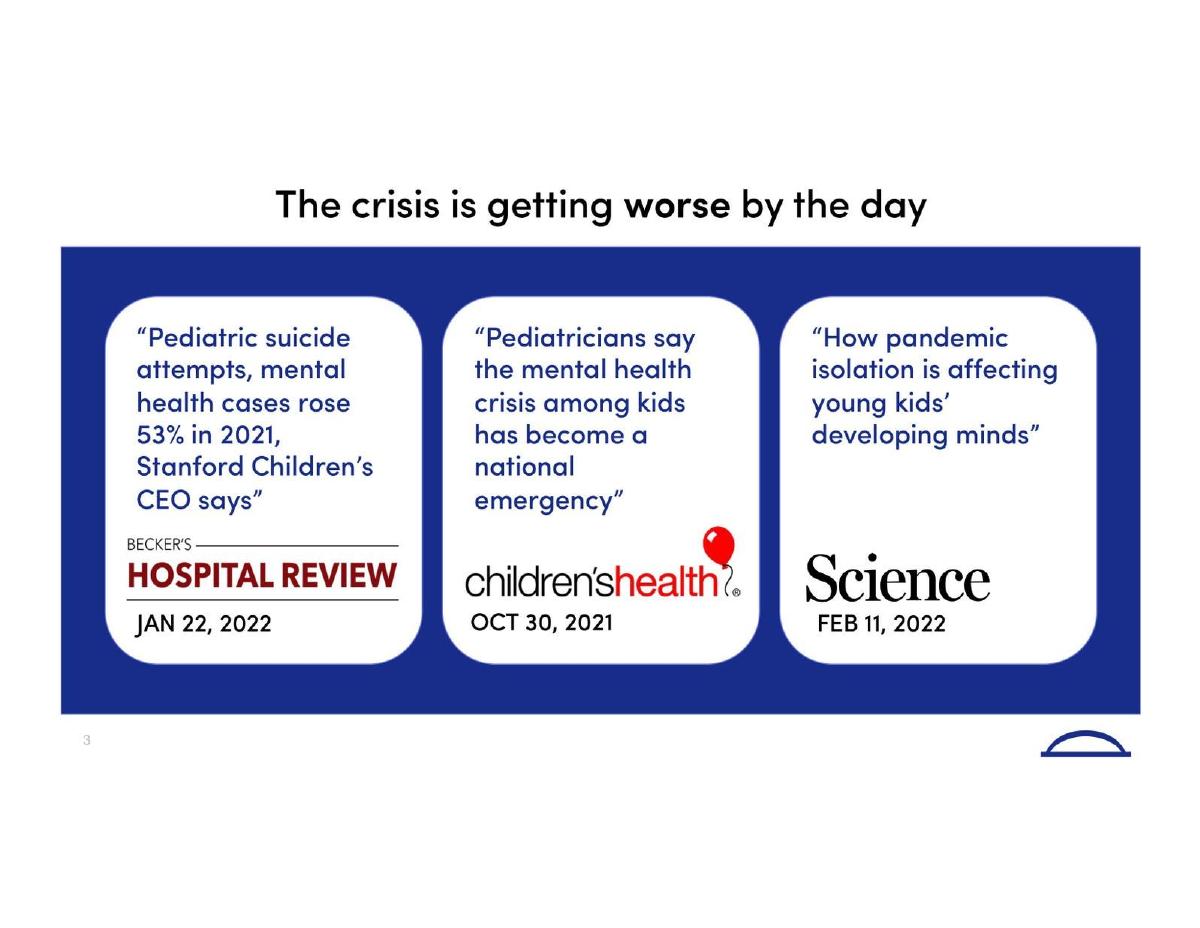
Slide 3 is the 'Why Now' slide. It relies on third-party validation to establish the severity of the problem. By quoting Becker's Hospital Review (Jan 22, 2022) , the deck notes that "Pediatric suicide attempts, mental health cases rose 53% in 2021." It further bolsters this with headlines from Children's Health and Science , framing the situation as a 'national emergency.' This is a standard but effective tactic for healthcare startups: prove the market isn't just large, but that it is currently failing under the weight of a crisis.
Slide 5: The Core Insight
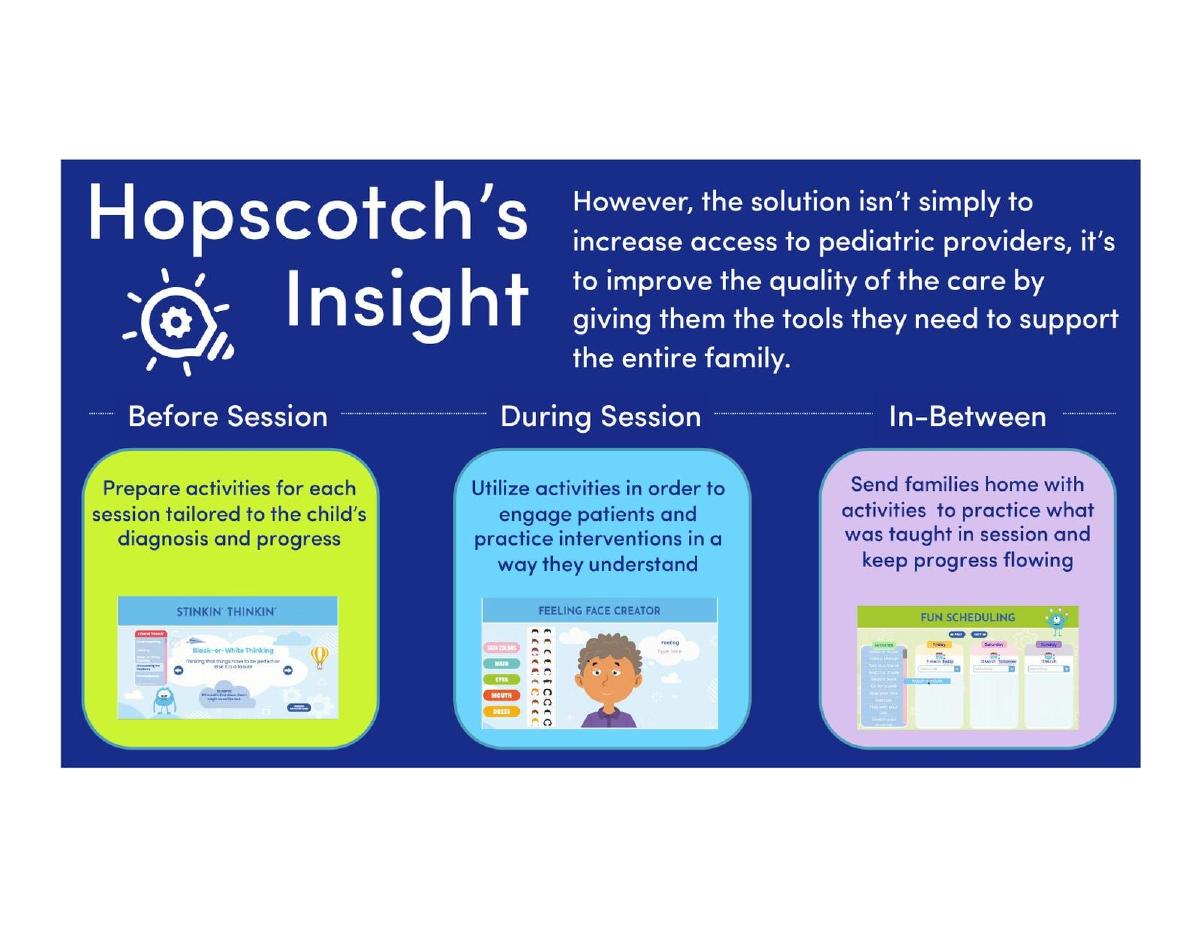
This is arguably the most important slide in the deck. It moves the conversation from 'access' to 'quality.' The text states: "However, the solution isn't simply to increase access to pediatric providers, it's to improve the quality of the care by giving them the tools they need to support the entire family."
The slide breaks down the patient journey into three distinct phases:
Before Session: Preparing activities tailored to the child's diagnosis. · During Session: Utilizing interactive tools like the 'Feeling Face Creator' to engage patients. · In-Between: Sending families home with 'Fun Scheduling' and activities to ensure progress doesn't stall between appointments.
This demonstrates that Hopscotch isn't just a video link; it is a clinical workflow tool.
Slide 7: The Mission Statement
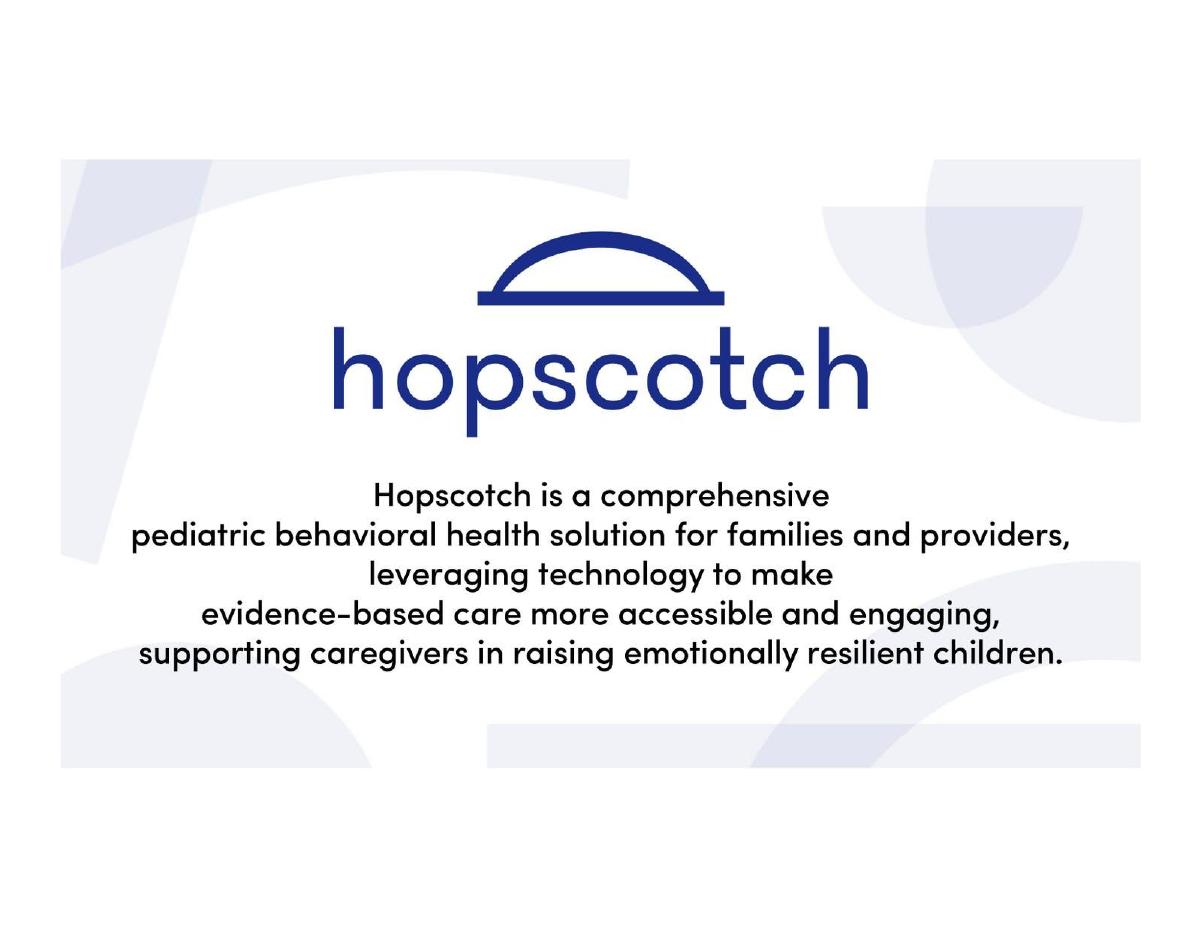
Slide 7 serves as a transition, defining Hopscotch as a "comprehensive pediatric behavioral health solution for families and providers." It emphasizes "evidence-based care" and "emotionally resilient children." This slide acts as a reset point, ensuring the investor understands the dual-sided nature of the platform before diving into the technical features.
Slide 9: The Platform Architecture
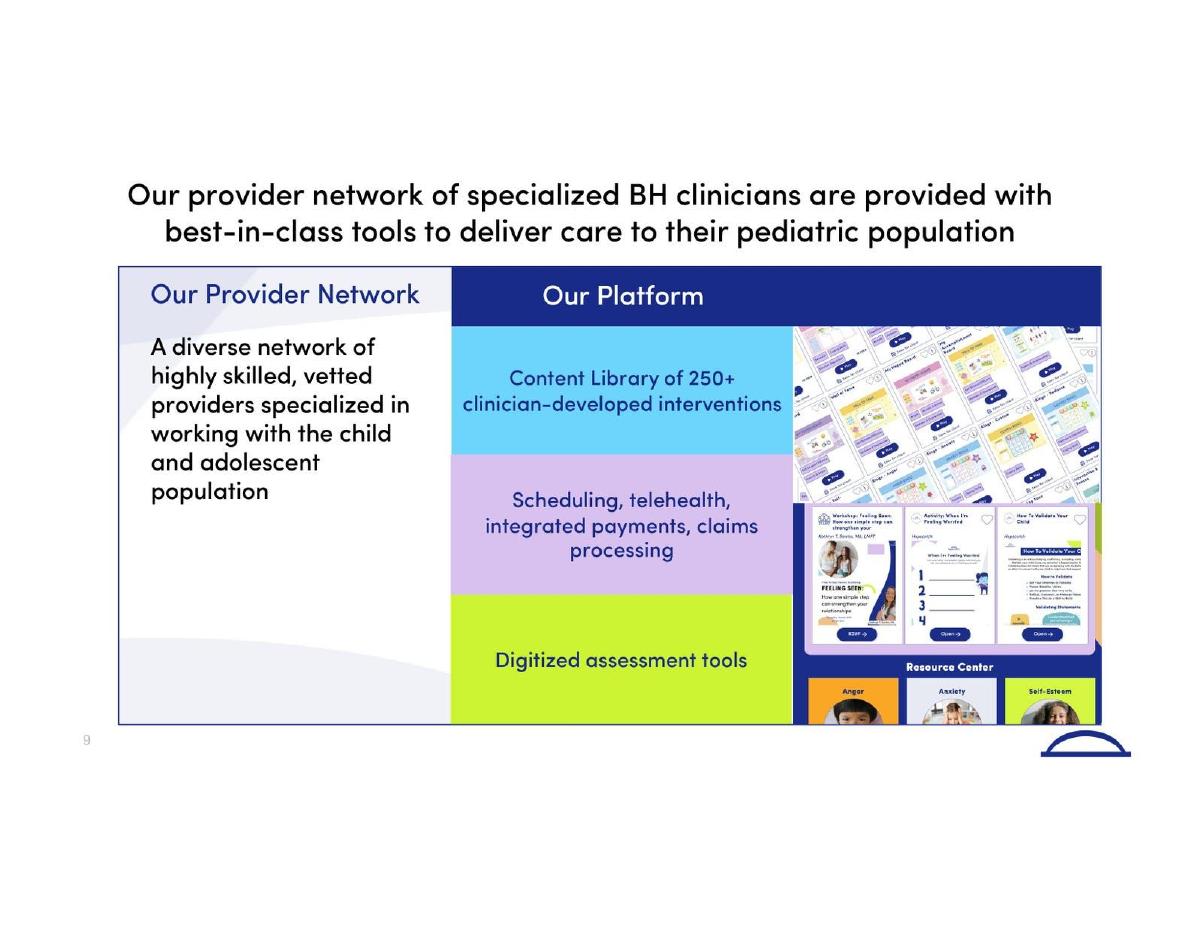
Slide 9 details the 'how.' The company divides its value proposition into two columns: Our Provider Network and Our Platform .
The network is described as "highly skilled, vetted providers." · The platform features a "Content Library of 250+ clinician-developed interventions." · It also includes the 'boring' but essential infrastructure: "Scheduling, telehealth, integrated payments, claims processing." · Finally, it mentions "Digitized assessment tools."
By including claims processing and payments, Hopscotch signals to investors that they are capturing the financial transaction, which is key for a Seed-stage company looking to prove a path to significant revenue.
Slide 12: The Leadership Team
The final slide in the provided sequence focuses on the team's pedigree. Marla Beyer (CEO) brings corporate strategy experience from large healthcare enterprises. Biju Kalissery (CTO) provides the technical backbone with 20 years of experience. The inclusion of Sourav Sengupta, MD, MPH as Chief Clinical Officer and Andrew Jatau, LPC as Head of BH Content is a strategic move to show that the '250+ interventions' mentioned earlier are backed by actual medical and clinical expertise. The slide features logos from UnitedHealth Group, MIT, and NYC Health + Hospitals , providing significant institutional credibility.
What Hopscotch Does Well
The deck is exceptionally strong at defining a clinical niche . By focusing exclusively on pediatrics, Hopscotch avoids the 'generalist telehealth' trap that many companies fell into post-2020. They recognize that treating a child requires different tools (games, visual aids, parental involvement) than treating an adult.
Furthermore, the product-market fit narrative is built into the workflow. By showing the 'Before, During, and In-Between' phases, they demonstrate a deep understanding of the clinician's daily pain points—specifically the difficulty of keeping children engaged and the lack of visibility into what happens between sessions.
What is Missing from the Deck
Despite raising $8M, the deck (as presented) leaves several critical questions unanswered for a typical investor:
Unit Economics: There is no mention of the Cost Per Acquisition (CPA) for providers or families, nor the Lifetime Value (LTV). · Revenue Model: While 'claims processing' is mentioned, the deck doesn't specify if they take a percentage of the billings, charge a SaaS fee to clinicians, or operate on a per-member-per-month (PMPM) basis with payers. · Traction: There are no slides showing current user growth, number of active clinicians, or patient outcomes data. · The Ask: The deck lacks a final slide detailing how much capital is being raised and exactly how it will be deployed (e.g., hiring, geographic expansion, R&D).
Founder Takeaways
Founders in the healthcare space should study how Hopscotch productized clinical expertise . Instead of just saying they have 'good content,' they quantified it (250+ interventions) and showed exactly where it fits in the provider's workflow. This turns a 'soft' asset into a 'hard' product feature.
Additionally, the team slide is a model for balanced hiring. A Seed-stage healthcare company needs a 'Builder' (CTO), a 'Strategist' (CEO), and a 'Practitioner' (CCO). Hopscotch checked all three boxes, which likely provided the necessary confidence for investors to commit $8M despite the missing financial projections in this specific slide sequence.
Frequently asked questions
- What is Hopscotch's primary business model according to the deck?
- Based on slide 9, Hopscotch operates as a dual-sided platform. It maintains a 'vetted' network of pediatric behavioral health clinicians while providing them with a comprehensive software suite. This suite includes a library of 250+ interventions, scheduling tools, telehealth capabilities, integrated payments, claims processing, and digitized assessment tools.
- How does Hopscotch differentiate its clinical approach?
- On slide 5, the company highlights its 'Insight' that simply increasing access isn't enough. They focus on 'quality of care' by providing tools for the 'entire family.' Their product facilitates engagement during three phases: 'Before Session' (tailored activities), 'During Session' (interactive interventions), and 'In-Between' (home practice to keep progress flowing).
- What metrics are used to justify the market need?
- Slide 3 cites three major sources to establish a crisis: a 53% increase in pediatric suicide attempts and mental health cases in 2021 (Becker's Hospital Review), a declaration of a 'national emergency' by pediatricians (Children's Health), and the impact of pandemic isolation on developing minds (Science).
- Who are the key members of the leadership team?
- Slide 12 lists Marla Beyer (Co-Founder & CEO) with corporate healthcare strategy experience; Biju Kalissery (Co-Founder & CTO) with 20 years of engineering experience; Sourav Sengupta, MD, MPH (Chief Clinical Officer); and Andrew Jatau, LPC (Head of BH Content), who previously founded a pediatric content site.
- What is missing from this pitch deck?
- The 12-slide deck is missing several standard venture components: a specific funding 'Ask' (amount and use of proceeds), a detailed slide on unit economics or revenue growth, a competitive landscape matrix, and a clear roadmap for geographic or service line expansion beyond the current pediatric focus.