Tilly presents a 12-slide deck focused on the emotional and informational gaps in the fertility journey. By positioning themselves as a 'safe go-to-place' for reducing fertility stress, the company targets a massive global market of 1 in 6 couples struggling to conceive. The deck highlights strong early traction, including 50% month-to-month growth since their June 2021 beta launch and over 2,000 users across 40 countries by December 2021. While the deck excels at establishing founder-market fit through personal narratives and medical expertise, it lacks a specific financial 'Ask' and detaile…
Key takeaways
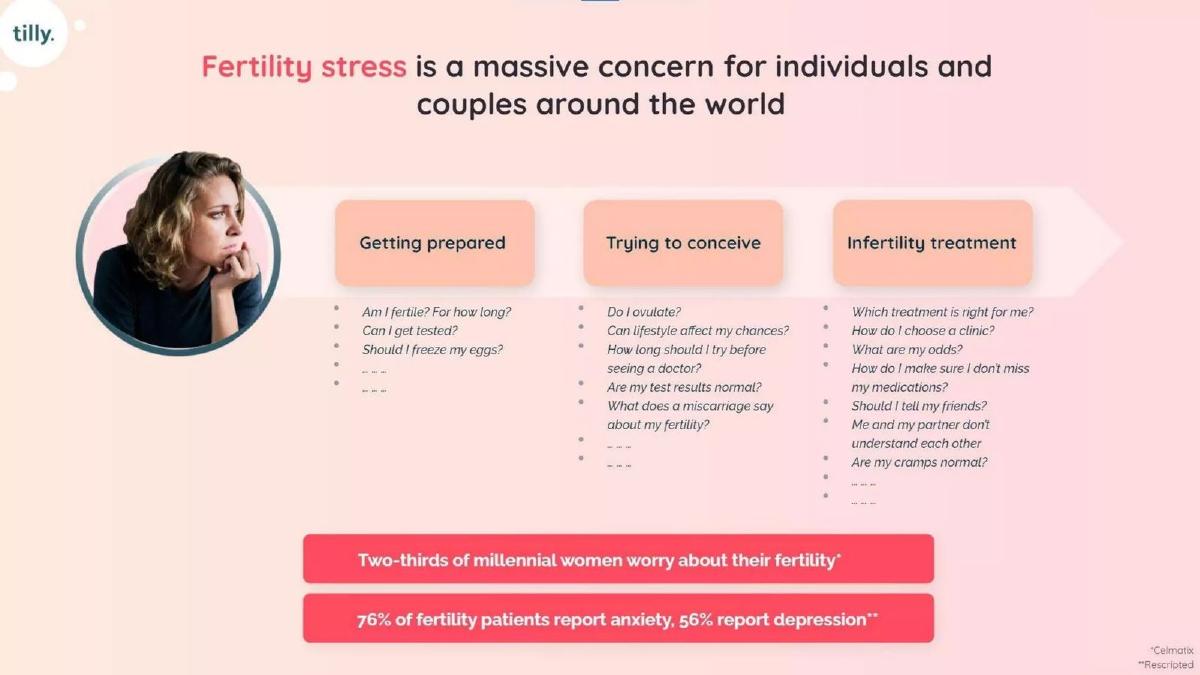
- Tilly identifies a significant psychological gap in fertility care, noting that 76% of fertility patients report anxiety (Slide 2).
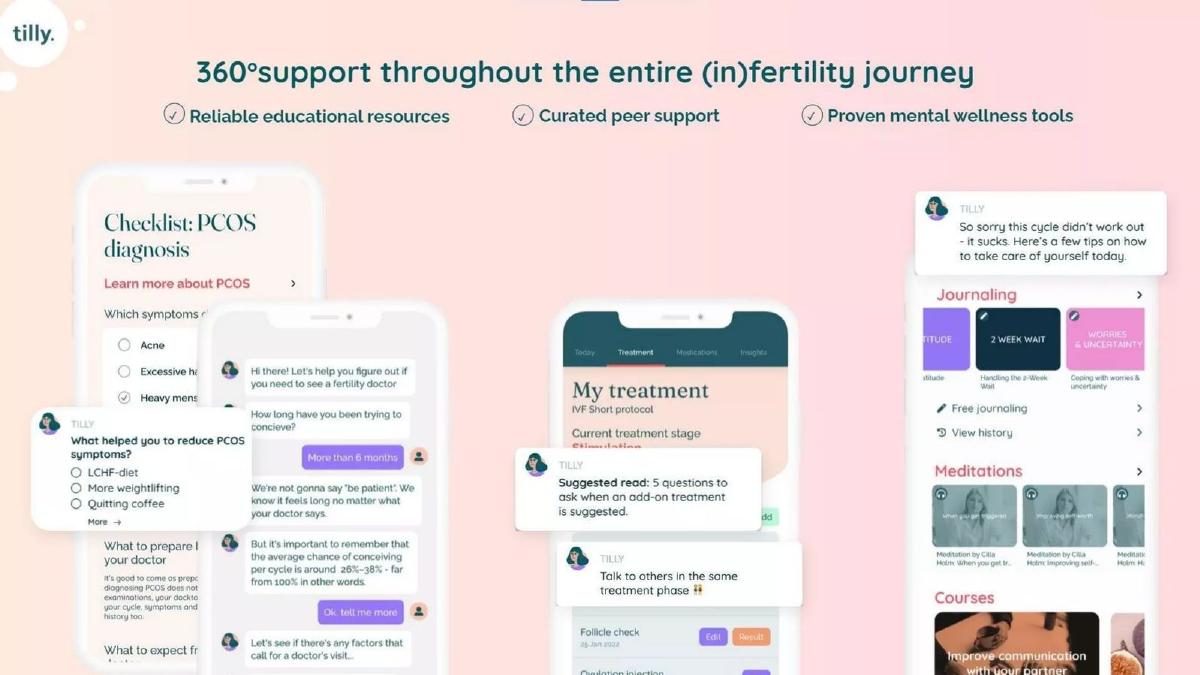
- The platform offers a '360-degree' support system including educational resources, peer support, and mental wellness tools (Slide 5).
- The market opportunity is defined by 48.5 million people in infertility treatment, with IVF costs ranging from $4,000 to $12,000 per treatment (Slide 7).
- Tilly achieved 50% month-to-month user growth between June and December 2021 (Slide 8).
- The company successfully monetized early through hormone and sperm tests, with 450+ tests sold at approximately 900 SEK each (Slide 8).
- The founding team demonstrates strong founder-market fit, with the CEO and COO sharing personal experiences with miscarriages and IVF (Slide 10).
- The deck outlines a clear expansion roadmap targeting 50,000 users by December 2022 and 200,000 by December 2023 (Slide 11).
- The deck omits a specific funding amount or valuation, ending instead with a general call to action for more info (Slide 12).
Introduction: The Emotional Side of Fertility
Tilly enters the health-tech space not just as a tracker, but as a support system. The deck, used in late 2021, focuses heavily on the psychological burden of infertility. By framing the problem through the lens of 'stress reduction,' Tilly carves out a niche that is distinct from the clinical, data-heavy approach of many incumbents. The following teardown examines how they balance empathy with growth metrics to attract early-stage investment.
Slides 1-3: Defining the Emotional Gap
Slide 1: Title The deck opens with a clean, lifestyle-oriented visual. The tagline, "The safe go-to-place for reducing fertility stress," immediately establishes the brand's value proposition. It positions the app as a companion rather than just a utility.
Slide 2: The Problem This slide breaks down the fertility journey into three phases: Getting prepared, Trying to conceive, and Infertility treatment. It uses heavy-hitting statistics to validate the emotional toll: "76% of fertility patients report anxiety, 56% report depression." By citing sources like Celmatix and Rescripted, the founders ground their emotional appeal in clinical data.
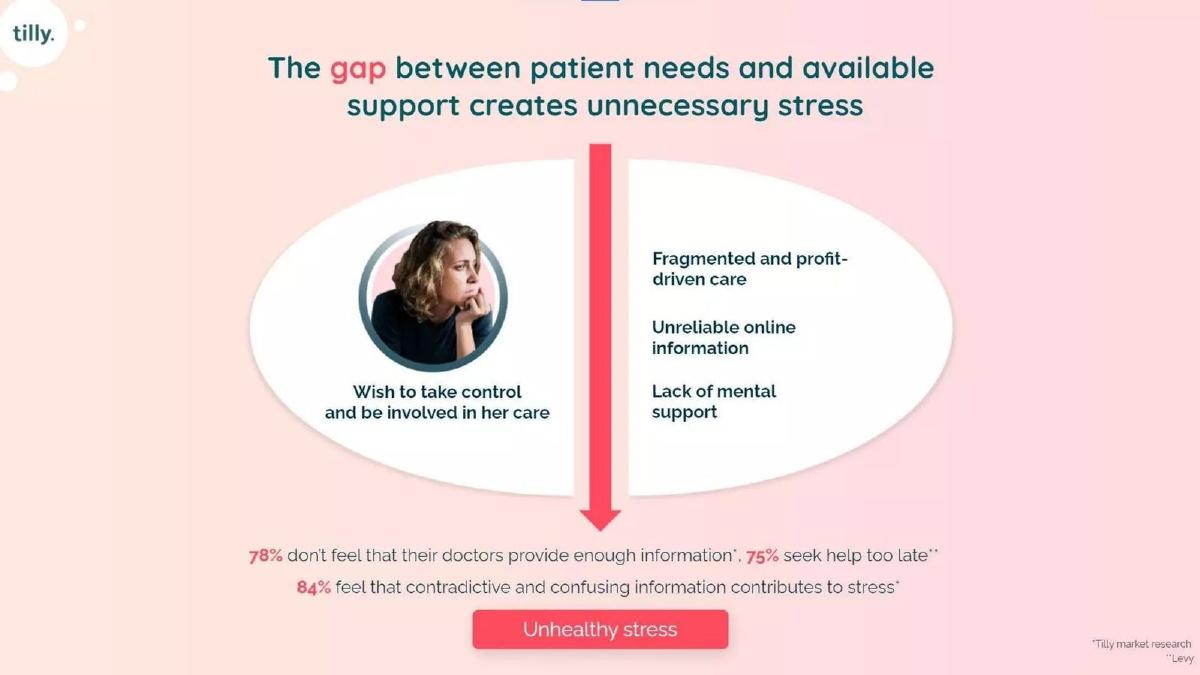
Slide 3: The Gap Tilly identifies a specific friction point: the gap between patient needs and available support. They list three primary pain points: fragmented and profit-driven care, unreliable online information, and a lack of mental support. The slide notes that "75% seek help too late," suggesting that a proactive support tool could improve clinical outcomes by encouraging earlier intervention.
Slides 4-6: The 360-Degree Solution
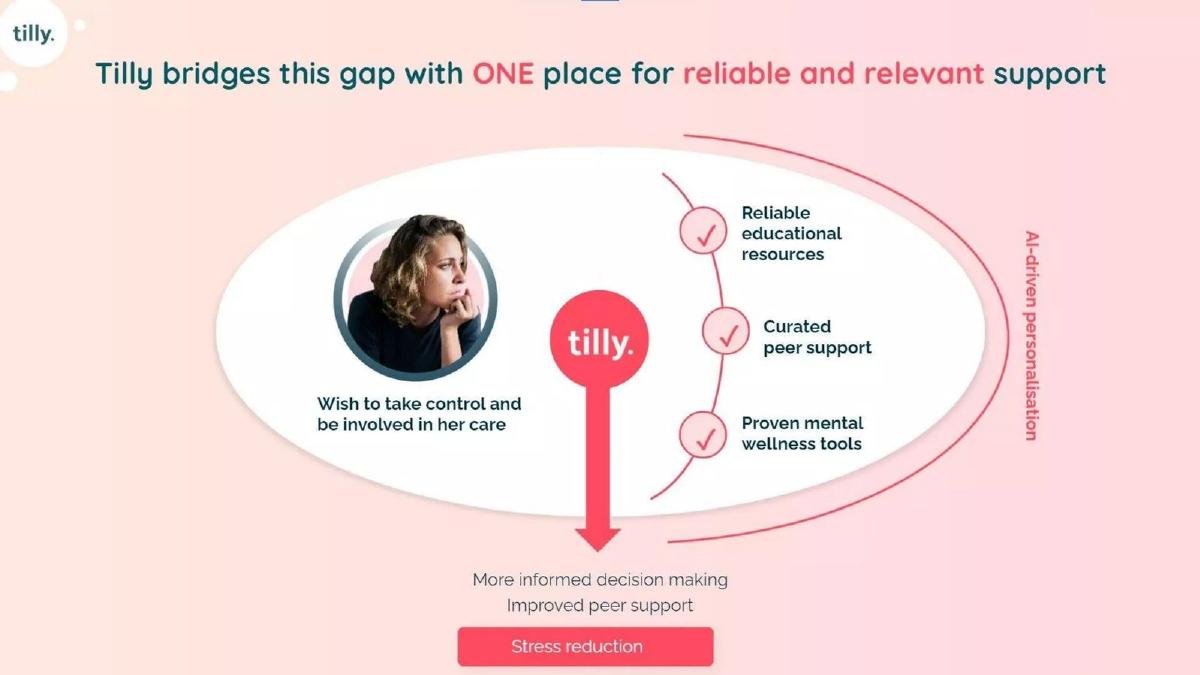
Slide 4: The Bridge Tilly introduces its solution as the "ONE place for reliable and relevant support." The slide highlights "AI-driven personalisation" as a key technical differentiator, aiming to move the user from "Unhealthy stress" to "Stress reduction" through informed decision-making and peer support.
Slide 5: Product Deep Dive This slide provides the first look at the app interface. It showcases features such as a PCOS diagnosis checklist, a conversational UI for determining if a doctor's visit is necessary, treatment plan tracking, and mental wellness tools like journaling and meditations. The inclusion of a "2-week wait" journal entry shows a deep understanding of the specific anxieties unique to fertility patients.
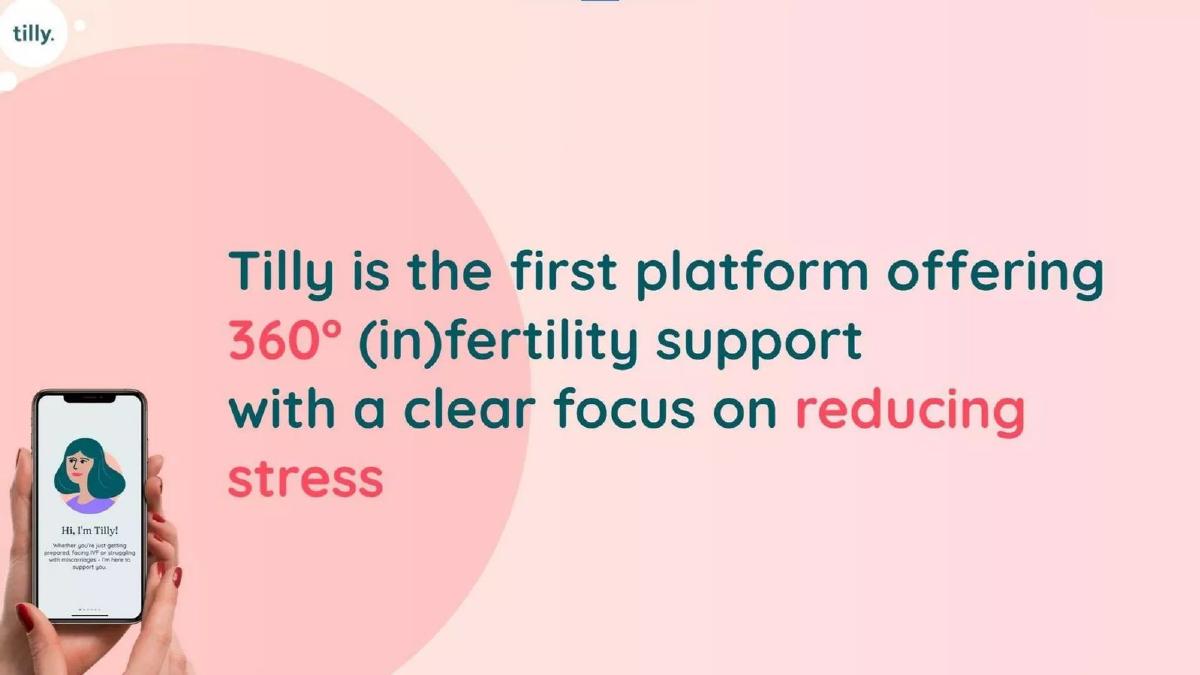
Slide 6: Positioning Tilly reinforces its market position as the "first platform offering 360° (in)fertility support with a clear focus on reducing stress." This slide serves as a transition from the product's features to the broader market opportunity.
Slides 7-9: Market Size and Early Traction
Slide 7: Market Opportunity The deck uses a funnel visualization to show the scale of the market. It starts with 600 million people "Getting prepared" (with egg freezing growing at 25% annually) and narrows down to 48.5 million in "Infertility treatment." A key figure here is the cost: "IVF cost (1 treatment): $4,000-12,000." Tilly notes that reaching just 2% of those diagnosed with infertility would generate 1 million yearly users, illustrating a clear path to scale.
Slide 8: Traction Timeline This is the strongest slide for investors. Tilly reports 50% month-to-month growth since their June 2021 beta. By December 2021, they reached 2,000+ users in 40+ countries and 1,200 monthly active users. Crucially, they demonstrate early monetization: "450+ tests á 900 SEK sold." The fact that 60% of buyers are not yet actively trying to conceive suggests a strong top-of-funnel for their preparation products.
Slide 9: Social Proof User testimonials from "Camilla" and "Niki" emphasize the app's ability to save time on "googling" and provide evidence-based info. A quote from "Jesper, OB/GYN" adds professional validation, stating he would recommend the app to his patients because it addresses the psychological aspects current care fails to meet. The average rating is listed as 4.6/5.
Slides 10-12: Team, Roadmap, and Call to Action
Slide 10: The Team The team slide is exceptionally strong in terms of founder-market fit. CEO Jenny Ann Ax:son Johnson and COO Anna Sane both list their personal fertility histories (miscarriages and IVF) alongside their professional credentials. This vulnerability builds trust. The presence of Dr. Evangelia Elenis as Chief Medical Advisor, with affiliations to Harvard Medical School, provides the necessary medical gravity. The slide also displays logos of supporters like Antler, Sting, and Propel Capital.
Slide 11: The Roadmap Tilly outlines an aggressive growth plan. Following a "Seed round" in late 2021, they aim for UK expansion and 50,000 users by December 2022. The long-term goal is a Series A and 200,000 users by December 2023, with potential US expansion. The roadmap is clear, though it lacks specific milestones for product development beyond "Recruitment."
Slide 12: The Conclusion The final slide summarizes the investment thesis: proven demand, strong organic growth, sustainable CAC, and a passionate team. However, it fails to include a specific financial ask, simply providing an email address for "more info."
What Works in the Tilly Deck
The deck excels at emotional storytelling backed by data . By starting with the psychological burden of infertility, the founders create a compelling narrative that makes the product feel necessary rather than just nice-to-have. The use of specific patient stats (Slide 2) and doctor testimonials (Slide 9) creates a dual-layered validation that appeals to both the user's needs and the medical community's standards.
The founder-market fit is another standout element. In the health-tech space, investors often look for founders who have lived the problem. By being transparent about their own miscarriages and IVF journeys, Jenny and Anna demonstrate a level of empathy and commitment that is difficult to replicate. This is balanced well by the technical and medical expertise of the CTO and Chief Medical Advisor.
Finally, the early monetization proof on Slide 8 is a significant de-risking factor. Selling 450+ tests at 900 SEK (approximately $85-90 USD) during a beta phase proves that users are willing to pay for fertility insights through the Tilly platform, providing a glimpse into a viable business model beyond just a free support app.
What is Missing from the Tilly Deck
The most glaring omission is the Financial Ask . A pitch deck is a fundraising tool, yet this deck ends without stating how much money is being raised or what the valuation expectations are. While Slide 11 mentions a "Seed round," it doesn't specify if this deck is for that round or what the specific capital allocation will be (e.g., % to marketing vs. % to R&D).
There is also a lack of Competitive Analysis . The fertility tech space is crowded with players like Carrot, Modern Fertility (acquired by Ro), and various cycle trackers. Tilly claims to be the "first platform" for 360-degree support, but they don't provide a matrix or comparison to show how they actually stack up against existing solutions. Investors need to know why a user would choose Tilly over an established player.
Lastly, the deck is light on Unit Economics . While they mention "Sustainable CAC" on the final slide, they don't provide the actual numbers. For a consumer app, understanding the Lifetime Value (LTV) relative to the Cost Per Acquisition (CAC) is vital for assessing the long-term scalability of the business.
What a Founder Should Copy
Founders should emulate Tilly’s funnel-based market sizing (Slide 7). Instead of just throwing out a massive "TAM" number, they break the market down into logical stages of the user journey. This shows a sophisticated understanding of their customer segments and how they plan to capture value at different price points (from $140 monthly spend to $40,000 for egg freezing).
The traction slide layout (Slide 8) is also a model of clarity. By combining a timeline with specific, high-impact bullet points (users, growth rate, items tracked, revenue), they provide a comprehensive snapshot of the business's health in a single glance. It avoids the clutter of multiple charts while still delivering the hard data investors crave.
Finally, the integration of personal narrative into the team slide is a powerful move for mission-driven startups. It transforms the team from a list of resumes into a group of people with a deep, personal stake in the company's success. For any startup in the wellness or healthcare space, this level of authenticity can be a major competitive advantage in a crowded pitch environment.
Final Thoughts
Tilly’s deck is a masterclass in building a brand that feels both professional and deeply human. While it needs more financial rigor and competitive positioning to satisfy late-stage investors, as a Seed-stage deck, it successfully communicates a clear problem, a validated solution, and a team that is uniquely qualified to execute. The focus on the "unhealthy stress" of fertility is a sharp strategic choice that differentiates them in a market often dominated by cold, clinical data.
Frequently asked questions
- What is the core problem Tilly is trying to solve?
- Tilly addresses the 'unhealthy stress' caused by fragmented, profit-driven fertility care and unreliable online information. According to slide 3, 78% of patients feel their doctors don't provide enough information, and 84% feel that contradictory information contributes to their stress. Tilly aims to be the single, reliable source for both emotional support and medical education during the fertility journey.
- How does Tilly differentiate itself from other fertility apps?
- Unlike simple cycle trackers, Tilly positions itself as a '360-degree' support platform. Slide 6 emphasizes a clear focus on reducing stress through AI-driven personalization. The product includes specific tools like journaling for the '2-week wait,' meditations for self-worth, and courses on partner communication, which are often overlooked by purely clinical or tracking-focused competitors.
- What metrics does Tilly use to prove traction?
- Tilly uses a mix of engagement and growth metrics on slide 8. They report 50% monthly growth, 1,200 monthly active users, and over 40,000 tracked items within the app. They also highlight early revenue through the sale of 450+ tests (hormone and sperm) and a community presence of over 4,000 followers/subscribers as of December 2021.
- Who are the key members of the Tilly team?
- The team combines management experience with medical expertise. CEO Jenny Ann Ax:son Johnson has 10+ years in Ed-tech, while COO Anna Sane has 10+ years in marketing and consulting. Both share personal fertility struggles. They are supported by CTO Per Lindström and Chief Medical Advisor Dr. Evangelia Elenis, an OB/GYN with research ties to Uppsala University and Harvard Medical School (Slide 10).
- What is missing from this pitch deck?
- The most notable omission is a clear 'Ask' slide. While slide 11 mentions a 'Seed round' and 'Series A' on a timeline, slide 12 does not specify how much capital is being raised, the valuation, or the specific allocation of funds. Additionally, the deck lacks a detailed competitor matrix and a breakdown of unit economics (LTV/CAC ratios).