Tiferet Academy’s pitch deck, prepared for a 2013 launch on Long Island, proposes a modernized Jewish day school model. The core value proposition centers on 'Accelerated Learning' and 'Sustainable Tuition' through a blended learning rotation. The deck is heavily conceptual, using external case studies like Acton Academy and quotes from education reformers like Sir Ken Robinson to validate its methodology. While it provides a clear roadmap for grade-level expansion (starting with Pre-K through 2nd grade), it lacks specific financial projections, a defined leadership team, and a finalized curr…
Key takeaways
- The school planned to launch on Long Island in 2013 with a focus on sustainable tuition (Slide 1).
- The pedagogical model is a triad of real-world skills, blended learning, and project-based learning (Slide 2).
- Students rotate through three modalities: online instruction, teacher-led instruction, and assistant-led collaborative activities (Slide 3).
- The deck uses Acton Academy as a benchmark, citing a gain of 2.5 grade levels in math and reading within one year (Slide 4).
- The curriculum combines traditional Judaic studies (Torah, Mitzvot, Ivrit) with modern skills like entrepreneurship and critical thinking (Slide 6).
- Growth plans involve opening with one section for Pre-K through 2nd grade and adding one new grade annually (Slide 7).
- At the time of the deck, the school was still searching for a Head of School and evaluating educational consulting firms (Slide 8).
- The technology strategy was in the research phase, focusing on selecting blended learning providers and vendors (Slide 9).
Tiferet Academy: Reimagining the Yeshiva Day School
The Tiferet Academy pitch deck represents a specific moment in the early 2010s when the 'blended learning' movement began to intersect with the crisis of rising tuition in private religious education. The deck is less of a financial ask and more of a pedagogical manifesto intended to build consensus among stakeholders, parents, and potential committee members for a new school on Long Island.
Slide 1: Title and Vision
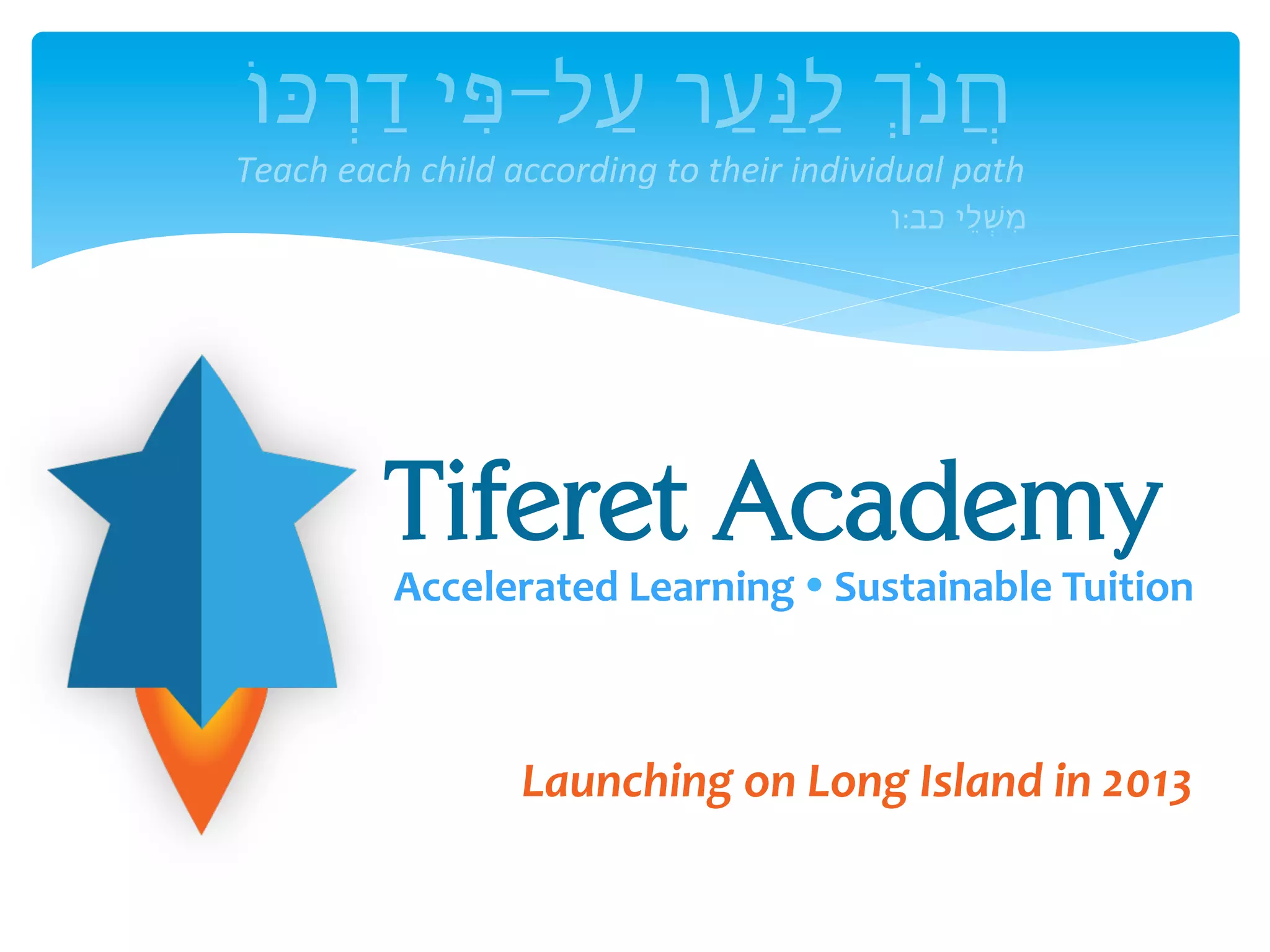
The cover slide establishes the brand identity: Tiferet Academy. The tagline, 'Accelerated Learning • Sustainable Tuition,' immediately addresses the two biggest concerns for private school parents: academic outcomes and cost. The inclusion of a Hebrew verse from Proverbs (22:6), 'Teach each child according to their individual path,' anchors the modern 'blended learning' approach in traditional Jewish values. The launch date is explicitly set for 2013 on Long Island.
Slide 2: The 21st Century Education Framework
Slide 2 uses a Venn diagram to define the '21st Century Classroom.' It sits at the intersection of three pillars: Real-World Skill Focus, Blended Learning, and Project-Based Learning. This slide serves to differentiate Tiferet from traditional, lecture-heavy yeshivas, signaling a shift toward modern educational trends that were gaining traction at the time.
Slide 3: The Blended Learning Rotation Model
This slide provides the most concrete operational detail in the deck. It illustrates a rotation model where students move between three stations: Online Instruction (individualized software), Teacher-led Instruction (small group focus), and Collaborative Activities led by an assistant. This model is the engine behind the 'Sustainable Tuition' claim, as it suggests a more efficient use of lead teacher time and the potential for varied staffing ratios.
Slide 4: Validation via Acton Academy
Because Tiferet was a new entity in 2013, it lacked its own data. Slide 4 borrows credibility from Acton Academy, a well-known pioneer in the micro-school and blended learning space. The slide cites a specific metric: the average Acton student gained 2.5 grade levels in math and reading in one year. This is a classic 'proof of concept' slide, using a successful peer to justify the proposed model.
Slide 5: Intellectual Endorsements
Slide 5 features quotes from Sir Ken Robinson, Geoff Mulgan, and Seth Godin. These figures are not affiliated with the school but are used to provide 'social proof' for the project-based learning philosophy. The quotes emphasize creativity, teamwork, and student agency, further distancing Tiferet from 'mainstream schooling.'
Slide 6: Tiferet Values and Curriculum Balance
This slide attempts to bridge the gap between modern educational theory and religious requirements. It lists traditional Judaic values (Torah & Mitzvot, Tikun Olam, Ivrit B'Ivrit) alongside modern secular goals (Critical thinking, Entrepreneurial skills, Individual development). This balance is crucial for the target demographic—parents who want a religious environment but are wary of sacrificing secular academic rigor.
Slide 7: The Growth Roadmap
The 'Plan for Growth' is conservative and incremental. The school intended to open with single sections for Pre-K through 2nd grade. The strategy of 'adding a new grade each year' is a standard low-risk approach for new private schools, allowing the institution to grow organically with its founding class rather than attempting to fill a K-8 building on day one.
Slide 8: Education and Curriculum Status
Slide 8 reveals that the school was still in the very early stages of development. It notes that they were 'currently evaluating multiple educational consulting firms' and that the curriculum would only be finalized after a Head of School was hired. This slide functions as a call to action for committee members, listing tasks like 'Research educational best practices' and 'Interview parents.'
Slide 9: Technology Strategy
Similar to the curriculum slide, the technology slide shows a work-in-progress. The 'Current Status' is listed as 'Researching multiple Blended Learning providers' and 'Setting up website.' It outlines the need for a committee to oversee technical aspects like hardware and software selection, reinforcing that the school was in the planning phase rather than ready to launch.
Slide 10: Addressing the Quality vs. Cost Myth
The final slide in this set tackles the 'Myth & Reality' of their model. It addresses the skepticism that a 'cheaper' school must be 'lower quality.' The slide argues that blended learning is actually 'teacher-centric' because it frees teachers to do what they do best: differentiated instruction. This is a defensive but necessary slide to combat the perception that technology in the classroom is merely a cost-cutting measure that replaces human educators.
What Works in This Deck
Clear Value Proposition: The 'Sustainable Tuition' hook is a powerful motivator for the target audience. · Visualizing the Model: The rotation diagram on Slide 3 makes a complex pedagogical concept easy to understand for non-educators. · Strategic Benchmarking: Using Acton Academy's data provides a necessary 'reason to believe' in a model that was relatively new at the time. · Cultural Alignment: The use of Hebrew text and traditional values ensures the school feels like a legitimate choice for the Jewish community despite its modern methods.
What Is Missing from the Deck
The Team: There are no bios for the founders or the board. In education, the 'who' is often as important as the 'how.' · Financial Specifics: While 'Sustainable Tuition' is promised, there are no actual tuition figures or budget projections to show how the blended model achieves these savings. · Location Details: 'Long Island' is a large area; the deck lacks a specific target neighborhood or facility plan. · Competitive Analysis: There is no mention of other local yeshivas or how Tiferet specifically competes with them beyond price. · The 'Ask': The deck does not specify a fundraising goal or a specific request for capital, suggesting it may have been used primarily for parent recruitment or committee building.
Founder Lessons: Copy This, Avoid That
Copy the 'Rotation Model' Visualization: If your business model relies on a specific process or workflow to save costs or improve outcomes, visualize it clearly as Tiferet did on Slide 3. It moves the conversation from abstract theory to operational reality.
Avoid the 'Consultant' Trap: Slide 8 and 9 essentially say, 'We haven't decided what we are doing yet; we are looking for consultants to tell us.' While honest, this can undermine investor confidence. It is better to present a 'Proposed Curriculum' or 'Technology Shortlist' to show that the founders have a strong starting point, even if it is subject to change by a future Head of School.
Use External Data Wisely: Tiferet’s use of Acton Academy data is a smart way to fill a data vacuum. If you are a pre-revenue startup, find a 'proxy' company that uses a similar model and cite their success to validate your market assumptions.
Define the 'Sustainable' in Sustainable Tuition: If your primary differentiator is price, you must eventually show the math. A slide comparing the 'Traditional Model' cost structure vs. the 'Blended Model' cost structure would have made the 'Sustainable Tuition' claim much more persuasive to a financially-minded donor or investor.
Frequently asked questions
- What is the primary value proposition of Tiferet Academy?
- The primary value proposition is the combination of 'Accelerated Learning' and 'Sustainable Tuition.' By using a blended learning model where students rotate between online, teacher-led, and assistant-led stations, the school aims to provide a high-quality, individualized Jewish education at a lower cost than traditional private day schools.
- How does the school plan to handle its curriculum development?
- According to Slide 8, the curriculum was not finalized at the time of the presentation. The school was in the process of evaluating educational consulting firms and planned to finalize the curriculum only after hiring a Head of School. A committee was tasked with researching best practices and interviewing parents to map child needs.
- What evidence is provided to support the blended learning model?
- The deck relies on a case study from Acton Academy in Austin, TX. Slide 4 shows a bar chart where Acton students gained 2.5 grade levels in a single year compared to public school students. It also features endorsements from education experts like Sir Ken Robinson and Seth Godin to support project-based learning.
- What was the school's initial expansion strategy?
- The plan for growth (Slide 7) was to launch with single sections for Kindergarten, 1st Grade, and 2nd Grade, with Pre-K included based on demand. The long-term strategy was to add one new grade level each year as the initial cohort progressed.
- Who are the key people behind Tiferet Academy?
- The provided slides do not list the founders, board members, or the specific 'Committee' members mentioned in the tasks. Slide 8 indicates that the search for a Head of School was ongoing, suggesting the organization was in a pre-operational leadership phase.