Thymia’s 9-slide deck is a masterclass in scientific credibility and clear analogical positioning. By framing their AI-powered mental health assessment tool as the psychological equivalent of a blood pressure cuff, the founders successfully bridged the gap between complex neuropsychology and tangible medical utility. The deck leans heavily on the founders' academic credentials—featuring three PhDs in core leadership roles—to justify their claim of building the world’s most accurate assessment tool. While the deck is light on specific financial projections and current traction metrics, it clea…
Key takeaways
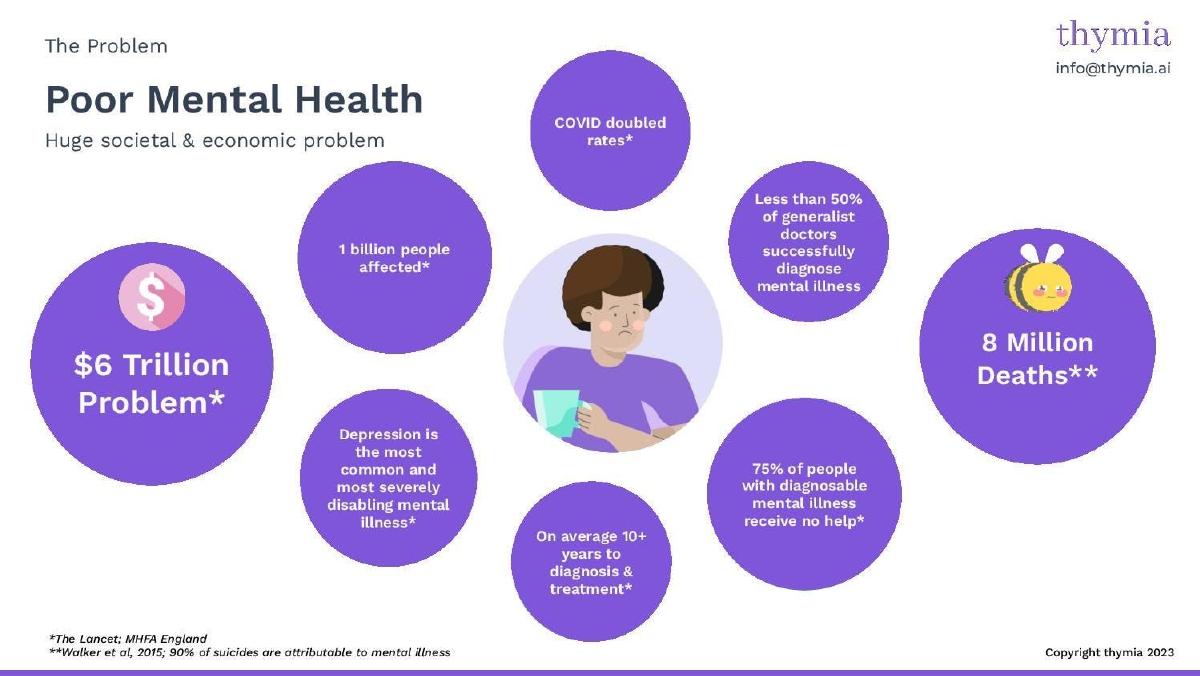
- The deck identifies a $6 trillion global economic problem and cites 8 million deaths attributable to mental illness on Slide 2.
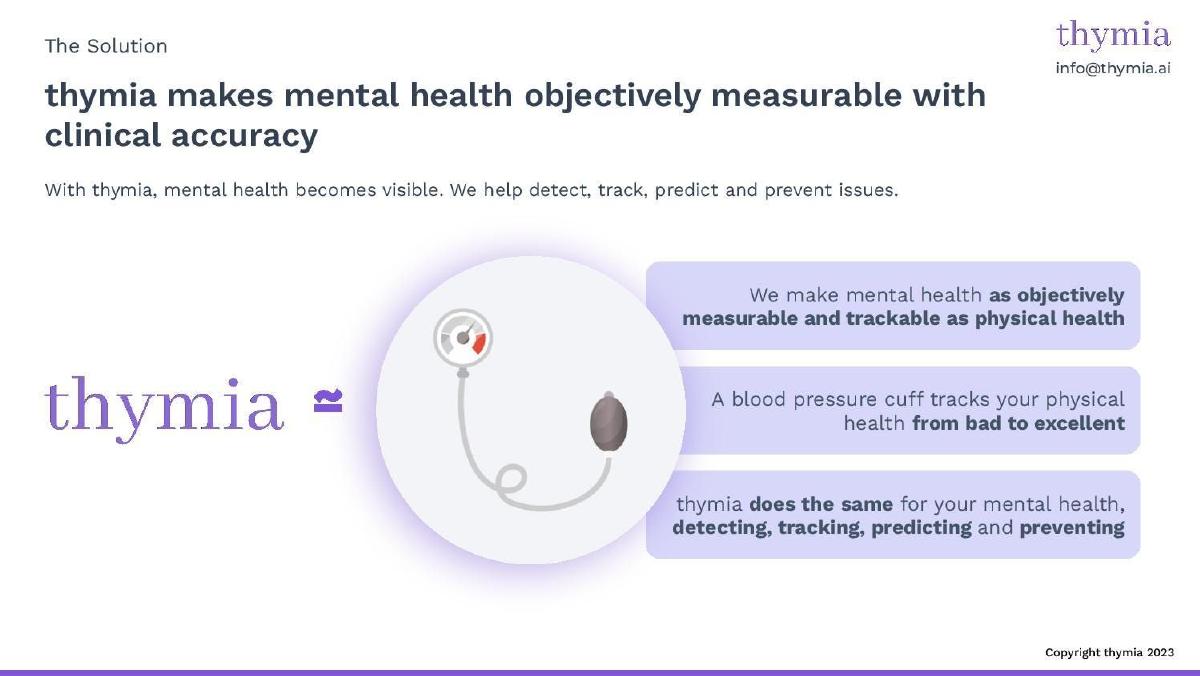
- Thymia uses a strong analogy, comparing their tool to a blood pressure cuff to explain how they make mental health 'objectively measurable' on Slide 4.
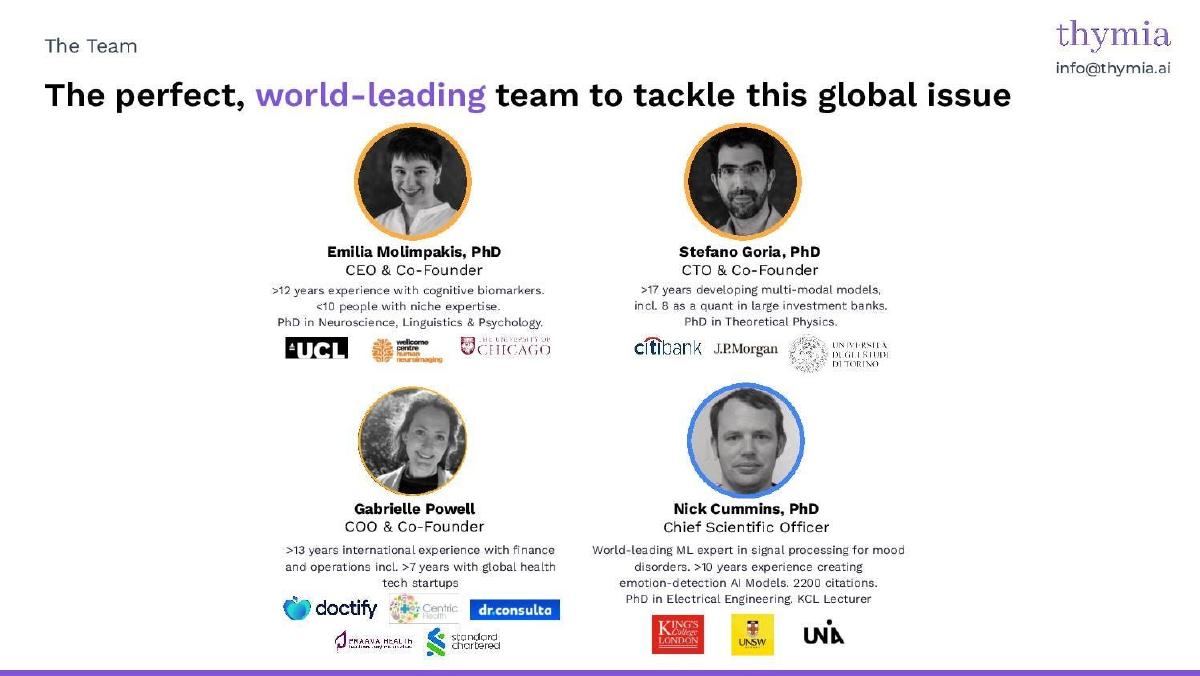
- The founding team is highly technical, featuring three PhDs with backgrounds in neuroscience, linguistics, theoretical physics, and electrical engineering on Slide 5.
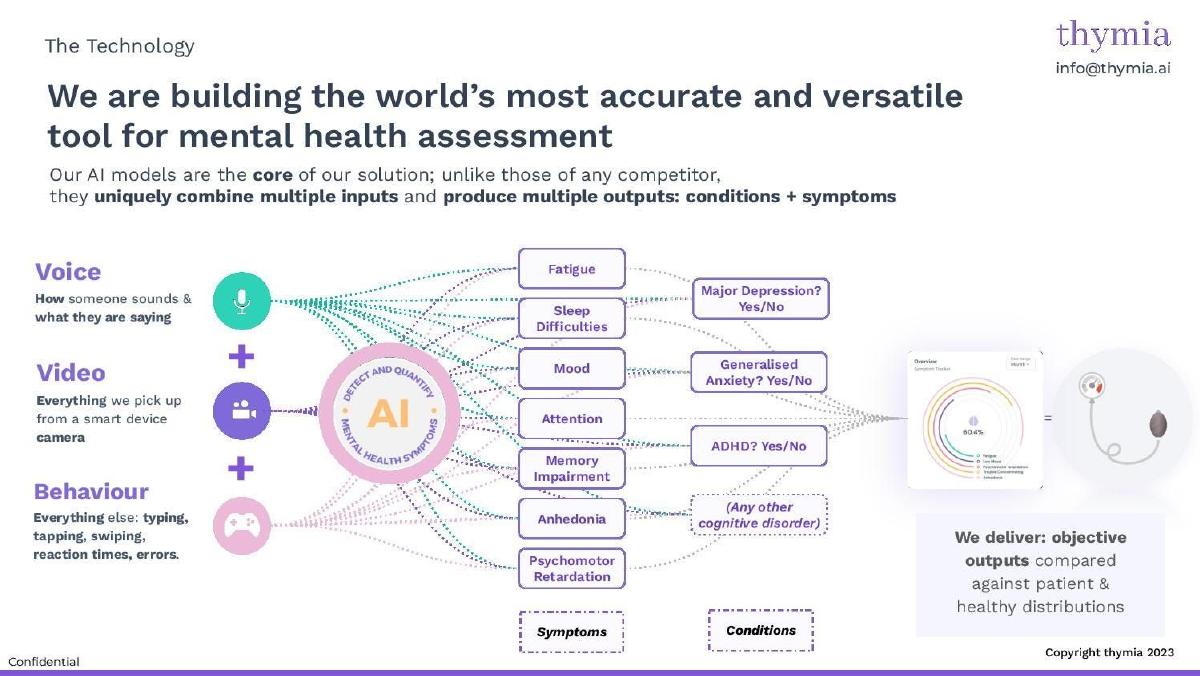
- The technology is multimodal, combining voice, video, and behavioral data (typing, swiping) to detect symptoms like fatigue and anhedonia on Slide 6.
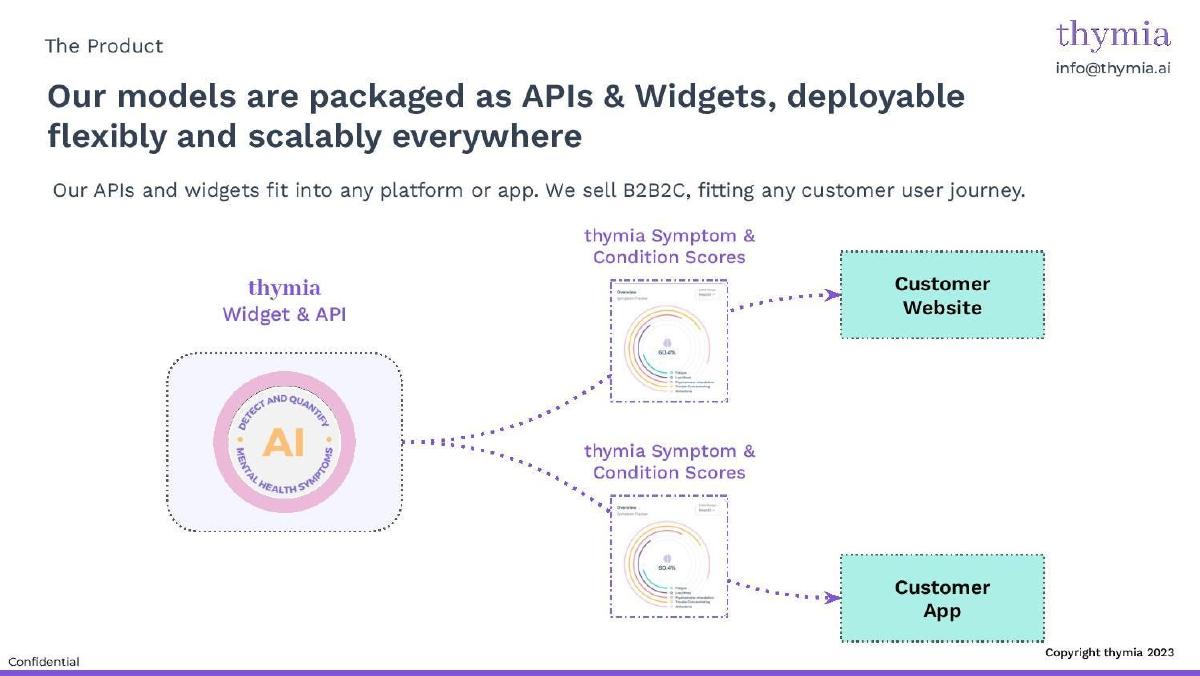
- The business model is B2B2C, delivering models via APIs and widgets into existing customer platforms on Slide 7.
- Regulatory approval is the core of their strategy, with a stated goal to dominate the clinical space within 5 years on Slide 8.
- The deck sets a specific deadline for Series A readiness, targeting Q3 2024 for key revenue and product milestones on Slide 9.
- The deck omits a specific 'Ask' slide, current revenue figures, and a detailed competitor matrix.
Slide 1: Title Slide
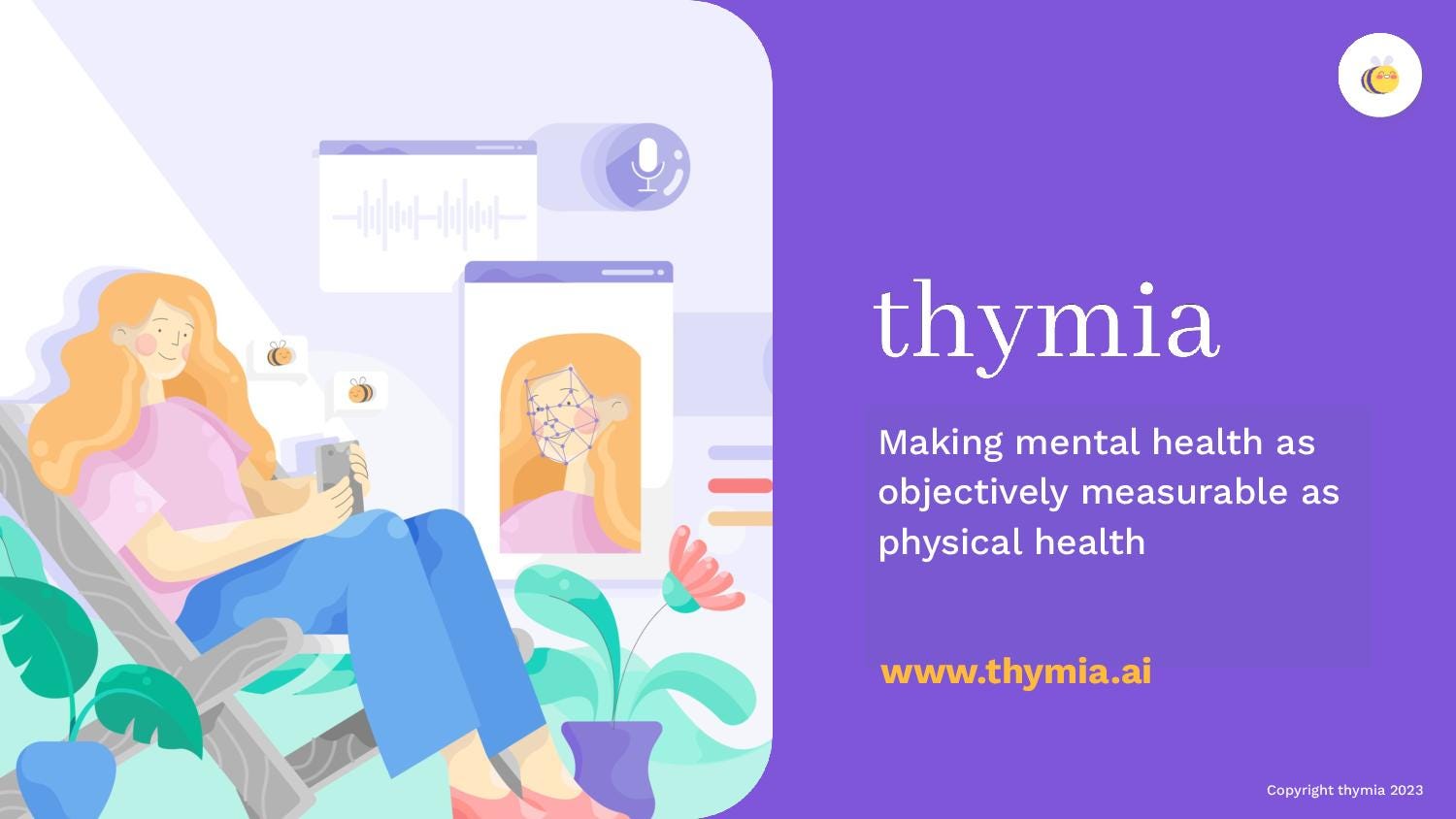
The deck opens with a clean, branded title slide. It features the company name, 'thymia,' and the tagline: 'Making mental health as objectively measurable as physical health.' The visual includes a stylized illustration of a person using a mobile device for a video call, with overlays suggesting facial tracking and voice analysis. This immediately establishes the company's focus on digital, objective assessment.
Slide 2: The Macro Problem
Slide 2 addresses 'Poor Mental Health' as a 'Huge societal & economic problem.' The slide uses a series of circles to highlight staggering statistics: a '$6 Trillion Problem,' '1 billion people affected,' and '8 Million Deaths.' It also notes that COVID doubled rates and that it takes an average of '10+ years to diagnosis & treatment.' Crucially, it points out a clinical failure: 'Less than 50% of generalist doctors successfully diagnose mental illness.' This sets a high-stakes stage for a technological intervention.
Slide 3: The Tooling Gap
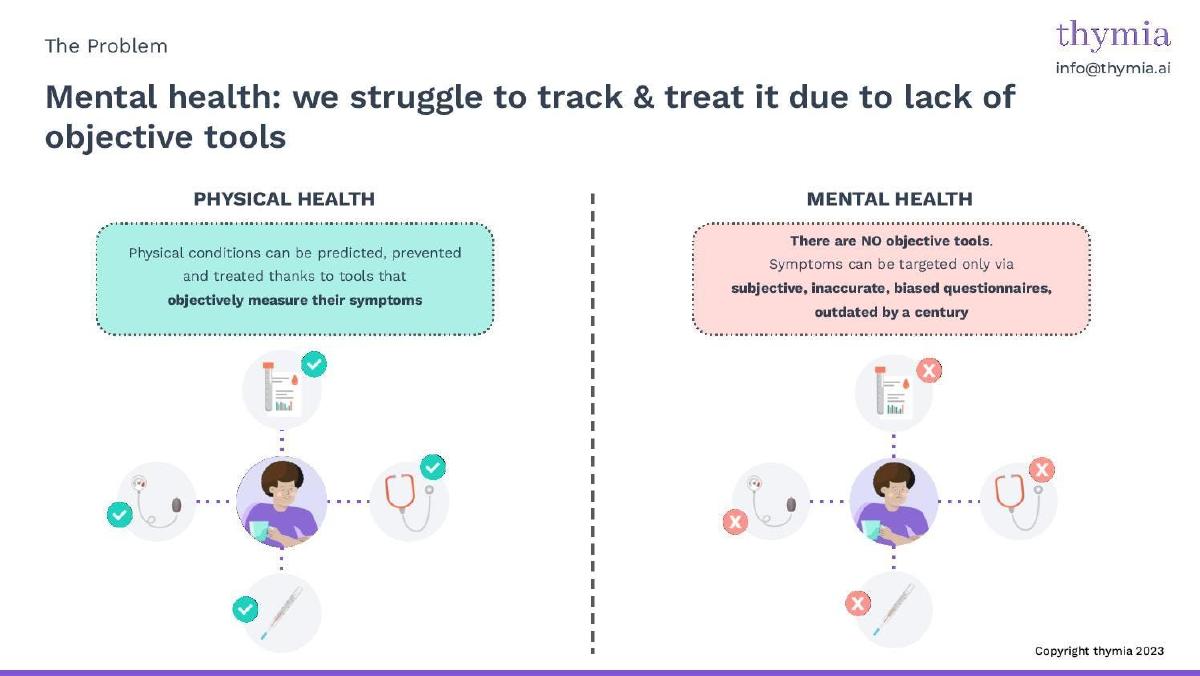
This slide contrasts physical health and mental health to highlight a lack of objective tools. On the left, physical health is shown as predictable and treatable thanks to objective measurements (thermometers, blood tests, stethoscopes). On the right, mental health is depicted with 'X' marks over those same tools, stating: 'There are NO objective tools. Symptoms can be targeted only via subjective, inaccurate, biased questionnaires, outdated by a century.' This slide effectively defines the 'enemy' as the status quo of subjective reporting.
Slide 4: The Solution Analogy
Thymia introduces its solution by doubling down on the physical health analogy. Slide 4 explicitly states: 'thymia ≈ A blood pressure cuff.' It claims to make mental health 'objectively measurable and trackable as physical health.' By comparing their complex AI to a common, understood medical device, they simplify the value proposition for investors: they are building the standard diagnostic hardware (or software equivalent) for the brain.
Slide 5: The Team
The team slide is a significant strength for a Seed-stage deep tech company. It features four leaders, three of whom hold PhDs. CEO Emilia Molimpakis has over 12 years of experience with cognitive biomarkers and a PhD from UCL. CTO Stefano Goria brings 17 years of experience in multi-modal models, including time as a quant at Citibank and J.P. Morgan. CSO Nick Cummins is described as a 'World-leading ML expert in signal processing for mood disorders' with over 2200 citations. COO Gabrielle Powell rounds out the group with 13 years of finance and operations experience. The logos of UCL, University of Chicago, J.P. Morgan, and King's College London provide immediate institutional credibility.
Slide 6: The Technology
Slide 6 provides a technical overview of how the system works. It describes a multimodal approach combining Voice (acoustics and linguistics), Video (camera data), and Behaviour (typing, swiping, reaction times). These inputs feed into an AI that detects and quantifies 'Symptoms' (fatigue, sleep, mood, attention, etc.) which then map to 'Conditions' (Major Depression, Generalised Anxiety, ADHD). The slide emphasizes that they deliver 'objective outputs compared against patient & healthy distributions,' suggesting a normative database against which users are measured.
Slide 7: The Product and Distribution
This slide explains the business model and delivery mechanism. Thymia’s models are 'packaged as APIs & Widgets,' allowing them to be 'deployable flexibly and scalably everywhere.' They explicitly state a 'B2B2C' strategy, showing how the 'thymia Symptom & Condition Scores' flow from their API into a 'Customer Website' or 'Customer App.' This indicates a platform-agnostic approach where they act as the intelligence layer for other health providers.
Slide 8: The Strategy
The long-term strategy is to 'Dominate clinical space within 5 years fueled by Regulatory Approval.' The slide shows a roadmap starting with the 'world’s largest clinically validated depression & fatigue datasets,' moving through 'Class I Regulatory Approval,' and finally 'Scaling in Target Market.' The target markets are segmented into Primary Care (GPs), Secondary Care (Psychiatrists), and Digital Healthcare (online-only providers). This slide signals that the company understands the regulatory moats required in MedTech.
Slide 9: The Route to Series A
The final slide sets clear milestones for the next 12-18 months, targeting 'Series A metrics by Q3 2024.' It lists four pillars: Revenue (scaling sales to hit targets by Oct '24), Users (deepening customer success), Product (5+ new symptoms in 5 new languages), and Defensibility (Medical Device Regulation & IP patents by Dec '24). This slide serves as a de facto roadmap for how the current investment will be used to reach the next valuation inflection point.
What Works in the Thymia Deck
The Analogy: Comparing AI neuropsychology to a 'blood pressure cuff' is brilliant. It takes a 'black box' technology and gives it a familiar, clinical utility that any investor can understand.
Technical Credibility: In the AI and Healthcare space, the 'who' is as important as the 'what.' Having three PhDs with specific expertise in the problem domain (neuroscience, signal processing, theoretical physics) makes the claim of 'world-leading' technology much more believable.
Multimodal Breadth: By showing that they track voice, video, and behavior, they differentiate themselves from simpler 'mood tracker' apps. The complexity of the inputs (Slide 6) suggests a higher barrier to entry for competitors.
Regulatory Focus: Many health-tech startups try to bypass regulation by staying in the 'wellness' category. Thymia leans into regulation as a 'fuel' for dominance, which appeals to institutional healthcare investors who value clinical validation.
What is Missing from the Thymia Deck
The Ask: The deck does not state how much money they are looking for or the terms of the round. While this is often handled in a separate document or conversation, its absence here leaves the narrative without a clear call to action.
Current Traction: While they mention having the 'world's largest datasets,' the deck is light on current commercial traction. There are no mentions of current pilot programs, revenue figures, or specific B2B partners already using the API.
Competitive Landscape: The deck claims their models are 'unlike those of any competitor' (Slide 6) but does not provide a competitive matrix or explain how they differ from other players in the digital phenotyping space (e.g., Mindstrong or Ellipsis Health).
Unit Economics: There is no mention of how the API is priced (per user, per call, or flat fee). For a B2B2C model, understanding the margin and pricing structure is critical for evaluating the revenue milestones on Slide 9.
Founder Takeaways
Use 'The Enemy' to frame your solution: Thymia spends two slides (2 and 3) defining the problem and the failure of current tools. By the time they introduce their solution, the reader is already convinced that the current way of doing things is broken.
Lead with your strongest asset: For Thymia, that is the team. If you have a high-pedigree founding group, don't hide them at the end of the deck. Slide 5 acts as a massive credibility boost that carries through the technical slides that follow.
Set a deadline for your next round: Slide 9 is a great example of 'forward-looking accountability.' By stating exactly what metrics they will hit by Q3 2024 to be ready for a Series A, they show investors they are thinking about the long-term capital strategy, not just the current check.
Simplify the complex: AI-powered neuropsychology is difficult to explain. Use visual flowcharts (Slide 6) and simple analogies (Slide 4) to ensure the core value proposition isn't lost in the technical jargon.
Frequently asked questions
- What is Thymia's core product?
- Thymia builds AI-powered models delivered via APIs and widgets that objectively measure mental health symptoms. As shown on Slide 6, the system analyzes voice (how someone sounds), video (camera data), and behavior (typing/swiping) to quantify symptoms like fatigue, mood, and attention, ultimately helping to identify conditions like Major Depression or ADHD.
- How does Thymia plan to generate revenue?
- According to Slide 7, Thymia operates a B2B2C model. They package their AI models as APIs and widgets that can be integrated into third-party customer websites and apps. This allows them to fit into various user journeys within primary care, secondary care, and digital healthcare sectors.
- What is the team's background?
- The team is exceptionally academic. Slide 5 lists CEO Emilia Molimpakis (PhD in Neuroscience, Linguistics & Psychology), CTO Stefano Goria (PhD in Theoretical Physics), and CSO Nick Cummins (PhD in Electrical Engineering). The leadership also includes COO Gabrielle Powell, who brings over 13 years of international finance and operations experience.
- What are the key milestones for their next funding round?
- Slide 9 outlines the 'Route to Series A,' targeting Q3 2024. Key goals include hitting revenue targets by Oct 2024, adding 5+ new symptoms in 5 new languages, and securing Class I Medical Device Regulation and IP patents by December 2024.
- What is missing from the Thymia pitch deck?
- The deck lacks a formal 'Ask' slide detailing exactly how much they are raising (though publisher reports state $2.7M). It also omits a detailed competitive landscape, specific current revenue or user numbers, and a breakdown of unit economics or pricing tiers for their API.