Thoughtful AI's Series A deck is a masterclass in efficiency, using just 9 slides to secure $20M. The narrative centers on the massive inefficiency of US healthcare administration, which consumes 3.5% of GDP. By positioning their technology as 'Fully Human Capable' (FHC) bots rather than traditional SaaS, they justify high ACVs ranging from $180k to $900k. The deck highlights exceptional capital efficiency, reporting $362k ARR per employee and 190% Net Revenue Retention (NRR) within their Ideal Customer Profile. While the deck lacks a traditional 'Ask' slide or detailed technical architecture…
Key takeaways
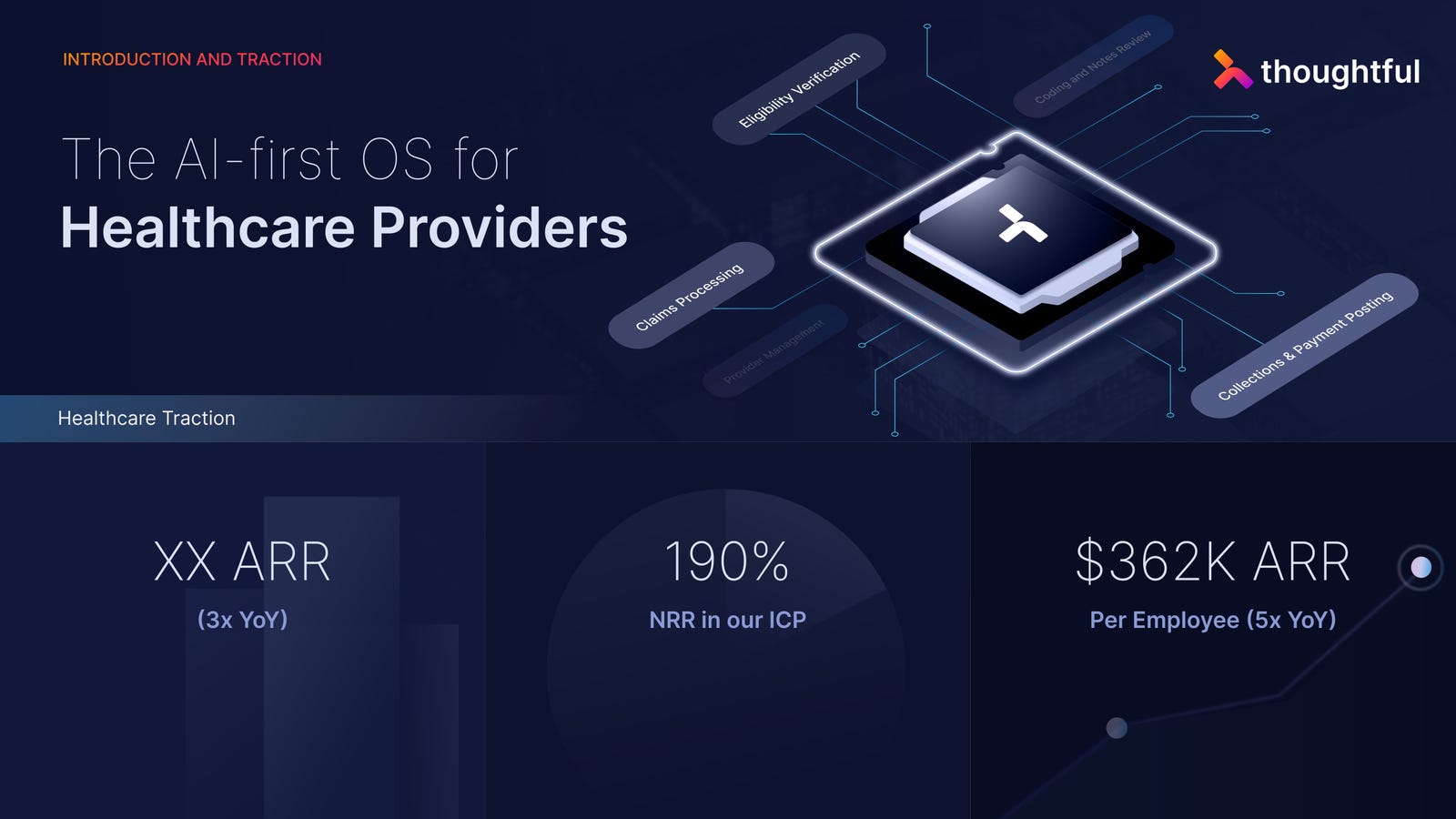
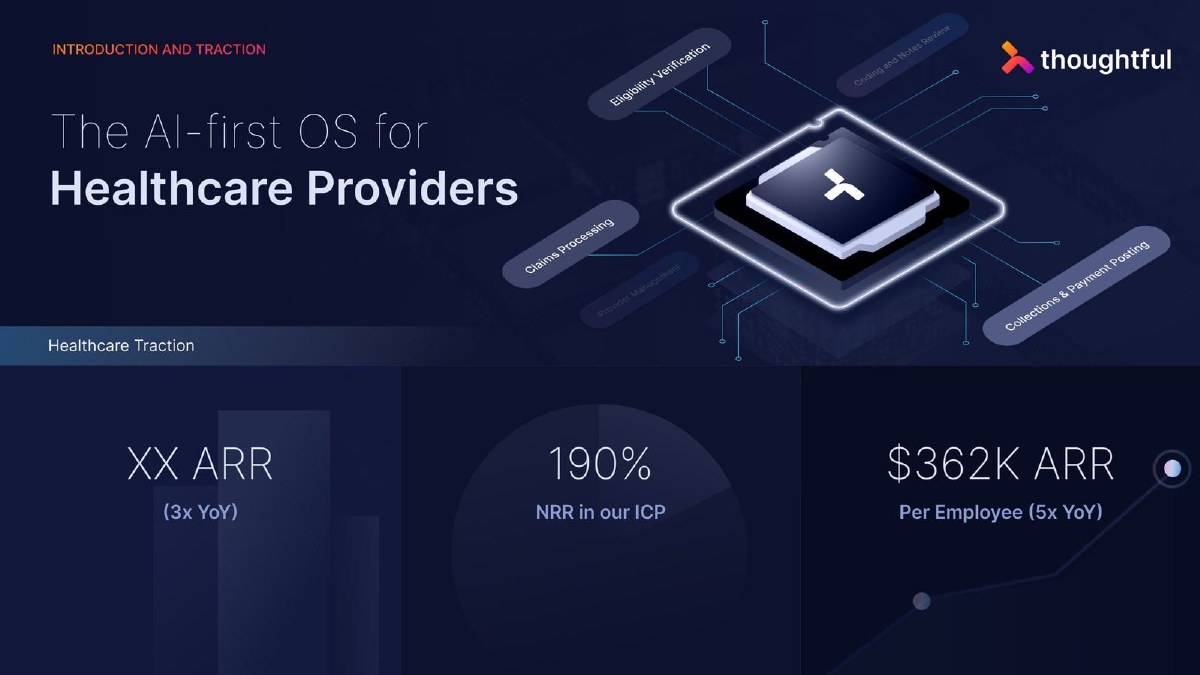
- The company reports a high-efficiency operation with $362K ARR per employee, representing a 5x year-over-year increase on Slide 1.
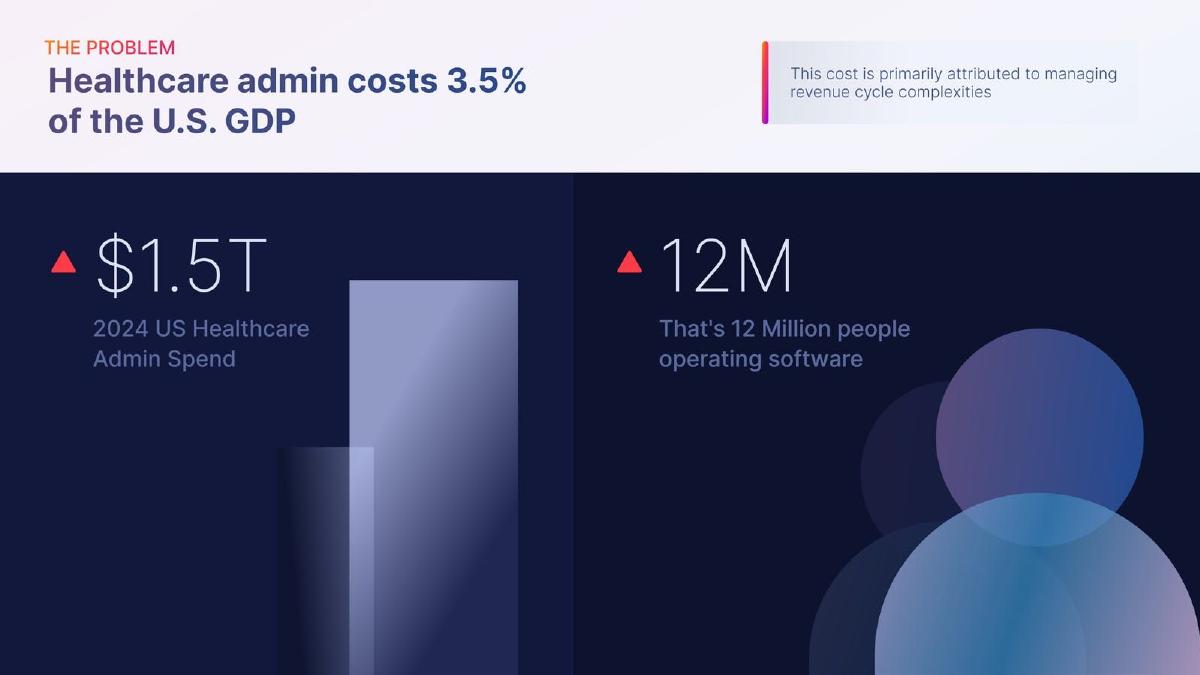
- Thoughtful AI targets a massive $1.5 trillion US healthcare admin spend, specifically focusing on the 12 million people currently operating software on Slide 2.
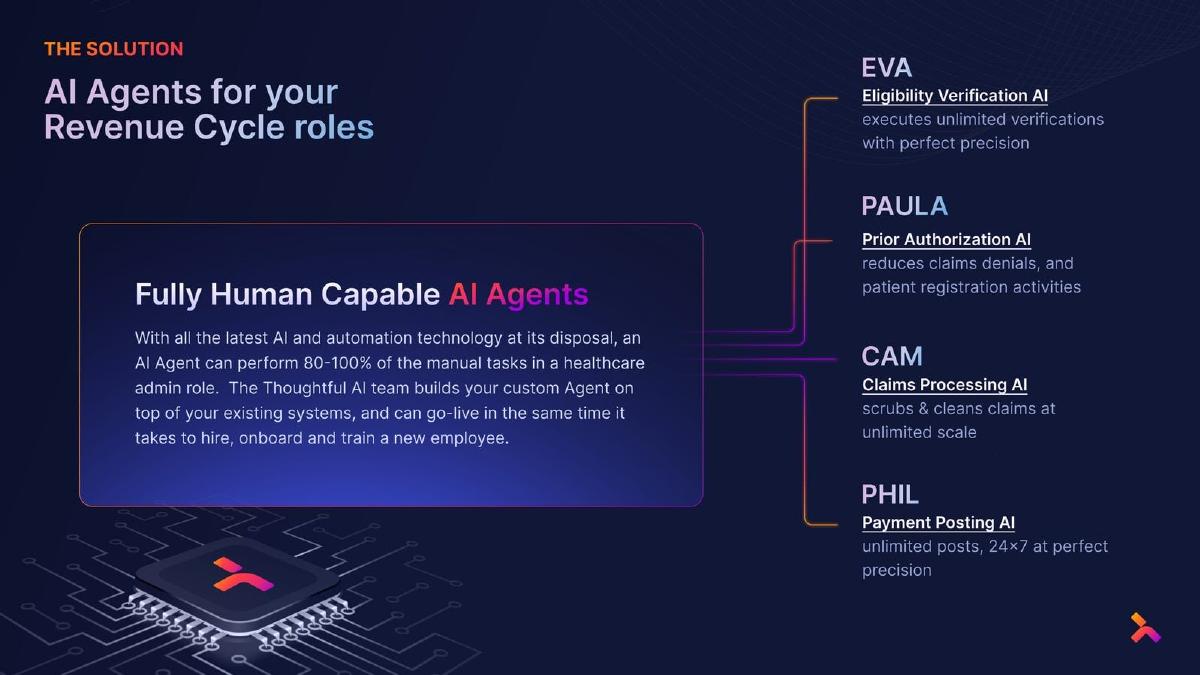
- The product is modularized into named AI agents—EVA, PAULA, CAM, and PHIL—each handling specific revenue cycle roles like eligibility and payment posting on Slide 3.
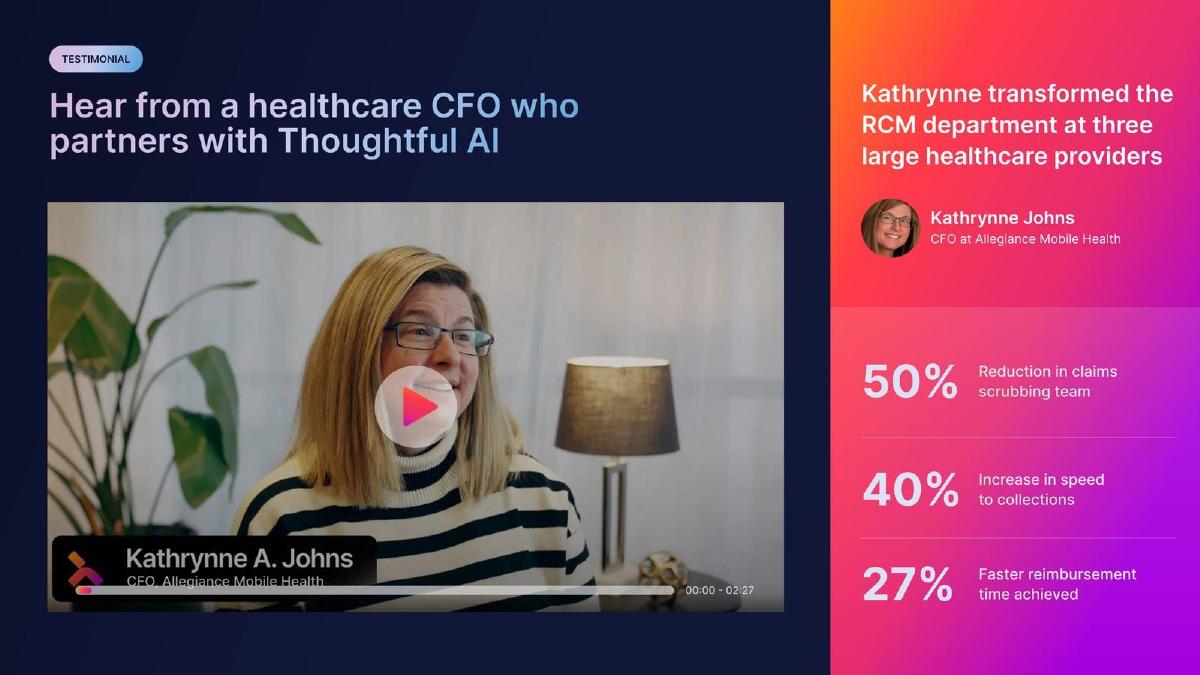
- A customer testimonial from a healthcare CFO claims a 50% reduction in the claims scrubbing team and a 27% faster reimbursement time on Slide 4.
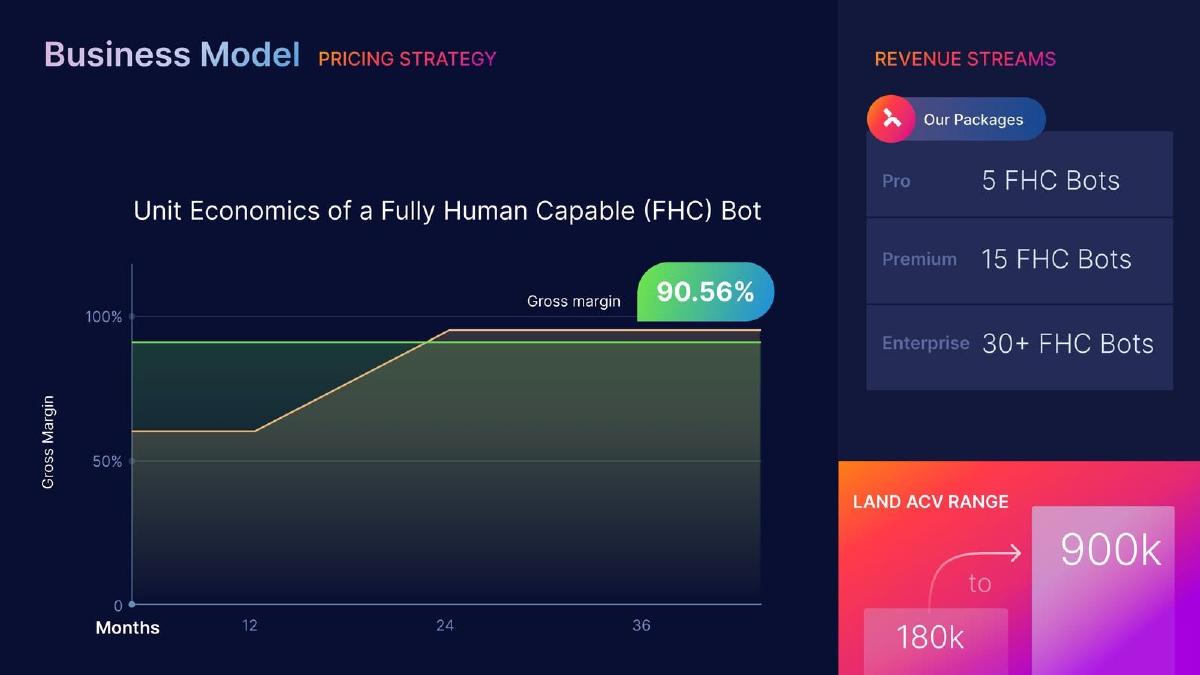
- The business model shifts from per-user pricing to bot-based packages, with an Enterprise tier offering 30+ 'Fully Human Capable' bots on Slide 6.
- Unit economics show a projected gross margin of 90.56% after a 24-month ramp-up period on Slide 6.
- The competitive landscape on Slide 7 positions Thoughtful as the only 'Enterprise-Grade' solution that offers 'Full Human Replacement' compared to legacy SaaS players.
- The growth strategy on Slide 8 outlines a path to $100M ARR by growing from 7 to 50 logos within their current ICP.
Slide-by-Slide Teardown
Slide 1: Introduction and Traction
The deck opens with a bold claim: 'The AI-first OS for Healthcare Providers.' This slide serves as a combined title and traction summary. It features three key metrics that immediately establish the company's momentum. First, it notes 'XX ARR' with a '3x YoY' growth rate. While the specific dollar amount is redacted in this public version, the growth rate is the primary signal for Series A investors. Second, it claims '190% NRR in our ICP,' an exceptionally high Net Revenue Retention rate that suggests customers are rapidly expanding their usage after the initial land. Finally, it highlights '$362K ARR Per Employee,' noting this is a '5x YoY' improvement. This last metric is crucial for an AI company, as it proves the technology is driving internal efficiency, not just providing a service through hidden human labor.
Slide 2: The Problem
Thoughtful AI frames the problem in macroeconomic terms. The headline states that 'Healthcare admin costs 3.5% of the U.S. GDP.' Below this, two large figures provide the scale: '$1.5T' in 2024 US Healthcare Admin Spend and '12M' people operating software. This slide is effective because it identifies the 'unit' of the problem—not just a vague dollar amount, but the specific number of human workers whose tasks are ripe for automation. By focusing on 'people operating software,' they set the stage for their solution: software that operates itself.
Slide 3: The Solution
The solution is presented as 'Fully Human Capable AI Agents.' The slide explains that these agents can perform '80-100% of the manual tasks in a healthcare admin role.' The company uses a modular branding strategy, naming their agents: EVA (Eligibility Verification), PAULA (Prior Authorization), CAM (Claims Processing), and PHIL (Payment Posting). This anthropomorphism is a strategic choice; it reinforces the idea that these are not just features, but digital employees that can be 'hired' to fill specific roles. The slide also promises that these agents can go live in the same time it takes to train a new human employee, addressing the common fear of long implementation cycles in healthcare.
Slide 4: Testimonial
Social proof is critical in healthcare, a sector notoriously slow to adopt new technology. This slide features Kathrynne Johns, CFO at Allegiance Mobile Health. The metrics provided are specific and impressive: a '50% Reduction in claims scrubbing team,' a '40% Increase in speed to collections,' and '27% Faster reimbursement time achieved.' By showing that a CFO has 'transformed the RCM department at three large healthcare providers' using Thoughtful AI, the company moves from theoretical value to proven ROI.
Slide 5: Market Opportunity
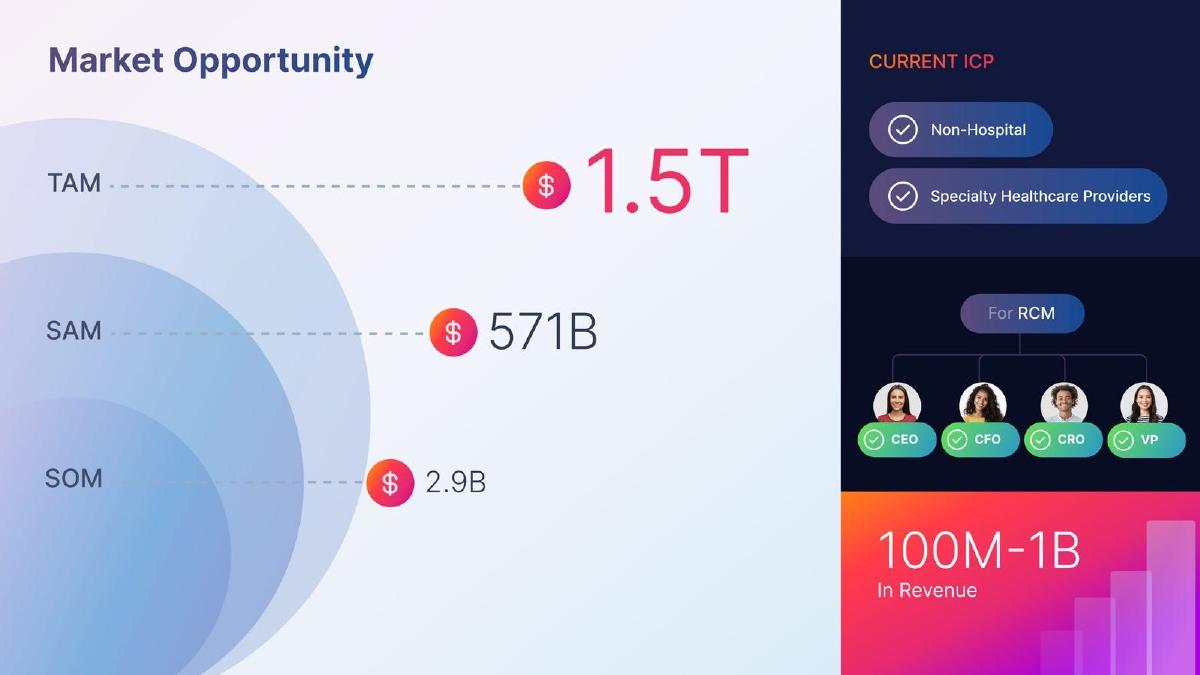
This slide breaks down the $1.5T TAM (Total Addressable Market) into a $571B SAM (Serviceable Addressable Market) and a $2.9B SOM (Serviceable Obtainable Market). More importantly, it defines the 'Current ICP' (Ideal Customer Profile) on the right side. They are targeting 'Non-Hospital' and 'Specialty Healthcare Providers' with revenue between '$100M-1B.' This specificity is excellent for a Series A deck; it shows investors that the team knows exactly who to sell to today to reach their next milestones, rather than trying to boil the ocean of the entire healthcare market.
Slide 6: Business Model & Pricing
This is perhaps the most important slide for understanding the company's scalability. It introduces the 'Fully Human Capable (FHC) Bot' as the unit of economic value. The graph shows that while gross margins start lower during the initial months of implementation, they ramp to a projected '90.56%' by month 24. The pricing packages are tiered by the number of bots: Pro (5 bots), Premium (15 bots), and Enterprise (30+ bots). The 'Land ACV Range' of '$180k to 900k' is significantly higher than typical SaaS, reflecting the 'human replacement' value proposition rather than a 'seat-based' software model.
Slide 7: Competitive Landscape
Thoughtful AI uses a standard 2x2 matrix but with highly specific axes: 'SMB vs. Enterprise-Grade' on the Y-axis and 'SaaS vs. Full Human Replacement' on the X-axis. They place themselves in the top-right quadrant—the only player offering enterprise-grade full human replacement. They categorize incumbents like Waystar and R1 as 'Enterprise-Grade SaaS,' implying that while those companies are large, they still require significant human intervention to operate. This positioning justifies their high ACV and distinguishes them from 'legacy' automation tools.
Slide 8: The Path to $1B ARR
This slide provides a roadmap for long-term growth. To reach '$100M ARR,' they need to grow from 7 to 50 logos within their current ICP. This feels achievable and grounded in their current traction. To reach '$1B ARR,' they anticipate needing 250 logos—which they point out is still less than 1% of the market—plus the launch of 'adjacent products' like 'Financial' tools and an 'AI-first EHR.' This slide effectively communicates both the immediate goal and the massive upside potential.
Slide 9: The Team
The final slide highlights a lean team of '13 Employees.' It reiterates the '$362K ARR/employee' metric, which is a point of pride for the company's capital efficiency. The 'Allocation' pie chart shows a healthy split for a Series A company: 50% R&D, 40% S&M (Sales and Marketing), and 10% G&A (General and Administrative). The slide also notes their HQ in Austin, TX, but notably lacks the detailed professional pedigrees (previous companies, universities) often found on team slides, relying instead on the efficiency metrics to prove the team's capability.
What Thoughtful AI Does Well
The deck is exceptionally focused on unit economics and efficiency . By repeatedly citing the ARR per employee and the high NRR, Thoughtful AI proves that they are building a high-leverage business, not a services firm disguised as an AI company. The framing of their product as 'Fully Human Capable' bots is a brilliant positioning move. It allows them to anchor their pricing to the cost of a human salary rather than the cost of a software subscription, which explains the high $180k-$900k ACV range. Furthermore, the use of a specific CFO testimonial with hard ROI percentages (50% team reduction) provides the 'reason to believe' that is often missing from AI pitches.
What is Missing from the Deck
There are three notable omissions in this deck. First, there is no 'Ask' slide . While we know from publisher reports that they raised $20M, the deck itself does not state how much they are looking for or how they plan to deploy that specific capital. Second, the Team slide is thin on detail . While the efficiency metrics are great, investors usually want to see the specific domain expertise of the founders in healthcare or AI. Third, there is very little technical detail . The deck explains what the bots do, but not how they do it. In a crowded AI market, a slide explaining their 'moat'—whether it's proprietary data access, a unique orchestration layer, or specific integrations—would have strengthened the case for their competitive advantage.
What Other Founders Should Copy
Founders should emulate Thoughtful AI's modular product branding . By naming their AI agents (EVA, PAULA, etc.), they make a complex technical solution feel tangible and easy to buy. This 'digital worker' framing is much more compelling to a CFO than a list of API features. Additionally, the transparency regarding the ICP on Slide 5 is a best practice. Showing that you have narrowed your focus to a specific revenue band and provider type demonstrates maturity and a clear go-to-market strategy. Finally, the mathematical breakdown of the path to $1B on Slide 8 is excellent. It demystifies the 'unicorn' ambition by showing exactly how many logos are required to hit the target, making the goal feel like a matter of execution rather than luck.
Frequently asked questions
- What is the specific market focus of Thoughtful AI?
- Thoughtful AI focuses on Revenue Cycle Management (RCM) for midmarket healthcare providers. According to Slide 5, their Ideal Customer Profile (ICP) includes non-hospital and specialty healthcare providers with annual revenues between $100 million and $1 billion. They specifically target the administrative labor costs associated with claims processing, eligibility verification, and payment posting.
- How does Thoughtful AI justify its high contract values?
- The company positions its product as a 'Full Human Replacement' rather than a software tool. Slide 6 shows a 'Land ACV Range' of $180k to $900k. By framing the value proposition as replacing human headcount with 'Fully Human Capable' (FHC) bots, they can capture a larger share of the budget previously allocated to salaries and benefits.
- What are the key performance metrics shared in the deck?
- Slide 1 highlights three primary metrics: 3x year-over-year ARR growth (though the absolute ARR figure is redacted as 'XX'), 190% Net Revenue Retention (NRR) within their ICP, and $362k ARR per employee. These metrics suggest high product-market fit and an extremely lean, scalable operation.
- How does the company plan to reach $1 billion in ARR?
- Slide 8 details a two-stage growth plan. First, they aim for $100M ARR by expanding to 50 logos within their current ICP. To reach $1B, they plan to capture 250 logos (which they note is less than 1% of the market) and launch adjacent products, including financial tools and an 'AI-first EHR' (Electronic Health Record).
- Who is the target buyer within a healthcare organization?
- Slide 5 explicitly identifies the buying committee for their RCM solutions. This includes the CEO, CFO, CRO (Chief Revenue Officer), and VP-level executives. The inclusion of a CFO testimonial on Slide 4 reinforces that their primary value proposition is financial efficiency and cost reduction.