How AI startups answer "why won't OpenAI or the incumbent just build this?": foundation-model gaps, legacy-vs-AI-native maps.
AI Competition Slide: Foundation Models, Incumbents and AI-Native Rivals
An AI startup faces three kinds of rival at once: the foundation-model labs, the software incumbents adding AI to products customers already use, and a crowd of new AI-native startups. Investors usually ask about the first two before anything else. This guide compares seven real AI competition slides, from a named argument about why two AI app builders can't copy a pricing model to a slide that simply says no competitor can build its models.
TL;DR
Name the rival investors will think of first and give a specific reason it won't win this customer. Openbuilder names Replit and Lovable and argues that matching its free-to-build pricing would cost them most of their revenue. Coworker shows why general models and naive retrieval lack company context. A map with 'legacy' and 'AI-native' axes places you, but doesn't explain why incumbents can't add AI. "No competitor can develop" our models is a claim, not an argument.
AI competition slides from real pitch decks
Each example shows the slide above its analysis and links to the full teardown. Slides that give a reason rivals can't follow come first. Claims are as shown on the slides; comments are ours.
Openbuilder competition slide — slide 8
AI app builder for non-technical users.
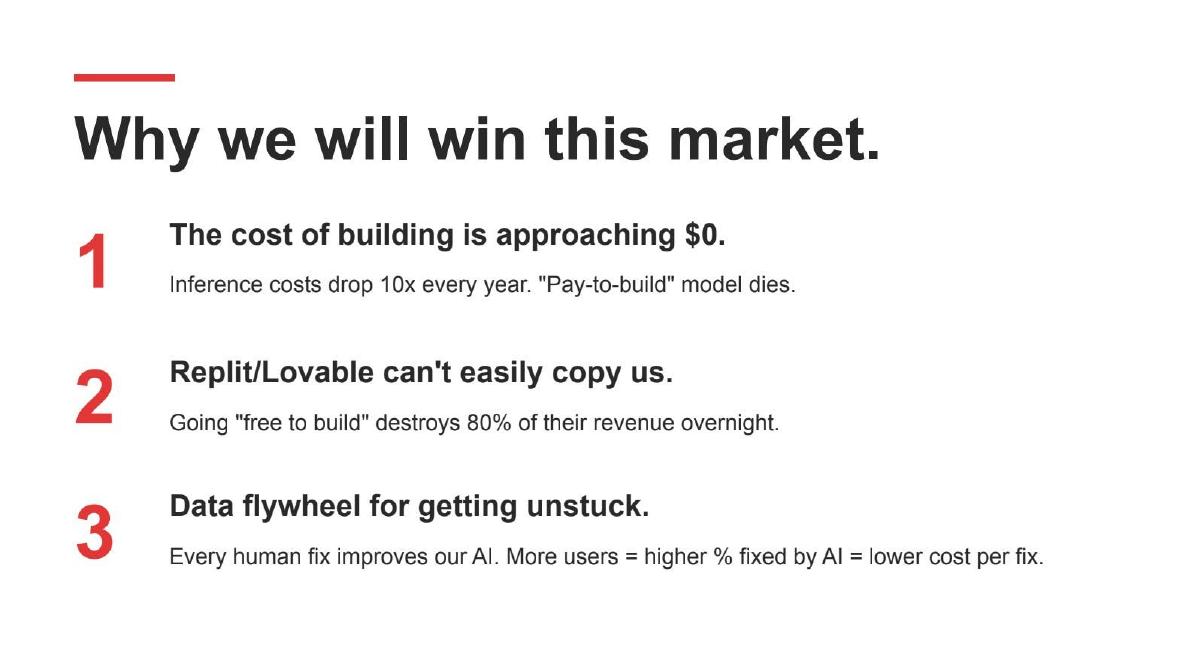
Openbuilder deck, slide 8. Exact stored slide matched to this analysis.
Our analysis: A reason rivals can't follow.
Evidence and limitation: It names the two rivals investors will think of and gives a reason they won't follow: copying the pricing would hurt their own revenue. The 10x and 80% figures have no source on the slide, and the flywheel is asserted, not measured.
What a founder can adapt: "[Named rival] can't [match X] without [losing Y% of revenue / breaking Z]; source: [ ]."
Supporting analysis
What the deck claims: "Why we will win this market." "1. The cost of building is approaching $0. Inference costs drop 10x every year. 'Pay-to-build' model dies." "2. Replit/Lovable can't easily copy us. Going 'free to build' destroys 80% of their revenue overnight." "3. Data flywheel for getting unstuck. Every human fix improves our AI. More users = higher % fixed by AI = lower cost per fix."
Presentation choice: A business-model conflict lasts longer than a feature lead.
When it does not fit: Unsourced percentages carrying the argument.
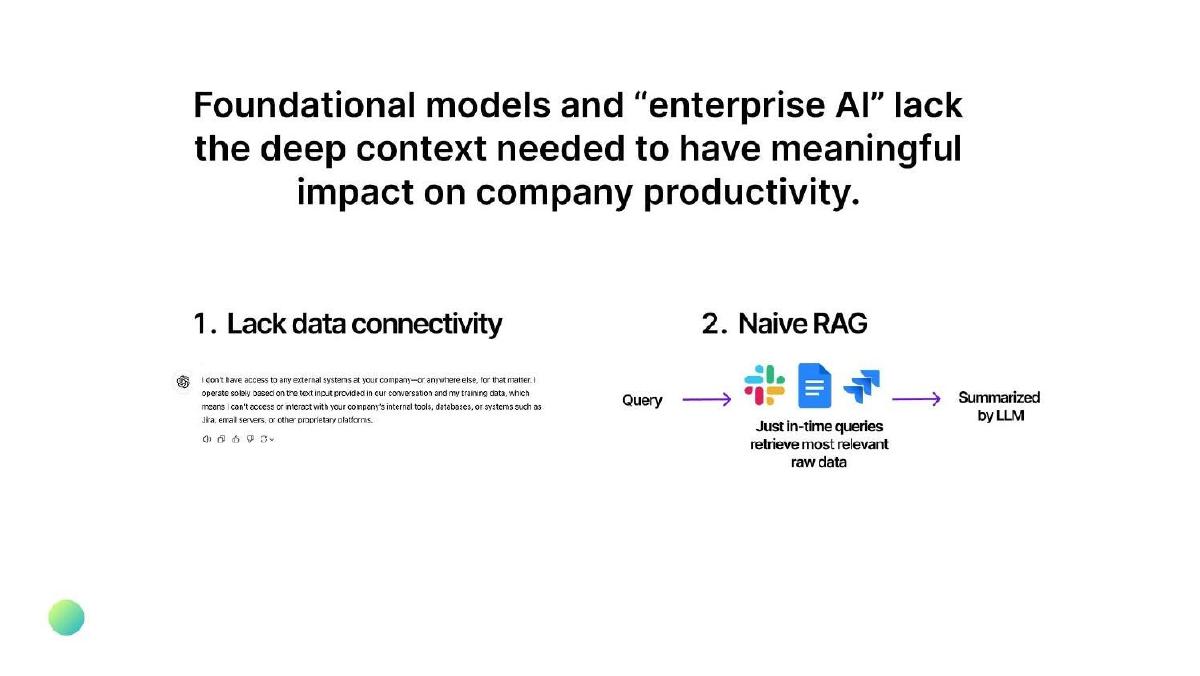
Coworker deck, slide 8. Exact stored slide matched to this analysis.
Our analysis: The labs' gap, shown.
Evidence and limitation: It takes on the foundation models directly and shows two concrete gaps instead of logos. It doesn't name an enterprise AI rival or say why the labs couldn't add connectors themselves.
What a founder can adapt: "General models can't [X] because [Y]; retrieval alone fails at [Z]; we [ ]."
Supporting analysis
What the deck claims: "Foundational models and 'enterprise AI' lack the deep context needed to have meaningful impact on company productivity." "1. Lack data connectivity" — a screenshot of an assistant reply saying it cannot access the company's internal tools, databases or systems. "2. Naive RAG" — Query → "Just in-time queries retrieve most relevant raw data" → "Summarized by LLM."
Presentation choice: It answers the question investors ask first about AI startups.
When it does not fit: Leaving out the named enterprise rival.
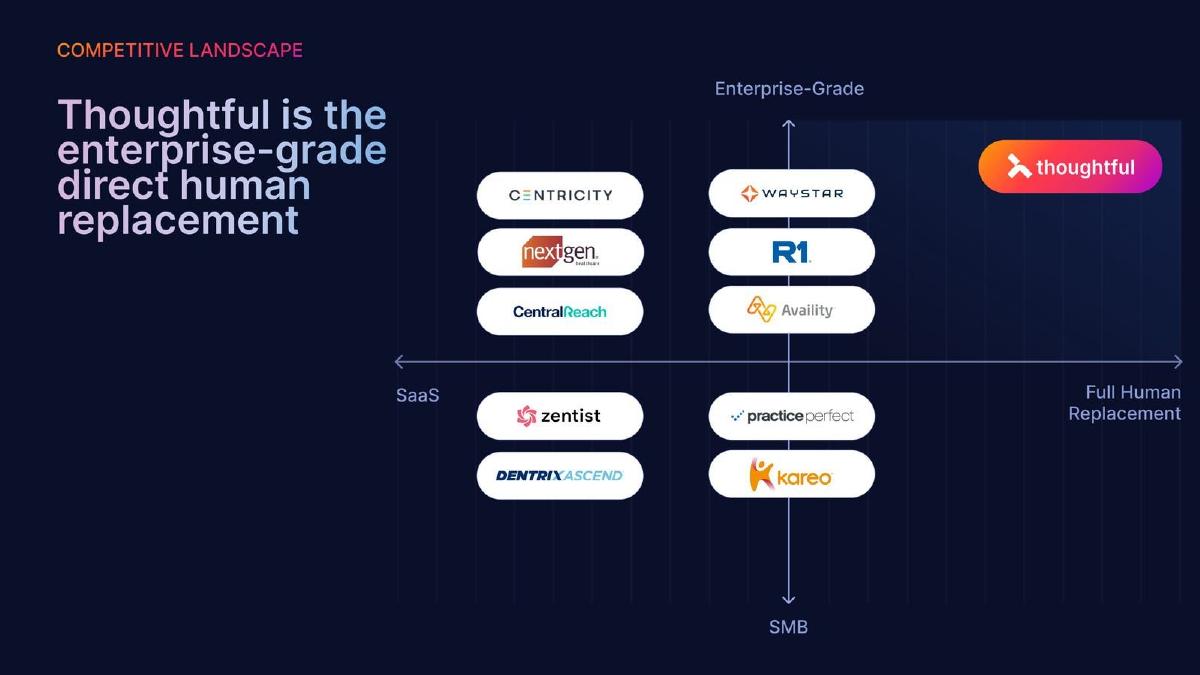
Thoughtful AI deck, slide 7. Exact stored slide matched to this analysis.
Our analysis: Named field, clear axis.
Evidence and limitation: Ten named healthcare rivals, and an axis — software vs replacing a person's work — that says what it sells. No rival sits near it, and the slide doesn't say what each rival lacks.
What a founder can adapt: Place named rivals on one axis you sell on, and say why none sits in your corner.
Supporting analysis
What the deck claims: "Competitive landscape — Thoughtful is the enterprise-grade direct human replacement." Axes: SMB to Enterprise-Grade; SaaS to Full Human Replacement. Named: CentralReach, NextGen, Centricity, Zentist, Dentrix Ascend, Waystar, R1, Availity, PracticePerfect, Kareo. Thoughtful alone at top right.
Presentation choice: Investors can see who the buyer compares it with.
When it does not fit: An empty corner with no explanation.
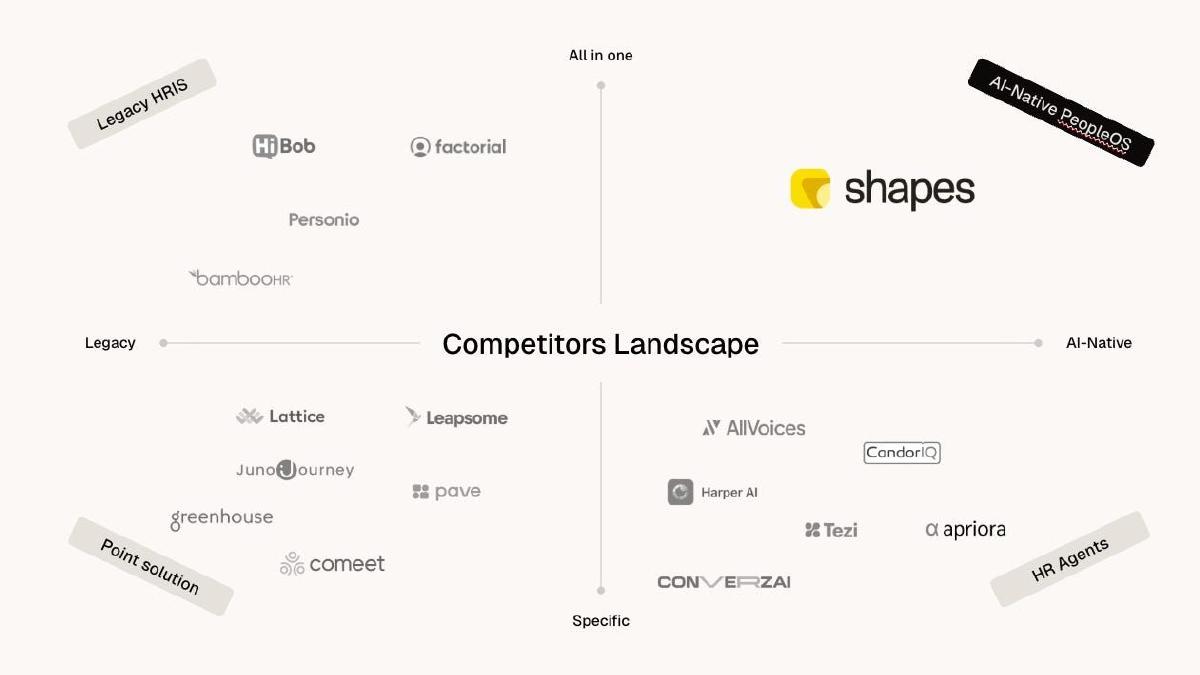
Shapes deck, slide 3. Exact stored slide matched to this analysis.
Our analysis: Incumbents and AI rivals, grouped.
Evidence and limitation: About 16 named rivals in three labelled groups, including other AI startups — more honest than logos alone. It doesn't say why HiBob or Personio can't add AI to their all-in-one suites.
What a founder can adapt: Label each group and add one line on why its members won't move into your corner.
Supporting analysis
What the deck claims: "Competitors Landscape." Axes: Legacy to AI-Native; All in one to Specific. Legacy HRIS: HiBob, Factorial, Personio, BambooHR. Point solution: Lattice, Leapsome, JuneJourney, Pave, Greenhouse, Comeet. HR agents: AllVoices, CondorIQ, Harper AI, Tezi, Apriora, ConverzAI. Shapes alone in "AI-Native PeopleOS."
Presentation choice: It shows the founder knows both kinds of rival.
When it does not fit: "AI-native" standing in for a reason.
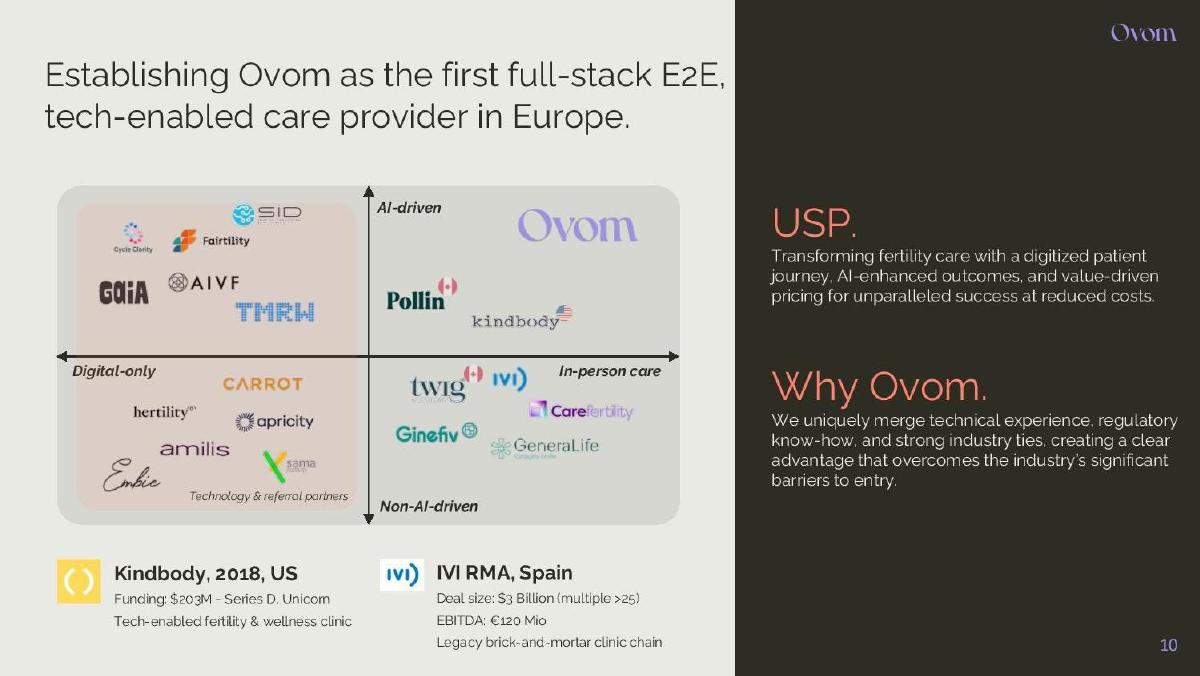
Ovom deck, slide 9. Exact stored slide matched to this analysis.
Our analysis: Shared corner, honest.
Evidence and limitation: It admits two rivals share its quadrant and adds benchmark figures that size the prize. The "AI-driven" axis isn't defined, and the figures are about rivals, not proof Ovom wins.
What a founder can adapt: Show who shares your corner and one reason customers pick you over them.
Supporting analysis
What the deck claims: "Establishing Ovom as the first full-stack E2E, tech-enabled care provider in Europe." Axes: AI-driven to Non-AI-driven; Digital-only to In-person care. About 20 named providers; Ovom top right with Pollin and Kindbody. Benchmarks: "Kindbody, 2018, US — Funding: $203M – Series D. Unicorn"; "IVI RMA, Spain — Deal size: $3 Billion (multiple >25), EBITDA: €120 Mio." Side panel: "USP" and "Why Ovom."
Presentation choice: Showing near rivals is more credible than an empty corner.
When it does not fit: Undefined "AI-driven" labels.
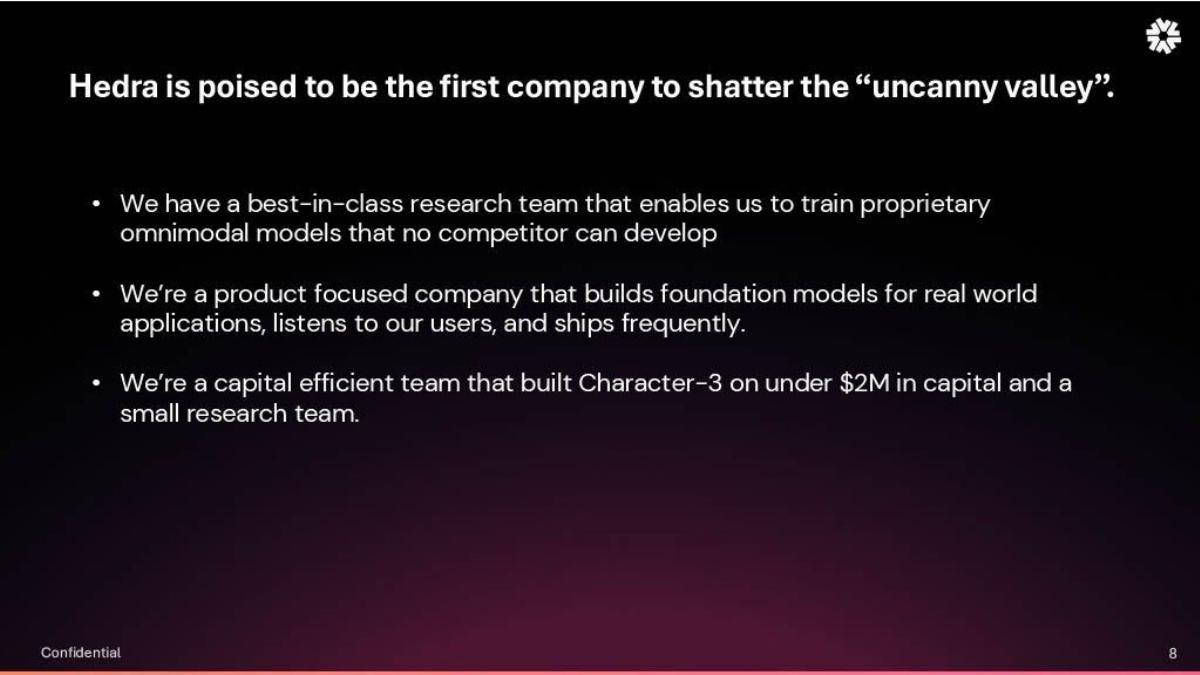
Hedra deck, slide 6. Exact stored slide matched to this analysis.
Our analysis: A moat claimed, not shown.
Evidence and limitation: The $2M figure is a concrete, checkable point. The rest names no rival and gives no benchmark; "no competitor can develop" is the claim investors most want proved.
What a founder can adapt: "On [benchmark/blind test], [model] scored [x] vs [named rival] [y] ([date])."
Supporting analysis
What the deck claims: "Hedra is poised to be the first company to shatter the 'uncanny valley'." "We have a best-in-class research team that enables us to train proprietary omnimodal models that no competitor can develop." "We're a product focused company that builds foundation models for real world applications…" "We're a capital efficient team that built Character-3 on under $2M in capital and a small research team."
Presentation choice: Model-quality claims need a comparison.
When it does not fit: "No competitor can" without evidence.
Brand analytics for AI search. Weaker example as a competition slide.
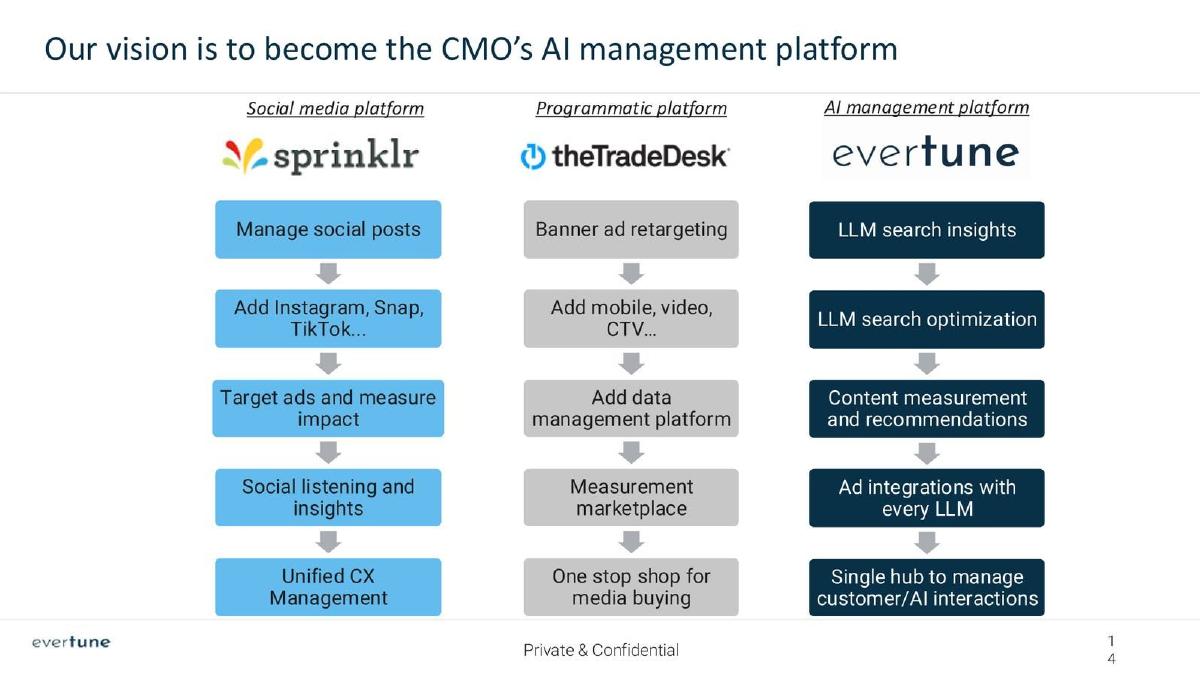
Evertune deck, slide 14. Exact stored slide matched to this analysis.
Our analysis: Analogy, not competition.
Evidence and limitation: An analogy to past category winners, useful for vision. It names no direct rival in AI search analytics, so it doesn't answer who else is chasing this.
What a founder can adapt: Pair the analogy with a slide naming current rivals.
Supporting analysis
What the deck claims: "Our vision is to become the CMO's AI management platform." Three columns: Social media platform (Sprinklr), Programmatic platform (The Trade Desk), AI management platform (Evertune), each a path from one tool to a hub — ending in "Single hub to manage customer/AI interactions."
Presentation choice: Investors still need the rivals named.
When it does not fit: Using an analogy as the competition slide.
Which kind of AI competition slide answers which question.
Approach
Example
Answers
Leaves open
Reason rivals can't follow
Openbuilder
Why named rivals won't copy
Sources for figures
Foundation-model gap
Coworker
Why not ChatGPT
Named enterprise rivals
Named quadrant
Thoughtful AI, Shapes
Who the buyer compares
Why incumbents can't add AI
Shared quadrant + benchmarks
Ovom
Who is close
Why customers pick it
Moat claim
Hedra
What it believes
Proof
Category analogy
Evertune
Where it's headed
Current rivals
Key Takeaways
Answer "why won't the model labs do this?" directly.
Name the incumbent and why it can't follow.
A business-model reason beats a feature list.
"AI-native" is a position, not a moat.
Back any model-quality claim with a benchmark or customer.
Write your AI competition slide
Answer these before you draw a quadrant.
Labs. Why won't OpenAI, Google or Anthropic build this themselves?
Incumbent. Which product holds your customer today, and why can't it add AI?
AI rivals. Which AI startups chase the same buyer?
Lasting edge. What data, pricing or distribution will still set you apart in two years?
Copyable framework: Labs: [why not]. [Incumbent] can't [X] because [Y]. Versus [AI rivals]: [lasting edge, with evidence].
Illustrative example 1 — written by us
Before: "Proprietary models that no competitor can develop."
After: "On [named test], our model scored [x] vs [rival] [y] ([date])."
What improved: Our illustrative rewrite of Hedra's claim; bracketed text is a placeholder, not company fact.
What's different about AI competition
Models improve and get cheaper quickly, so a feature lead can disappear in months. Incumbents can add AI to products that already hold the customer and the data. That shifts the question from "what can you do that others can't?" to "why will you still be ahead in two years?" — usually proprietary data, a workflow the labs won't build, or a business model rivals can't copy without hurting themselves.
What investors check
Whether the slide addresses the foundation-model labs and the obvious incumbent by name. Whether the claimed advantage is structural (data, pricing, distribution, regulation) or a head start. Whether quadrant axes are ones customers choose by, or drawn so only the startup fits the empty corner.
How we read each slide
We quote the text on the slide images. We have not checked competitors' products, pricing or revenue, or any model-quality claim. None of these pages was in our stored image set, so we rendered each from the original deck file in our library.
Common mistakes
Ignoring the labs. Say why the model makers won't do it.
"AI-native" as a moat. Explain why incumbents can't catch up.
Empty corner. Say why no rival sits there.
Unproved model claims. Show a benchmark or customer result.
Analogy only. Still name today's rivals.
Diagnostic checklist
Foundation-model labs addressed.
Main incumbent named, with why it can't follow.
AI-native rivals named.
One structural advantage, with evidence.
Frequently asked questions
How should an AI startup answer "why won't OpenAI build this?"
Show a specific gap the model makers won't close. Coworker shows general models lacking access to company systems and naive retrieval returning raw data; Openbuilder argues its free-to-build pricing is one Replit and Lovable can't match without losing revenue.
Is "AI-native vs legacy" a good competition slide axis?
It places you but doesn't explain why incumbents can't add AI. Shapes maps about 16 named HR rivals on legacy vs AI-native; pair a map like that with one line on why the legacy suites won't catch up.
How we chose these examples
Corpus: published pitch deck teardowns on StartupFundraising.com. Founder-uploaded private decks are excluded.
Selection (2026-09-26): we searched AI teardowns for competition headings, rendered twelve candidate decks with neighbouring pages, and kept seven.
Excluded: Arize, Azoma and Mito (the competition page wasn't at the page we rendered), Vespa and Prolific (no competition page in the pages checked; Prolific is used in other guides).
None of the chosen pages was in our stored image set; we rendered them from the original deck PDFs and stored them with the existing slide-image workflow. All seven decks were confirmed as published teardowns on 2026-09-26.
Competitor names, revenue shares, funding figures and model claims are quoted from the slides and not independently verified.
Review: slide images were checked on 2026-09-26 and matched to company, deck and page (editorial model review). No person has yet completed an editorial review of this page. We make no claim that any slide caused a fundraising outcome.