Hivebuy’s 2021 seed deck is a masterclass in brevity, using just 9 slides to secure $1.7 million in funding. The presentation focuses heavily on the 'Status Quo' and the operational 'Challenge,' highlighting that indirect procurement accounts for 10-28% of company revenue (Slide 2). By positioning itself as a solution specifically 'made for and with SMEs' (Slide 4), Hivebuy addresses a market often overlooked by enterprise-grade ERPs. While the deck is remarkably light on traditional venture metrics—omitting a market size slide, a competitive landscape, and a formal 'Ask'—it succeeds by visua…
Key takeaways
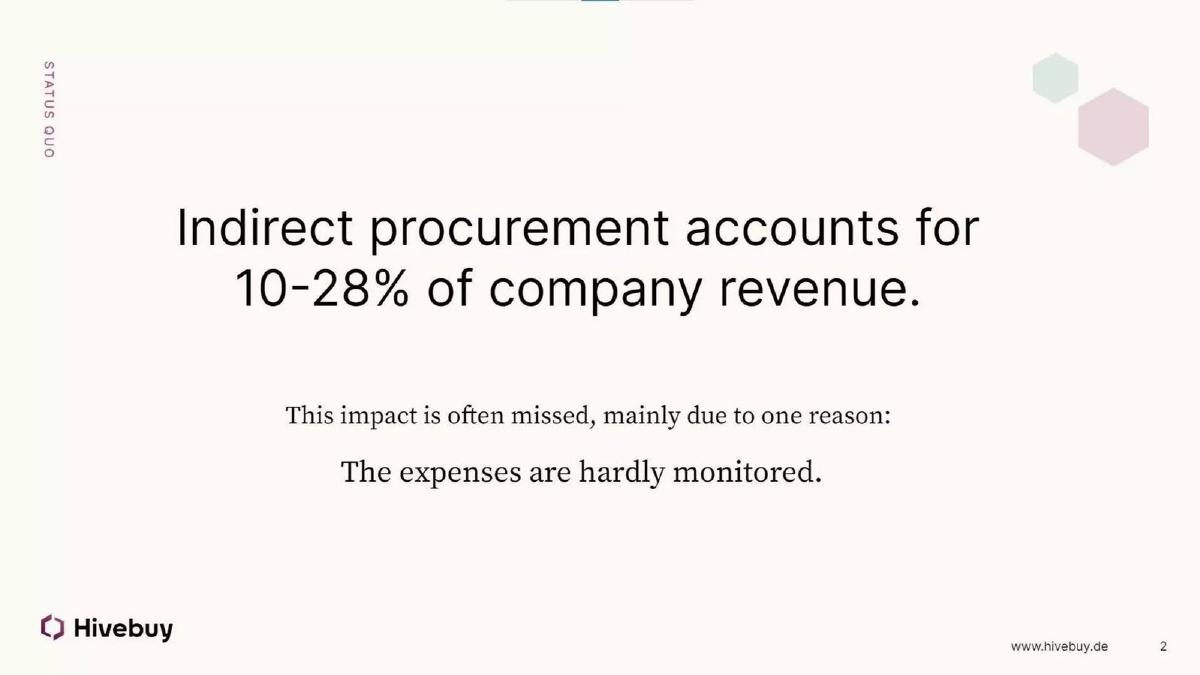
- Indirect procurement is identified as a significant financial leak, representing 10-28% of total company revenue (Slide 2).
- The deck targets Small and Medium Enterprises (SMEs) specifically, claiming a lack of transparent solutions for this segment (Slide 4).
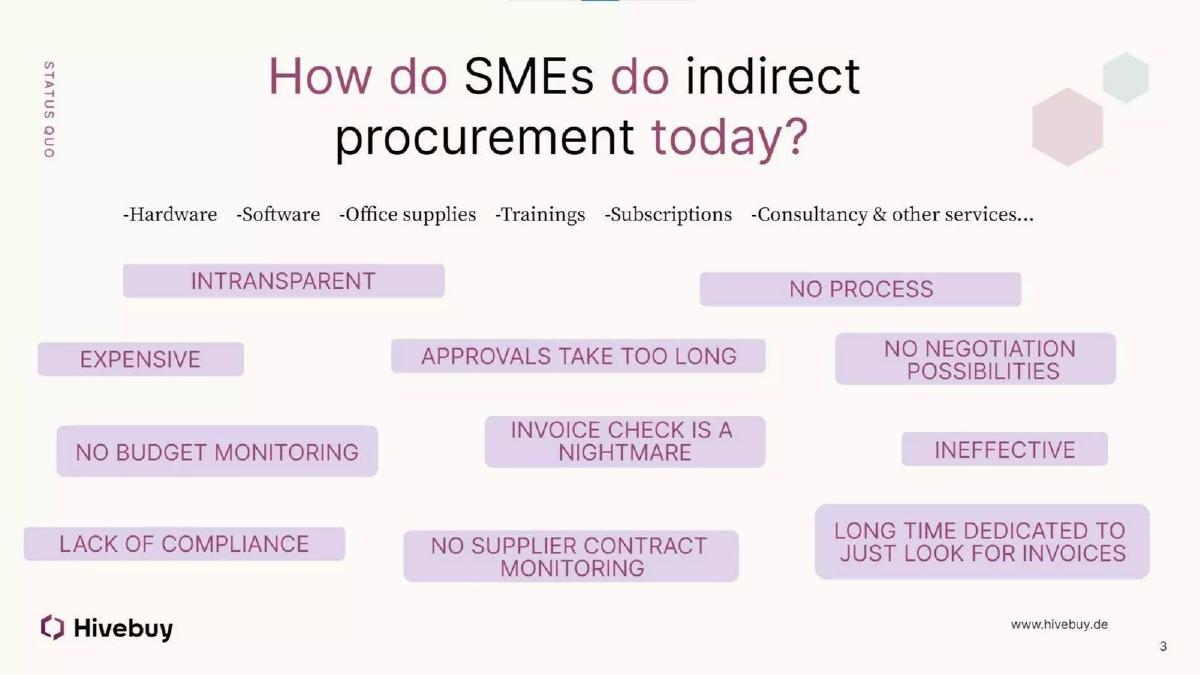
- The product scope covers hardware, software, office supplies, trainings, subscriptions, and consultancy services (Slide 3).
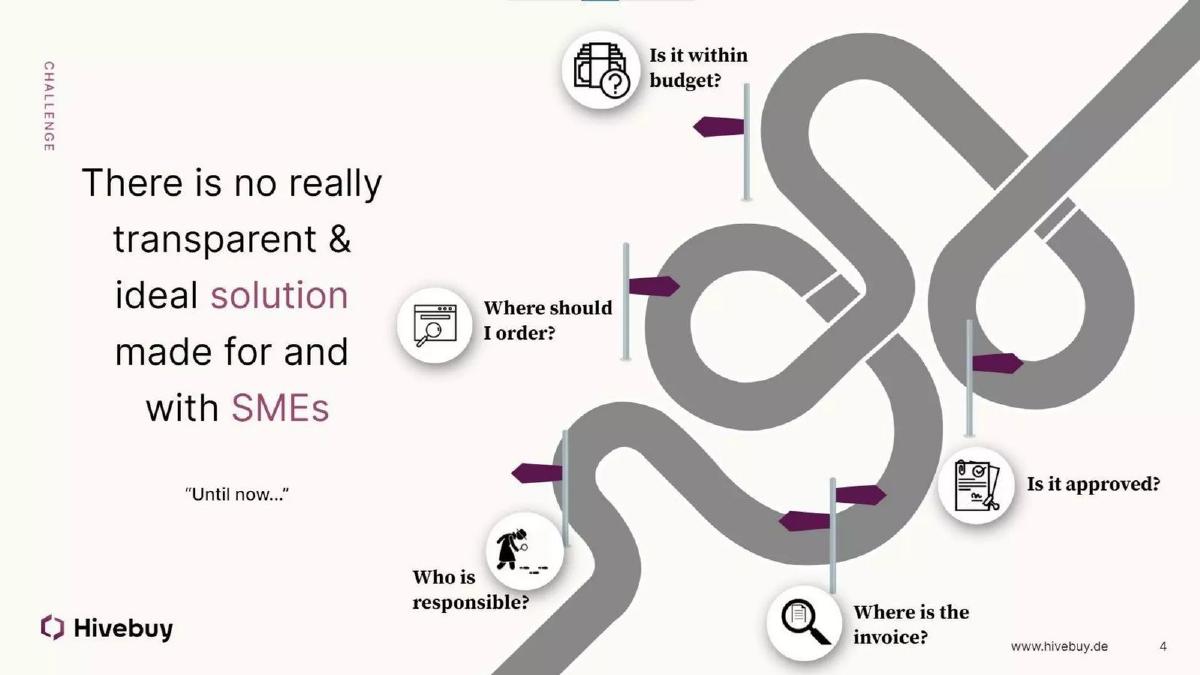
- Hivebuy visualizes the procurement journey as a winding path of friction points, including budget checks, vendor selection, and invoice tracking (Slide 4).
- The solution promises to automate invoice matching with existing accounting systems (Slide 5).
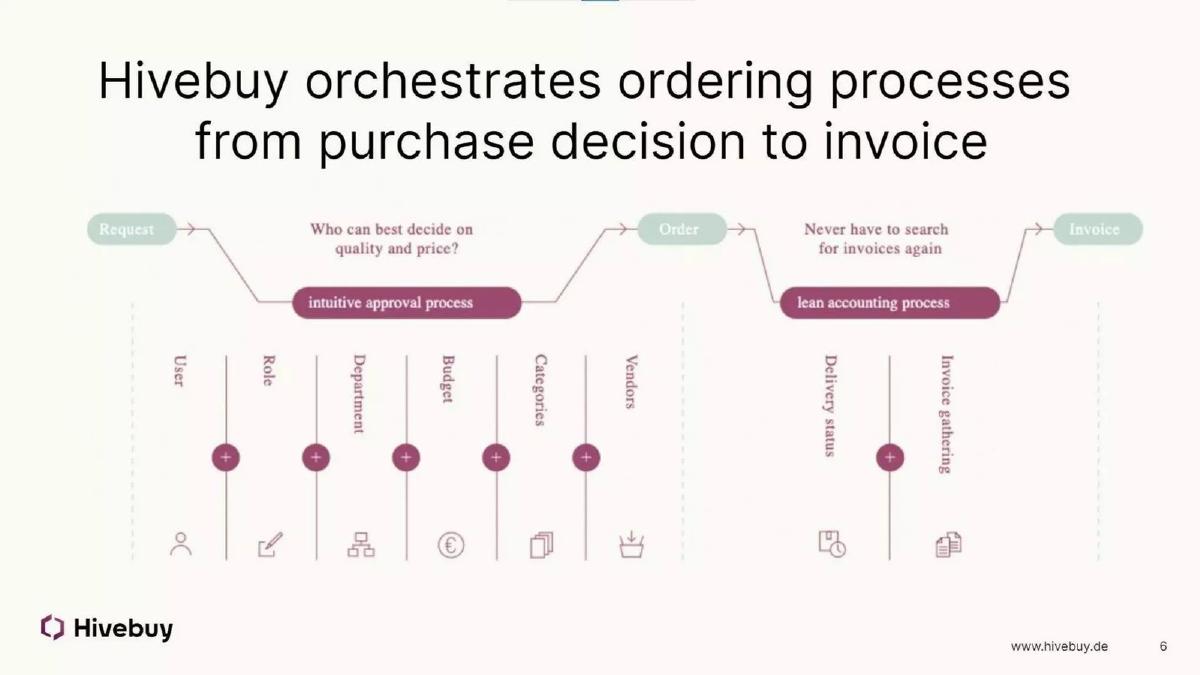
- Workflow orchestration is broken down into two main phases: an 'intuitive approval process' and a 'lean accounting process' (Slide 6).
- The deck omits standard fundraising slides such as TAM/SAM/SOM, competition, financial projections, and the specific capital request.
- Founder Bettina Fischer is the only team member featured, appearing on both Slide 8 and Slide 9.
The Minimalist Seed Deck: Hivebuy’s 9-Slide Strategy
The Hivebuy pitch deck is an exercise in restraint. In an era where seed-stage decks often balloon to 20 or 30 slides filled with speculative TAM (Total Addressable Market) figures and complex unit economics, Hivebuy secured $1.7 million using only nine slides. The deck is characterized by a clean aesthetic, a heavy focus on the operational 'mess' of procurement, and a direct appeal to the needs of Small and Medium Enterprises (SMEs).
The Hook: Problem and Status Quo (Slides 1-3)
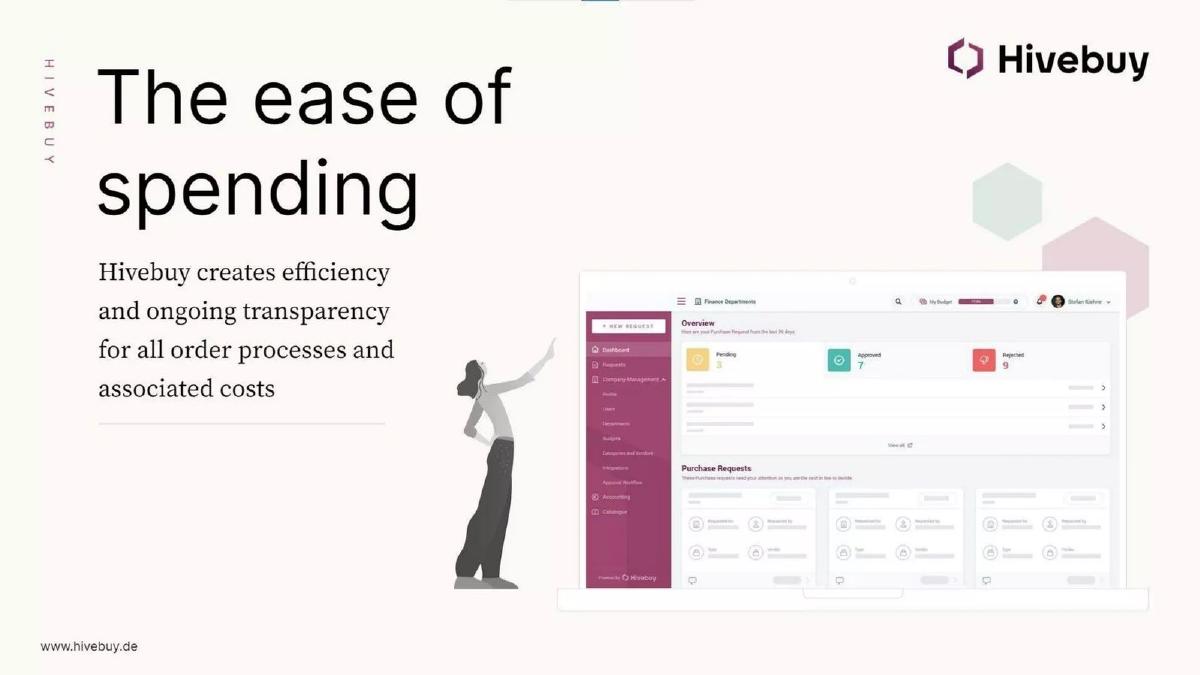
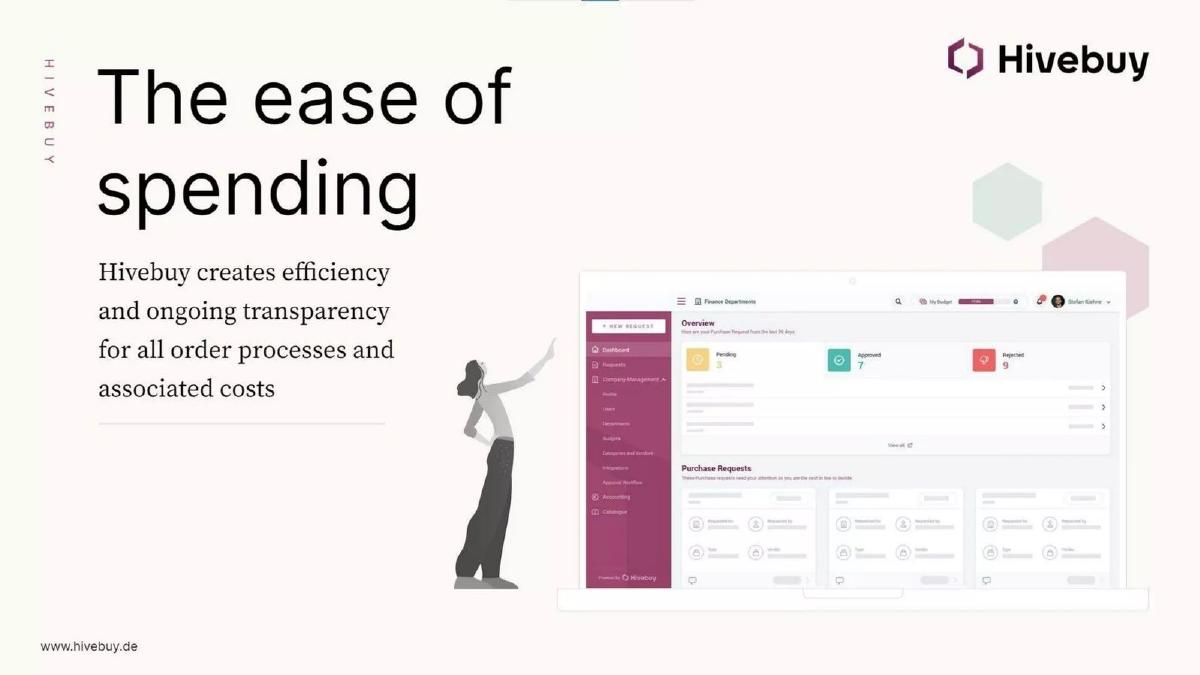
Slide 1: Title Slide The deck opens with the tagline 'The ease of spending.' It immediately defines the value proposition: efficiency and ongoing transparency for order processes and costs. A product mockup is featured prominently, showing a dashboard with 'Pending,' 'Approved,' and 'Rejected' purchase requests. This sets the stage for a tool that is ready to use, not just a concept.
Slide 2: The Financial Impact Hivebuy makes a bold claim on Slide 2: 'Indirect procurement accounts for 10-28% of company revenue.' By quantifying the problem early, they justify the need for a dedicated solution. The slide notes that this impact is often missed because expenses are 'hardly monitored.' This is a classic 'hidden cost' narrative that creates urgency for investors.
Slide 3: The Pain Points Slide 3 lists the categories of indirect procurement—Hardware, Software, Office supplies, Trainings, Subscriptions, and Consultancy. It then surrounds these with a cloud of pain points: 'Intransparent,' 'No Process,' 'Invoice check is a nightmare,' and 'Lack of compliance.' This slide validates the experience of any SME operator who has struggled with a growing headcount and a corresponding explosion in miscellaneous receipts.
The Challenge and The Solution (Slides 4-5)
Slide 4: The SME Gap Slide 4 is the 'Challenge' slide. It asserts that there is no 'transparent & ideal solution made for and with SMEs.' This is the company’s core market positioning. It uses a winding, grey path graphic to illustrate the confusing journey of a purchase request, asking questions like 'Where should I order?' and 'Is it within budget?' This visualization effectively communicates the mental overhead Hivebuy intends to eliminate.
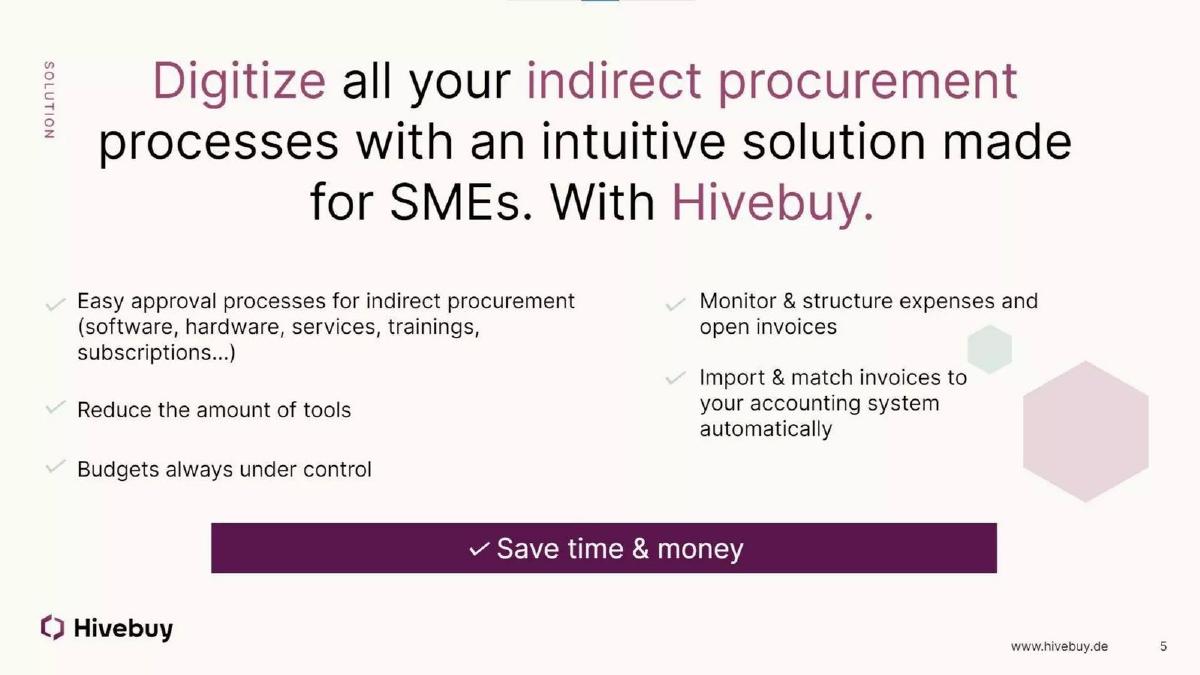
Slide 5: The Digital Transformation The 'Solution' slide (Slide 5) is a direct response to the previous slide's chaos. It promises to 'Digitize all your indirect procurement processes.' Key features listed include easy approval processes, reducing the number of tools, and automatic invoice matching. The bottom of the slide features a dark purple bar with the text 'Save time & money,' which is the ultimate bottom-line benefit for the target customer.
Product Mechanics and Workflow (Slides 6-7)
Slide 6: Orchestration Workflow Slide 6 provides a deeper dive into how the software actually works. It splits the process into two halves: the 'intuitive approval process' and the 'lean accounting process.' It shows the transition from Request to Order to Invoice. This slide is crucial because it demonstrates that the founders understand the multi-step nature of procurement, involving users, roles, departments, budgets, and vendors. It moves the conversation from 'what' the product does to 'how' it handles complexity.
Slide 7: Ease of Use Slide 7 reinforces the 'How it Works' section with three pillars: Uncomplicated setup, rapid buy-in through team/role assignments, and cost savings through clear communication. It ends with a call to action to 'request the free demo access today,' further blurring the lines between an investor deck and a sales deck.
The Team and The Close (Slides 8-9)
Slide 8: Founder Statement Slide 8 features a 'Founder Statement' from Bettina Fischer, CEO. She reiterates the mission of creating efficiency and transparency without a long setup process. While it provides a face to the company, it is notable that this deck does not include a traditional 'Team' slide featuring co-founders, advisors, or previous successful exits. This is a significant omission for a seed round, as investors typically bet on the collective strength of the founding team.
Slide 9: Contact and Call to Action The final slide is a 'Book a Meeting' page. It provides the CEO's direct phone number and email address. The text is in German ('Unverbindlichen und persönlichen Beratungstermin buchen'), indicating that while the rest of the deck is in English, the primary initial market or the specific investor target was likely in the DACH (Germany, Austria, Switzerland) region.
What Works in the Hivebuy Deck
Clarity of Purpose: Within the first three slides, the viewer knows exactly what Hivebuy does, who it is for, and why the problem is worth solving. · Visualizing the 'Mess': Slide 4’s winding path is an excellent way to represent a non-linear, frustrating process without using too much text. · Focus on Indirect Spend: By narrowing the focus to 'indirect' procurement, Hivebuy carves out a niche that feels more manageable and less competitive than general ERP or direct supply chain management. · Clean Design: The use of white space, a consistent color palette (purple and grey), and professional iconography makes the company appear more mature than a typical seed-stage startup.
What is Missing from the Hivebuy Deck
Market Size (TAM/SAM/SOM): There is no mention of how many SMEs exist in their target market or the total dollar value of the procurement problem globally. Investors usually want to see the 'billion-dollar' potential. · Competitive Landscape: The deck ignores competitors. Even if Hivebuy is 'made for SMEs,' they are still competing against Excel, Slack-based approvals, and other fintech platforms. · Business Model: There is no mention of how Hivebuy makes money. Is it a SaaS subscription? A percentage of spend? A per-user fee? This is a glaring omission for a seed deck. · Traction and Milestones: The deck contains no data on current users, revenue, or growth. It is entirely focused on the product and the problem, which suggests it may have been used at the very beginning of the seed raise. · The Ask: There is no slide stating how much money they are raising or what they plan to do with the capital (e.g., hiring, marketing, product development).
What a Founder Should Copy
The 'Status Quo' Slide: Use a single, powerful statistic to anchor the problem. Hivebuy’s 10-28% figure (Slide 2) is memorable and provides an immediate 'why.' · Workflow Mapping: If your product solves a process-heavy problem, use a diagram like Slide 6 to show the 'before and after' or the step-by-step orchestration. It proves you have built more than just a pretty UI. · Specific Pain Point Clouds: Slide 3’s list of categories (Hardware, Software, etc.) helps the viewer visualize the actual items being managed, making the abstract concept of 'procurement' concrete. · Direct CTA: Even in an investor deck, a clear next step (Slide 9) is better than a vague 'Thank You' slide.
Frequently asked questions
- How much did Hivebuy raise with this deck?
- According to the catalogue facts, Hivebuy raised $1,700,000 in a Seed round in 2021. Interestingly, the deck itself does not contain a slide detailing the use of funds or the specific amount being sought, which suggests this version may have been used for initial interest or as a follow-up to verbal negotiations.
- What specific problem does Hivebuy solve?
- Hivebuy targets 'indirect procurement,' which includes non-core business expenses like software subscriptions, office supplies, and consultancy. Slide 3 lists the current pain points as being 'intransparent,' 'expensive,' and lacking budget monitoring. It aims to replace 'nightmare' invoice checks with a digital, automated workflow.
- Is there a competitive analysis in the deck?
- No. The deck completely omits a competitive landscape or a 'Why Us' comparison against incumbents like SAP Ariba or modern spend management tools like Spendesk or Moss. It relies entirely on the premise that existing solutions are not 'made for and with SMEs' (Slide 4).
- What is the primary value proposition for the finance department?
- The primary value is 'ongoing transparency' and efficiency. Slide 5 specifically highlights the ability to 'Import & match invoices to your accounting system automatically,' which reduces the manual labor associated with what Slide 3 calls the 'long time dedicated to just look for invoices.'
- Who is the target audience for this deck?
- While used for fundraising, the deck’s tone and structure—concluding with a 'Book a Meeting' call to action and a phone number (Slide 9)—suggest it was also designed to serve as a high-level sales deck for potential SME partners or early adopters.