Hoard presented a vision in 2018 to bridge the gap between traditional finance and the burgeoning crypto economy. The deck centers on the 'Smaug Network,' a proprietary zero-knowledge exchange protocol intended to facilitate feeless and private transactions. With a founding team boasting experience from Wells Fargo and the Department of Defense, Hoard aimed to solve issues of accessibility and fungibility in crypto. The deck is notable for its detailed compliance roadmap across U.S. states and a clear revenue model based on transaction spreads and fixed fees. However, it relies heavily on a p…
Key takeaways
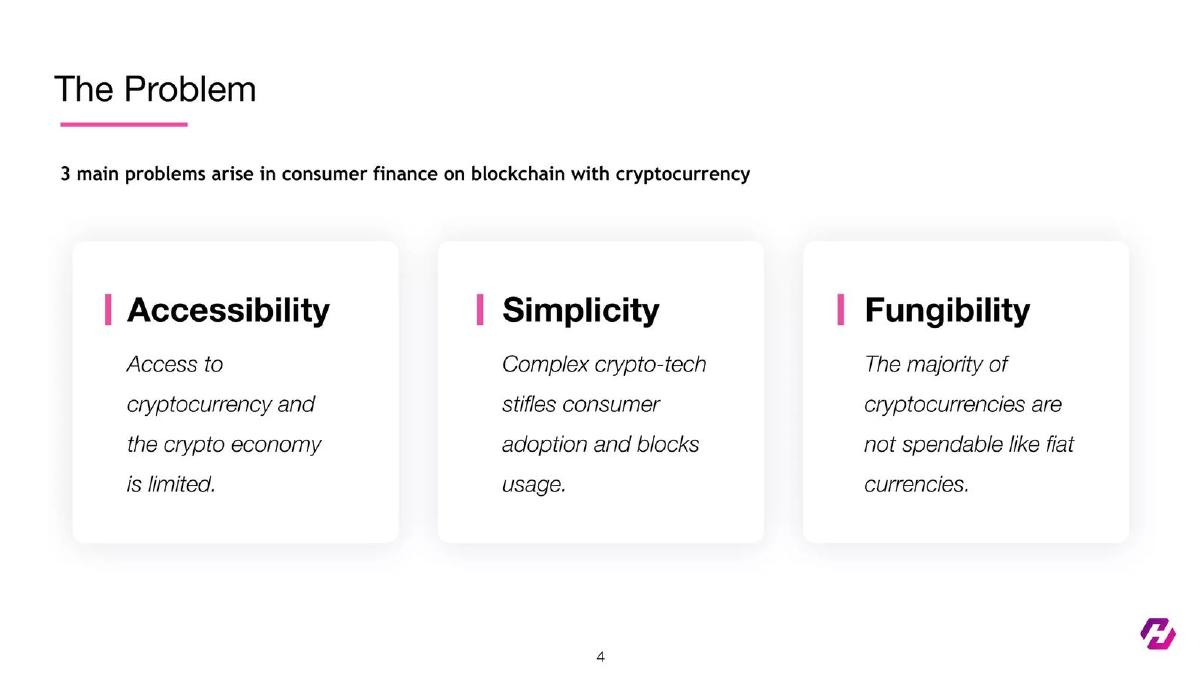
- The company identifies accessibility, simplicity, and fungibility as the three primary barriers to consumer crypto adoption on slide 4.
- Hoard's technical backbone is the Smaug Network, described on slide 10 as a decentralized zero-knowledge exchange protocol enabling feeless trades.
- The team includes founders with backgrounds at Wells Fargo, Morgan Stanley, and the Department of Defense, supported by advisors from Venmo and ReadWrite Labs (slide 7).
- Traction includes a 10,000-person waitlist, completion of the INV FinTech Accelerator, and $700,000 previously raised in private equity (slide 8).
- The revenue model is diversified across a 2.25% fiat gateway fee, a 2.25% investing fee, and market spreads on trading and payments (slide 11).
- A significant portion of the deck is dedicated to a planned Initial Coin Offering (ICO) for the OAR token, with a $30,000,000 hard cap and a $0.50 public price (slide 16).
- Compliance is a core focus, with slide 14 tracking money service business (MSB) licensing status across all 50 U.S. states.
- The roadmap on slide 9 lists ambitious milestones including a fiat gateway, rule-based investing, and artificial intelligence integration throughout 2018.
Executive Summary and Vision
Slides 1-3: The Identity of Hoard
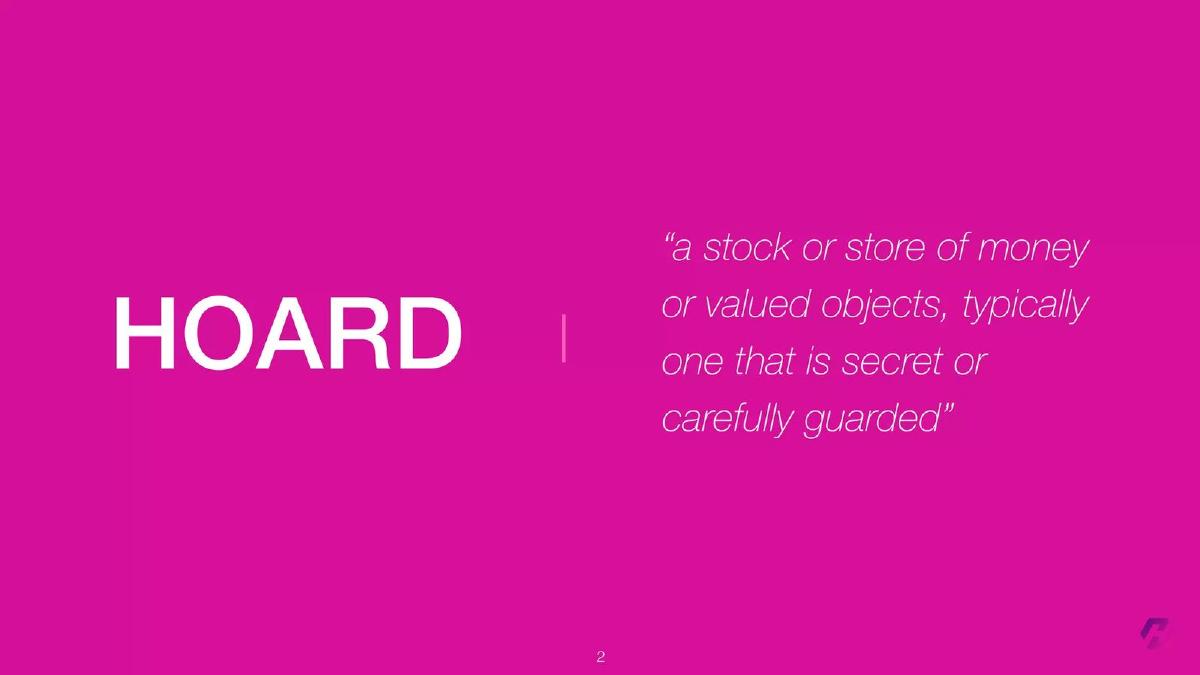
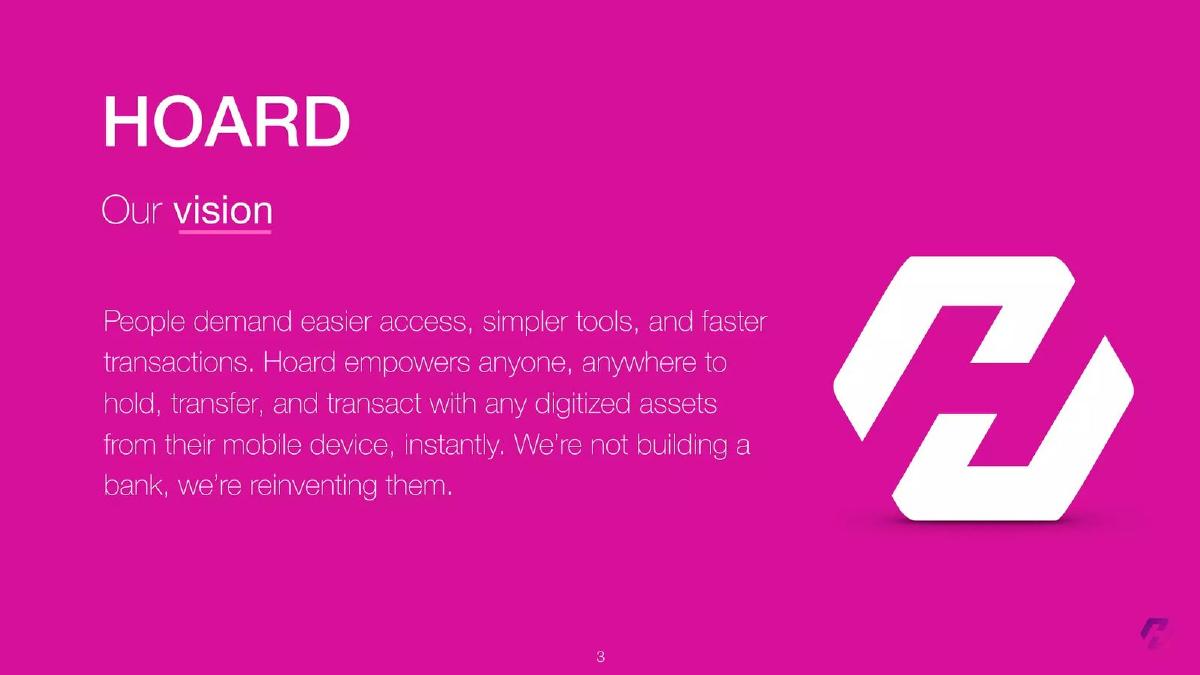
The deck opens with a high-fidelity mockup of the Hoard app on slide 1, positioning itself as "The cryptocurrency app you can bank on!" The branding is dominated by a vibrant magenta, and the initial slide identifies Jason Davis as the presenter for Hoard, Inc. in 2018. Slide 2 provides a literal definition of the word "Hoard," emphasizing the concept of a "carefully guarded" store of money, which sets the tone for a security-focused financial product. Slide 3 articulates the vision: empowering anyone to hold, transfer, and transact with digitized assets instantly from a mobile device. The company explicitly states, "We’re not building a bank, we’re reinventing them."
Problem and Solution
Slides 4-5: Friction in the Crypto Economy
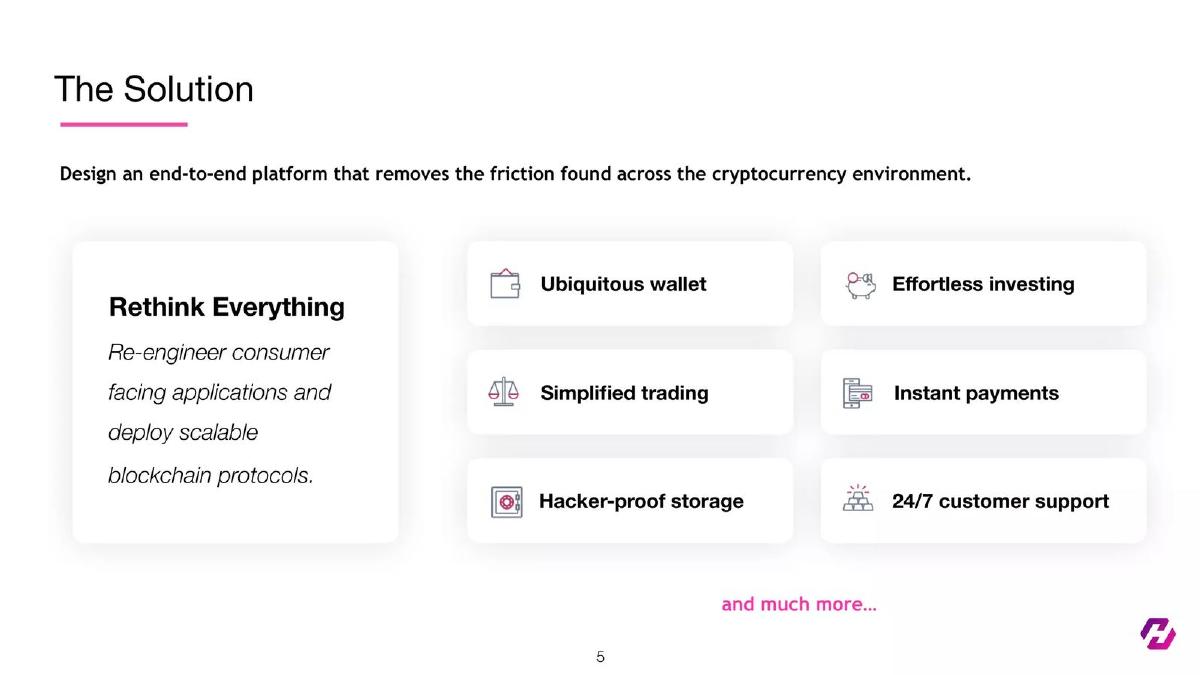
Slide 4 identifies three specific pain points in consumer finance on the blockchain: Accessibility (limited access to the crypto economy), Simplicity (complex tech blocking usage), and Fungibility (cryptocurrencies not being spendable like fiat). Slide 5 introduces the solution: an end-to-end platform designed to remove this friction. The solution components include a "Ubiquitous wallet," "Simplified trading," "Hacker-proof storage," "Effortless investing," "Instant payments," and "24/7 customer support." The slide emphasizes a "re-engineering" of consumer-facing applications alongside scalable blockchain protocols.
Market Context and Team
Slides 6-7: Competition and Human Capital
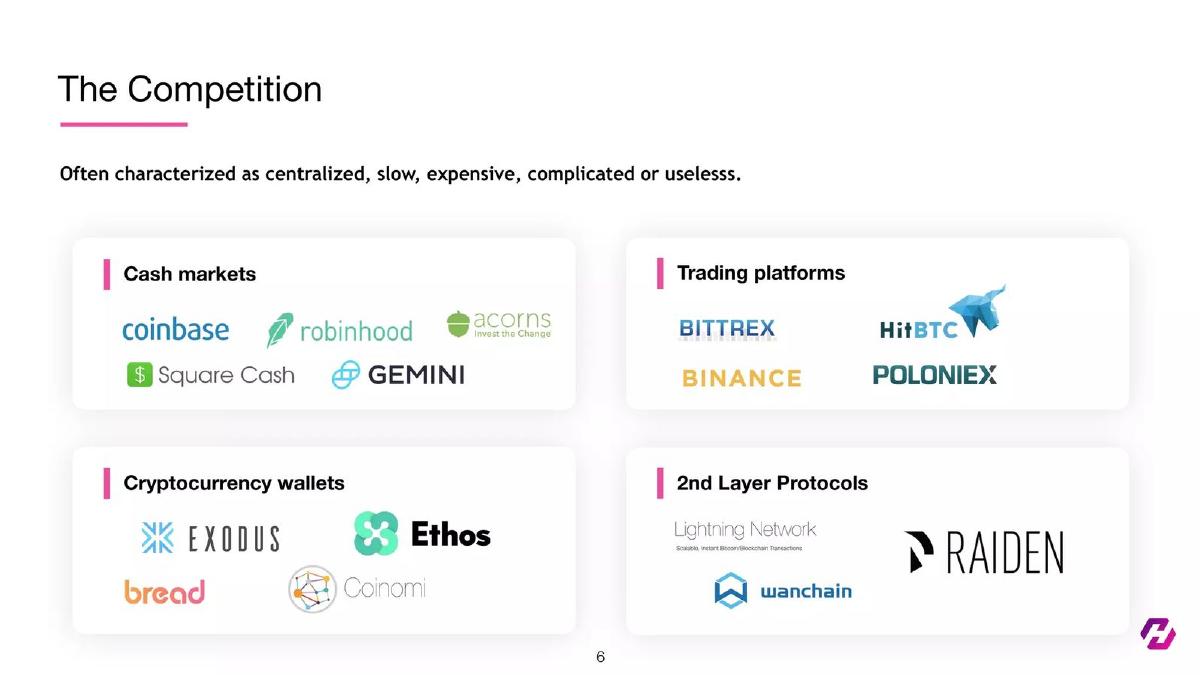
Slide 6 categorizes the competition into four buckets: Cash markets (Coinbase, Robinhood, Square Cash, Gemini, Acorns), Trading platforms (Bittrex, Binance, HitBTC, Poloniex), Cryptocurrency wallets (Exodus, Bread, Ethos, Coinomi), and 2nd Layer Protocols (Lightning Network, Wanchain, Raiden). The deck characterizes these competitors as "centralized, slow, expensive, complicated or useless."
The team slide (Slide 7) highlights a strong pedigree. CEO Jason Davis and CPO George Worrell both cite experience at Wells Fargo, with Worrell also listing Morgan Stanley. CTO Dan Lipert is credited with a background in the Department of Defense (DoD) focusing on DevOps and AI. The advisory board includes individuals from ReadWrite Labs, Venmo, and the law firm Orrick, Morrison & Forester. The slide notes that the company is home to 8 full-time technical employees, 6 advisors, and 10 dedicated project contributors.
Traction and Roadmap
Slides 8-9: Progress to Date and Future Milestones
Slide 8 presents a timeline of traction. Key milestones include raising $700,000 in private equity , completing the INV FinTech Accelerator, and growing the team to over 25 people. The slide also claims over 12 publications, a 10,000-person waitlist, and 5,000 followers. It concludes with the note that the MVP app is "releasing soon."
The roadmap on slide 9 is aggressive, spanning from Q4 2017 to Q4 2018. It lists the launch of the Wallet, Portfolios, Swaps, a Fiat gateway, Rule-based investing, the Smaug DEX, Cash markets, a Trading floor, and Artificial Intelligence. It also notes that compliance work for MSB and Broker/Dealer status began in Q3 2017.
Technical Infrastructure and Business Model
Slides 10-11: The Smaug Network and Revenue
Slide 10 introduces "Smaug," a decentralized zero-knowledge exchange protocol that serves as the "backbone of Hoard’s advanced product infrastructure." The advantage of this network is listed as feeless trades, instant/trustless transactions via a native coin, and a master node community. Slide 11 breaks down the revenue model:
Fiat Gateway: 2.25% per transaction (Debit + ACH) · Trading: 0.00% per transaction + spread (Trade pairs + swaps) · Payments: 0.00% per transaction + spread (Merchant POS) · Investing: 2.25% per transaction (ACH only)
User Experience and Strategy
Slides 12-13: Interface and Growth
Slide 12 showcases "The Experience" through mobile mockups of automated investing (Round Ups), the self-custody wallet, and simplified payments. The design is dark-themed and minimalist. Slide 13 outlines the growth strategy, which relies on a "Send engine" (sending crypto via email/SMS), partnerships with financial institutions, and a token allocation event to fund the ecosystem.
Compliance and Market Opportunity
Slides 14-15: Regulatory Status and TAM
Slide 14 is a comprehensive compliance checklist for all 50 U.S. states. It uses color-coding to show which states are Pending (blue), Active (green), or Not filed (black). At the time of the deck, most states were listed as Pending or Not filed, with a few like California and Texas appearing active. Slide 15 uses pie charts to compare the "Global coin market" (2%) to the "US stock market" (98%) and current crypto usage (5%) to the "Global TAM" (95%), suggesting massive room for growth.
Tokenomics and Use of Proceeds
Slides 16-18: The OAR Token Sale
Currency symbol: OAR · Token allocation: 80,000,000 · Max supply: 120,000,000 · Public price: $0.50 · Soft cap: $3,000,000 USD · Hard cap: $30,000,000 USD
Slide 17 explains the utility of holding OAR, including staking for rewards and eliminating transaction fees. Slide 18 details the allocation: 67% for token distribution, 13% for the team, 13% for master nodes, and 7% for reserves. The proceeds are earmarked primarily for Engineering & Design (45%) and Marketing & Operations (25%).
Final Contact
Slide 19: Closing
The deck concludes with a "Thank You" slide providing the company website and contact emails for the CEO, CTO, and a dedicated address for SAFT (Simple Agreement for Future Tokens) inquiries.
What Hoard Does Well
The Hoard deck excels in its visual presentation and clarity of product vision. By using high-fidelity mockups (Slide 12), the founders make a complex technical concept—a zero-knowledge exchange protocol—feel like a tangible consumer app. The inclusion of a detailed compliance slide (Slide 14) is a sophisticated move for a 2018 crypto project, signaling to investors that the team understands the regulatory hurdles of operating a fiat-to-crypto gateway in the United States. Furthermore, the revenue model (Slide 11) is transparent; it avoids the vague "we will monetize later" trap by specifying exactly where the 2.25% fees and market spreads will be captured.
What is Missing from the Hoard Deck
Despite the strong team and technical vision, the deck is missing critical historical data. While it mentions a 10,000-person waitlist (Slide 8), there is no data on user acquisition costs (CAC) or projected lifetime value (LTV), which are standard for fintech teardowns. There is also a lack of detail regarding the "private equity" previously raised—specifically, who the investors were. Most notably, the deck lacks a clear competitive moat beyond the Smaug protocol. While they dismiss competitors as "useless" (Slide 6), they do not explain how they will prevent a well-capitalized incumbent like Coinbase or Square from simply integrating similar zero-knowledge features or lowering their own fees.
Founder Takeaways: What to Copy
Specific Revenue Breakdown: Copy the format of Slide 11. Instead of saying "transaction fees," break them down by channel (ACH, Debit, POS) and specify whether you are taking a flat percentage or a spread. · Regulatory Transparency: If you are in a regulated industry, a slide like Slide 14 is invaluable. It shows you have done the legwork to understand the state-by-state or country-by-country requirements for your license. · Utility-First Tokenomics: If your project involves a token, follow the lead of Slide 17. Clearly define why a user would want to hold the token (staking, fee reduction, privacy) rather than just treating it as a fundraising vehicle. · Pedigree Alignment: Slide 7 does a great job of highlighting not just where people worked, but what they did there (e.g., "Interaction, interface, & strategy designer" at Wells Fargo). This connects their past experience directly to their current role in the startup.
Frequently asked questions
- What is the Smaug Network mentioned in the deck?
- According to slide 10, the Smaug Network is Hoard's proprietary decentralized zero-knowledge exchange protocol. It serves as the infrastructure for the app, designed to provide feeless trades, swaps, and sends. It also supports 'master nodes' to ensure the network is faster and lighter than traditional blockchain layers, while maintaining transaction privacy.
- How does Hoard plan to generate revenue?
- Slide 11 details four primary revenue streams. The company charges a 2.25% fee per transaction for its Fiat Gateway (Debit + ACH) and its Investing platform (ACH only). For Trading and Merchant Payments, the fee is listed as 0.00% per transaction, but the company captures revenue through the market spread on those trades.
- What is the purpose of the OAR token?
- As described on slide 17, the OAR token has multiple utilities: it facilitates instant value transfers across the Smaug Network, enables private transactions, and guarantees fiat-to-crypto exchanges for instant settlements. Users can also stake OAR to run master nodes for rewards or to provide liquidity to eliminate transaction fees.
- What was the company's regulatory strategy?
- Hoard placed a high priority on U.S. compliance. Slide 14 shows a detailed map of Money Service Business (MSB) licensing. At the time of the deck, they had active filings in several states, including California and Texas, while dozens of others like New York and Florida were listed as 'pending' or 'not filed.'
- How much capital was Hoard seeking to raise?
- Slide 16 outlines the terms for their token sale. The company set a 'Soft cap' of $3,000,000 USD and a 'Hard cap' of $30,000,000 USD. This was in addition to the $700,000 in private equity they had already raised, as noted on the traction slide (slide 8).