Holloway's 2019 Seed deck is a masterclass in narrative-driven fundraising for a media-tech hybrid. By framing the problem as a decay in online trust due to ad-supported models, the founders positioned their 'living guides' as the 21st-century successor to the encyclopedia. The deck leans heavily on the founders' pedigree—Andy Sparks of Mattermark and Joshua Levy of Viv Labs—to justify a high-touch editorial model. While it lacks granular unit economics or a specific 'ask' slide, it successfully uses a 2016 GitHub experiment with 150,000 readers as a proof of concept. The strategy relies on a…
Key takeaways
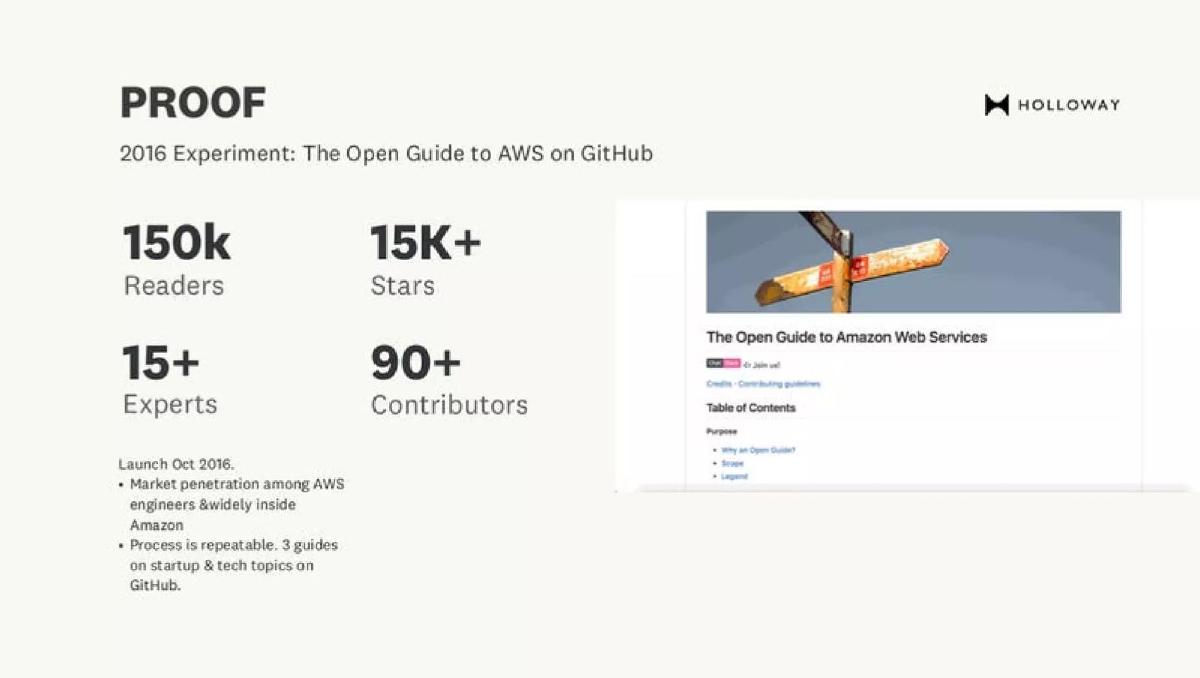
- The founders used a 2016 GitHub experiment with 150k readers and 15k stars as primary proof of market demand (Slide 3).
- Holloway identifies a gap in the 'Non-Fiction Reference' market where Quora and Stack Exchange provide inconsistent quality (Slide 10).
- The business model is bifurcated into a $48-$1,200/year membership for readers and a $20-$50/seat/month tool for enterprises (Slide 16).
- A unique 'Content Shelflife' chart argues that Holloway content lasts for decades, unlike Twitter (days) or blogs (weeks) (Slide 21).
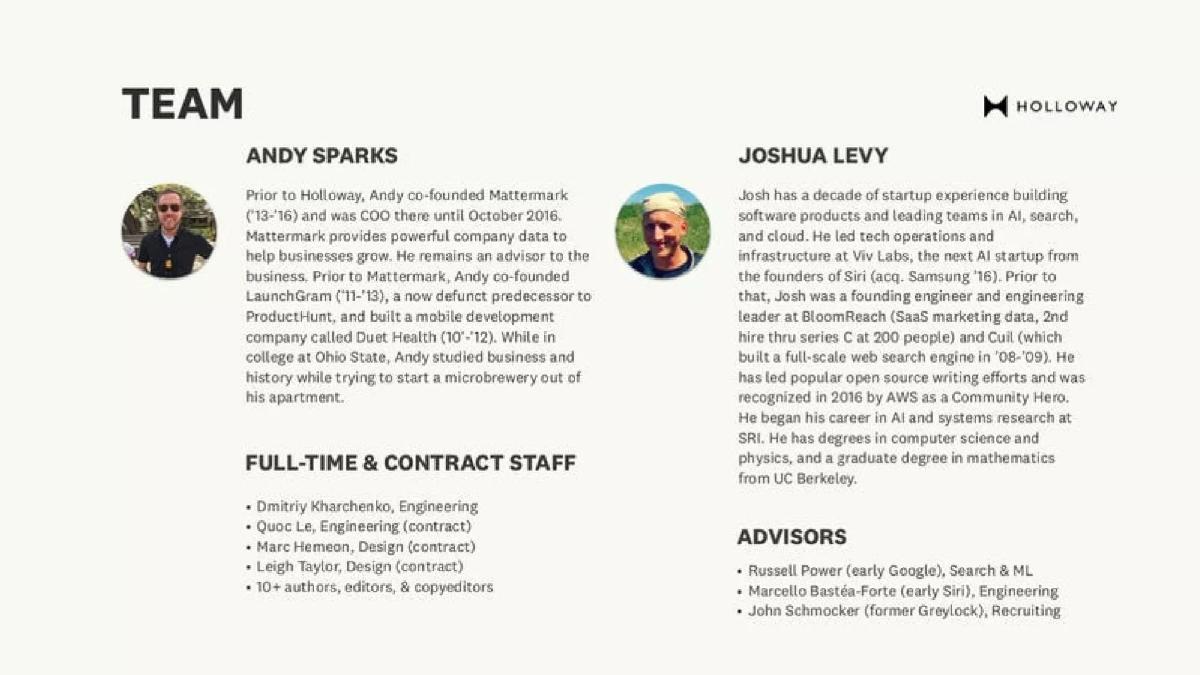
- The team slide highlights deep domain expertise in search, AI, and startup data from Mattermark, Viv Labs, and BloomReach (Slide 2).
- The deck explicitly rejects ad-supported models, citing that 80-90% of internet users find ads disruptive (Slide 23).
- Progress is measured by a transition from unpaid contributors to a paid author model with 10+ writers by Q4 2017 (Slide 9).
- The 'How Does It Work' slides illustrate a value chain where reader engagement feeds back into real-time demand data (Slides 14-15).
The Holloway Pitch Deck: A Strategic Teardown
Holloway’s 2019 Seed deck is a sophisticated example of how to pitch a content-first business in a tech-heavy venture capital environment. Raising $4.6M in a Seed round is no small feat for a media company, and this deck achieves it by reframing 'publishing' as a 'technology-enabled knowledge platform.' The deck is 23 slides long, characterized by a clean, minimalist aesthetic and a heavy emphasis on the 'shelf life' of information.
The Team and the Proof
Slide 2: Team . The deck leads with the founders, which is a standard move for Seed rounds where the 'who' often matters as much as the 'what.' Andy Sparks brings the operational experience of scaling Mattermark, while Joshua Levy provides the technical 'moat' with a background in AI and search at Viv Labs and SRI. The inclusion of advisors from early Google and early Siri reinforces the idea that this is a search and data problem, not just a writing project.
Slide 3: Proof . Before explaining the product, Holloway presents 'Proof' via a 2016 experiment: The Open Guide to AWS on GitHub. The metrics are compelling: 150k readers, 15k stars, and 90+ contributors. This slide serves to de-risk the investment by showing that the founders have already successfully executed a version of this model and found a massive audience for 'actionable guidance.'
Defining the Problem and the Vision
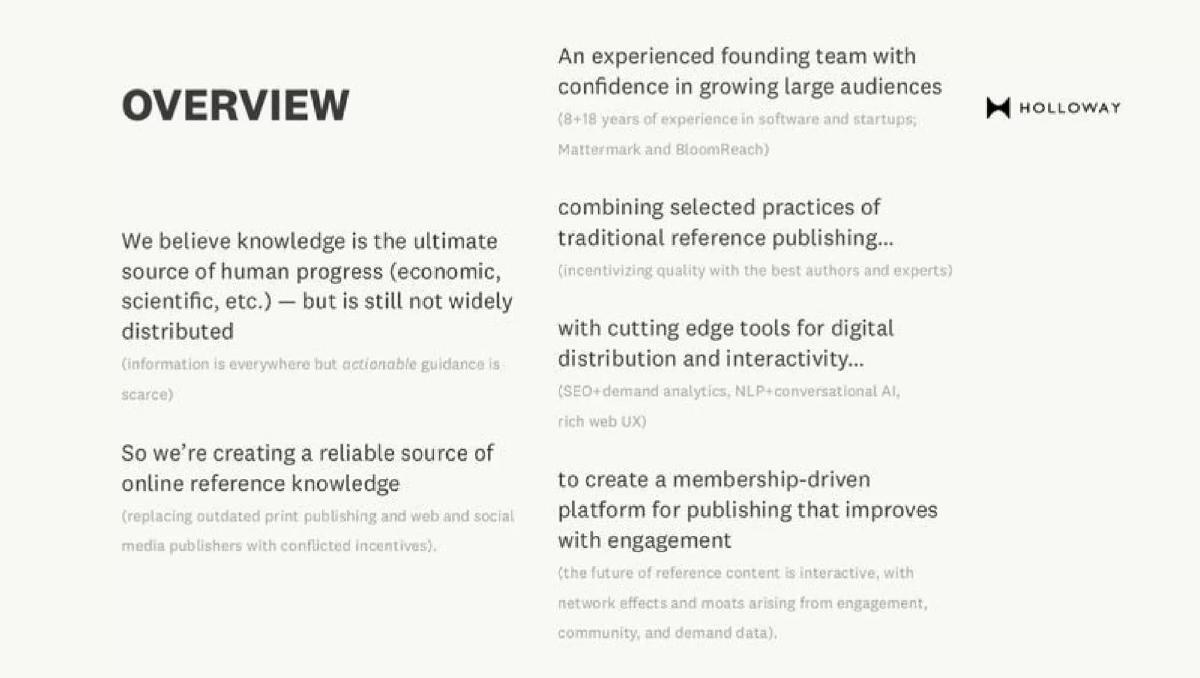
Slide 4: Overview . This slide acts as an executive summary. It defines the mission: creating a 'reliable source of online reference knowledge.' It explicitly mentions replacing 'outdated print publishing' and 'social media publishers with conflicted incentives.' This sets the stage for a subscription-based revenue model.
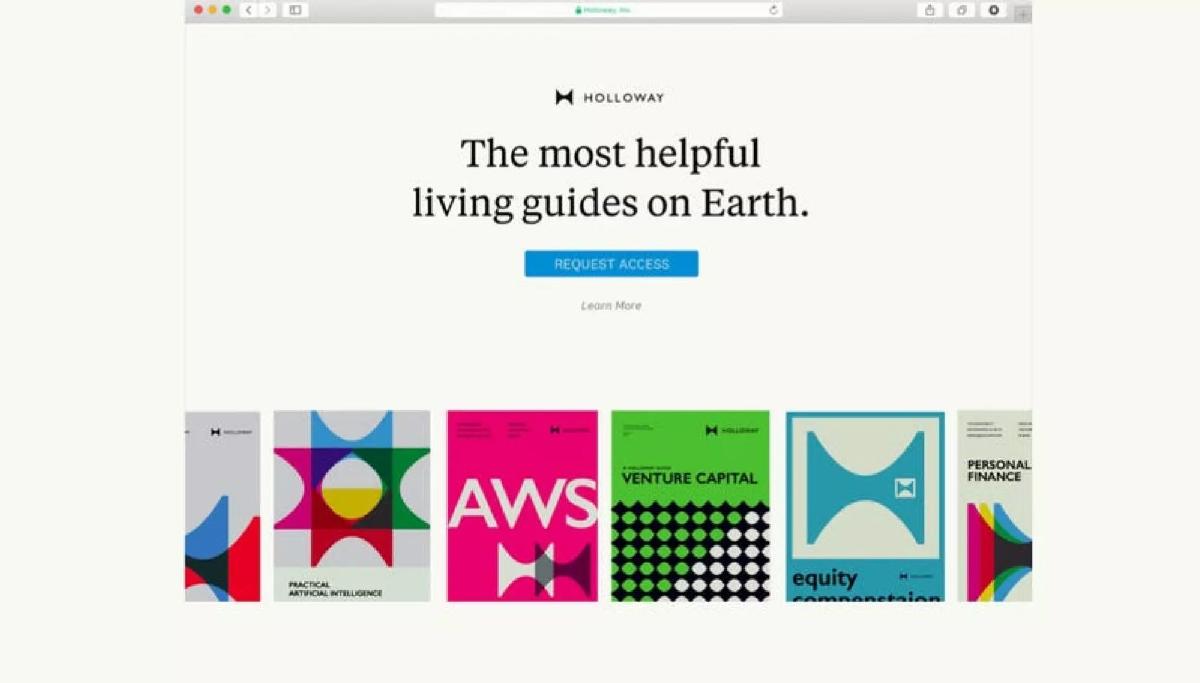
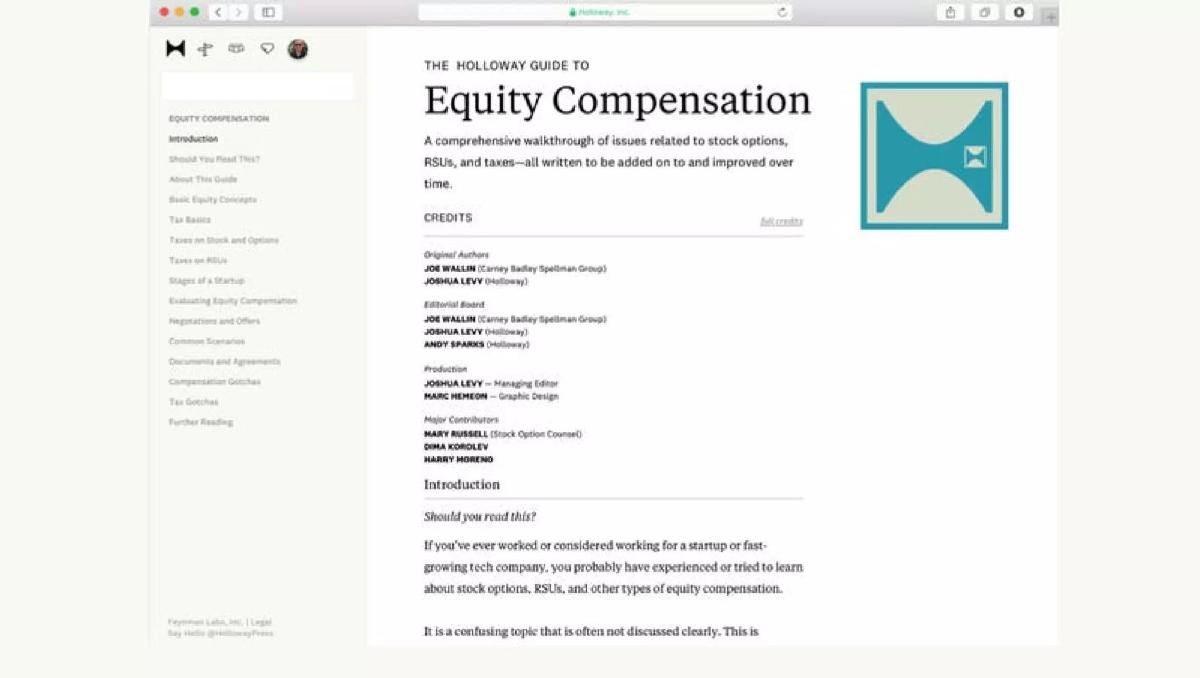
Slides 5-8: Product Walkthrough . These slides show the actual interface. Slide 5 uses the tagline 'The most helpful living guides on Earth.' Slides 6 and 7 show a deep dive into the 'Equity Compensation' guide, highlighting the editorial board, major contributors, and the granular, structured nature of the content. This isn't a blog; it's a digital textbook with a version-controlled, 'living' structure.
The Strategy and Market Context
Slide 9: Progress . This timeline shows the evolution from Q1 2017 to Q4 2017. A key detail here is the shift in Q4: 'Killed link lists... Switched to a paid author model.' This demonstrates a willingness to iterate and a commitment to quality over cheap, aggregated content.
Slide 10: The Library . This is a classic 'evolution of the market' slide. It maps various genres to their digital successors (e.g., Fiction to Kindle, News to NYTimes). Crucially, it leaves a question mark next to 'Non-Fiction Reference,' suggesting that Quora and Stack Exchange haven't fully solved the problem. This creates the 'gap' that Holloway intends to fill.
Slide 11: Problem . The problem is broken down into three pillars: Fragmented, Low Trust, and Misaligned. By citing 'SEO / click optimized' content and 'non-expert authors' as the enemy, Holloway aligns itself with the reader's frustration with the modern internet.
Slide 13: Why Now? . This slide identifies four tailwinds: the maturation of web content (fatigue with clickbait), the rise of the subscription economy, lowered barriers to collaborative contribution (the GitHub/Wikipedia effect), and the availability of data/intelligence to identify what people actually want to learn.
The Business Model and Competition
Slides 14-15: How Does It Work? . These slides illustrate the 'Information Value Chain.' Slide 15 is particularly important as it adds 'Contributions & demand data' as a feedback loop. This suggests that Holloway isn't just guessing what to write; they are using engagement data to drive their editorial roadmap.
Slide 16: Monetization . The revenue model is clear and ambitious. A 'Premium Reader Membership' is priced between $48 and $1,200 per user per year. This high ceiling suggests they are targeting professional use cases where the information has high ROI (like legal or financial advice). The 'Supply-Focused' revenue at $20-$50 per seat per month targets the enterprise market.
Slide 17: Consumer Market . Holloway uses a bottom-up and top-down approach. They cite 3 million NYT subscribers as a benchmark for paid content and a Pew Research stat that 84% of U.S. adults research specific topics. They calculate a $29B potential market based on a $119.88/year price point.
Slide 18: Competition . The competitive matrix uses 'Broad vs. Deep' and 'Mixed vs. Trusted' as axes. Holloway places itself in the 'Target Sector' alongside O'Reilly and Academic Journals—high trust, high depth—but differentiates by being a digital-first 'living' platform rather than a static publisher.
Roadmap and Appendix
Slides 19-20: Milestones and Timeline . The deck outlines a clear path through 2018, focusing on an invite-only alpha, building initial traction per topic, and then scaling the process. The 'Tentative Timeline' on slide 20 is highly detailed, mapping company, product, distribution, content, and team milestones across the year.
Slide 21: Content Shelflife . This is perhaps the most unique slide in the deck. It categorizes content by its 'shelf life,' from Snapchat (seconds) to Books (centuries). Holloway places itself in the 'Decades' category alongside Wikipedia. This is a powerful argument for the long-term value of the assets they are building; every dollar spent on content today continues to yield value for years.
What Works in This Deck
The Holloway deck succeeds because it treats content as an engineering problem. By using terms like 'value chain,' 'demand data,' and 'shelf life,' the founders speak the language of venture capitalists. The 'Proof' slide (Slide 3) is exceptionally strong; 150,000 readers for a technical guide on GitHub is a massive signal of product-market fit before the company even officially launched. The aesthetic of the deck also mirrors the product—clean, authoritative, and structured.
What Is Missing
The most notable omission is a specific 'Ask' slide. There is no mention of how much they are raising or what the specific valuation expectations are (though we know from catalogue facts they raised $4.6M). Additionally, while they mention a 'paid author model,' there is no breakdown of unit economics—how much does it cost to produce one guide versus the expected lifetime value of the subscribers that guide attracts? For a Seed round, this is often forgiven, but it is a question an investor would certainly ask in the room.
What a Founder Should Copy
Founders should emulate the 'Why Now' slide (Slide 13) and the 'Competitive Matrix' (Slide 18). Holloway doesn't just say 'we are better than Wikipedia'; they define the specific axes (Trust and Depth) where Wikipedia is broad and they are deep. The 'Content Shelflife' chart (Slide 21) is also a brilliant way to illustrate the 'compounding' nature of a business's assets. If you are building a business that creates long-term value, find a way to visualize that durability against the 'noise' of the current market.
Frequently asked questions
- What is Holloway's core product?
- Holloway builds 'living guides'—comprehensive, expert-authored digital books on complex topics like Equity Compensation and Venture Capital. Unlike static PDFs or physical books, these guides are designed to be updated over time and include interactive elements, as shown on slides 6 and 7.
- How does Holloway plan to make money?
- The company utilizes a two-pronged monetization strategy. First, a 'Demand-Focused' model charging individual consumers and prosumers between $48 and $1,200 per year. Second, a 'Supply-Focused' model launching in late 2019 targeting enterprises with group tools at $20-$50 per seat per month (Slide 16).
- Who are the founders and what is their background?
- The company was co-founded by Andy Sparks and Joshua Levy. Sparks was previously the COO of Mattermark and co-founder of LaunchGram. Levy has a decade of experience in AI and search, including roles at Viv Labs (acquired by Samsung), BloomReach, and SRI (Slide 2).
- What is the 'Why Now' for this business?
- Holloway argues that web content has matured to a point of fatigue with 'fake news' and clickbait. They cite a rise in the subscription economy and the fact that 84% of U.S. adults research specific topics of interest as a signal that users are willing to pay for high-value, vertical content (Slides 13 and 17).
- How does Holloway differentiate itself from Wikipedia or Quora?
- On slide 18, Holloway places itself in the 'Deep' and 'Trusted' quadrant. While Wikipedia is trusted and broad, and Quora is deep but has inconsistent quality, Holloway aims for consistent, expert-led quality on specific high-value topics, similar to O'Reilly or Academic Journals.