Silkroad Images presents a compelling case for a niche vertical in the massive stock photography market. By highlighting the stark contrast between stereotypical 'oriental' imagery found on mainstream platforms and the authentic reality of Middle Eastern life, the deck establishes an immediate and visceral problem-solution fit. With a reported $175k run rate and a growing library of content from over 400 photographers, the company demonstrates early traction in a market they value at $7.0B. However, the deck is notably light on financial projections, specific use of funds, and detailed team b…
Key takeaways
- The deck identifies a massive gap in authentic Middle Eastern and North African imagery on major platforms like Getty and Shutterstock (Slide 4).
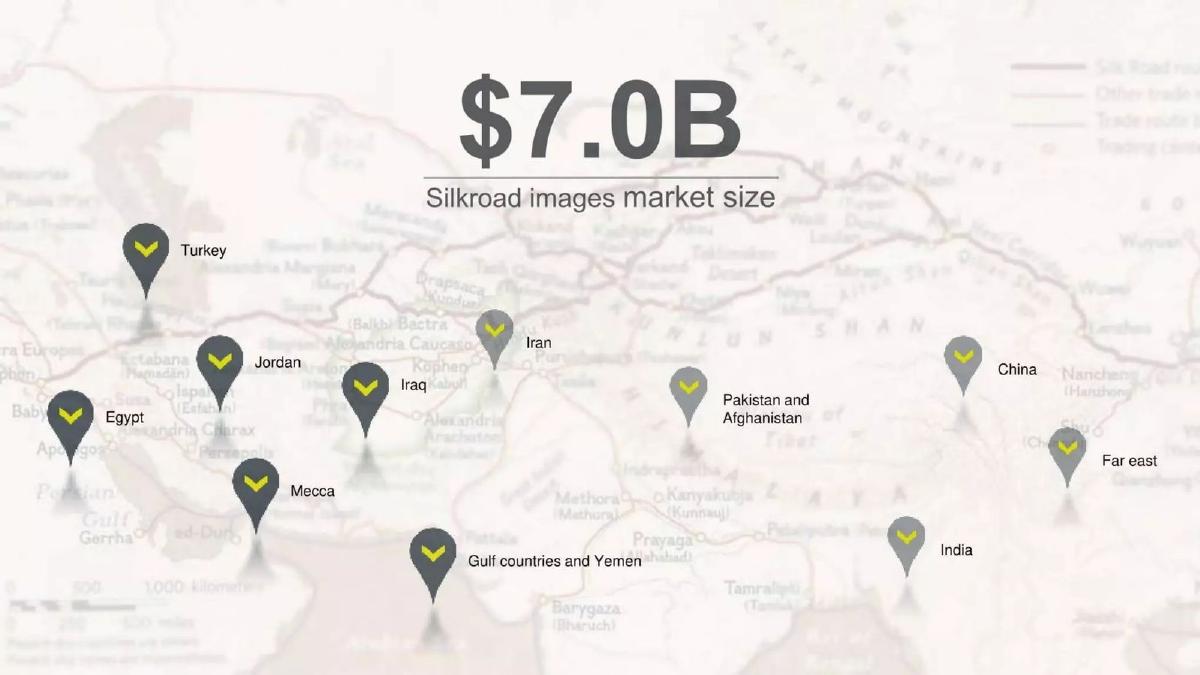
- Silkroad Images claims a total addressable market size of $7.0B, spanning from Turkey to the Far East (Slide 5).
- The company achieved a $175k run rate by 2014, with notable clients including APCO Worldwide and Mediaquest (Slide 7).
- Supply-side growth is strong, with 400+ photographers and a 35% month-over-month library growth rate (Slide 8).
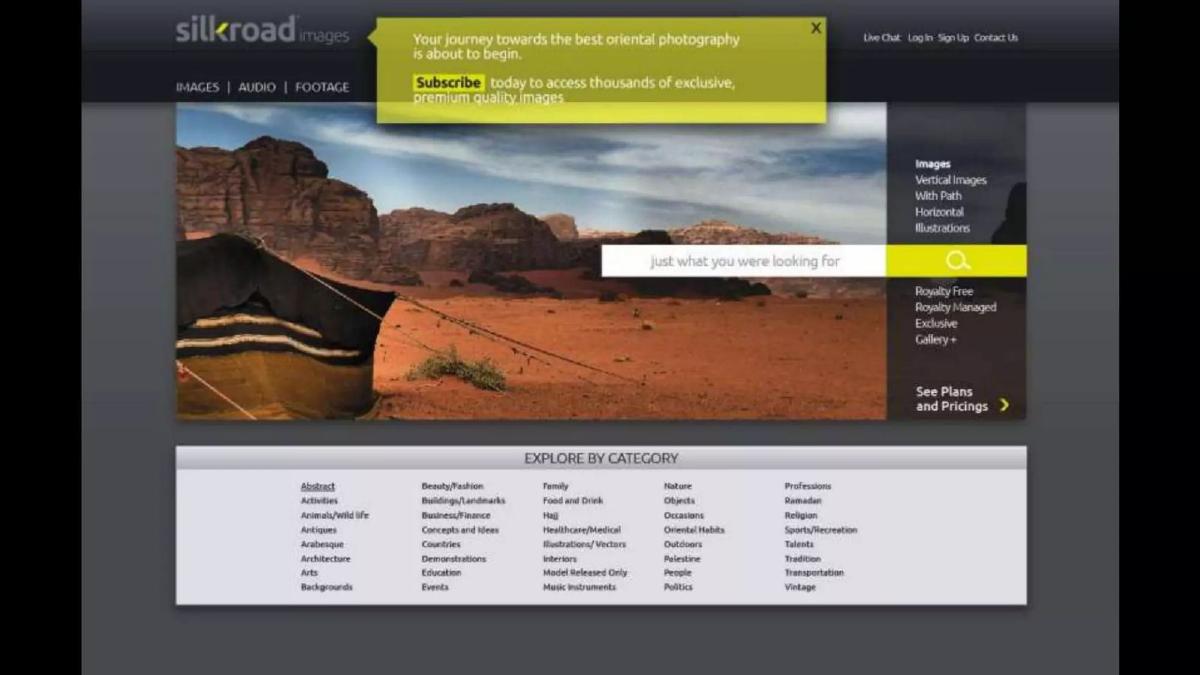
- The business model is subscription-based, as evidenced by the website interface shown on Slide 6.
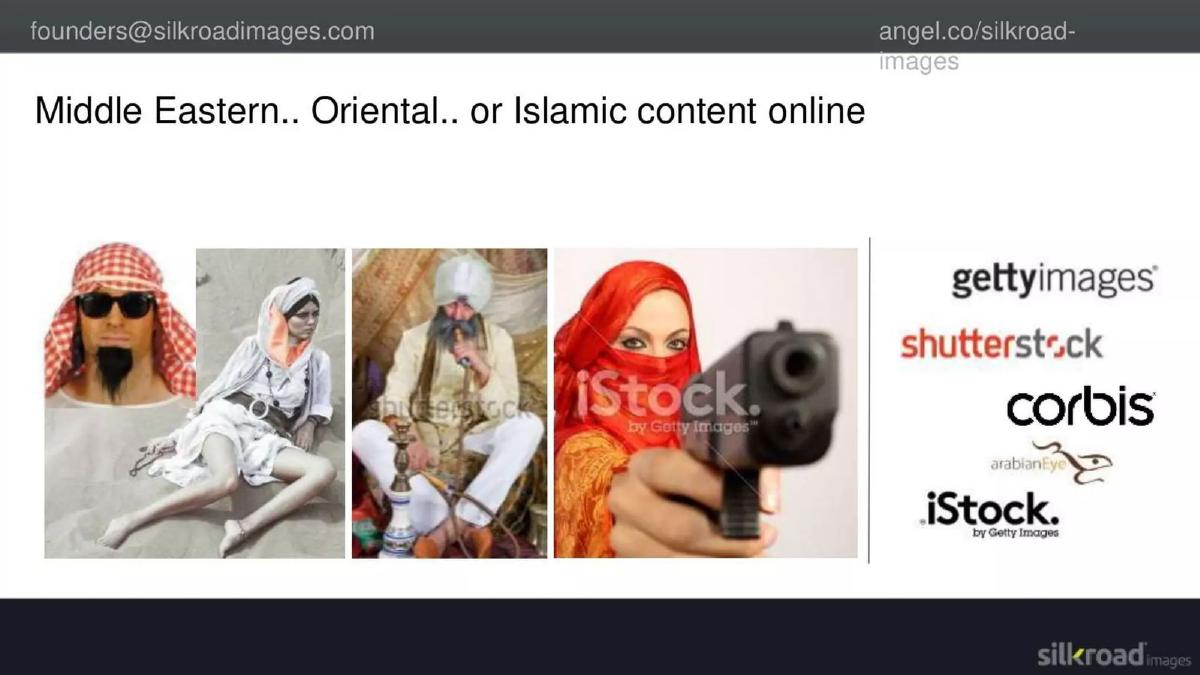
- The deck uses a 'Before vs. After' visual strategy to prove the necessity of their product (Slides 2, 3, and 4).
- There is a significant omission of a formal 'Ask' slide, leaving investors unclear on the specific funding goal or terms.
- The team slide (Slide 9) lacks names, titles, or professional backgrounds, relying entirely on a group photograph.
The Visual Correction: Silkroad Images Teardown
In 2014, Silkroad Images set out to disrupt the stock photography industry by addressing a glaring cultural blind spot. While giants like Getty and Shutterstock dominated the global market, their libraries were often criticized for providing stereotypical or inaccurate representations of the Middle East and North Africa (MENA). Silkroad Images positioned itself as the authentic alternative. This 13-slide deck is a masterclass in visual storytelling, though it leaves several business-critical questions unanswered.
The Hook and the Problem (Slides 1-4)
Slide 1: Title The deck opens with a clear value proposition: "Eastern identity images for Ad Agencies in North Africa to China." The branding is professional, and the contact information is immediately available. It sets a regional tone without being overly niche.
Slide 2 & 3: The Contrast These slides are purely visual and highly effective. Slide 2 shows a split screen: on the left, a stereotypical image of a militant; on the right, a modern professional man in a suit. Slide 3 follows the same pattern, contrasting an image of an oppressed woman behind bars with a modern woman in a hijab using a tablet. These slides don't need text; they communicate that the current market only sees the left side, while Silkroad provides the right side.
Slide 4: The Competitive Landscape This slide explicitly names the problem: "Middle Eastern.. Oriental.. or Islamic content online." It displays four cringeworthy, stereotypical stock photos (including a woman in a veil pointing a gun) and places the logos of Getty Images, Shutterstock, Corbis, and iStock next to them. This is a classic "villain" slide that makes the incumbent players look out of touch with the actual culture of the region.
Market Opportunity and Product (Slides 5-6)
Slide 5: Market Size The company claims a $7.0B market size. The map includes pins for Turkey, Jordan, Egypt, Mecca, Iraq, Iran, Gulf countries, Yemen, Pakistan, Afghanistan, India, China, and the "Far East." While the $7B figure is large, the deck does not provide a source for this valuation or a breakdown of the Serviceable Obtainable Market (SOM).
Slide 6: The Product This slide shows a screenshot of the Silkroad Images website. It highlights a subscription model ("Subscribe today to access thousands of exclusive, premium quality images"). The category list at the bottom is extensive, covering everything from "Arabesque" and "Hajj" to "Business/Finance" and "Nature." This demonstrates that they aren't just a niche cultural library; they are a full-service stock agency for the region.
Traction and Growth (Slides 7-8)
Slide 7: Revenue Silkroad reports a $175k Run Rate . This is a solid figure for a 2014 seed-stage company. They also list three logos—Zakat Foundation of America, APCO Worldwide, and Mediaquest—proving they have successfully moved into the B2B space with reputable organizations.
Slide 8: Supply Side The library is growing at 35% Month-over-Month (MoM) . They have 400+ photographers on board and set a goal of 1,000 professional photographers in Turkey for 2015. This slide is crucial because, in a marketplace business, supply-side growth is often the hardest hurdle to clear.
The Team and the Portfolio (Slides 9-13)
Slide 9: The Team This is a major weakness in the deck. It is a simple photograph of three individuals. There are no names, no titles, and no resumes. While the founders look professional, an investor has no way of knowing if they have experience in photography, tech, or the advertising industry.
Slides 10-12: Content Showcase The deck concludes with three slides showcasing the actual quality of their library. Slide 10 focuses on modern lifestyle and business; Slide 11 focuses on food and preparation; Slide 12 focuses on religious and traditional life. The quality of these images is high and directly supports the "authenticity" claim made at the start of the deck.
Slide 13: Closing The final slide is a high-impact landscape photo of a man by a campfire in the desert. It includes the contact email and AngelList link. Like the rest of the deck, it is visually stunning but lacks a final call to action or a summary of the investment opportunity.
What Works in the Silkroad Images Deck
Visual Proof: The "Before and After" slides (2-4) are the strongest part of the deck. They create an immediate emotional and logical realization that the current market is broken. · Clear Niche: The deck doesn't try to be everything to everyone. It focuses strictly on the "Silk Road" geography, which makes the $7B market claim feel more focused. · Supply-Side Traction: Showing 35% MoM library growth and 400+ photographers proves that the company has solved the initial "cold start" problem of a content marketplace.
What is Missing from the Silkroad Images Deck
The Ask: There is no mention of how much money the company is raising or what they plan to do with the capital. This is a fundamental omission for a pitch deck. · Team Credentials: A photo is not a team slide. Investors invest in people, and this deck provides zero information about the founders' backgrounds. · Financial Projections: While a $175k run rate is good, there is no indication of where that revenue is going. What are the margins? What is the projected revenue for the next 3-5 years? · Unit Economics: For a subscription business, metrics like Customer Acquisition Cost (CAC) and Lifetime Value (LTV) are essential. None are present here.
What a Founder Should Copy
The "Villain" Slide: If you are entering a market where the incumbents are doing a poor job, show it. Slide 4 is a perfect example of how to make your competitors look obsolete without saying a word. · Consistent Branding: The deck uses a consistent color palette (lime green and dark grey) and high-quality imagery that reflects the product they are selling. · B2B Validation: Listing specific, recognizable clients (Slide 7) is much more powerful than simply saying "we have customers."
Frequently asked questions
- What is the core problem Silkroad Images aims to solve?
- The core problem is the lack of authentic representation of Middle Eastern and Islamic culture in global stock photography. Slides 2, 3, and 4 demonstrate that existing providers often rely on stereotypes—such as images of militants, oppressed individuals, or culturally inaccurate costumes—which do not meet the needs of modern advertising agencies in the region.
- How does Silkroad Images generate revenue?
- Based on Slide 6, the company uses a subscription model. The website screenshot features a prominent 'Subscribe' call-to-action to access thousands of exclusive images. Slide 7 confirms they have reached a $175k run rate, indicating successful monetization through B2B clients like APCO Worldwide.
- What is the scale of their photographer network?
- As of the 2014 deck, Silkroad Images had a network of over 400 photographers (Slide 8). They also noted a specific target of 1,000 professional photographers in Turkey for 2015, suggesting a strategy of aggressive regional expansion to ensure content diversity.
- Who are the primary competitors mentioned?
- Slide 4 explicitly lists major global stock photo agencies as competitors: Getty Images, Shutterstock, Corbis, and iStock. It also mentions ArabianEye, a more regional competitor, but positions Silkroad as the superior choice for authentic, non-stereotypical content.
- What is missing from this pitch deck?
- The deck lacks several standard venture components. There is no 'Ask' slide detailing how much money is being raised, no financial projections or unit economics, no detailed competitor matrix beyond logos, and no professional biographies for the founding team shown on Slide 9.