Catnip's 2013 seed deck is a study in minimalism, utilizing only nine slides to secure $100,000 in funding. The presentation eschews traditional text-heavy problem/solution frameworks in favor of bold, high-impact metrics and visual product demonstrations. By highlighting a user base of one million and an average daily engagement of 13 minutes, the founders established immediate credibility. The deck also features a sophisticated grasp of unit economics for a seed-stage company, citing an LTV to CAC ratio of 4x. While it lacks a formal 'Ask' slide or a detailed roadmap, the deck successfully…
Key takeaways
- The deck claims a massive user base of one million users on slide 3.
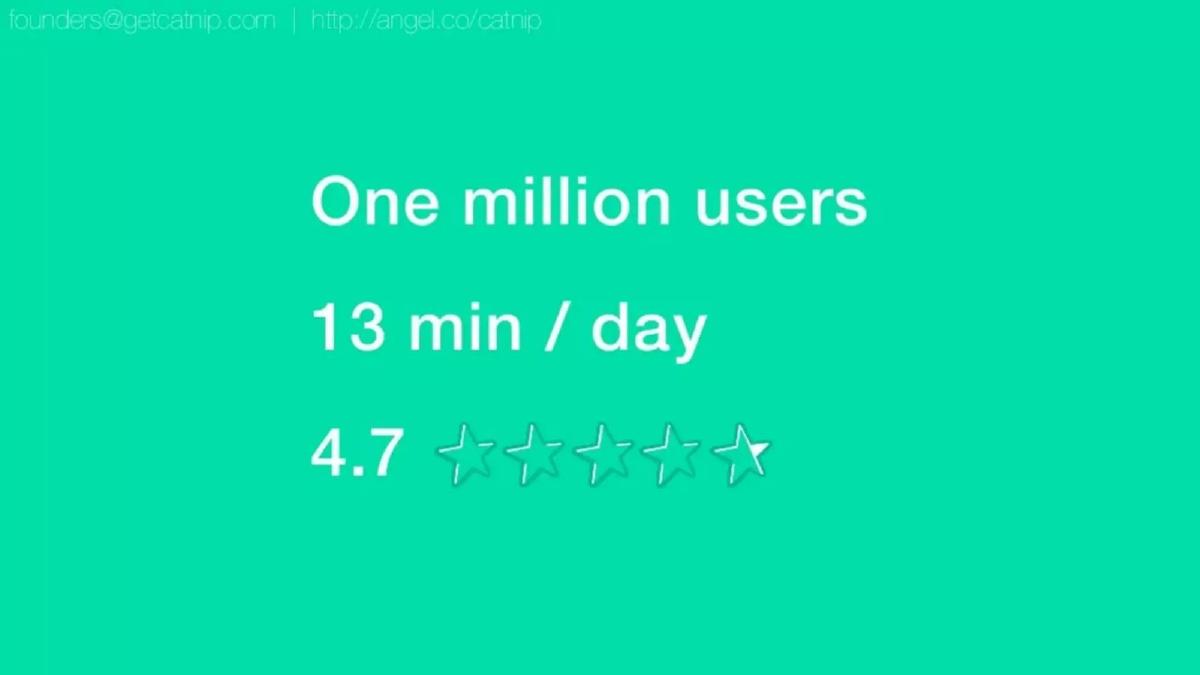
- Average user engagement is reported as 13 minutes per day on slide 3.
- The problem is framed as a shrinking attention span, dropping from 12 seconds in 2000 to 2.8 seconds today, according to slide 2.
- The business model relies on a healthy unit economic profile with LTV equal to 4x CAC as shown on slide 7.
- The company reports generating $15,000 per month in revenue on slide 7.
- The product features 'snackable content' and 'in-app messaging' to drive retention, as demonstrated on slides 4 and 6.
- The team slide (slide 8) highlights 'Second-time entrepreneurs' with backgrounds at P&G, Wired, and Ingenico.
- The deck completely omits a financial ask, use of funds, or a competition slide.
The Power of Brevity: Catnip’s 9-Slide Seed Deck
In the world of startup fundraising, there is a constant tension between providing enough detail to satisfy due diligence and keeping a deck punchy enough to maintain interest. Catnip, an online personal magazine and content aggregator, chose the latter. Their 2013 seed deck is a masterclass in minimalist communication. With only nine slides, they managed to secure $100,000 in funding by letting their traction do the talking.
This teardown examines how Catnip utilized high-level metrics and a clear understanding of their audience to build a compelling case for a social media content aggregator during the height of the mobile app boom.
The Hook and the Problem
Slide 1: Title Slide The deck opens with a clean, branded title slide featuring the Catnip logo—a stylized cat head with a leaf motif. The color palette is a consistent mint green, which carries through the entire presentation. There is no tagline here, just the brand identity.
Slide 2: The Attention Span Crisis Catnip immediately establishes the 'Why' of their existence. Slide 2 features a photo of a young woman using a smartphone with the text: "Average attention span is down to 2.8 sec VS 12 sec in 2000" . This is a classic 'shock' metric. It frames the market opportunity not as a lack of content, but as a lack of content that fits the modern human's ability to focus. By citing these specific figures, they justify the need for a platform that aggregates short-form, easily digestible media.
Traction and Product
Slide 3: The Big Numbers Instead of a long-winded solution slide, Catnip goes straight to the results. Slide 3 is a bold declaration of success: "One million users" , "13 min / day" , and a "4.7" star rating represented by five stars. For a seed-stage company, having one million users is a massive validator. The 13-minute daily engagement metric is equally important, as it proves that despite the 2.8-second attention span mentioned on the previous slide, users are returning to the app repeatedly throughout the day.
Slide 4: Snackable Content This slide introduces the product interface. It shows a mobile screen with tabs for different emotional categories: "Laughter", "Surprised", "Inspired", and "Cuteness". The headline "Snackable content" reinforces the solution to the attention span problem. The visuals show a DIY craft project, suggesting the content is visual and instructional but brief.
Slide 5: All in One Place Slide 5 emphasizes the aggregation aspect of the app. The headline "All in one place" is paired with a screenshot of a viral dog meme. This tells the investor that Catnip is a curator of the best content from across the web, saving the user the trouble of visiting multiple social networks.
Slide 6: In-app Messaging To address the 'social' component of the app, slide 6 highlights "In-app messaging" . The screenshot shows a user sharing a post with specific contacts (Morgan, Dan). This is a critical slide because it suggests the app isn't just a passive consumption tool; it has a built-in viral loop where users bring other users back into the experience through sharing.
Business Model and Team
Slide 7: Unit Economics This is arguably the most sophisticated slide in the deck. It moves away from user behavior and into business viability. The slide states: "LTV = 4 x CAC" and "$15K/month" . Underneath these figures are logos for major global brands: Pepsi, Henkel, Picnic, Toyota, Indesit, Nivea, and P&G. This slide tells a complete story: they know how much it costs to get a user, they know that user is worth four times that cost, they are already generating revenue, and they have the attention of blue-chip advertisers.
Slide 8: The Founders The team slide is titled "Second-time entrepreneurs" . It features CEO Dmitry Dumik and CTO Artem Ptashnik. The logos for P&G and Wired under Dumik, and Ingenico and the FB Start Program under Ptashnik, provide the necessary pedigree. The mention of "Hottest Russian startups" adds a layer of external validation to their previous efforts.
Slide 9: The Vision The final slide returns to the logo and a simple summary: "One million teens discover, snack and share content" . It defines the target market (teens) and the three core actions of the app (discover, snack, share). It’s a clean exit that leaves the investor with the scale of the current achievement.
What Works in the Catnip Deck
The most effective element of this deck is its unwavering focus on traction . By putting the "One million users" metric on slide 3, the founders immediately move the conversation from "Will this work?" to "How big can this get?".
The visual consistency is also a major plus. The use of the mint green brand color and high-quality mobile screenshots makes the product feel real and polished. Furthermore, the unit economics slide (Slide 7) is a rarity in seed decks from 2013. Most social apps at that time were focused purely on growth; by showing a 4x LTV/CAC ratio and $15,000 in monthly revenue, Catnip proved they had a sustainable path to profitability, not just a viral hobby.
What is Missing from the Catnip Deck
Despite its successes, the deck has several glaring omissions that would be considered red flags in a modern fundraising environment:
The Ask: There is no slide stating how much money they are looking for or what the terms of the round are. While the catalogue listing says they raised $100,000, the deck itself is silent on the financial requirement. · Use of Funds: Investors want to know how their capital will be deployed. Will it go toward engineering, user acquisition, or content partnerships? This deck offers no roadmap. · Competition: In 2013, the mobile content aggregation space was crowded with players like Flipboard, Pulse, and even early versions of Snapchat and Instagram. Catnip fails to mention how they differentiate themselves from these giants. · Market Size: While they mention "one million teens," they don't provide a Total Addressable Market (TAM) analysis. How many teens are there globally, and what is the dollar value of the advertising market they are targeting?
What a Founder Should Copy
Founders can learn a lot from Catnip’s minimalist approach to the problem slide . Instead of five slides explaining why the internet is noisy, they used one slide with one powerful statistic about attention spans. This respects the investor's time and gets to the meat of the pitch faster.
Additionally, the "Second-time entrepreneurs" branding is a powerful way to frame a team. If you have started a company before—even if it didn't result in a billion-dollar exit—highlighting that experience suggests you have already made the 'rookie' mistakes and are a safer bet for capital.
Finally, the integration of brand logos on the revenue slide is a great way to show market validation without needing a wall of text. Seeing Pepsi and Toyota logos next to a revenue figure immediately elevates the perceived status of the startup.
Final Thoughts
The Catnip deck is a product of its time—a period when mobile growth was the primary metric of interest. However, its core principles of brevity, bold traction, and clear unit economics remain relevant today. It proves that you don't need 20 slides to tell a compelling story if the numbers you do have are strong enough to stand on their own.
Frequently asked questions
- How much did Catnip raise with this deck?
- According to the catalogue listing from pitchdeckhunt.com, Catnip raised $100,000 in a Seed round in 2013. This is a relatively modest amount for a company claiming one million users, suggesting the round may have been a bridge or a very early-stage injection to scale existing momentum.
- What is the core problem Catnip aims to solve?
- Slide 2 identifies the problem as the drastic reduction in human attention spans. It notes that the average attention span was 12 seconds in 2000 but has fallen to just 2.8 seconds. Catnip positions itself as the solution by providing 'snackable content' that fits these brief windows of attention.
- What are the key engagement metrics presented?
- Catnip emphasizes two primary engagement figures on slide 3: a total user count of one million and an average time spent in the app of 13 minutes per day. Additionally, they boast a 4.7-star rating, indicating high user satisfaction alongside high volume.
- Does the deck explain how the company makes money?
- Slide 7 alludes to their monetization strategy by showing logos of major brands like Pepsi, Toyota, Nivea, and P&G. Combined with the metric of $15,000 per month, it implies an advertising or brand partnership model where these companies pay to reach the app's teen audience.
- Who are the founders of Catnip?
- As shown on slide 8, the company was led by CEO Dmitry Dumik and CTO Artem Ptashnik. The slide brands them as 'Second-time entrepreneurs' and lists experience with high-profile entities such as P&G, Wired, and the FB Start Program.