Castle Peak Mining Ltd.'s 2012 investor presentation focuses on its gold exploration projects in Ghana's Ashanti Belt, specifically the Akorade Project. The deck emphasizes the region's gold production history, the company's nine concessions, and the potential targets within the Nkwanta Concession. It details the company's share structure, including issued common shares, warrants, and stock options, totaling 103,855,732 fully diluted shares. The presentation also showcases a strong Board of Directors with extensive mining experience and highlights Ghana as a mining-friendly jurisdiction. Whil…
Key takeaways
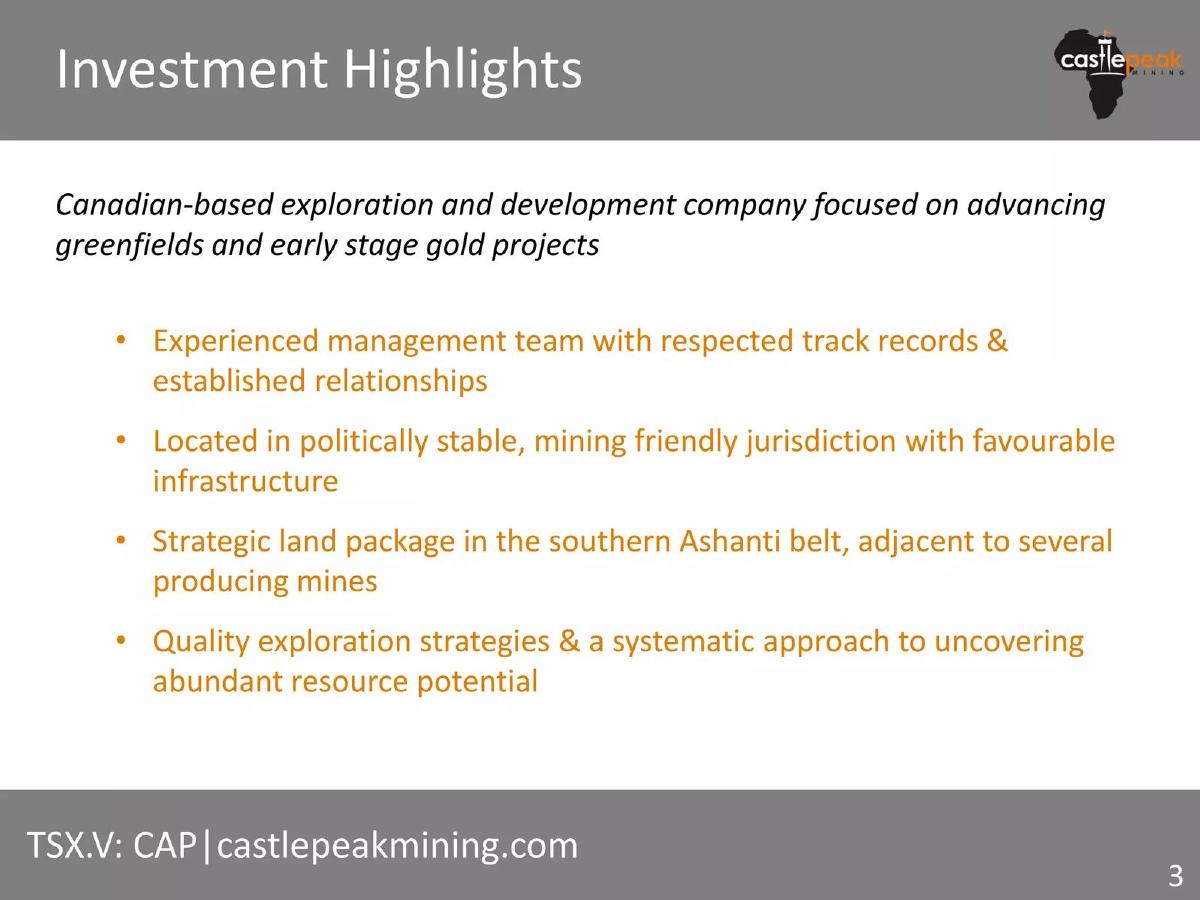
- The deck is an 'Investor Presentation' for Castle Peak Mining Ltd., dated 'August 2012' (Slide 1).
- The company's primary focus is a 'Strategic Gold Project in Ghana's Ashanti Belt' (Slide 1).
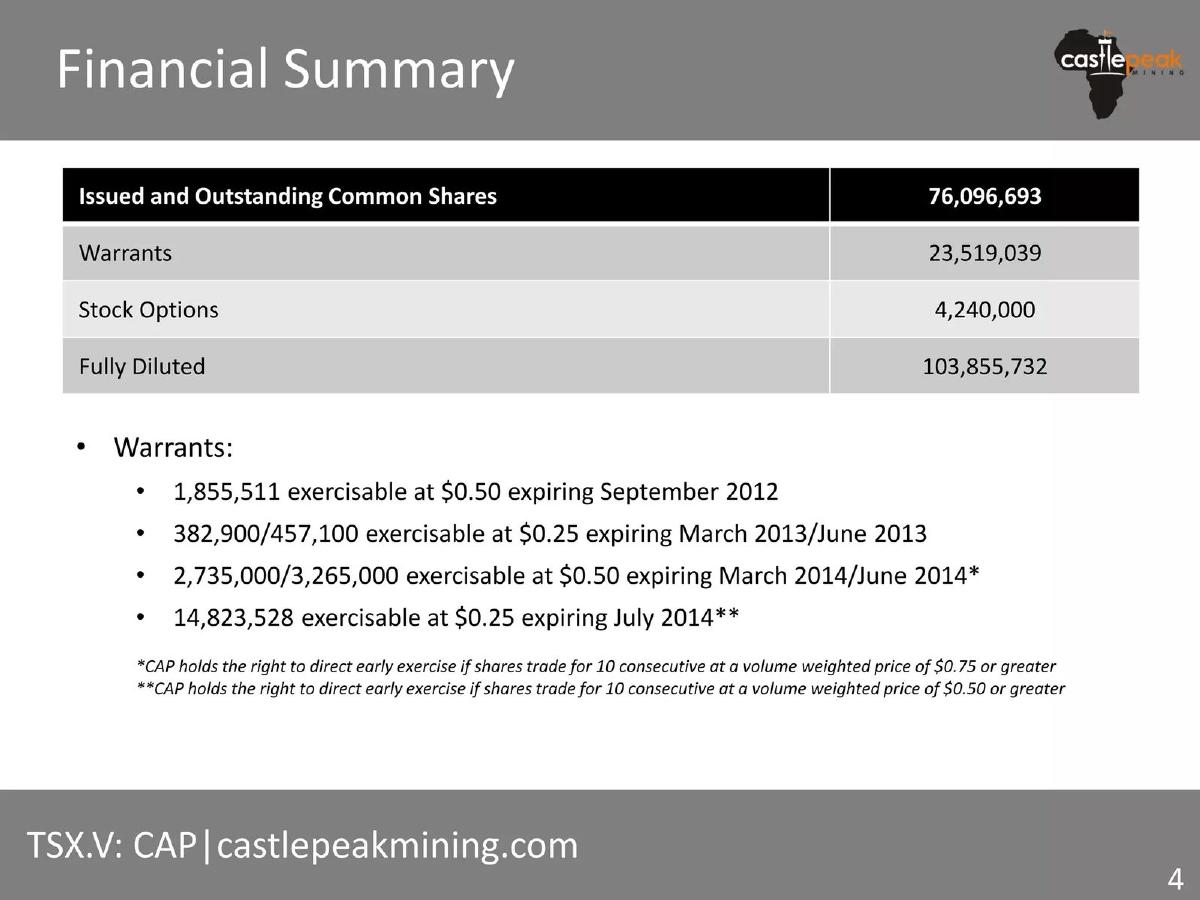
- As of August 2012, Castle Peak Mining Ltd. had '76,096,693' issued and outstanding common shares, with a fully diluted total of '103,855,732' shares (Slide 4).
- The Board of Directors includes five members, each with significant experience in mining and finance, such as Brian Lock (Chairman) and Randy Smallwood (Slide 7).
- Ghana is presented as the 'second largest gold producer in Africa' with 'past production of 150 million ounces' (Slide 10).
- The 'Akorade Project' consists of 'Nine concessions: Bonsaso (90%), Dompem (100%, 2.5% NSR), Enyinase (100%, 2.5% NSR), POW (82.5%), Asuogya (95%), Ayiem (95%), Nkwanta (95%), Kedadwen (95%) and Great Yorkshire (100%)' (Slide 13).
- The Nkwanta Concession identifies 'Apankrah Target,' 'Scorpio Target,' 'Nana Target,' and 'Un-named Target' as potential anchor resources (Slide 16).
- The deck outlines a '2012 Target Generation' strategy involving 25 target areas and a proposed Phase 1 drill program (Slide 19).
Castle Peak Mining Ltd. Pitch Deck Teardown: Gold Exploration in Ghana
This teardown analyzes the investor presentation for Castle Peak Mining Ltd., a company focused on gold exploration in Ghana. The deck, published on SlideShare as an 'Investor Presentation' and dated 'August 2012' on its title slide, provides insights into the company's assets, team, and operational context. It highlights the strategic importance of its projects in Ghana's Ashanti Belt, a region known for significant gold production. The presentation details the company's share structure, the expertise of its Board of Directors, and the geological specifics of its Akorade Project and Nkwanta Concession. While offering a comprehensive overview of its exploration activities and the favorable mining environment in Ghana, the deck omits certain elements typically sought by investors, such as a clear 'ask' or financial projections.
The analysis proceeds slide-by-slide, examining the content, structure, and effectiveness of each section. It then synthesizes these observations into sections on what works well, what is missing, and what aspects founders might consider emulating in their own pitch decks, particularly within the mining or natural resources sector.
Slide 1: Title Slide
The first slide introduces Castle Peak Mining Ltd. with a prominent logo that incorporates the shape of Africa. The title states: “Strategic Gold Project in Ghana’s Ashanti Belt” and identifies the document as a “Corporate Presentation – August 2012” . At the bottom, it displays “TSX.V: CAP | castlepeakmining.com” . This slide clearly establishes the company's name, its core business (gold mining), its geographic focus (Ghana's Ashanti Belt), and the date of the presentation. The stock ticker and website provide immediate avenues for further information. The design is clean, with a clear hierarchy of information.
Slide 4: Financial Summary
This slide, titled “Financial Summary” , provides a snapshot of the company's share structure. It lists “Issued and Outstanding Common Shares” as “76,096,693” . Below this, it details “Warrants” at “23,519,039” and “Stock Options” at “4,240,000” . The “Fully Diluted” share count is presented as “103,855,732” . A bulleted list provides further detail on warrants: “1,855,511 exercisable at $0.50 expiring September 2012” , “382,900/457,100 exercisable at $0.25 expiring March 2013/June 20 13” , “2,735,000/3,265,000 exercisable at $0.50 expiring March 2014/June 2014” , and “14,823,528 exercisable at $0.25 expiring July 2014” . Two footnotes clarify the conditions for asterisked warrants: “CAP holds the right to direct early exercise if shares trade for 10 consecutive at a volume weighted price of $0.75 or greater” and “CAP holds the right to direct early exercise if shares trade for 10 consecutive at a volume weighted price of $0.50 or greater” . This slide is highly specific about the company's capitalization, which is critical information for potential investors in a publicly traded entity.
Slide 7: Board of Directors
Titled “Board of Directors” , this slide introduces five key individuals. Brian Lock (Chairman) is described as having “30 years experience in mining, founder of Proton International Engineering Corp.” and EVP of Frontier Pacific Mining Corporation, with current directorships at Scorpio Gold Corporation, Canaco Resources Inc. and San Marco Resources Inc. Randy Smallwood, P.Eng is identified as a “Founding member and current President and CEO of Silver Wheaton Corp.” , with a background as a geological engineer and instrumental part of a 2005 merger. He is also a former Director of Ventana Gold Corp. and current Director of Tigray Resources Inc., Geologix Explorations Inc. and Riva Gold Corp. Peter J. Hawley, P.Geo is listed as “President, CEO and Director of Scorpio Gold Corp.” and Chairman and Director of Scorpio Mining Corp., and Director of Maxtech Ventures Inc., Chimata Gold Corp. and Abitex Resources Inc. Darren Lindsay, BSc, PGeo is the “President & Chief Executive Officer of Castle Peak Mining Ltd.” . Finally, Darryl Cardey, CA is a “Chartered Accountant and partner with CDM Capital Partners” , co-founder of Underworld Resources (bought by Kinross May 2010), and CFO of Crazy Horse Resources, and Minaurum Gold. This slide effectively showcases the depth of experience and industry connections within the company's leadership, which is a strong positive for an exploration company.
Slide 10: Mining Friendly Jurisdiction
This slide, titled “Mining Friendly Jurisdiction” , makes a case for Ghana as a prime location for mining operations. The main text states: “Ghana is the second largest gold producer in Africa with past production of 150 million ounces. Castle Peak’s Akorade project is located in southwest Ghana in the southern portion of the Ashanti volcanic belt.” Bullet points elaborate on Ghana's attributes: “Stable governmental system since Ghana became a British colony” , “Rated an investment grade country” , “Favourable mining and tax code” , “Import taxation excluded on equipment for foreign mining companies” , and “Excellent infrastructure and well trained labour force available” . A map of Ghana is included, highlighting the Ashanti Belt and the location of the Akorade Project. This slide effectively addresses geopolitical and economic risks, positioning Ghana as a secure and beneficial environment for investment in mining.
Slide 13: Akorade Project
The slide titled “Akorade Project” focuses on the company's core asset. It highlights “Nine contiguous licenses covering two key structural trends for gold deposits.” A bulleted list details these concessions: “Nine Concessions: Bonsaso (90%), Dompem (100%, 2.5% NSR), Enyinase (100%, 2.5% NSR), POW (82.5%), Asuogya (95%), Ayiem (95%), Nkwanta (95%), Kedadwen (95%) and Great Yorkshire (100%)” . Further bullet points describe geological features: “Cross Structures on Birimian-Tarkwaian Boundary host similar structural controls as deposits currently being mined by nearby Goldfields (Damang) and Anglogold-Ashanti (Iduapriem)” and “Flexures on N-S Structure host similar structural and geological targets as Golden Star (HBB-FatherBrown) and Endeavor Mining (Nzema)” . A detailed geological map of the Akorade Project area is provided, showing the various concessions and geological structures. This slide provides crucial technical details about the project's scope and geological potential, drawing parallels with successful nearby operations.
Slide 16: Nkwanta Concession - Targets
This slide focuses on specific exploration targets within the Nkwanta Concession, titled “Nkwanta Concession - Targets” . It begins with a statement: “Combined these targets have the potential to be an anchor resource for CAP.V” . Four specific targets are listed: “1. Apankrah Target: High potential based on productive ENE structural orientations and initial high grade drill results” ; “2. Scorpio Target: Strong chargeability based on IP survey. Appears to be a linking structure between the Apankrah & Nana targets” ; “3. Nana Target: Parallel structure north of Apankrah. Evaluating an inferred shoot based on drill results and the geometry confirmed at the Apankrah target” ; and “4. Un-named Target: Parallel structure located north of the Nana target. Active with artisanal mining” . A geological map of the Nkwanta area is included, visually representing these targets, soil anomaly data, and drill hole locations. This slide demonstrates a clear, data-driven approach to identifying and prioritizing exploration targets, directly linking them to potential resource growth for the company.
Slide 19: 2012 Target Generation
Titled “2012 Target Generation” , this slide outlines the company's strategy for identifying new gold targets. It lists several key actions: “25 target areas covering all 9 concessions” ; “Focused regional and target scale geological mapping, prospecting & sampling” ; “Further evaluate the Asuogya/Ayiem 9km gold in soil anomaly” ; “Select target refinement – geophysics, auger drilling & trenching” ; “Prioritize, compile & evaluate new highly prospective targets” ; “Review and compare new targets with pre-existing targets” ; and “Propose Phase 1 drill program on highest potential targets” . A map of the Akorade Project area is displayed, showing the various concessions with highlighted target areas. This slide communicates a systematic and multi-faceted approach to exploration, indicating ongoing and future work to expand the company's resource base.
Slide 24: Contact
The “Contact” slide provides detailed contact information for the company. It lists a “Corporate Office” in Vancouver, BC, with a street address, telephone, fax, and email ( “info@castlepeakmining.com” ). It also includes a Twitter handle: “@Castlepeakgold” . A “Ghana Office” address in Accra, Ghana, with a telephone number, is provided. Under “Investor Relations” , Ashlee Gunterback is listed as Investor Relations Manager with a direct phone extension and email ( “ashleeu@castlepeakmining.com” ). Darren Lindsay, President & CEO, also has a direct phone extension and email ( “darrenl@castlepeakmining.com” ). A photograph of what appears to be field operations in a tropical environment is included on the right side of the slide. This slide ensures that interested parties have multiple channels to reach the company and its key personnel.
Slide 25: Appendix – VTEM/Magnetic/Radiometric Airborne Geophysical Survey
The final provided slide is an “Appendix” section, specifically detailing a “– VTEM/Magnetic/Radiometric Airborne Geophysical Survey” . It states: “Completed a 3,425 km airborne survey over entire ~225 sq. km land package” . Further points include: “First modern compilation of the geology at a concession and prospect level” and “Confirmed initial interpretations of controls, specifically, flexures on the inferred north-south structures and cross structures on Birimian-Tarkwaian boundary resemble similar controls for deposits currently being mined in the area” . A complex geological map, likely derived from the geophysical survey data, is presented, showing magnetic and radiometric anomalies, inferred major structures, and the Akorade Project concessions. This appendix slide provides technical validation and depth to the company's exploration claims, demonstrating the use of advanced techniques to de-risk and define targets.
What Works Well
The Castle Peak Mining Ltd. pitch deck effectively communicates several key strengths. Firstly, the emphasis on Ghana as a “Mining Friendly Jurisdiction” (Slide 10) is a strong selling point, addressing potential concerns about political stability and regulatory environment. The detailed bullet points on Ghana's gold production history, stable government, and favorable tax codes provide a compelling argument for operating in the region. Secondly, the “Board of Directors” slide (Slide 7) is exceptionally strong. Each board member is presented with extensive, relevant experience in mining, finance, and geology, including leadership roles in other successful mining companies. This instills confidence in the leadership's capability to execute. Thirdly, the technical detail provided for the “Akorade Project” (Slide 13) and the “Nkwanta Concession - Targets” (Slide 16) is robust. The inclusion of specific concession names, ownership percentages, geological descriptions, and detailed maps demonstrates a thorough understanding of their assets and a systematic approach to exploration. The comparison to nearby successful operations like Goldfields and Anglogold-Ashanti (Slide 13) lends credibility to their project's potential. Finally, the “Financial Summary” (Slide 4) is transparent and precise regarding the company's share structure, including fully diluted numbers and warrant details, which is crucial for public companies and sophisticated investors.
What Is Missing
Despite its strengths, the Castle Peak Mining Ltd. pitch deck has several notable omissions. The most significant is the absence of a clear “ask” or “use of funds” slide. For an investor presentation, knowing how much capital the company is seeking and precisely how that capital will be deployed is fundamental. Without this, investors cannot assess the investment opportunity or the potential return on investment. Secondly, there are no explicit financial projections, revenue models, or valuation metrics presented. While an exploration company might not have immediate revenues, projections for future resource estimates, potential production timelines, and economic models (e.g., NPV, IRR) are typically expected. Thirdly, beyond the Board of Directors, there is no dedicated slide for the broader management team or operational personnel. While the board is strong, the day-to-day operational leadership is also critical. Fourthly, while Ghana is presented as a friendly jurisdiction, a more explicit “market opportunity” slide that quantifies the demand for gold, market trends, or the specific value proposition of Castle Peak's gold resources would strengthen the pitch. Lastly, there's no mention of environmental, social, and governance (ESG) factors, which are increasingly important for investors in the mining sector. Given the context of operating in Africa, addressing community relations, environmental impact, and governance practices would enhance the deck's completeness.
What a Founder Should Copy
Founders, particularly those in the natural resources or capital-intensive industries, can learn several valuable lessons from Castle Peak Mining Ltd.'s deck. First, the clarity and detail in the “Financial Summary” (Slide 4) regarding share structure, warrants, and options is exemplary. Transparency in capitalization is vital for investor confidence. Second, the “Board of Directors” slide (Slide 7) is a masterclass in showcasing expertise. Founders should emulate the practice of listing key individuals with their relevant experience, past successes, and current affiliations to build credibility. Third, the strategic framing of the operational environment as a “Mining Friendly Jurisdiction” (Slide 10) is effective. Identifying and articulating the advantages of your operating location, backed by specific facts (e.g., gold production, governmental stability), can de-risk the investment in investors' minds. Fourth, the technical depth provided for the “Akorade Project” (Slide 13) and the “Nkwanta Concession - Targets” (Slide 16) with detailed maps and geological explanations is crucial for technically-minded investors. Founders should not shy away from providing sufficient technical detail to substantiate their claims, especially when dealing with complex assets. Finally, the inclusion of an “Appendix” (Slide 25) for detailed technical data, like geophysical surveys, is an excellent way to provide supporting evidence without cluttering the main narrative. This allows interested investors to delve deeper into the technical merits of the project if they choose.
Frequently asked questions
- What is Castle Peak Mining Ltd.'s primary business focus?
- Castle Peak Mining Ltd. is focused on a 'Strategic Gold Project in Ghana's Ashanti Belt.' The company is engaged in gold exploration, specifically within its Akorade Project, which comprises nine concessions in a historically rich gold-producing region. The presentation highlights various targets within these concessions. (Slide 1, Slide 13)
- What is the share structure of Castle Peak Mining Ltd. as presented?
- As of August 2012, Castle Peak Mining Ltd. had '76,096,693' issued and outstanding common shares. Additionally, there were '23,519,039' warrants and '4,240,000' stock options, leading to a fully diluted share count of '103,855,732'. Details on warrant exercise prices and expiry dates are also provided. (Slide 4)
- Who are the key members of the Board of Directors?
- The Board of Directors includes Brian Lock as Chairman, Randy Smallwood as a founding member and current President and CEO of Silver Wheaton Corp., Peter J. Hawley, Darren Lindsay as President & Chief Executive Officer of Castle Peak Mining Ltd., and Darryl Cardey. Each member is described with extensive experience in mining and finance. (Slide 7)
- Why is Ghana considered a favorable location for Castle Peak Mining's operations?
- Ghana is presented as a 'Mining Friendly Jurisdiction' because it is the 'second largest gold producer in Africa' with 'past production of 150 million ounces'. The deck also notes its stable governmental system, investment-grade country rating, favorable mining and tax code, import taxation exclusion for foreign mining companies, and excellent infrastructure and labor force. (Slide 10)
- What is missing from this pitch deck that investors typically look for?
- The pitch deck does not include a clear 'ask' or 'use of funds' slide, which is crucial for investors to understand how their capital will be deployed. It also lacks detailed financial projections, a market opportunity slide beyond the jurisdictional overview, or a dedicated slide on the management team beyond the Board of Directors. (Omission from slides provided)