Carrum Health’s 2023 Series B deck is a masterclass in using external validation to de-risk a complex healthcare model. By leading with a peer-reviewed RAND Corporation study that proved $16k savings per surgery, the company moved past the 'proof of concept' phase into a 'scale' narrative. The deck successfully pivots from a niche provider of orthopedic surgical bundles to a broad enterprise platform tackling oncology—the top driver of employer healthcare costs. While the deck lacks a specific financial 'Ask' slide or detailed unit economics, it compensates with a robust partnership ecosystem…
Key takeaways
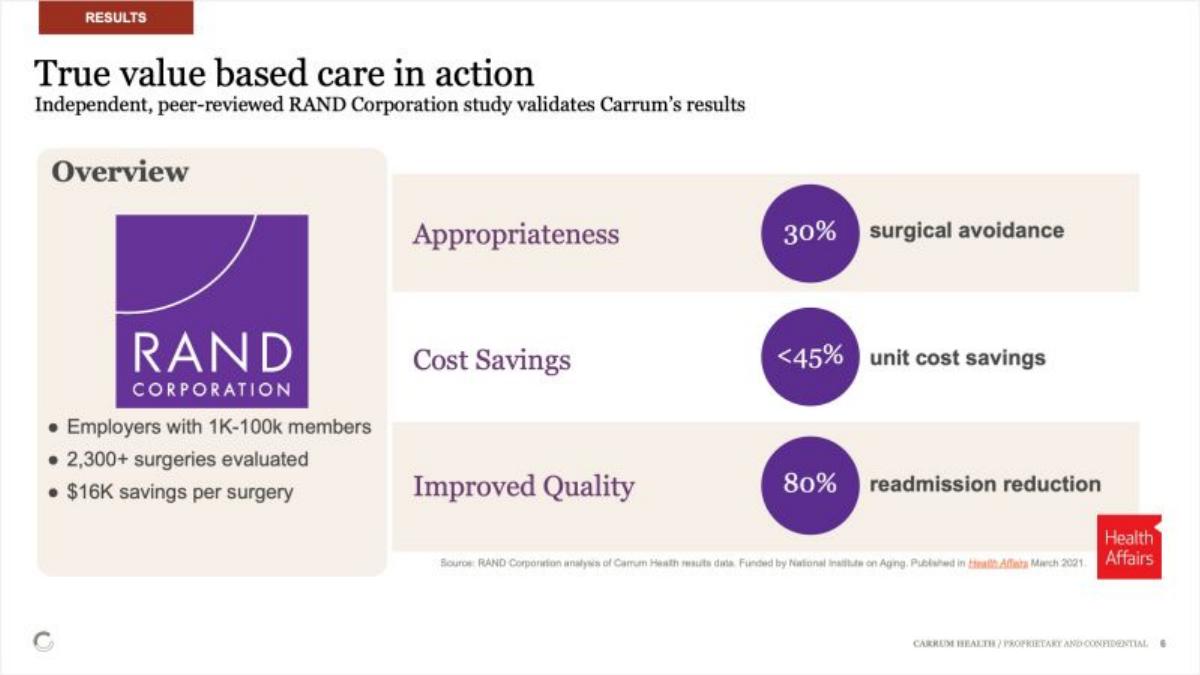
- The deck uses a peer-reviewed RAND Corporation study on slide 6 to validate $16k savings per surgery and an 80% reduction in readmissions.
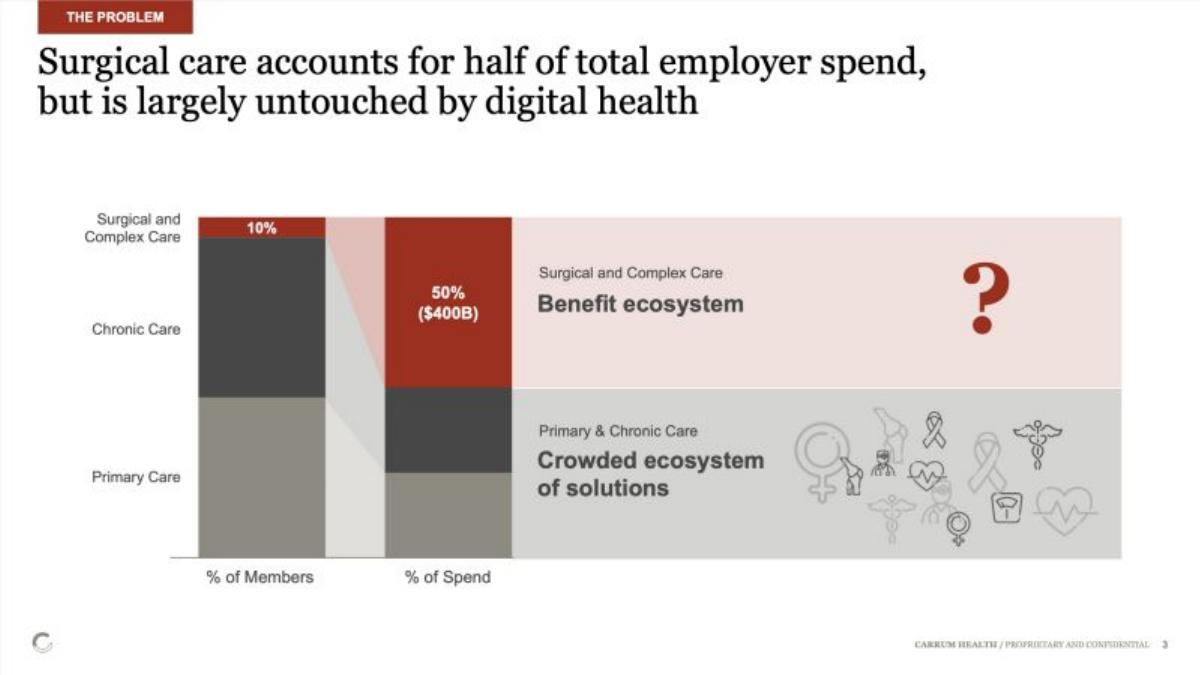
- Surgical and complex care is identified as 50% of total employer spend ($400B) but remains largely untouched by digital health (slide 3).
- Carrum Health positions its expansion strategy by comparing itself to Amazon, moving from 'Knee Replacement' to 'Full Surgical Care' (slide 8).
- Oncology is highlighted as the primary growth lever, noted as the #1 condition driving employer cost at 83% in a 2023 survey (slide 13).
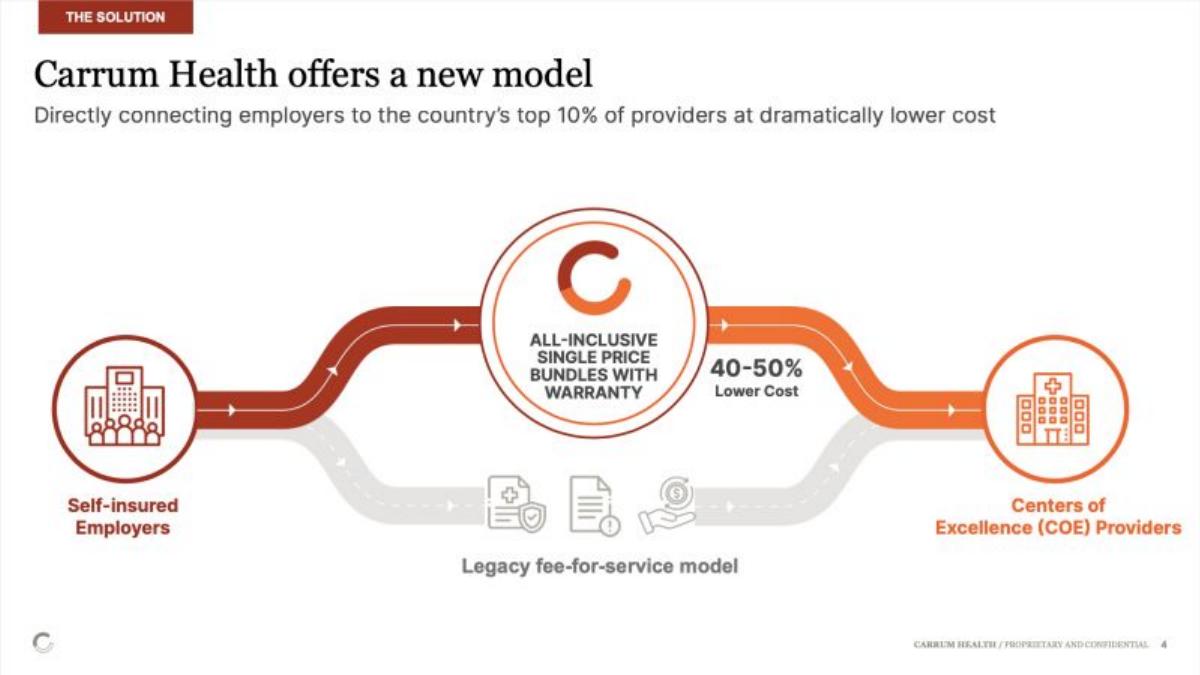
- The business model relies on 'all-inclusive single price bundles' that claim to offer 40-50% lower costs than legacy fee-for-service models (slide 4).
- The platform claims to connect employers directly to the top 10% of providers in the country (slide 4).
- Strategic partnerships with companies like Hinge Health, Sword, and Grail are used to demonstrate ecosystem integration (slide 9).
- The deck omits a specific 'Ask' slide, financial projections, and a breakdown of current revenue or burn rate.
Executive Summary: The Shift to Complex Care
Carrum Health’s Series B deck is a 18-slide presentation that focuses on the transition from a niche surgical marketplace to a comprehensive enterprise healthcare platform. In 2023, the company raised $45M to double down on oncology and surgical bundles. The deck is structured to move the investor from the macro problem (inefficient healthcare spending) to a validated solution (surgical bundles) and finally to a massive growth opportunity (oncology).
Slides 1-3: The Problem of Fragmented Care
Slide 1 introduces Carrum Health as a "true Value-Based Care marketplace platform." The subtitle emphasizes bringing surgical care payment and delivery into the 21st century. It is a standard, clean title slide that sets the stage for a B2B enterprise play.
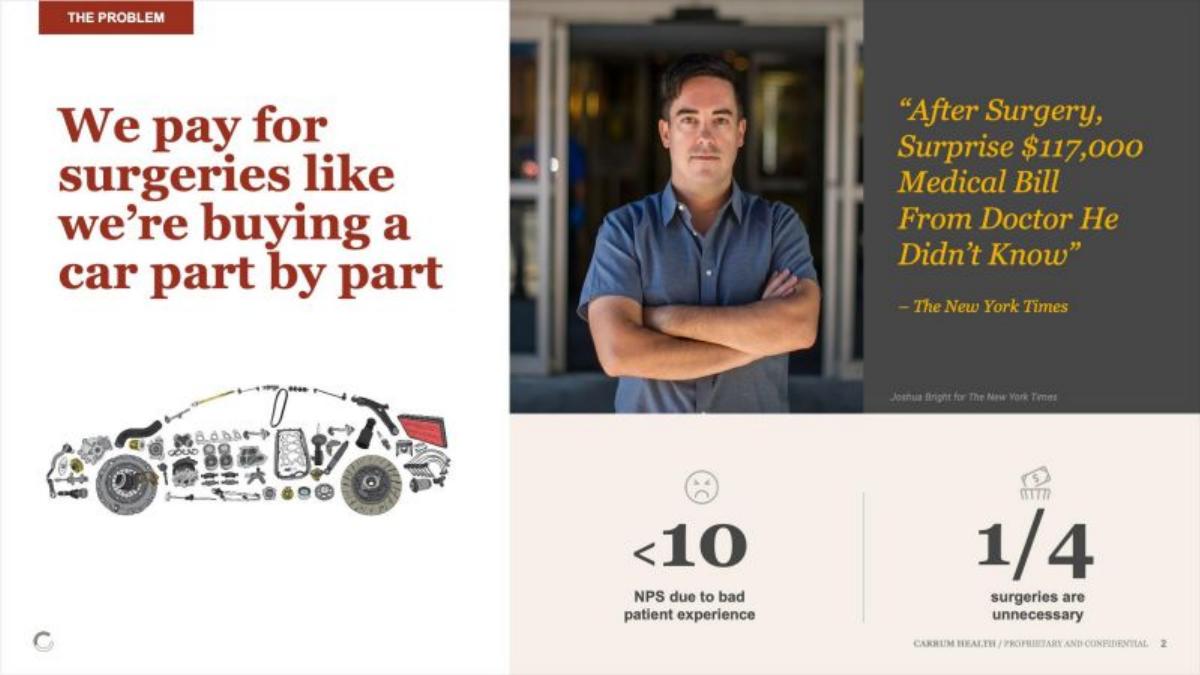
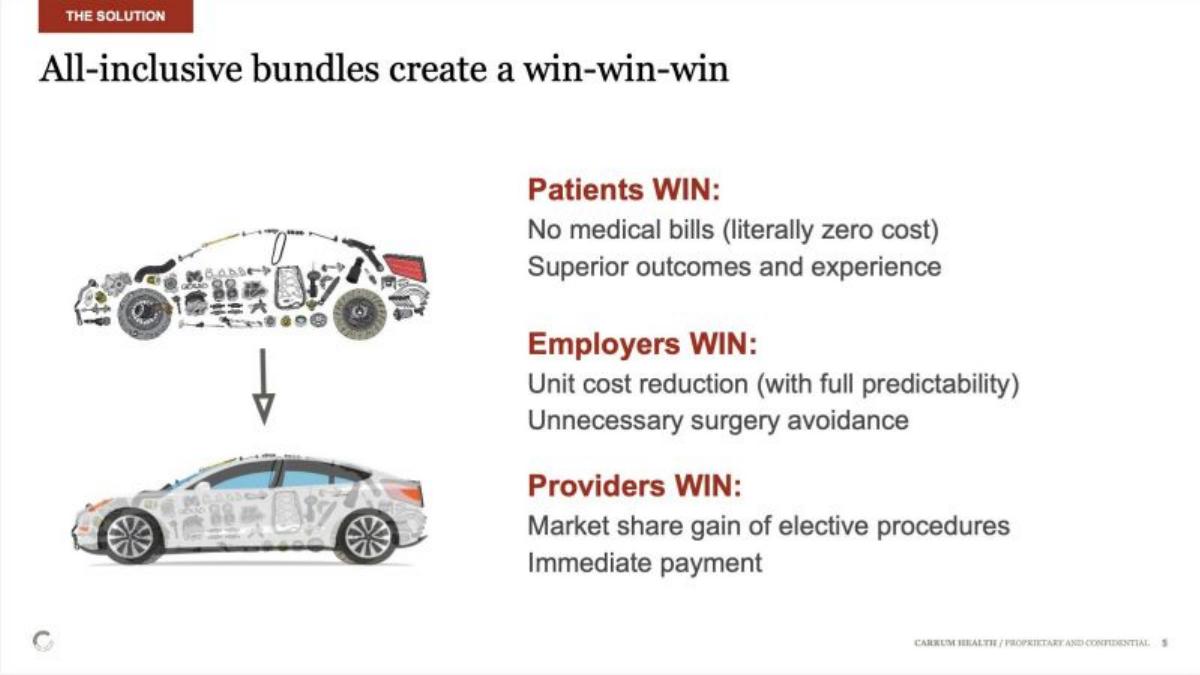
Slide 2 uses a powerful visual metaphor: a car disassembled into hundreds of parts. The headline, "We pay for surgeries like we're buying a car part by part," critiques the legacy fee-for-service model. The slide includes a New York Times quote about a surprise $117,000 medical bill and two stinging metrics: an NPS of less than 10 for patient experience and the claim that 1/4 of surgeries are unnecessary.
Slide 3 quantifies the market opportunity. It shows that while "Surgical and Complex Care" only accounts for 10% of members, it represents 50% ($400B) of total employer spend. The visual highlights that while Primary and Chronic care have a "crowded ecosystem of solutions," the complex care space is a giant question mark, positioning Carrum as the first mover in a high-spend category.
Slides 4-6: The Solution and Third-Party Validation
Slide 4 introduces the Carrum model. It depicts a streamlined path from self-insured employers to "Centers of Excellence" (COE) providers. The centerpiece is the "All-inclusive single price bundles with warranty," which the slide claims results in 40-50% lower costs compared to the legacy fee-for-service model shown in gray below it.
Slide 5 breaks down the "win-win-win" for stakeholders. Patients get zero-cost surgeries and superior outcomes; employers get unit cost reduction and surgery avoidance; providers get increased market share for elective procedures and immediate payment. This slide is critical for a marketplace business to show how it balances the needs of all participants.
Slide 6 is perhaps the most important slide in the deck. It presents an independent, peer-reviewed RAND Corporation study. The metrics are specific and impressive: $16K savings per surgery, 30% surgical avoidance, and an 80% readmission reduction. By using RAND rather than internal metrics, Carrum effectively ends the debate over whether their model works, allowing the rest of the deck to focus on scale.
Slides 7-10: Platform Scalability and Expansion
Slide 7 pivots to the technology. It describes an "Industry-leading technology engineered to help us scale." It lists four pillars: plug-and-play integration, a data foundation, an AI-driven platform, and care digitization. However, this slide is light on details, using icons rather than screenshots or technical architecture diagrams.
Slide 8 uses the "Amazon of Healthcare" narrative. It shows Amazon moving from books to "everything" and Carrum moving from "Knee Replacement" to a "Full Surgical Care Offering." This is a classic venture capital framing technique to suggest that a company’s current success is just the first chapter of a much larger story.
Slide 9 showcases the partnership ecosystem. Logos like Hinge Health, Accolade, and Virgin Pulse are displayed to prove that Carrum is integrated into the existing employer benefit stack. This de-risks the "go-to-market" hurdle by showing that they don't have to sell in a vacuum.
Slide 10 provides a visual representation of expansion. A pie chart of employer spend is broken down into Musculoskeletal (the starting point), Oncology, Cardiac, Women's Health, and Bariatrics. This slide bridges the gap between their surgical roots and their oncology future.
Slides 11-15: The Oncology Opportunity
Slide 11 is a transition slide with a high-quality photo and the text "The Oncology Opportunity." It signals a deep dive into the company's new primary growth lever.
Slide 12 humanizes the cancer problem. It notes that 1 in 4 cancer patients have declared bankruptcy or lost their homes, and 74% of cancer care is delivered in facilities with low survival rates. This creates an emotional and ethical urgency for the Carrum model.
Slide 13 returns to the data. It cites a 2023 BGH Survey showing Cancer is the #1 condition driving employer cost (83%), surpassing Musculoskeletal (MSK) at 76%. It also highlights a stark disparity: less than 1% of employees receive a cancer diagnosis, yet they account for 12-15% of medical spend.
Slide 14 shows that 50% of employers are looking to adopt "Centers of Excellence" to tackle cancer. This aligns market demand perfectly with Carrum’s existing COE infrastructure.
Slide 15 outlines the oncology product: Screening & Detection, Guidance, and a Value-based Oncology COE Network. This slide shows that Carrum is moving beyond just the surgery/treatment phase into the earlier stages of the patient journey.
Slides 16-18: Team and Conclusion
Slide 16 introduces the leadership team. It features Founder/CEO Sach Jain and five other C-suite members. While the slide claims a "proven track record," it lacks the logos of previous successful exits or major healthcare companies where these individuals worked, which is a slight missed opportunity for a Series B deck.
Slide 17 is a simple "Thank You" slide with the website URL. Slide 18 is a promotional slide for the source of the deck and not part of the Carrum presentation.
What Carrum Health Does Well
The Carrum Health deck excels at external validation . By leading with the RAND Corporation study, they move the conversation from "does this work?" to "how fast can we grow?" This is essential for a Series B round where investors are looking for a repeatable machine rather than an experiment. They also do an excellent job of problem-sizing . By showing that 10% of members drive 50% of costs, they make the case that their platform is the most efficient way for an employer to save money.
The Amazon analogy is also a strong strategic choice. It gives investors a familiar mental model for how a company that started with knee replacements can eventually dominate the entire complex care category. The focus on oncology in the latter half of the deck provides a clear "Why Now?"—employers are desperate for cancer cost solutions in 2023.
What is Missing from the Deck
Despite being a Series B deck, there is a surprising lack of financial transparency . There are no slides showing ARR growth, gross margins, or customer retention rates (GRR/NRR). While the RAND study proves savings for the employer, the deck doesn't explain the unit economics for Carrum. How much do they take from each bundle? What is their CAC (Customer Acquisition Cost)?
There is also no 'Ask' slide . Usually, a pitch deck concludes with a slide stating how much money is being raised and exactly how it will be allocated (e.g., 40% R&D, 40% Sales, 20% Ops). This deck feels more like a general capabilities presentation or a high-level strategic overview rather than a tactical fundraising tool. Finally, the competitive landscape is entirely absent. In a crowded digital health market, failing to mention how they differ from competitors like Transcarent or SurgeryPlus is a notable omission.
What Other Founders Should Copy
Founders should emulate Carrum’s use of metaphor and visual storytelling . The car parts analogy on Slide 2 is an immediately understandable way to explain a complex billing problem. It sticks in the mind much longer than a bulleted list of grievances about fee-for-service models.
The third-party validation strategy on Slide 6 is the gold standard. If you can get an independent body to verify your ROI, put it front and center. It acts as a "shield" against skeptical investors. Additionally, the market expansion roadmap on Slide 10 is a great way to show a massive TAM (Total Addressable Market) without using a generic, unhelpful "billion-dollar market" slide. It shows exactly which categories they will enter and why, making the growth feel inevitable rather than aspirational.
Conclusion
Carrum Health’s deck is a polished, professional narrative that successfully positions the company as an essential enterprise platform. While it leans heavily on high-level strategy and third-party validation at the expense of granular financial data, the strength of the RAND study and the clear focus on the oncology "white space" was evidently enough to secure a $45M lead from a major growth equity firm. It is a prime example of how to sell a "scale-up" story by focusing on market dominance and proven ROI.
Frequently asked questions
- What is Carrum Health's core value proposition?
- Carrum Health operates a value-based healthcare marketplace that replaces the traditional fee-for-service model with all-inclusive surgical and oncology bundles. According to slide 4, they connect self-insured employers directly to 'Centers of Excellence' (the top 10% of providers), resulting in 40-50% lower costs and a 'win-win-win' for patients, employers, and providers.
- How does Carrum Health prove its financial impact?
- Unlike many startups that rely on internal data, Carrum Health uses an independent, peer-reviewed study by the RAND Corporation. Slide 6 cites this study, which evaluated over 2,300 surgeries and found $16k in savings per surgery, 30% surgical avoidance, and an 80% reduction in readmissions.
- Why is the company expanding into oncology?
- The deck identifies oncology as the next major frontier because it has become the top driver of employer healthcare costs. Slide 13 notes that while less than 1% of employees receive a cancer diagnosis, they account for 12-15% of total medical spend, making it a high-impact area for value-based pricing.
- What is missing from the Carrum Health Series B deck?
- The deck is notably missing a financial 'Ask' slide detailing how the $45M will be spent. It also lacks a detailed competition slide, specific revenue figures (ARR/MRR), and unit economics. While it mentions an 'AI-driven platform' on slide 7, it provides very little technical detail on how that AI actually functions.
- Who are Carrum Health's key partners?
- Slide 9 lists several strategic partners including AccessHope, Accolade, Apree Health, Grail, Hinge Health, Included Health, Sword, Rightway, and Virgin Pulse. These partnerships are intended to simplify procurement for employers and create a more cohesive member experience.