QIDS is a Barcelona-based startup targeting a specific pain point: the chaotic nature of parent group chats on general-purpose messaging apps like WhatsApp. Their 9-slide seed deck relies heavily on the sheer volume of existing group communication—citing 7 billion group messages sent daily—to justify a specialized vertical solution. The deck succeeds in defining a clear problem (information overload) and a specific target audience (parents), but it leaves significant gaps regarding monetization and long-term defensibility. With only 2,600 users at the time of the deck, the company was seeking…
Key takeaways
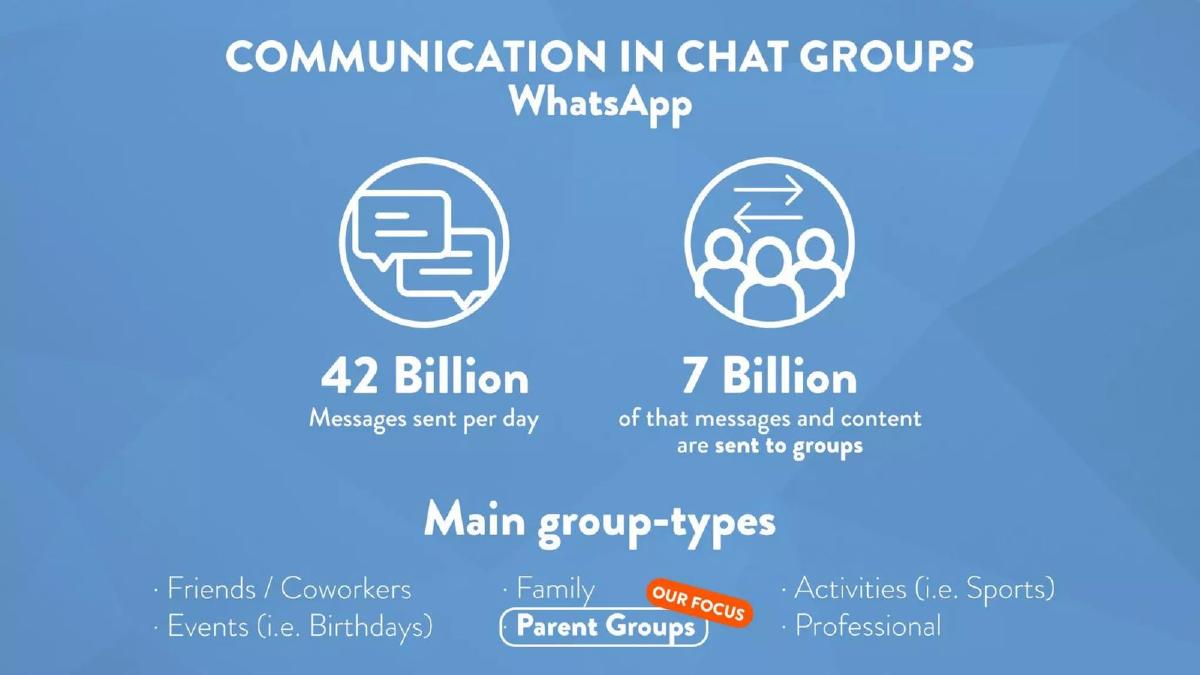
- The company identifies a massive market opportunity by piggybacking on WhatsApp's 42 billion daily messages, specifically the 7 billion sent to groups (Slide 3).
- QIDS focuses exclusively on 'Parent Groups' as their primary entry point into the messaging market (Slide 3).
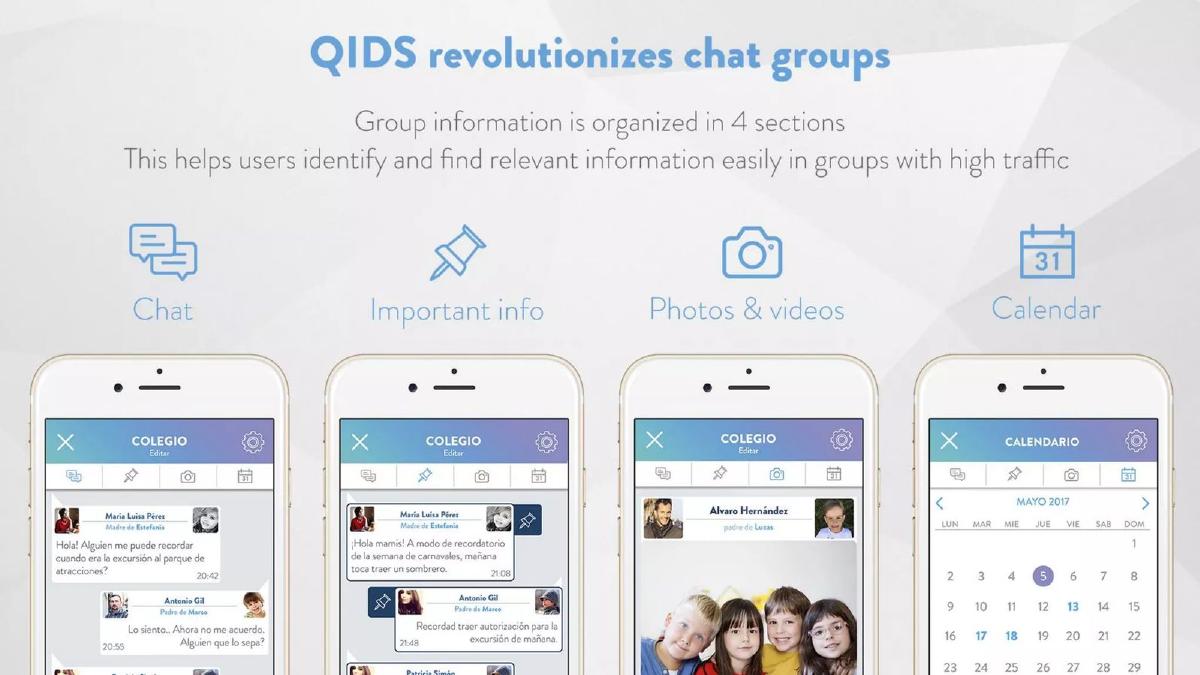
- The product architecture is built around four functional pillars: Chat, Important Info, Photos & Videos, and Calendar (Slide 5).
- User activity metrics at the time of the deck showed 2.6k total users with 1.2k Monthly Active Users (MAU) and 150-250 Daily Active Users (DAU) (Slide 7).
- The startup had previously raised 55k € from friends, family, and fools (FFF) and 60k € from ENISA before opening this 200k € seed round (Slide 7).
- Future monetization plans are mentioned as an objective but are not detailed with specific models or pricing (Slide 7).
- The team slide highlights a mix of engineering and marketing backgrounds, with logos from Danone, L'Oreal, and SAP suggesting past corporate experience (Slide 8).
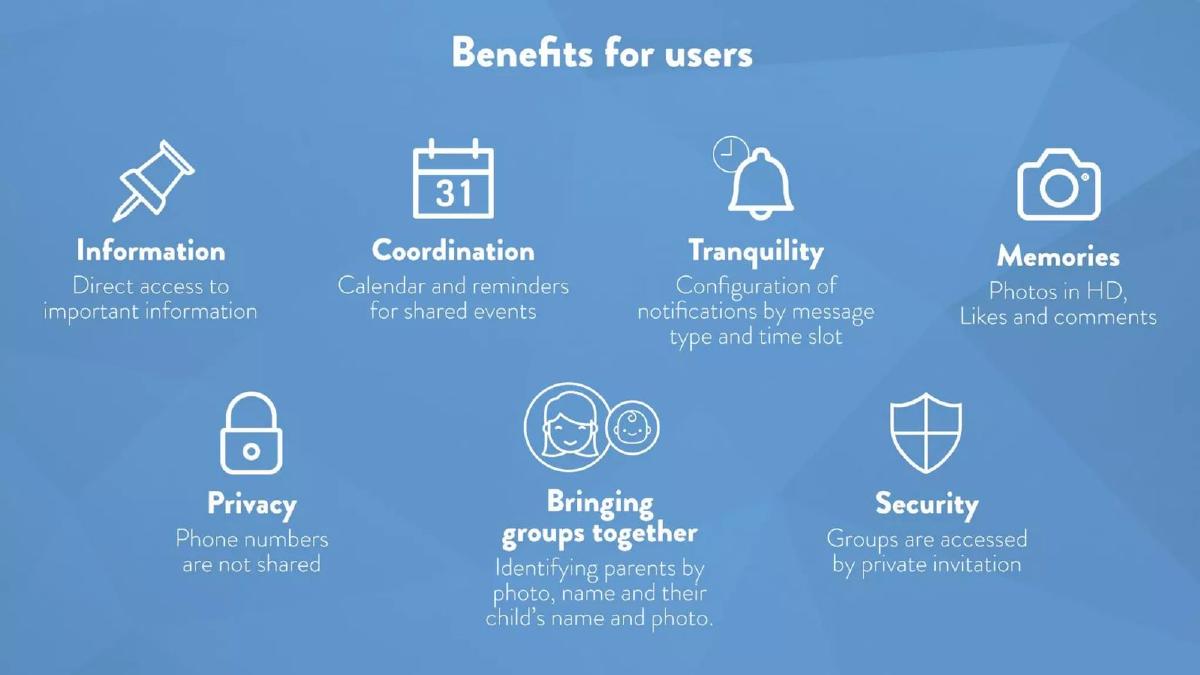
- Privacy is a core value proposition, specifically stating that phone numbers are not shared within the app (Slide 6).
Slide 1: Title Slide
The deck opens with a minimalist title slide featuring the QIDS logo—a stylized 'q' inside a rounded square with a blue-to-purple gradient. There is no tagline or mission statement on this slide, relying entirely on the visual brand identity against a geometric white background.
Slide 2: The Vision
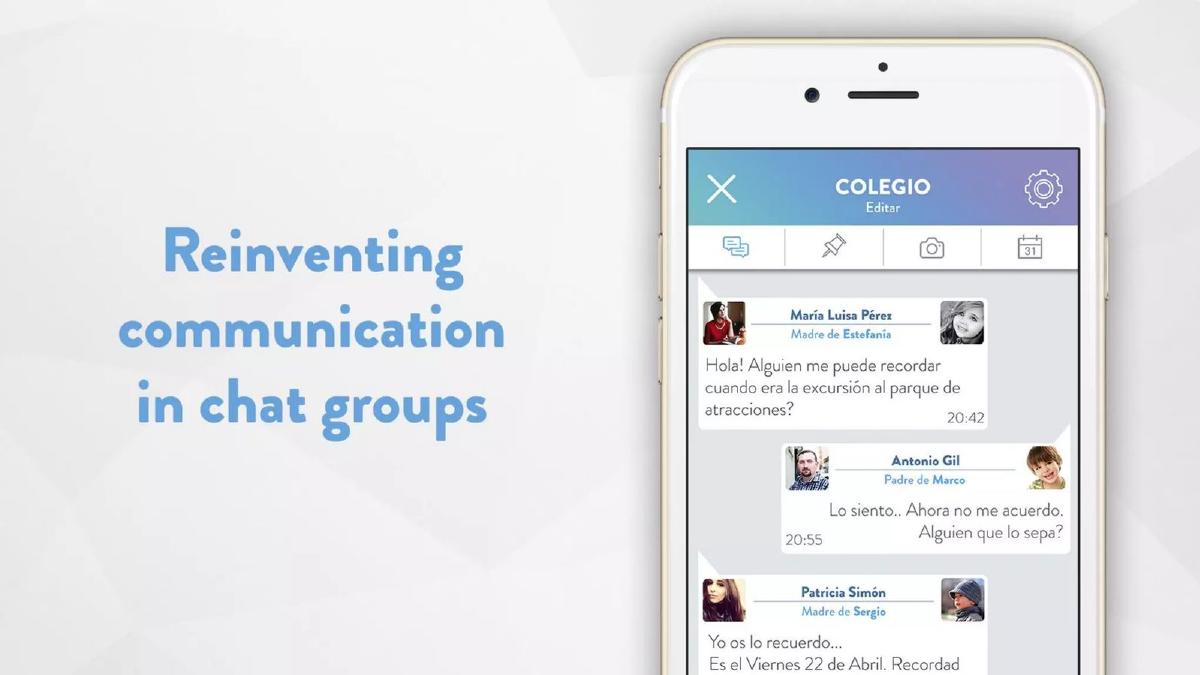
Slide 2 introduces the core value proposition: "Reinventing communication in chat groups." It features a high-fidelity mobile mockup of the app interface. The interface shown is a group named "COLEGIO" (School), displaying a chat between parents. This slide establishes the product's aesthetic and its primary use case—school-related parent communication—right at the start.
Slide 3: Market Context and Focus
This slide uses WhatsApp's massive scale to justify the need for a specialized tool. It cites "42 Billion Messages sent per day" and notes that "7 Billion of that messages and content are sent to groups." The slide then categorizes group types, including Friends, Events, Family, Activities, and Professional. QIDS explicitly highlights "Parent Groups" as their specific focus. By doing this, they attempt to carve out a niche in a saturated market by focusing on the highest-friction group type.
Slide 4: The Problem (Pain Points)
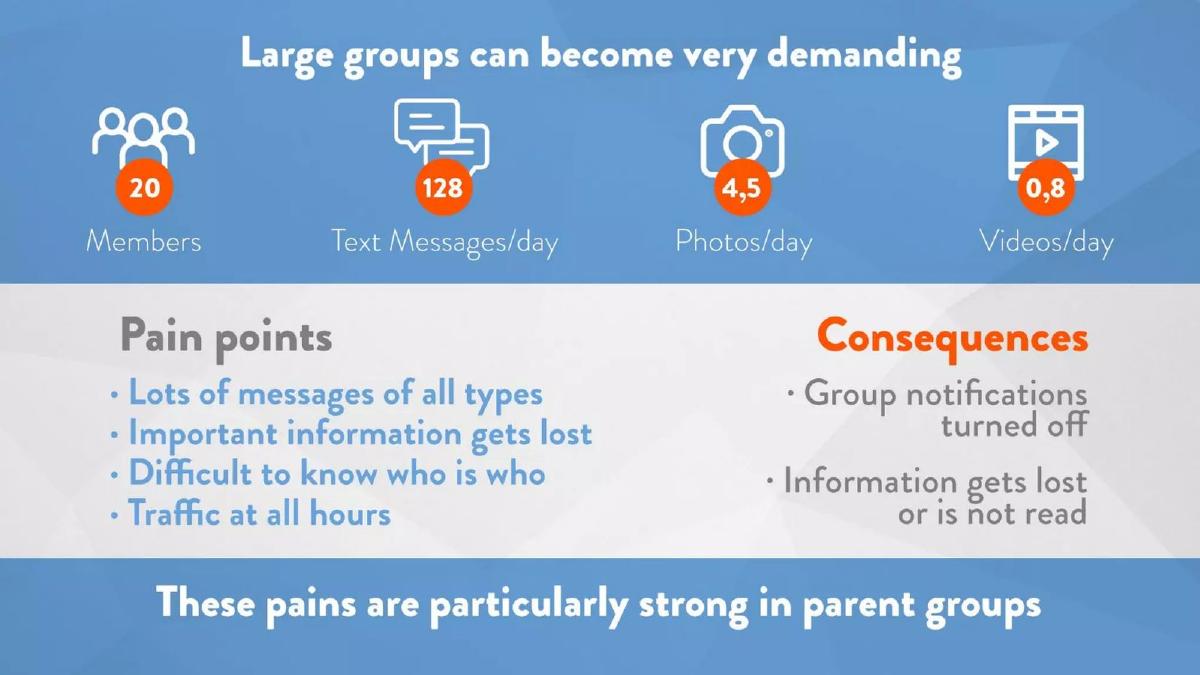
Slide 4 quantifies the chaos of large groups. It states that a group of 20 members averages 128 text messages, 4.5 photos, and 0.8 videos per day. The listed pain points include "Important information gets lost," "Difficult to know who is who," and "Traffic at all hours." The consequence, according to the slide, is that users turn off notifications, leading to missed information. This slide effectively builds the case for a structured alternative to standard chronological chat apps.
Slide 5: The Solution (Product Architecture)
QIDS presents its solution by showing how it organizes information into four modules: Chat, Important info, Photos & videos, and Calendar. The slide includes four phone mockups, each demonstrating one of these features. For example, the 'Important info' tab shows pinned messages about carnival reminders, and the 'Calendar' tab shows a monthly view with specific event dots. This is the most important slide for understanding the product's functional differentiation from WhatsApp.
Slide 6: User Benefits
This slide lists seven key benefits: Information, Coordination, Tranquility, Memories, Privacy, Bringing groups together, and Security. Notable details include "Configuration of notifications by message type and time slot" (Tranquility) and the fact that "Phone numbers are not shared" (Privacy). The "Bringing groups together" benefit mentions identifying parents by their child's name and photo, which is a specific social feature tailored to the parent-teacher-student ecosystem.
Slide 7: Milestones and Metrics
Slide 7 provides a comprehensive timeline from the initial idea in February 2016 to the "Open SEED Round" in May 2017. Key financial data points include a 55k € FFF round and a 60k € ENISA loan. The user metrics are listed as 2.6k users, 1.2k MAU, >500 WAU, and 150-250 DAU. The slide also lists objectives for the next 12 months, including "E-wallet (i.e. shared birthday gifts)" and "Monetization." The target for the current seed round is stated as 200k €.
Slide 8: The Team
The team slide introduces four founders with headshots, titles, and contact information. Quim Zurano (CEO) is described as a Founder Institute graduate. Pablo Oramas (CTO) is noted for mobile app development expertise. Mathieu Prieur (CMO) and Roland Umlauft (CFO) round out the leadership. A row of logos at the bottom (SAP, Danone, L'Oreal, etc.) suggests the team's pedigree or past employers, though the specific relationship to these companies isn't explicitly defined.
Slide 9: Appendix
The final slide is an appendix featuring a screenshot of a television appearance on TV3. The headline in the video states "QIDS, UNA APP GRATUÏTA PENSADA PER A AQUESTS GRUPS" (QIDS, a free app designed for these groups). This serves as social proof and media validation for the startup's concept.
What QIDS Does Well
The QIDS deck is highly effective at identifying a specific, relatable pain point. Almost every parent has experienced the frustration of a 30-person WhatsApp group where a single question about a field trip is buried under 50 messages of 'thank you' or unrelated chatter. By quantifying this (128 messages a day for 20 people on Slide 4), they make the problem feel urgent and measurable.
The product visualization on Slide 5 is also a strength. Instead of just listing features, they show exactly how the UI handles different types of data. The separation of 'Chat' from 'Important Info' and 'Calendar' is a logical architectural response to the problem they described. It clearly communicates how the user experience will differ from the incumbent (WhatsApp).
What is Missing from the QIDS Deck
The most glaring omission is a detailed Business Model . While Slide 7 mentions 'Monetization' as a future objective, there is no explanation of how a free app for parents will eventually generate a return for investors. Will it be a subscription? Ad-supported? Transaction fees on the mentioned 'E-wallet'? Without this, the 200k € ask feels like a bridge to nowhere.
Second, there is no Competitor Analysis . While they position themselves against WhatsApp, they ignore other school-specific communication apps like Remind, ClassDojo, or Bloomz, which were already established in various markets by 2017. Investors need to know why QIDS will win against both the general-purpose giants and the specialized incumbents.
Finally, the Go-To-Market (GTM) strategy is vague. They mention 'Virality (Member get Member)' on Slide 7, but they don't explain how they will achieve the initial critical mass in schools. Messaging apps live and die by network effects; if only three parents in a class of thirty use the app, the product fails. The deck doesn't explain how they overcome this 'cold start' problem.
Founder's Guide: What to Copy
Founders should look at Slide 3 as a great example of Market Slicing . Instead of claiming they are going to replace all messaging, QIDS acknowledges the massive scale of the market and then visually circles their specific entry point (Parent Groups). This makes a daunting task—competing with WhatsApp—feel focused and achievable.
The Timeline and Milestones on Slide 7 is also a model of transparency. It clearly shows the capital raised to date (115k € total) and what was achieved with that money (MVP launch, 2.6k users, TV appearance). This builds trust by showing that the founders are capable of executing on a budget and have a clear roadmap for the next 200k €.
Lastly, the Problem Quantification on Slide 4 is excellent. Using specific numbers (128 texts/day) rather than vague adjectives (e.g., "too many messages") makes the pitch much more persuasive. It gives the investor a concrete metric to visualize the user's daily friction.
Frequently asked questions
- What specific problem is QIDS trying to solve?
- QIDS addresses the 'noise' and information loss inherent in large group chats. According to Slide 4, a group of 20 members can generate 128 text messages and multiple media files daily. This leads to users turning off notifications and missing important information. QIDS aims to organize this chaos by separating chat from structured data like calendar events and pinned announcements.
- How does QIDS plan to make money?
- The deck is notably thin on revenue details. Slide 7 lists 'Monetization' and an 'E-wallet (i.e. shared birthday gifts)' as objectives for the next 12 months. However, there is no slide dedicated to the business model, unit economics, or projected revenue streams. This suggests the company was in a pre-revenue, growth-focused phase during this seed round.
- What is the current traction of the app?
- As of May 2017 (the final date on the timeline), QIDS reported 2,600 total users. Engagement metrics included 1,200 Monthly Active Users (MAU), over 500 Weekly Active Users (WAU), and between 150 to 250 Daily Active Users (DAU). The timeline on Slide 7 shows a steady but modest growth curve since the MVP launch in October 2016.
- Who are the founders and what is their background?
- The team consists of Quim Zurano (CEO), Pablo Oramas (CTO), Mathieu Prieur (CMO), and Roland Umlauft, Ph.D. (CFO). The founders possess a mix of technical and business credentials, including an MBA and a PhD in Finance. Slide 8 displays logos of various major corporations like Oracle, Danone, and Western Digital, implying the team has professional experience at these firms.
- What are the primary features of the QIDS application?
- The app organizes group information into four distinct sections: a standard Chat interface, an 'Important info' section for pinned messages, a gallery for 'Photos & videos', and a shared 'Calendar' for event coordination. Slide 6 also emphasizes privacy features, such as the ability to join groups without sharing phone numbers and identifying parents by their child's name and photo.