The Shopify Q4 2017 investor deck serves as a masterclass in presenting a platform-as-a-service (PaaS) business model. By 2017, Shopify had evolved beyond a simple website builder into a central hub for merchants to sell across marketplaces, social media, and physical locations. The deck emphasizes a 'flywheel' effect created by a vast partner ecosystem of 2,300+ apps and 15,000+ referring agencies. Financial performance is the core of the pitch, showcasing a jump from $23.7M in revenue in 2012 to $673.3M in 2017. The presentation successfully balances high-level vision—leveraging 'tens of bi…
Key takeaways
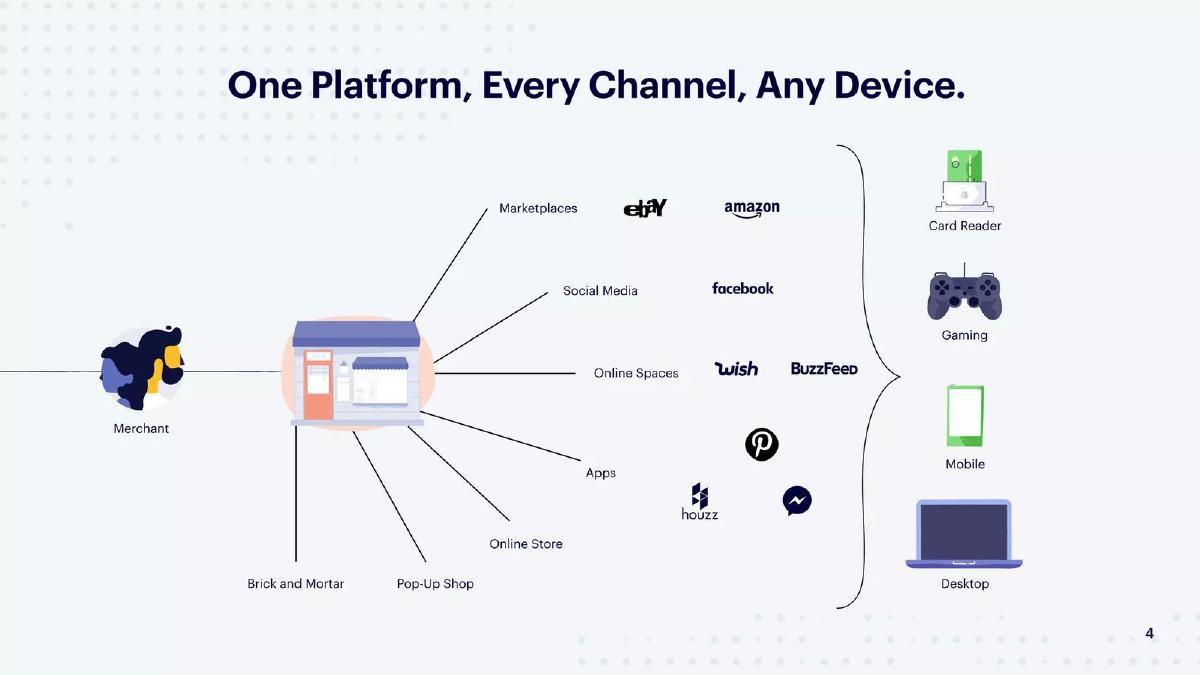
- Shopify positions itself as a central hub connecting merchants to marketplaces like Amazon and eBay, social media, and physical retail (Slide 4).
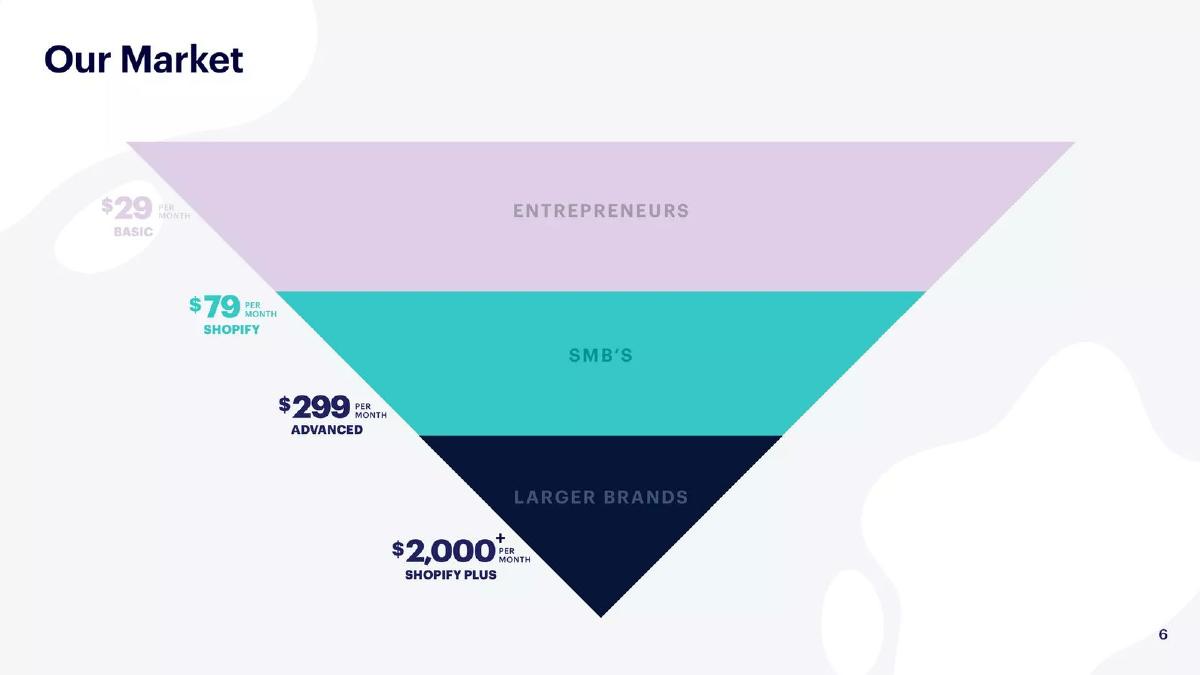
- The pricing strategy uses a tiered funnel starting at $29/month for entrepreneurs and scaling to $2,000+/month for Shopify Plus (Slide 7).
- Revenue growth is aggressive, showing a 73% year-over-year increase to $673.3M in 2017 (Slide 16).
- The business model relies on two distinct streams: Subscription Solutions and Merchant Solutions, with the latter driving significant growth (Slide 16).
- Gross profit followed revenue closely, reaching $380.3M in 2017, an 82% increase over the previous year (Slide 19).
- The partner ecosystem is a moat, featuring over 2,300 apps and 15,000 agencies that referred at least one merchant in a 12-month period (Slide 13).
- The deck highlights a data advantage, citing tens of billions of interactions accumulated over 10+ years to be used for machine learning (Slide 22).
- A specific merchant profile, T.Y. Fine Furniture, is used to humanize the platform's utility for local artisans (Slide 10).
Executive Summary: The Infrastructure of Commerce
The Shopify Q4 2017 investor deck represents a pivotal moment in the company's history. By this stage, Shopify was no longer a startup trying to prove product-market fit; it was a public entity demonstrating its ability to dominate the global commerce landscape. The deck is structured to show scale, reliability, and an expanding moat through its ecosystem. It moves away from technical features and focuses heavily on the 'Merchant Journey' and the financial flywheel of a multi-channel platform.
Slide 1: Title and Visual Identity
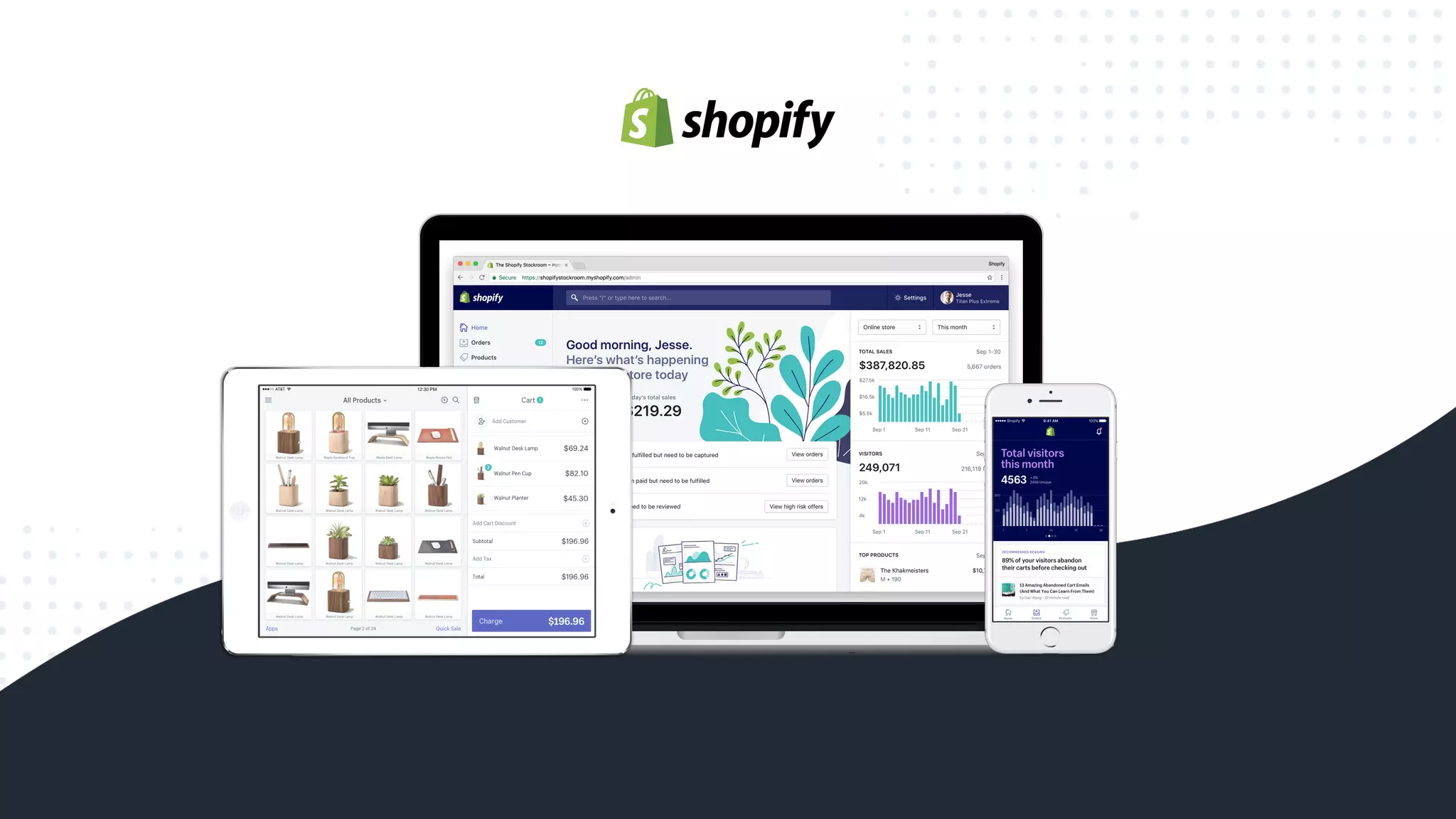
The cover slide is minimalist, featuring the Shopify logo and a collection of hardware and software interfaces. It immediately establishes the brand's presence across desktop, tablet, and mobile devices. The dashboard shown on the laptop screen displays a total sales figure of $387,820.85, subtly signaling that the platform handles significant transaction volumes for its users.
Slide 4: The Multi-Channel Hub
This is arguably the most important conceptual slide in the deck. It positions the 'Merchant' at the center, with Shopify acting as the bridge to every possible sales channel. The slide lists Marketplaces (eBay, Amazon), Social Media (Facebook), Online Spaces (Wish, BuzzFeed), Apps (Pinterest, Houzz), and physical locations (Brick and Mortar, Pop-Up Shop). By framing the product this way, Shopify defines itself as the operating system for commerce, making it appear indispensable to a merchant's operations regardless of where they sell.
Slide 7: Market Segmentation and Pricing
Slide 7 uses an inverted pyramid to display Shopify’s market reach and pricing tiers. It clearly defines four segments:
Basic: $29 per month for Entrepreneurs. · Shopify: $79 per month for SMBs. · Advanced: $299 per month for growing businesses. · Shopify Plus: $2,000+ per month for Larger Brands.
This slide is a clear indicator of a 'land and expand' strategy. It shows investors that Shopify has a low-friction entry point for new businesses but also has the sophisticated infrastructure required to retain high-value enterprise clients.
Slide 10: The Human Element
To prevent the deck from becoming too abstract, Slide 10 features a 'Profile' of a real merchant: Tarik Yousef of T.Y. Fine Furniture in Columbus, Ohio. This slide serves to ground the technology in real-world utility. It mentions that Tarik uses Shopify to power both his online store and his physical storefront, reinforcing the multi-channel message from Slide 4.
Slide 13: The Partner Ecosystem
This slide details the 'moat' Shopify has built. It highlights three key groups:
App Developers: ~2,300 apps extending product capabilities. · Agencies: >15K referred at least one merchant in the last 12 months. · Theme Designers: Contributing to the Shopify Theme Store.
By citing these numbers, Shopify demonstrates that it has a massive, unpaid sales force (agencies) and a R&D department (app developers) that it does not have to pay for, which significantly enhances the platform's value to the end merchant.
Slide 16: Revenue Growth Trajectory
The financial section begins with a bar chart showing 'Strong Consistent Revenue Growth.' The data is impressive: revenue grew from $23.7M in 2012 to $673.3M in 2017. The slide also breaks down revenue into 'Subscription solutions' and 'Merchant solutions.' The latter, which includes transaction-based revenue like Shopify Payments, shows faster growth, indicating that Shopify is successfully monetizing the success of its merchants, not just their monthly fees.
Slide 19: Gross Profit Expansion
Following the revenue slide, Slide 19 shows Gross Profit. The figures mirror the revenue growth, reaching $380.3M in 2017 (an 82% increase). This slide is intended to show that as the company scales, it is maintaining healthy margins, which is a key concern for investors in high-growth SaaS companies.
Slide 22: Investment Highlights
This slide summarizes the core thesis for an investor. It lists six pillars: Enormous Opportunity, Powerful Business Model, World-class Product, Vast Ecosystem, Data Advantage, and Vision. Notably, the 'Data Advantage' section mentions 'tens of billions of interactions accumulated over 10+ years,' suggesting that Shopify is preparing to use AI and machine learning to further optimize merchant sales, providing a forward-looking growth catalyst.
Slide 25: Non-GAAP Financial Measures
The final slide in this selection is a dense legal and accounting disclosure. It explains that Shopify uses non-GAAP measures like 'Adjusted operating loss' and 'Adjusted net loss' to provide a clearer picture of operational performance by excluding stock-based compensation. This is standard for public tech companies but serves as a reminder that at this stage, the company was still optimizing for growth over bottom-line GAAP profitability.
What Shopify Does Exceptionally Well
The deck excels at visualizing a complex ecosystem. Instead of showing a list of features, it shows a flow of value . Slide 4 and Slide 13 are masterclasses in explaining platform dynamics. They show how Shopify sits in the middle of a merchant's world, connecting them to customers, developers, and service providers. This makes the platform feel like a 'toll booth' on the road to commerce, which is a very attractive narrative for investors.
Furthermore, the use of tiered pricing (Slide 7) combined with the revenue breakdown (Slide 16) tells a complete story of monetization. It shows that Shopify wins when its merchants win. This alignment of incentives is a powerful psychological tool in fundraising, as it suggests that the company's growth is naturally fueled by the success of its customers.
What is Missing from the Deck
Because this is a Q4 investor update for a public company, it lacks several elements found in a traditional startup pitch deck:
No Team Slide: The deck assumes the audience knows the leadership. There is no mention of the founders' backgrounds or the size of the engineering team. · No Specific 'Ask': There is no slide requesting a specific dollar amount or outlining a valuation, as the stock price is determined by the public market. · No Competitor Comparison: The deck does not mention Magento, BigCommerce, or Amazon Webstore. It focuses entirely on Shopify's own ecosystem, projecting an air of market leadership where competitors are irrelevant. · Unit Economics: While total revenue and profit are shown, the deck omits specific Customer Acquisition Cost (CAC) or Lifetime Value (LTV) ratios, which are usually highly scrutinized in private rounds.
Lessons for Founders
Founders should study how Shopify humanizes data . They don't just show a bar chart of growth; they include a slide about a furniture maker in Ohio. This creates an emotional connection to the 'why' behind the technology. If you are building a B2B platform, always include a slide that shows how a single customer uses your entire suite of tools.
Another key takeaway is the segmentation of revenue . If your startup has both a recurring SaaS fee and a transaction-based fee, show them separately. This demonstrates that you have multiple levers for growth and that you aren't just reliant on adding new logos, but also on the organic growth of your existing user base.
Finally, the ecosystem slide (Slide 13) is a powerful way to show defensibility. If you can show that other companies are building businesses on top of your product, you are no longer just a tool—you are a platform. Investors value platforms much higher than tools because platforms are significantly harder to displace.
Frequently asked questions
- What is the primary value proposition presented in the Shopify deck?
- Shopify presents itself as a 'One Platform, Every Channel, Any Device' solution. As shown on Slide 4, the platform acts as the central nervous system for a merchant, managing sales across physical stores, pop-up shops, online stores, mobile apps, and third-party marketplaces like Amazon and eBay. This positioning shifts the narrative from being a 'website builder' to an essential commerce infrastructure.
- How does Shopify segment its target market and pricing?
- Slide 7 illustrates a four-tier pricing strategy designed to capture the entire merchant lifecycle. It starts with 'Basic' at $29/month for new entrepreneurs, moves to 'Shopify' at $79/month for SMBs, 'Advanced' at $299/month, and finally 'Shopify Plus' at $2,000+/month for larger brands. This allows Shopify to grow its Average Revenue Per User (ARPU) as the merchants themselves scale.
- What role do third-party developers play in Shopify's business model?
- Third-party developers are central to Shopify's 'Vast Ecosystem' moat. Slide 13 notes that there are approximately 2,300 apps extending the platform's capabilities. By allowing external developers to build on their API, Shopify ensures that merchants can find niche solutions (accounting, SEO, marketing) without Shopify having to build every feature themselves, creating high switching costs for users.
- What are the key financial metrics highlighted in the 2017 deck?
- The deck focuses on top-line growth and gross profit. Slide 16 shows revenue growing from $23.7M in 2012 to $673.3M in 2017. Slide 19 shows gross profit reaching $380.3M in 2017. Notably, the deck distinguishes between 'Subscription Solutions' (recurring fees) and 'Merchant Solutions' (success-based fees like payments), showing that both are scaling rapidly.
- Does the deck mention profitability or specific use of funds?
- The provided slides do not include a specific 'Ask' or 'Use of Funds' slide, which is common for a public company investor update rather than an early-stage venture round. Slide 25 discusses 'Non-GAAP Financial Measures,' specifically mentioning 'Adjusted operating loss' and 'Adjusted net loss,' suggesting the company was still prioritizing growth over GAAP profitability at that time.