Pyte’s 12-slide deck is a highly focused narrative on the friction between data utility and privacy regulations. The company, which raised a $5M Seed extension in 1Q2024 as reported by Business Insider, positions itself as the solution for enterprises that cannot use traditional 'clean rooms' for sensitive PII or PHI. The deck stands out for its clarity on use cases—specifically audience overlap and joint analytics—and its heavy emphasis on technical pedigree, featuring a team of PhDs and world-class competitive coders. While the deck lacks a traditional competitor matrix or detailed unit eco…
Key takeaways
- The company explicitly states a fundraising target of a $5M extension in 1Q2024 on slide 9.
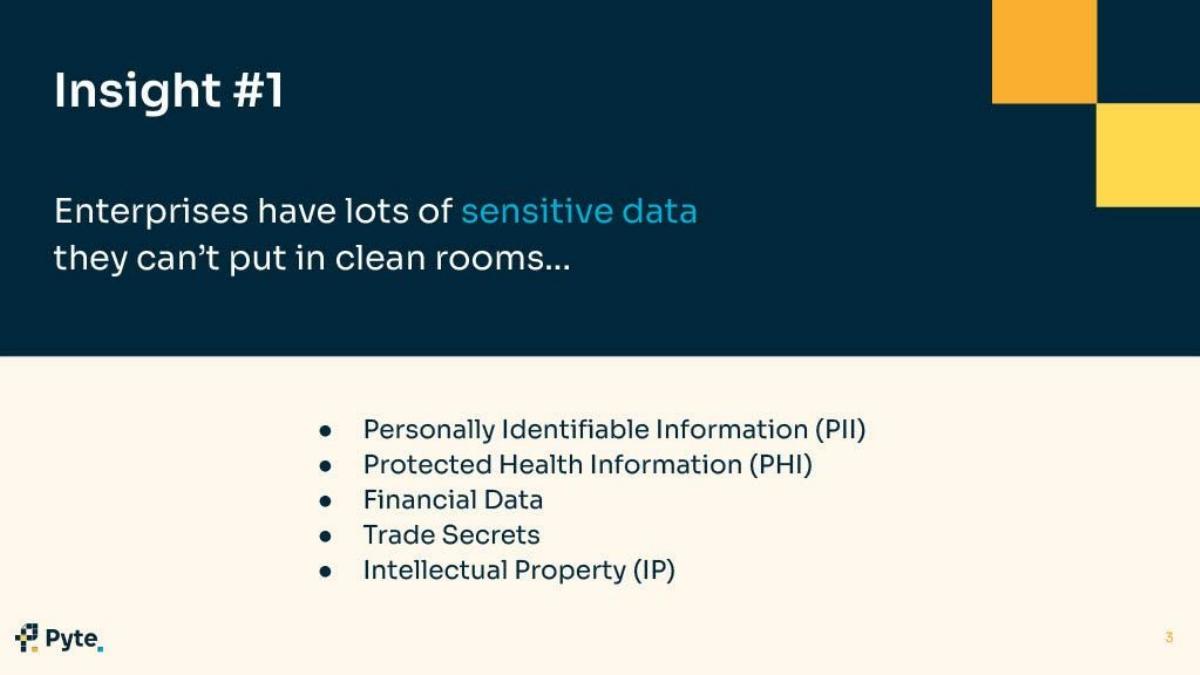
- Pyte identifies five specific types of sensitive data that cannot be placed in traditional clean rooms: PII, PHI, Financial Data, Trade Secrets, and IP (Slide 3).
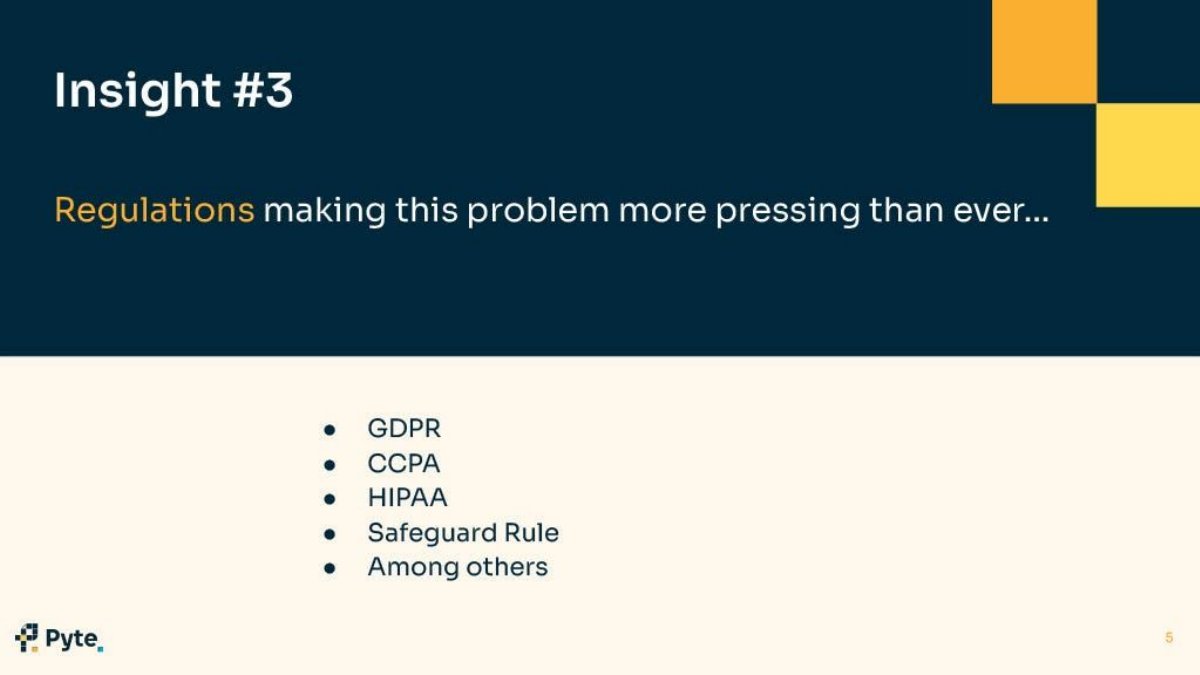
- The deck cites four major regulatory frameworks—GDPR, CCPA, HIPAA, and the Safeguard Rule—as primary market drivers (Slide 5).
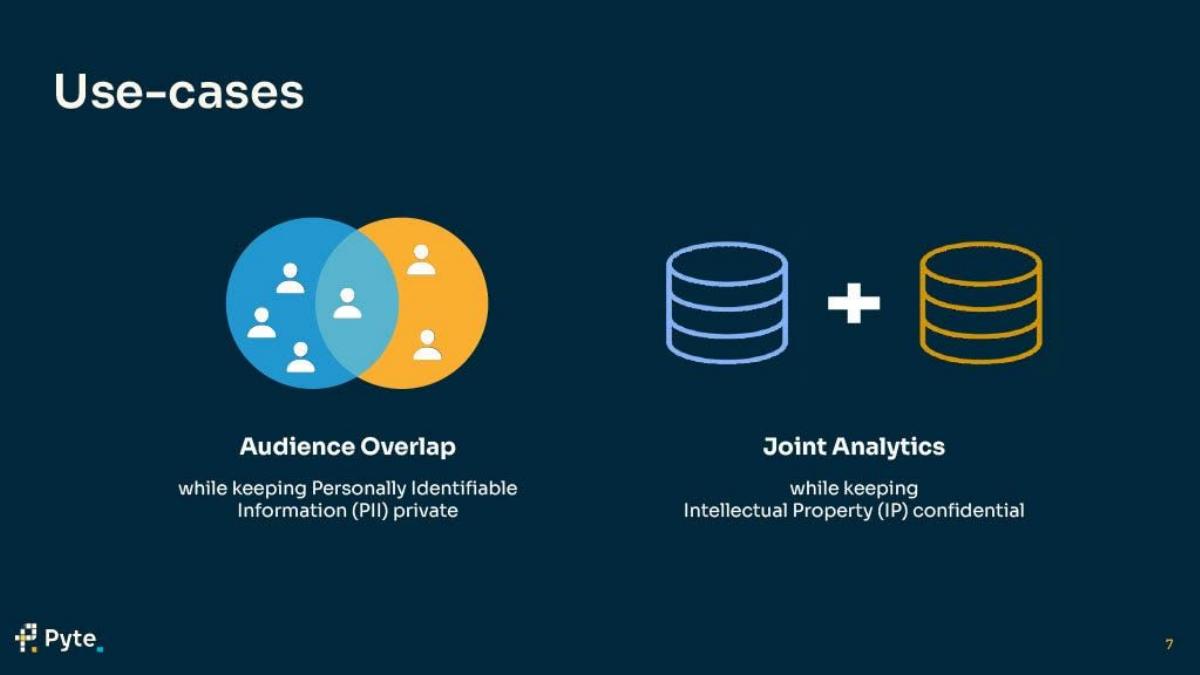
- Two primary use cases are highlighted: Audience Overlap for PII and Joint Analytics for IP protection (Slide 7).
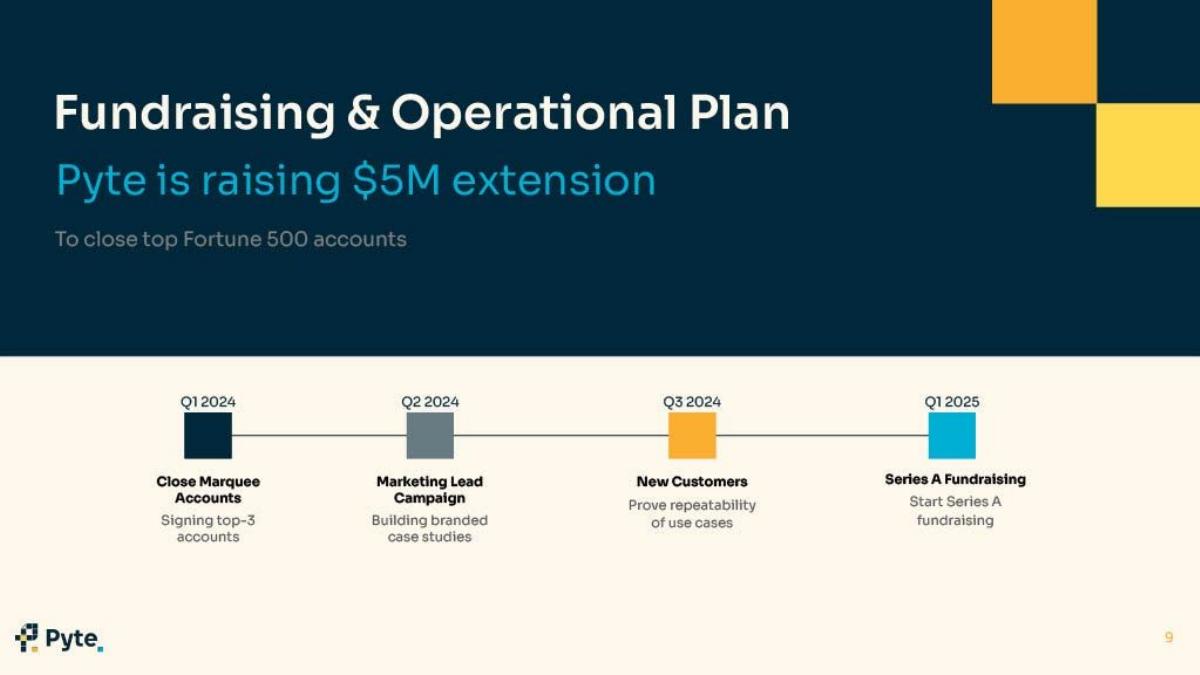
- The operational plan targets closing 'top-3 accounts' in 1Q 2024 and starting Series A fundraising in 1Q 2025 (Slide 9).
- The team slide showcases six technical hires, including three PhDs and a Google Hash Code winner, emphasizing R&D strength (Slide 12).
- The deck omits a traditional market size (TAM) slide and a competitor comparison table.
- The visual branding is consistent, using a grid-based geometric motif and a dark blue/yellow color palette throughout all 12 slides.
The Narrative of Secure Collaboration
Pyte’s pitch deck is a concise 12-slide presentation that focuses on the intersection of data utility and privacy. In an era where data is the most valuable corporate asset but also the greatest liability due to regulation, Pyte positions itself as the bridge. The deck, used for a $5M Seed extension in early 2024, is notable for its restraint; it does not over-explain the math, but rather focuses on the enterprise pain points and the caliber of the people solving them.
Slide 1-2: Brand Identity and Positioning
The deck opens with a clean, geometric visual style. Slide 1 introduces the company name and the tagline: "Enterprise Data Collaboration. Without the Compromise." This immediately sets the stage for a solution that solves a zero-sum game—the trade-off between using data and protecting it. The mention of "Fundraising 1Q2024" on the cover slide provides immediate context for the deck's purpose.
Slide 3: Insight #1 - The Data Barrier
Slide 3 identifies the core friction point. It states that "Enterprises have lots of sensitive data they can’t put in clean rooms..." It then lists five specific categories: Personally Identifiable Information (PII), Protected Health Information (PHI), Financial Data, Trade Secrets, and Intellectual Property (IP) . By listing these, Pyte is signaling that they understand the specific silos within a Fortune 500 company that are currently locked away from collaboration.
Slide 5: Insight #3 - Regulatory Tailwinds
Slide 5 moves from the internal data problem to the external pressure. It notes that "Regulations making this problem more pressing than ever..." and lists GDPR, CCPA, HIPAA, and the Safeguard Rule . This slide is crucial for a Seed-stage company because it establishes 'Why Now?' The regulatory environment acts as a forced catalyst for enterprise adoption of privacy-enhancing technologies (PETs).
Slide 7: Use-Cases
Slide 7 translates the technical capability into business value. It highlights two primary scenarios: Audience Overlap (while keeping PII private) and Joint Analytics (while keeping IP confidential). The use of simple Venn diagrams and database icons helps non-technical investors visualize how two separate entities can interact without exposing their raw data sets to one another.
Slide 9: Fundraising & Operational Plan
This slide is the most data-dense regarding the company's immediate future. It explicitly states "Pyte is raising $5M extension" with the goal "To close top Fortune 500 accounts." The timeline provided is specific:
1Q 2024: Close Marquee Accounts (Signing top-3 accounts). · 2Q 2024: Marketing Lead Campaign (Building branded case studies). · 3Q 2024: New Customers (Prove repeatability of use cases). · 1Q 2025: Series A Fundraising.
This roadmap shows a clear understanding that the next 12 months are about validation and repeatability rather than just R&D.
Slide 12: The Technical Team
The final slide in the sequence is a 'Who's Who' of technical talent. It features six individuals, emphasizing their credentials:
Ilia Iliashenko: PhD in Cryptography from KU Leuven. · Javad Talebi: PhD in Computer Science from UC Irvine, formerly at Microsoft. · Govind Ramnarayan: PhD in Computer Science from MIT. · Borys Miniaiev: Google Hash Code Winner and ICPC World Champion. · Luka Kalinovicic: Ex-Google, IOI and ICPC Medalist. · Rustam Kolumbayev: Entrepreneurial experience in regulated industries.
For a deep-tech startup, the team slide is often the most important. Pyte uses this slide to demonstrate that they have the 'academic and competitive muscle' to execute on complex cryptographic promises.
What Pyte Does Well
Pyte excels at problem definition . By specifically naming the types of data (PII, PHI, IP) and the specific regulations (GDPR, HIPAA), they move the conversation away from abstract 'privacy' and toward concrete 'compliance and risk management.' This is a language that enterprise buyers and VCs understand.
The operational clarity on slide 9 is also a strength. Many Seed decks are vague about what the money will be used for. Pyte is specific: they need the $5M to move from their first three marquee accounts to a repeatable sales motion. This gives investors a clear metric for success: if the company hasn't proven repeatability by 3Q 2024, the Series A in 2025 is at risk.
Finally, the team pedigree is presented effectively. Instead of just listing logos, they list specific achievements like 'ICPC World Champion' and 'PhD in Cryptography.' In the cybersecurity sector, where the underlying tech is often a 'black box' to outsiders, the quality of the engineers is the primary proxy for the quality of the product.
What is Missing from the Deck
The most glaring omission is a Competitor Matrix . The privacy-enhancing technology (PET) space is crowded, with players ranging from established firms to other startups focusing on Multi-Party Computation (MPC) or Fully Homomorphic Encryption (FHE). Pyte does not explain how their specific cryptographic approach differs from or outperforms existing solutions.
There is also no Market Size (TAM) slide. While the problem is clearly large, investors usually want to see the founder's calculation of the total addressable market. Without this, it is difficult to judge if Pyte is a niche security tool or a foundational piece of the new data economy.
Lastly, the deck lacks Unit Economics or Pricing Models . While it mentions 'closing accounts,' it doesn't specify if these are $50k pilots or $500k annual contracts. For a Seed extension, investors typically look for early signals of the pricing power and the sales cycle length, neither of which are detailed here.
Founder Takeaways
Founders building in deep tech should take note of how Pyte abstracts complexity . They don't fill slides with equations; they fill them with 'Use-Cases' and 'Insights.' They treat the technology as a given—validated by the team's PhDs—and focus the pitch on the business hurdles (regulations) and the business goals (Fortune 500 accounts).
Another takeaway is the transparency of the 'Extension' . Rather than trying to hide that this is an extension round, Pyte leans into it, showing exactly how this bridge capital will get them to a Series A. This honesty builds trust with sophisticated investors who can see through 'pre-Series A' rebranding.
Finally, the visual consistency of the deck is a lesson in professional presentation. The use of a consistent grid and color palette makes the company appear more mature and 'enterprise-ready' than a standard template would. It reflects a level of attention to detail that investors often associate with the product itself.
Frequently asked questions
- What is the specific problem Pyte is solving?
- Pyte addresses the limitation of data 'clean rooms' for highly sensitive information. According to slide 3, enterprises have data like PII, PHI, and trade secrets that are too sensitive for current sharing methods. By using cryptographic techniques, Pyte allows these parties to collaborate on data without actually sharing the underlying raw information, maintaining privacy while extracting utility.
- How does Pyte justify the timing of their fundraise?
- The deck points to increasing regulatory pressure on slide 5, listing GDPR, CCPA, and HIPAA. By framing these regulations as 'making this problem more pressing than ever,' Pyte creates a sense of urgency for enterprise adoption, suggesting that traditional data processing methods are becoming legally and operationally non-compliant.
- What are the core technical strengths of the team?
- The team is heavily weighted toward advanced research and engineering. Slide 12 lists three PhDs from institutions like KU Leuven, UC Irvine, and MIT. It also highlights competitive programming accolades, including an ICPC World Champion and a Google Hash Code winner, signaling to investors that the company possesses the rare talent required to build complex cryptographic systems.
- What is the roadmap for the $5M Seed extension?
- Slide 9 outlines a four-quarter plan. In 1Q 2024, the focus is on closing top-3 marquee accounts. 2Q 2024 focuses on marketing and case studies, followed by proving repeatability in 3Q 2024. This sequence is designed to de-risk the business model ahead of a planned Series A raise in 1Q 2025.
- Does the deck explain how the technology works?
- The provided slides focus more on the 'what' and 'why' rather than the 'how.' While slide 12 mentions cryptography research, the deck avoids deep technical diagrams of multi-party computation (MPC) or homomorphic encryption, choosing instead to focus on business use cases like audience overlap and joint analytics on slide 7.