A New Law as Your Why Now: How to Pitch Regulation-Driven
When a rule creates your market: name it, date it, say who it binds and what it forces or permits, link it to a buyer, and show buyers already acting.
A New Law as Your Why Now: How to Show a Rule Creates Demand for Your Product
Seven slides from real pitch decks use a law, order or regulation as the reason their market is opening. We checked each rule against its official text and compare what each slide lets an investor verify, what it leaves out, and what we would change.
TL;DR
A rule is only a why-now argument if an investor can check it and see how it turns into a purchase. Name the rule exactly, give its date and current status, say who it binds, and say what it forces, permits or pays for. Then connect that effect to a specific buyer and show evidence that buyers are already acting on it.
In the slides below, the clearest ones name the rule (Kora: FERC Order 2222; 10Six: FERC Orders 755 and 784). The weakest list rule names with no effect (Pyte) or cite a rule that binds someone other than the customer (ecoCompass cites an order covering federal agencies while selling to homeowners and building owners). Anja Health shows the opposite case honestly: a rule exists, yet only 2% of parents bank cord blood, so the rule alone did not create demand.
Rules used as a why-now on real slides
Each example shows the exact stored slide, rendered from the original public deck file, above its analysis. Slide claims are the companies' own and have not been verified unless we say so. Rule facts come from the official texts in the sources list.
Kora why now slide — slide 6
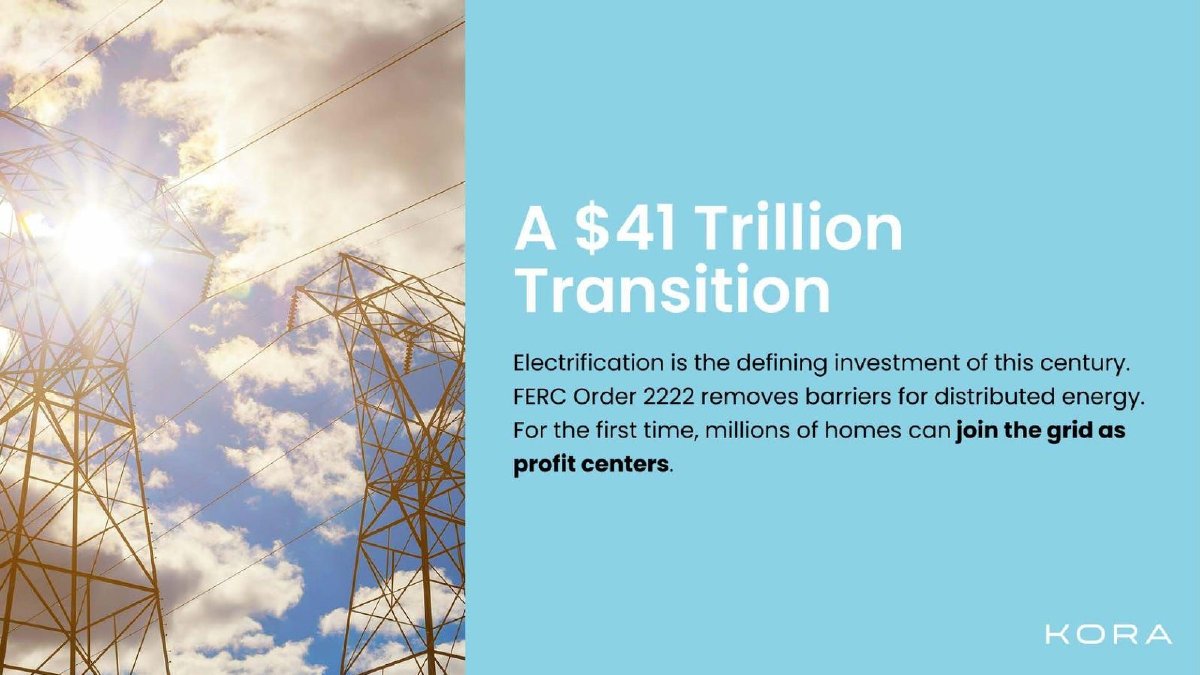
Home energy company, 2024 seed deck. A page headed "A $41 Trillion Transition".
Kora deck, slide 6. Exact stored slide matched to this analysis.
Our analysis: A permission or opened-market rule, named exactly and described in nearly the rule's own words.
Evidence and limitation: Order 2222's summary: it amends FERC's regulations "to remove barriers to the participation of distributed energy resource aggregations" in grid operators' markets. Effective December 21, 2020; operators had to file compliance by September 17, 2021 and propose implementation dates.
What a founder can adapt: Add the operator markets you will enter and when each accepts aggregations, plus any pilot earnings. "Profit centers" needs a figure per home.
Supporting analysis
What the deck claims: "FERC Order 2222 removes barriers for distributed energy. For the first time, millions of homes can join the grid as profit centers."
Presentation choice: The citation is precise, and the effect matches the order's summary.
When it does not fit: Don't pair a precise rule with an unsourced headline number; the $41 trillion figure has no source on the slide.
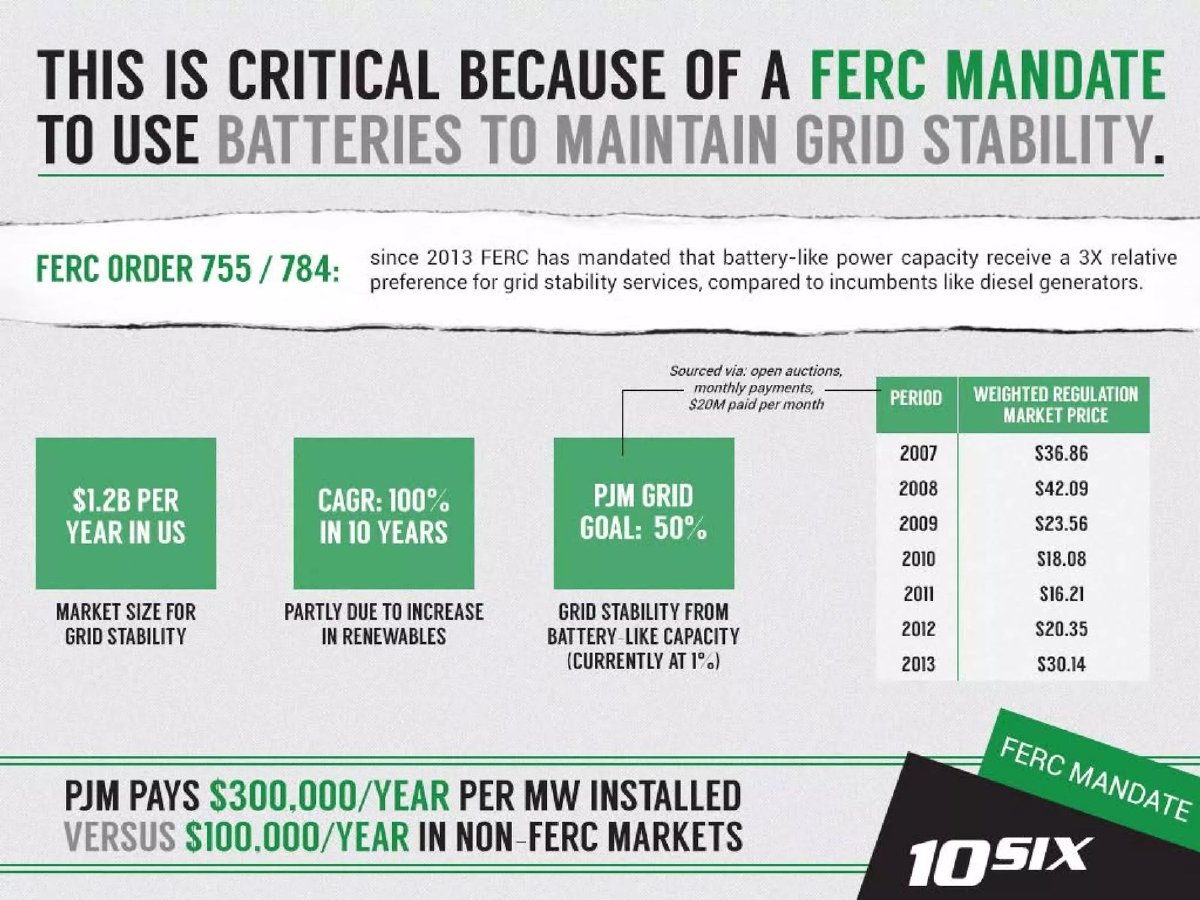
Grid battery company, 2014 deck. Headline: "This is critical because of a FERC mandate to use batteries to maintain grid stability."
10Six deck, slide 7. Exact stored slide matched to this analysis.
Our analysis: A payment-change rule, described as a preference mandate.
Evidence and limitation: Order 755 (effective December 30, 2011) requires a capacity payment plus a performance payment; it cites studies finding storage up to two to three times as effective. It does not set a 3x preference. Order 784 (2013) requires accounting for speed and accuracy. Market figures are the company's and unverified.
What a founder can adapt: State the mechanism as the order does (pay for measured performance) and source the PJM figures.
Supporting analysis
What the deck claims: "FERC Order 755 / 784: since 2013 FERC has mandated that battery-like power capacity receive a 3X relative preference for grid stability services." Also $1.2B per year US market, 100% CAGR, PJM goal 50% (currently 1%), a PJM weighted regulation price table 2007 to 2013 ($36.86 to $30.14), and "PJM pays $300,000/year per MW installed versus $100,000/year in non-FERC markets".
Presentation choice: Names both orders, adds a price series and a payment comparison an investor can test.
When it does not fit: Don't describe a rule's effect in stronger terms than its text; it invites a reader to discount the slide.
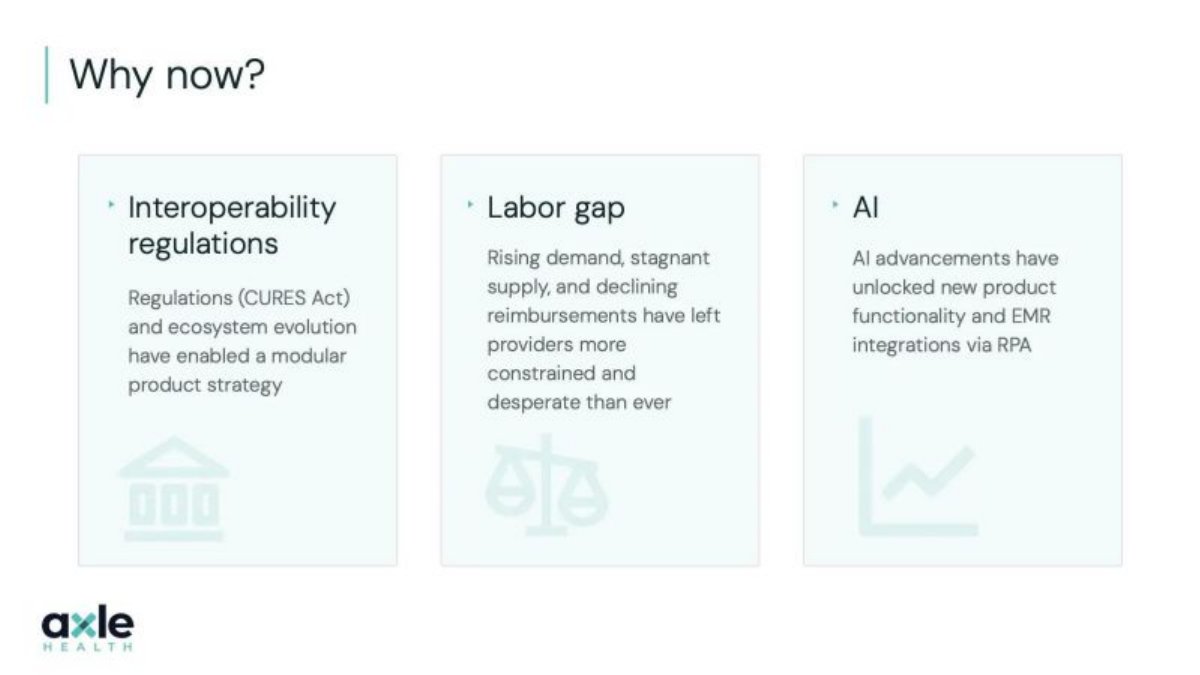
Home health software, 2025 Series A deck. "Why now?" page with three panels.
Axle Health deck, slide 8. Exact stored slide matched to this analysis.
Our analysis: A permission rule: access to health records that integrations depend on. Named, but the slide does not say which provision or what it lets Axle do.
Evidence and limitation: The 21st Century Cures Act (2016) made sharing electronic health information the expected norm and led to ONC's information blocking rules (ONC page).
What a founder can adapt: Say what the rule lets you do that you could not before, for example read schedule data from a record system without a custom contract, and when that became enforceable.
Supporting analysis
What the deck claims: "Interoperability regulations: Regulations (CURES Act) and ecosystem evolution have enabled a modular product strategy." Other panels: labor gap; AI advances enabling EMR integrations via RPA.
Presentation choice: Puts the rule beside two other drivers, so the argument does not rest on regulation alone.
When it does not fit: Don't treat "enabled a modular product strategy" as a demand argument; it explains how you build, not why customers buy now.
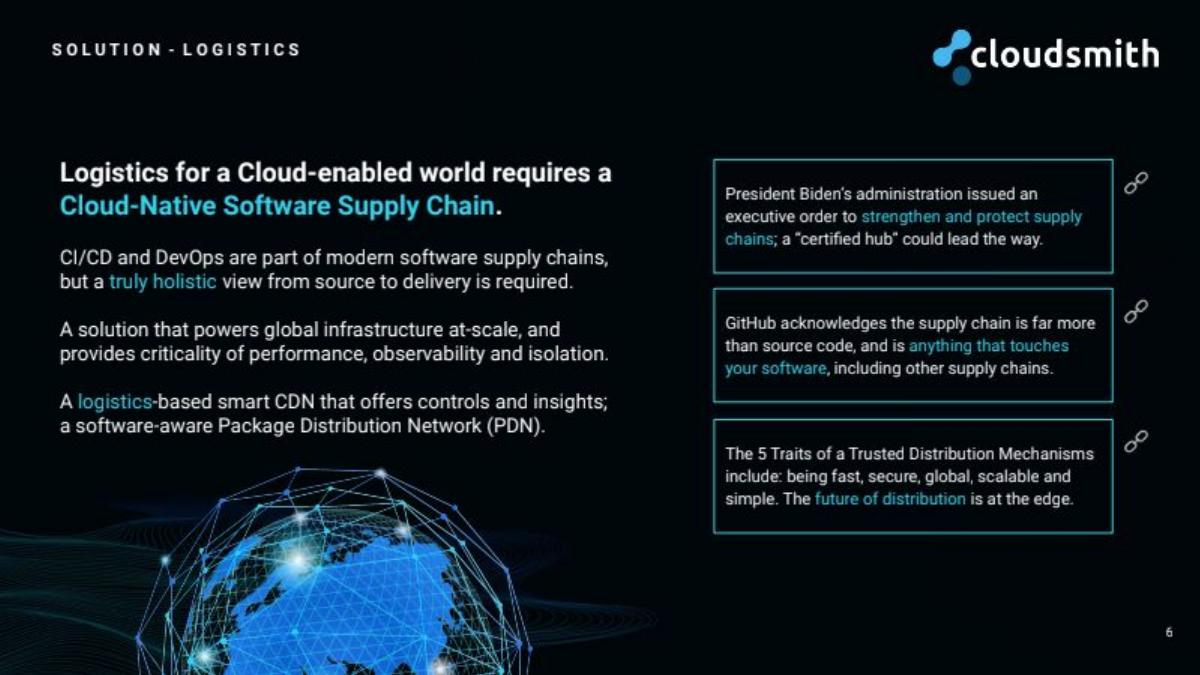
Software supply-chain platform, 2024 Series A deck. "Solution - Logistics" page with three linked callouts.
Cloudsmith deck, slide 6. Exact stored slide matched to this analysis.
Our analysis: A requirement to act, binding federal software procurement, not every buyer.
Evidence and limitation: Executive Order 14028 (May 12, 2021), section 4, covers software supply chain security; 4(e) lists practices including providing a purchaser an SBOM, for software sold to the federal government. "Certified hub" does not appear in the order.
What a founder can adapt: Name the order and section, and say which customers sell software to government or to suppliers who do.
Supporting analysis
What the deck claims: "President Biden's administration issued an executive order to strengthen and protect supply chains; a 'certified hub' could lead the way."
Presentation choice: Links the product to a recognised policy shift, and the callout carries a link icon to a source.
When it does not fit: Don't put your own product concept in a sentence about the order; "certified hub" reads as if the order calls for one.
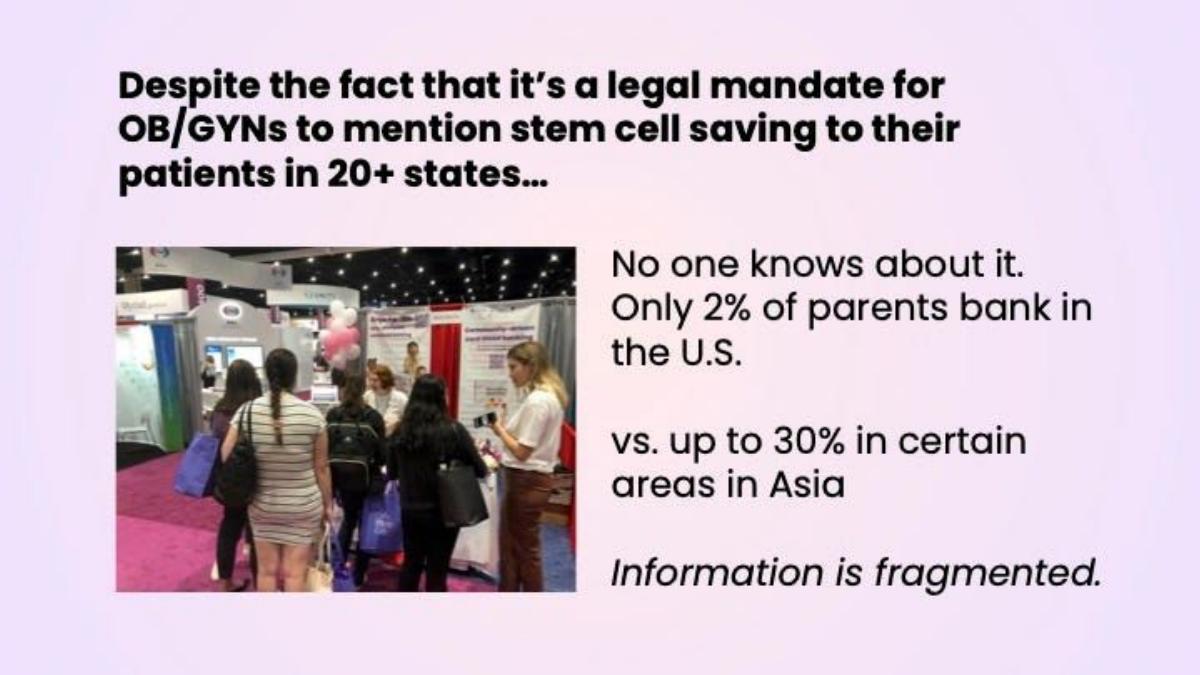
Anja Health deck, slide 6. Exact stored slide matched to this analysis.
Our analysis: A duty-to-inform rule, used to show a gap rather than demand.
Evidence and limitation: Arizona's statute (ARS 32-3212) requires a health professional to inform a second-trimester patient of cord blood options. The Parent's Guide to Cord Blood Foundation's list shows other states, such as California and Arkansas, encourage but do not mandate education. The 2% and 30% figures are the company's.
What a founder can adapt: Say "required or encouraged in [n] states" and give the source; keep the low-adoption point.
Supporting analysis
What the deck claims: "Despite the fact that it's a legal mandate for OB/GYNs to mention stem cell saving to their patients in 20+ states... No one knows about it. Only 2% of parents bank in the U.S. vs. up to 30% in certain areas in Asia. Information is fragmented."
Presentation choice: Honest about the limit: the rule has not converted parents, which is the gap the product addresses.
When it does not fit: Don't count encouragement laws as mandates.
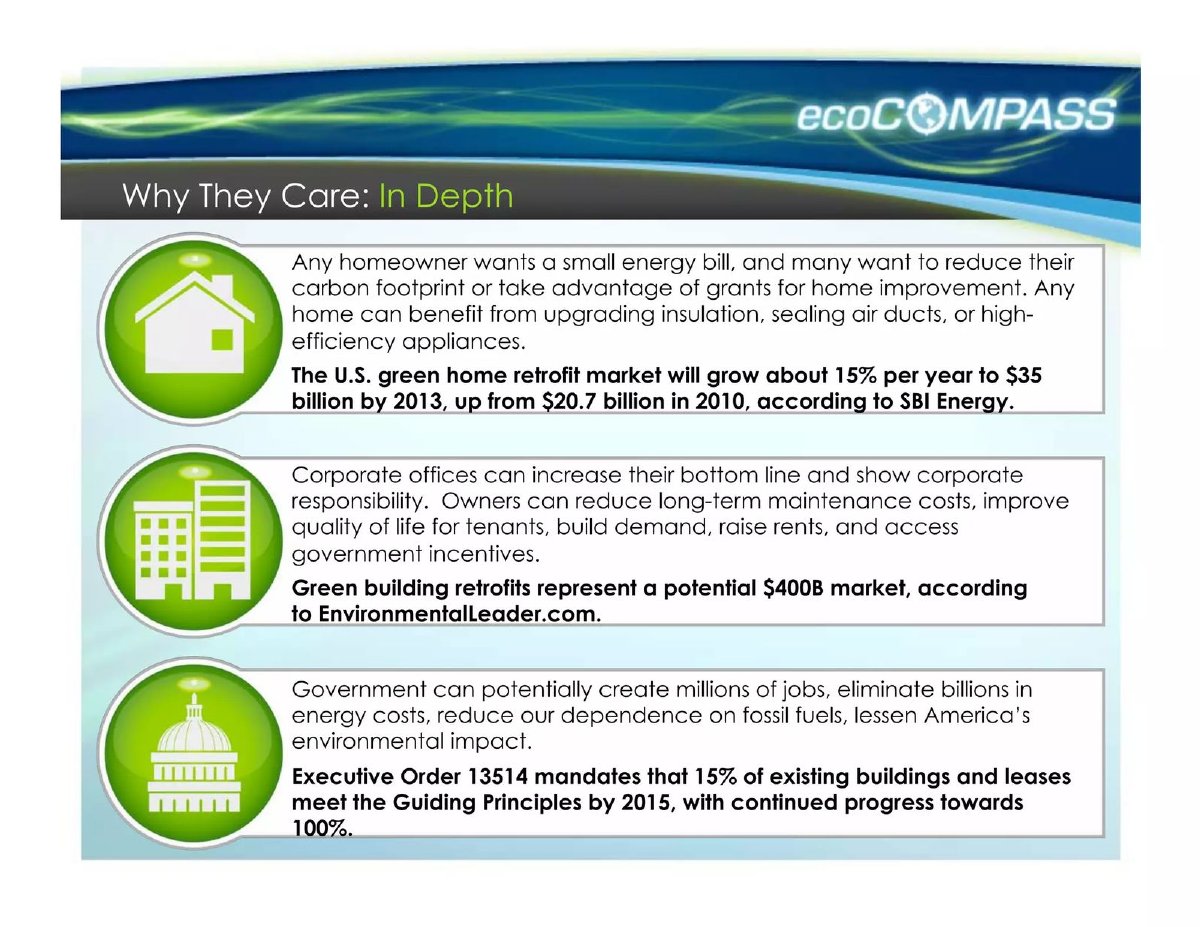
Energy efficiency marketplace, circa 2012 deck. "Why They Care: In Depth" with homeowner, corporate and government panels.
ecoCompass deck, slide 9. Exact stored slide matched to this analysis.
Our analysis: A requirement to act, accurately quoted, binding federal agencies only.
Evidence and limitation: EO 13514 (October 5, 2009) section 2: at least 15% of each agency's existing buildings and leases above 5,000 gross square feet meet the Guiding Principles by fiscal year 2015. Revoked by EO 13693 on March 19, 2015.
What a founder can adapt: Say "federal agencies" and show how the company reaches them. Track the rule's status; it was revoked about three years after this deck.
Supporting analysis
What the deck claims: "Executive Order 13514 mandates that 15% of existing buildings and leases meet the Guiding Principles by 2015, with continued progress towards 100%." Homeowner and corporate panels cite SBI Energy and EnvironmentalLeader.com market figures.
Presentation choice: Quotes the rule's number and deadline, and puts government in its own panel.
When it does not fit: Don't let a government mandate stand in for homeowner or corporate demand.
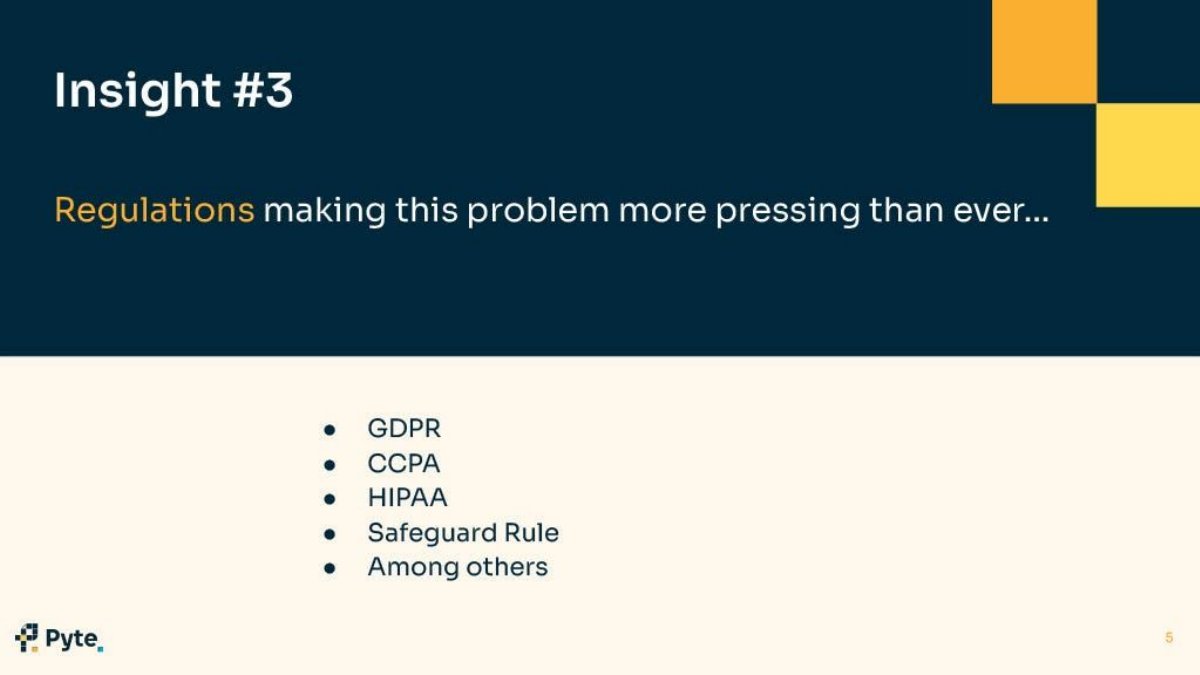
Privacy-preserving data collaboration, 2024 seed extension deck. "Insight #3".
Pyte deck, slide 5. Exact stored slide matched to this analysis.
Our analysis: A list of rules as background risk; no kind of rule is identified.
Evidence and limitation: The slide names four rules but no provision, date or effect.
What a founder can adapt: Pick the one obligation your product helps meet, for example a limit on sharing personal data with a partner, and say which buyer faces it.
Supporting analysis
What the deck claims: "Regulations making this problem more pressing than ever..." followed by GDPR, CCPA, HIPAA, Safeguard Rule, "Among others".
Presentation choice: Signals that the buyer operates under several privacy regimes, which is true for many data teams.
When it does not fit: Don't present a list of regulation acronyms as a timing argument; none of these is new, and the slide does not say what changed.
Our reading of each slide against the five things a regulation why-now needs. "Partly" means present but incomplete or inaccurate.
Company
Rule named
Date or status
Who it binds
Effect stated accurately
Buyers acting
Kora
Yes (Order 2222)
No
Partly (distributed energy)
Yes
No
10Six
Yes (Orders 755, 784)
Partly ("since 2013")
Partly (PJM markets)
No ("3X preference")
Partly (price table, payment claim)
Axle Health
Partly (Cures Act)
No
No
Partly
No
Cloudsmith
No (unnamed order)
No
No
Partly ("certified hub" added)
No
Anja Health
Partly (state mandates)
No
Yes (OB/GYNs)
Partly ("20+ states")
Yes, as a gap (2%)
ecoCompass
Yes (EO 13514)
Yes (15% by 2015)
No (agencies implied)
Yes
No
Pyte
Yes (four acronyms)
No
No
No
No
Key Takeaways
Name the rule and its number, not "new regulations" or "an executive order".
Give the date it took effect and its status today. A rule that has been revoked or not yet implemented is a different argument.
Say who the rule binds. If it binds federal agencies, your customer is the government, not every company.
Say what kind of rule it is: a requirement to act, a permission or opened market, a change in how a service is paid, or a duty to inform.
Quote the rule's effect accurately. 10Six's "3X relative preference" is not what Order 755 says; the order requires payment for performance.
Show buyers acting because of the rule: pilots, contracts, procurement language, or registrations.
Say what happens to the business if the rule is delayed, narrowed or repealed.
Write your regulation why-now
Fill these in before designing the slide. If you cannot fill the last two, the rule is background, not your timing argument.
Rule. Exact name and number, and the provision that matters.
Date and status. When it took effect, whether it is phased by region or sector, and whether it is still in force.
Kind of rule. Requirement to act, permission or opened market, payment change, or duty to inform.
Who it binds. The group the rule applies to, and whether that group is your buyer.
Effect in the rule's words. What it forces, permits or pays for, quoted or closely paraphrased.
Buyers acting. Pilots, contracts, procurement language or market prices that show money moving because of the rule.
Without the rule. Which revenue continues if the rule is delayed, narrowed or repealed.
Copyable framework: [Rule, number] (effective [date], [status]) [requires / permits / pays] [group] to [effect]. Our buyers, [buyer], [evidence of action]. Without it, [revenue that continues].
Illustrative example 1 — written by us
Before: Regulations are making this problem more pressing than ever: GDPR, CCPA, HIPAA.
After: Hypothetical: [Rule, provision] (in force since [date]) limits [buyer] from [action] without [condition]. [n] of our pilot customers cite it in procurement. Without it, [use case] still drives [share] of pipeline.
What improved: Invented for illustration; bracketed values are placeholders. Replaces a list with one obligation, one buyer and evidence of action.
Why a rule is not automatically a why-now
Investors hear "regulation is driving demand" often. The claim is attractive because a rule seems to force buyers to spend money. In practice most rules do something narrower: they bind one group, apply from a date, allow exceptions, and leave buyers choices about how to comply. A slide that names a rule without these details asks the investor to do the legal reading themselves, and many will not give the claim credit.
The existing why-now guide treats regulation as one of four kinds of timing argument and asks for "the named enabler and what it does for you". The regulatory slide guide covers a different case: rules a company needs permission under, such as clearances and licences. This guide covers the case in between, where a rule is the reason the market exists or is growing, and the founder has to prove that link.
Four kinds of rule, and what each needs on the slide
Our classification, used throughout this guide. A requirement to act obliges a defined group to do something your product helps with. Show who is bound, the deadline, the penalty or enforcement, and why buyers would buy rather than build. A permission or opened market lets new participants or data flows in. Show what was blocked before, the date it opened, and that participants can now earn money from it. A payment change alters how a service is paid. Show the old and new price or payment basis, from a market source. A duty to inform requires someone to tell customers about an option. It rarely creates demand on its own, so show conversion evidence alongside it.
Most slides in our sample fit one kind. The problems start when a slide describes one kind of rule as if it were another, for example presenting a duty to inform as a mandate to buy, or a permission as a requirement.
A permission rule from our sample, in its official wording: ONC describes the Cures Act as making the sharing of electronic health information the expected norm, with rules against information blocking. It opens access; it does not oblige anyone to buy a particular product, so a slide built on it has to show who now pays for that access. (ONC, US Department of Health and Human Services)
Date and status: check before you present
Rules change. Executive Order 13514, cited on ecoCompass's slide, was signed on October 5, 2009 and revoked by Executive Order 13693 on March 19, 2015, section 16(b). A deck that still cited it after 2015 would describe a requirement that no longer existed. FERC Order 2222, cited by Kora, took effect on December 21, 2020, but each regional grid operator had to file its own tariff changes by September 17, 2021 and propose its own implementation date. "Order 2222 removes barriers" is true as a statement of the rule; whether homes in a given market can earn money yet depends on that operator's schedule.
Executive Order 13514 applied to federal agencies: it required each agency to ensure that at least 15% of its existing buildings above 5,000 gross square feet, and building leases above that size, met the Guiding Principles by fiscal year 2015. ecoCompass's slide quotes this accurately, but the slide's other two panels describe homeowners and corporate building owners, who were not bound by it. The order supported a government sales channel, not demand from the homeowners and building owners on the rest of the slide.
Executive Order 14028, the May 12, 2021 order on cybersecurity that Cloudsmith's slide refers to without naming, works through federal software purchasing. Section 4(e) lists practices that guidance for software sold to the government should include, among them providing a purchaser a Software Bill of Materials. That is a strong reason why software suppliers to government, and their own suppliers, care about supply-chain tooling. It does not oblige every software company to buy a distribution network, and the order does not mention a "certified hub", the slide's phrase. (The White House (Federal Register), The White House (Federal Register))
Quote the rule's effect accurately
10Six's slide says that since 2013 FERC has mandated that battery-like capacity receive a "3X relative preference" for grid stability services. Order 755 (effective December 30, 2011) requires grid operators to pay frequency regulation resources a capacity payment plus a payment for performance that reflects how much regulation service a resource actually provides when it follows the dispatch signal accurately. The order cites studies finding storage can be up to two to three times as effective as a combustion turbine for regulation. It does not mandate a 3x preference; faster resources earn more because they provide more measured service. Order 784 (2013) adds that transmission providers account for the speed and accuracy of regulation resources.
The founder's underlying point is real: payment for performance favours fast resources like batteries. But an investor who reads the order will find the slide's wording overstated, and will then discount the rest of the slide. Our recommendation: describe the mechanism in the rule's terms and let your own figures show the price effect, with their source. (Federal Energy Regulatory Commission (Federal Register), Federal Energy Regulatory Commission (Federal Register))
A rule plus evidence that buyers are acting
The strongest regulation slides pair the rule with proof that money is moving because of it. 10Six does part of this: a table of PJM's weighted regulation market price by year, 2007 to 2013, and a claim that PJM pays $300,000 per MW-year installed versus $100,000 in non-FERC markets. These are the company's figures and we have not verified them, but they give an investor numbers to check. Kora and Axle give none: each names a rule and asserts an effect.
Anja Health supplies the most useful counter-example. Its slide states that a legal mandate for OB/GYNs to mention stem cell saving exists in 20+ states, then says only 2% of US parents bank. The rule is real in some states: Arizona's statute requires a health professional to inform a patient in her second trimester of cord blood options. But the Parent's Guide to Cord Blood Foundation's state list shows several states only encourage education, so "legal mandate in 20+ states" overstates. More importantly, Anja uses the rule to show a gap, not demand. That is an honest use: a duty to inform had not converted parents, and the company's product is the conversion. (Arizona State Legislature, Parent's Guide to Cord Blood Foundation)
Say what happens if the rule changes
Investors will ask what remains of the business if the rule is delayed, narrowed or repealed. ecoCompass is the example in our sample of a cited requirement being revoked. Our recommendation: one line on the slide or in speaker notes, stating which revenue depends on the rule and which would continue without it. If nothing continues without it, the rule is a regulatory risk as much as a tailwind, and belongs on the risks slide too. (The White House (Federal Register))
A worked example: from "new regulations" to a checkable claim
Hypothetical example, invented for illustration. A startup sells software that helps small battery owners join grid markets. Its draft slide reads: "New FERC rules unlock a huge market for home batteries."
Rewritten: "FERC Order 2222 (effective December 21, 2020) requires grid operators to let aggregations of distributed resources, with a minimum size no higher than 100 kW, sell into their markets. [Operator] began accepting aggregations on [date]. Our 40 pilot homes earned [$x] in [month] from [service]. Revenue without the order: installation fees only." Bracketed values are placeholders the founder fills from their own records.
The rewrite names the rule, dates it, states its effect in the rule's terms (the 100 kW ceiling is in the order), names the operator whose schedule matters, shows money moving, and states what survives without it. (Federal Energy Regulatory Commission (Federal Register))
Common mistakes
Unnamed rule. "An executive order" or "new policies" gives the investor nothing to check.
Wrong group. Citing a rule that binds federal agencies while selling to homeowners or companies.
Overstated effect. Describing payment for performance as a mandated preference, or encouragement as a mandate.
Stale status. Citing a revoked or not-yet-implemented rule as if it were in force.
Acronym list. Listing long-standing rules with no change and no effect.
No buyer evidence. Asserting demand from a rule without showing anyone buying because of it.
Diagnostic checklist
The rule is named with its number.
The slide gives its effective date and current status.
The group the rule binds is your buyer, or the slide explains the link.
The rule's effect is stated in its own terms.
Company figures beside the rule have a source.
There is evidence buyers are acting because of the rule.
You can say what revenue survives if the rule changes.
Frequently asked questions
Should regulation be my main why-now?
Only if the rule changed recently, binds or permits your buyer, and you can show buyers acting on it. Otherwise pair it with another driver, as Axle Health does with labour and AI.
How much legal detail belongs on the slide?
The rule's name and number, its date and status, and one line on its effect. Put the citation and provision in the appendix or data room.
Is a law requiring doctors to inform patients a demand driver?
Search (2026-10-03): the durable corpus index was searched for rule names (FERC, Order, Executive Order, PSD2, Cures Act, GDPR, mandate, regulation) on why-now, opportunity and market pages; decks from publicly listed companies (for example IntelGenx, Sirona) were excluded.
Seven pages are used, each rendered from the original public deck file and read from the image. Five images were new uploads (Kora 6, 10Six 7, Axle Health 8, ecoCompass 9, Pyte 5); Anja Health 6 and Cloudsmith 6 reused existing stored images, checked against the original pages.
Each rule was checked against its official text: Federal Register full text for Orders 755, 784 and 2222 and Executive Orders 13514, 13693 and 14028; the Arizona statute (Arizona Legislature site); ONC's information blocking page. The cord blood state list is a secondary source. Company figures are not verified.
Classifications and recommendations are our editorial reading, not legal advice. Drafted with AI assistance and checked by an editorial model against the slide images and sources; not reviewed by a person.