Pitch Deck Why Now Slides: Real Examples and What Works
How real startups argue timing on the why-now slide: a worsening problem, a technology or regulatory shift, a behaviour change or market growth.
Pitch Deck Why Now Slides: Real Examples and What Works
Seven why-now slides from real decks, shown in full, compare the different kinds of change founders use to argue that their company should exist now rather than five years ago.
TL;DR
A why-now slide should name the specific change that makes your product possible or necessary today, and connect it directly to your company. The examples below use four kinds of change: a problem that is getting worse, a technology or regulatory shift, a change in who buys or how they behave, and market growth. The shifts that persuade are specific and tied to the product. General growth figures describe a market but rarely explain why this company, at this moment.
Why-now slides from real pitch decks
Each example shows the exact stored slide above its analysis and links to the full teardown. Figures are the companies' own claims, with any sources as printed on the slide; we have not verified them. Stage and year are not recorded in our collection for these decks unless stated, and we do not guess them.
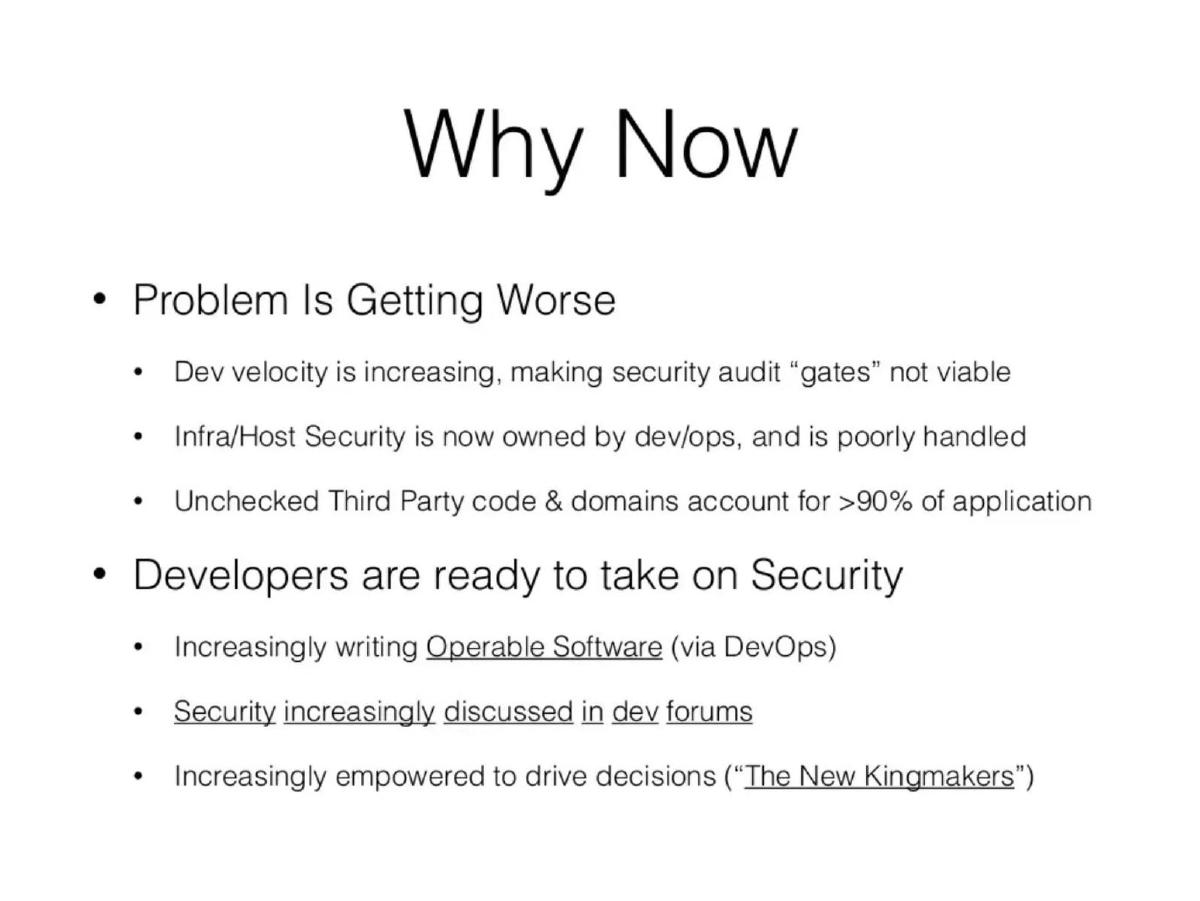
Snyk why now slide — slide 3
Developer-first security tooling. Stage and year not recorded.
Snyk deck, slide 3. Exact stored slide matched to this analysis.
Our analysis: It pairs a problem that is growing with a buyer who has newly gained power. Together those explain why a product sold to developers, rather than to security teams, fits this moment.
Evidence and limitation: The >90% figure has no visible source on the slide, and dense bullets are hard to read in a sent deck. The argument depends on the linked references being credible.
What a founder can adapt: Write one line for what has made the problem worse and one for who can now buy or adopt a fix.
Supporting analysis
What the deck claims: Two headings. "Problem Is Getting Worse": developer velocity makes security audit gates unworkable, infrastructure security is now owned by dev/ops and poorly handled, and unchecked third-party code and domains account for more than 90% of applications. "Developers are ready to take on Security": they increasingly write operable software via DevOps, discuss security in developer forums, and drive decisions ("The New Kingmakers"). Several lines are hyperlinked references.
Presentation choice: It pairs a problem that is growing with a buyer who has newly gained power. Together those explain why a product sold to developers, rather than to security teams, fits this moment.
When it does not fit: The >90% figure has no visible source on the slide, and dense bullets are hard to read in a sent deck. The argument depends on the linked references being credible.
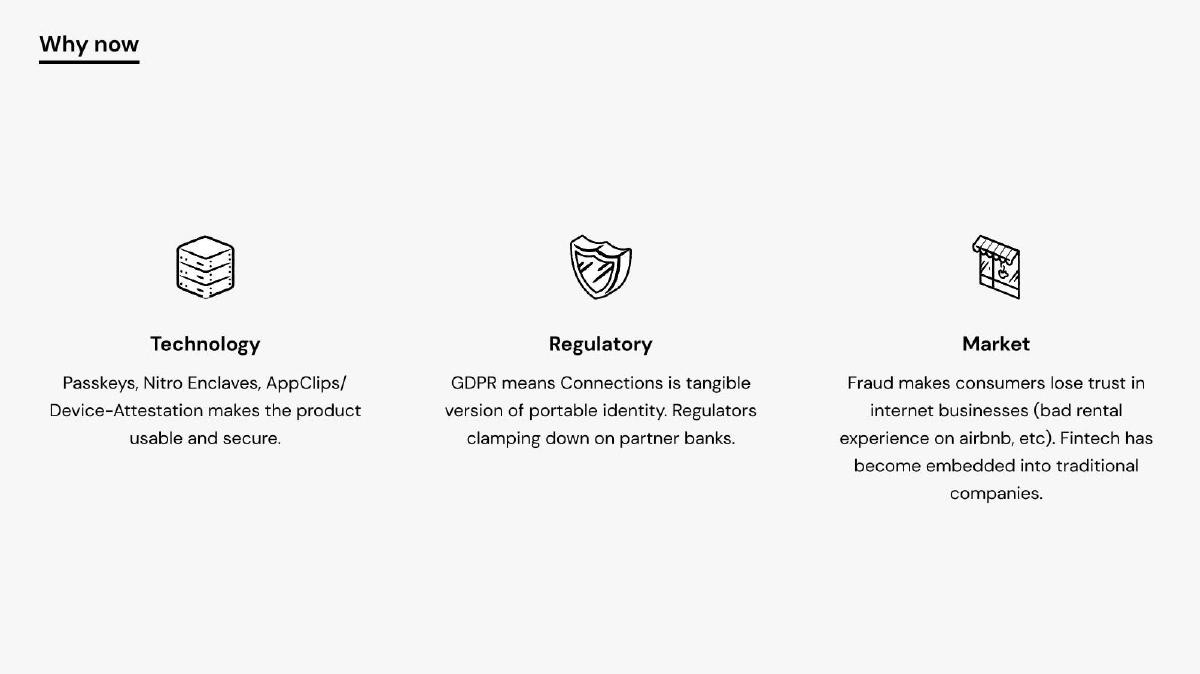
Identity verification and portable identity. Stage and year not recorded.
Footprint deck, slide 5. Exact stored slide matched to this analysis.
Our analysis: Each column names a concrete enabler and says what it does for Footprint's product. The technology column in particular answers "why couldn't this be built before?"
Evidence and limitation: The market column is looser ("bad rental experience on Airbnb, etc.") and has no dates or evidence. Three columns of equal weight can hide which shift actually matters most.
What a founder can adapt: Use a technology / regulation / market structure only if each column names a specific change and its effect on you.
Supporting analysis
What the deck claims: Three columns. Technology: passkeys, Nitro Enclaves and AppClips/device attestation make the product usable and secure. Regulatory: GDPR makes its "Connections" a tangible version of portable identity, and regulators are clamping down on partner banks. Market: fraud makes consumers lose trust in internet businesses, and fintech has become embedded in traditional companies.
Presentation choice: Each column names a concrete enabler and says what it does for Footprint's product. The technology column in particular answers "why couldn't this be built before?"
When it does not fit: The market column is looser ("bad rental experience on Airbnb, etc.") and has no dates or evidence. Three columns of equal weight can hide which shift actually matters most.
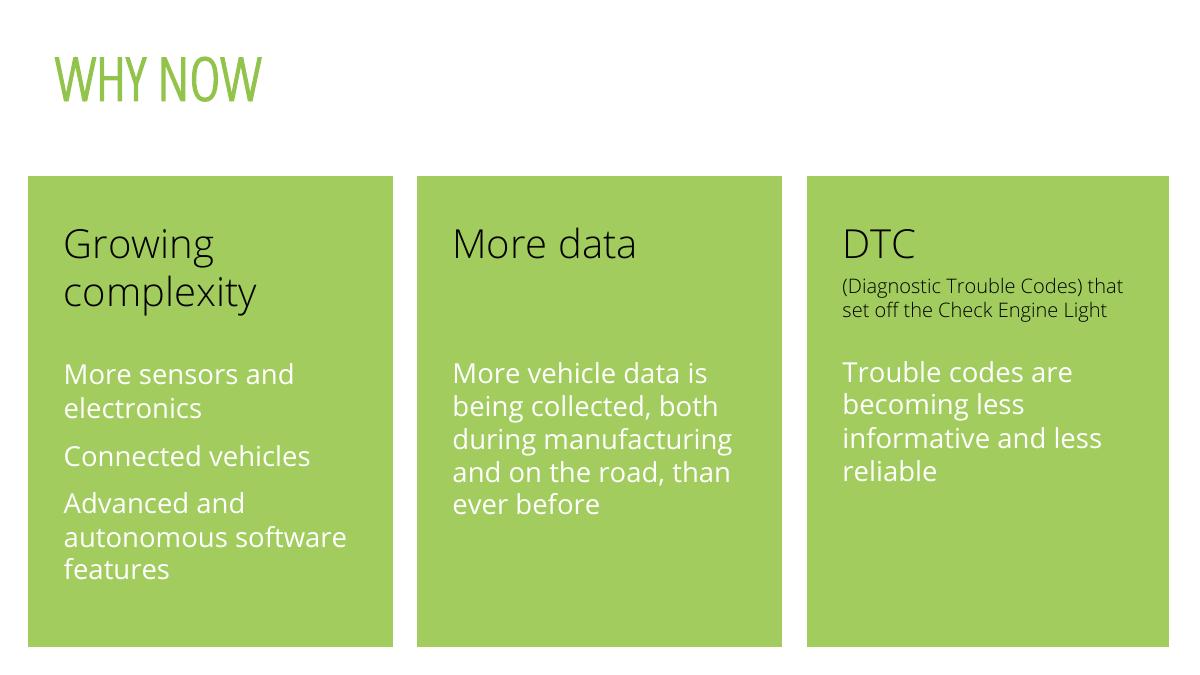
Machine-learning analytics for automotive quality. Stage and year not recorded.
Acerta deck, slide 6. Exact stored slide matched to this analysis.
Our analysis: The three blocks form a chain: complexity grows, data grows, and the existing diagnostic tool gets worse. That logic points directly to an analytics product built on the new data.
Evidence and limitation: No figures, dates or sources support any block. "More data than ever before" is true of many industries and needs a number to carry weight.
What a founder can adapt: Build the slide as a short causal chain ending with why the incumbent method is failing.
Supporting analysis
What the deck claims: Three blocks. Growing complexity: more sensors and electronics, connected vehicles, advanced and autonomous software features. More data: more vehicle data collected during manufacturing and on the road than ever before. DTC (diagnostic trouble codes): trouble codes are becoming less informative and less reliable.
Presentation choice: The three blocks form a chain: complexity grows, data grows, and the existing diagnostic tool gets worse. That logic points directly to an analytics product built on the new data.
When it does not fit: No figures, dates or sources support any block. "More data than ever before" is true of many industries and needs a number to carry weight.
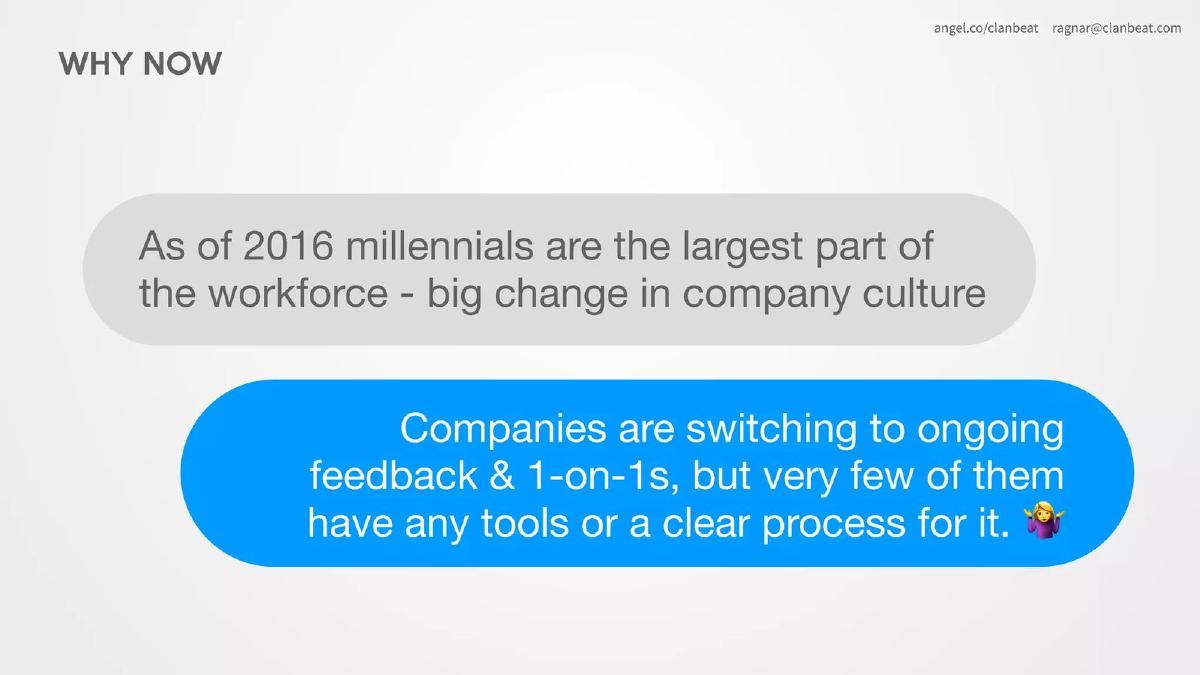
Employee feedback and one-on-one software. The slide dates its shift to 2016; deck year not otherwise recorded.
Clanbeat deck, slide 4. Exact stored slide matched to this analysis.
Our analysis: It connects a dated workforce change to a behaviour change and then to a gap in tools, in two sentences. The chat format also hints at the product's style.
Evidence and limitation: Neither statement carries a source, and "very few have any tools" is an assertion. Demographic shifts are slow; an investor may ask why the gap has not already been filled.
What a founder can adapt: State the shift with a year, the behaviour it causes, and the gap that behaviour leaves.
Supporting analysis
What the deck claims: Two chat-style bubbles: "As of 2016 millennials are the largest part of the workforce – big change in company culture" and "Companies are switching to ongoing feedback & 1-on-1s, but very few of them have any tools or a clear process for it."
Presentation choice: It connects a dated workforce change to a behaviour change and then to a gap in tools, in two sentences. The chat format also hints at the product's style.
When it does not fit: Neither statement carries a source, and "very few have any tools" is an assertion. Demographic shifts are slow; an investor may ask why the gap has not already been filled.
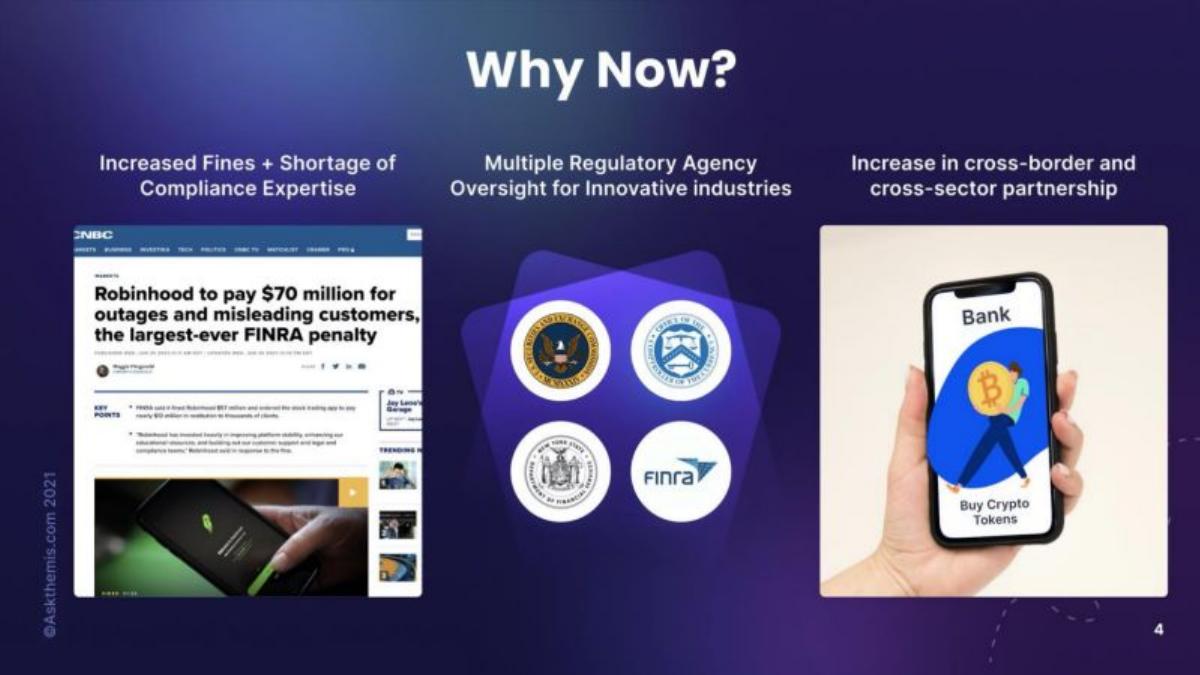
Themis deck, slide 4. Exact stored slide matched to this analysis.
Our analysis: A real headline makes regulatory risk tangible to a non-specialist in a second. The three panels move from penalty to oversight to the partnerships that create more exposure.
Evidence and limitation: One headline illustrates the risk; it does not show that fines are rising overall. The "shortage of compliance expertise" claim has no support on the slide.
What a founder can adapt: If regulation drives your timing, show one concrete enforcement event and say what it means for your customer.
Supporting analysis
What the deck claims: "Why Now?" with three panels: increased fines and a shortage of compliance expertise (illustrated with a CNBC headline, "Robinhood to pay $70 million for outages and misleading customers, the largest-ever FINRA penalty"); multiple regulatory agency oversight for innovative industries (agency seals including FINRA); and more cross-border and cross-sector partnerships (a phone showing a bank app offering crypto tokens).
Presentation choice: A real headline makes regulatory risk tangible to a non-specialist in a second. The three panels move from penalty to oversight to the partnerships that create more exposure.
When it does not fit: One headline illustrates the risk; it does not show that fines are rising overall. The "shortage of compliance expertise" claim has no support on the slide.
E-commerce fulfilment for European brands. The slide cites Q4 2021 figures.
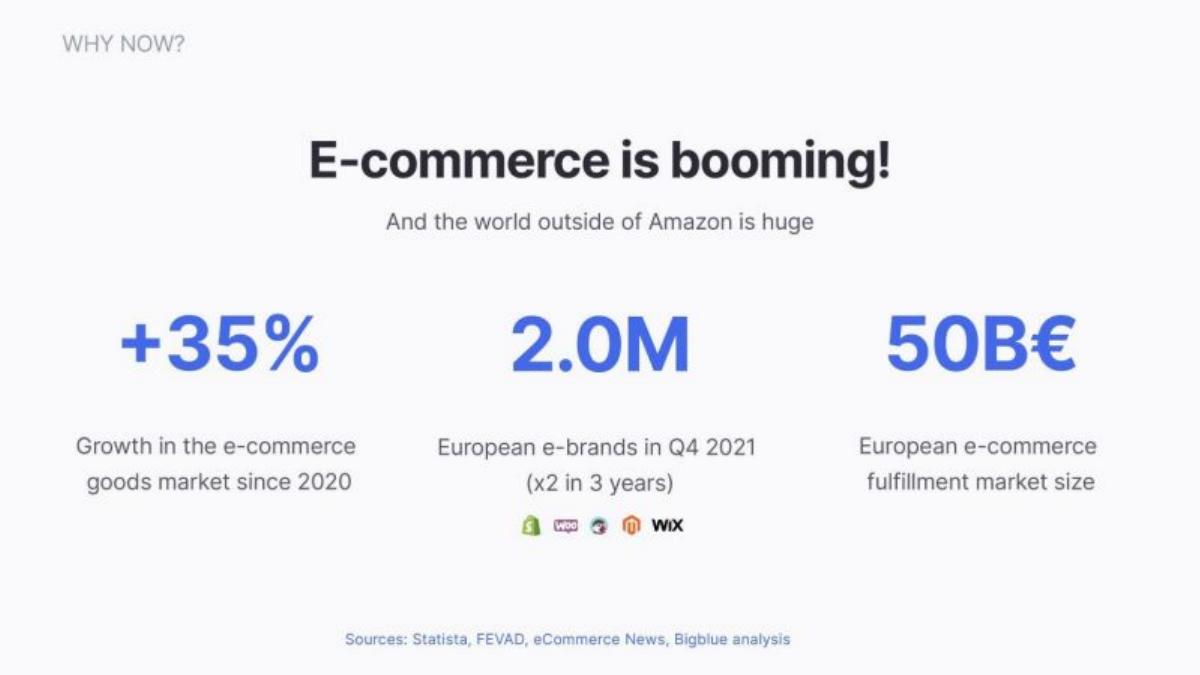
Bigblue deck, slide 2. Exact stored slide matched to this analysis.
Our analysis: Three large, sourced numbers are quick to read and establish that the customer base (independent brands) is growing, which is the relevant point for a fulfilment provider.
Evidence and limitation: Growth explains why the market is attractive, not why a new entrant wins now. Pair it with the change that incumbents handle badly. "Bigblue analysis" as a source needs its method.
What a founder can adapt: If you use market growth, pick the metric that counts your customers, not the whole market, and print the source.
Supporting analysis
What the deck claims: "E-commerce is booming! And the world outside of Amazon is huge", with three figures: +35% growth in the e-commerce goods market since 2020, 2.0M European e-brands in Q4 2021 (x2 in 3 years), and a €50B European e-commerce fulfilment market. Sources are printed: Statista, FEVAD, eCommerce News, Bigblue analysis.
Presentation choice: Three large, sourced numbers are quick to read and establish that the customer base (independent brands) is growing, which is the relevant point for a fulfilment provider.
When it does not fit: Growth explains why the market is attractive, not why a new entrant wins now. Pair it with the change that incumbents handle badly. "Bigblue analysis" as a source needs its method.
A/B testing for publishers' ad layouts. The slide cites a forecast from 2012 to 2017, so the deck dates from that period.
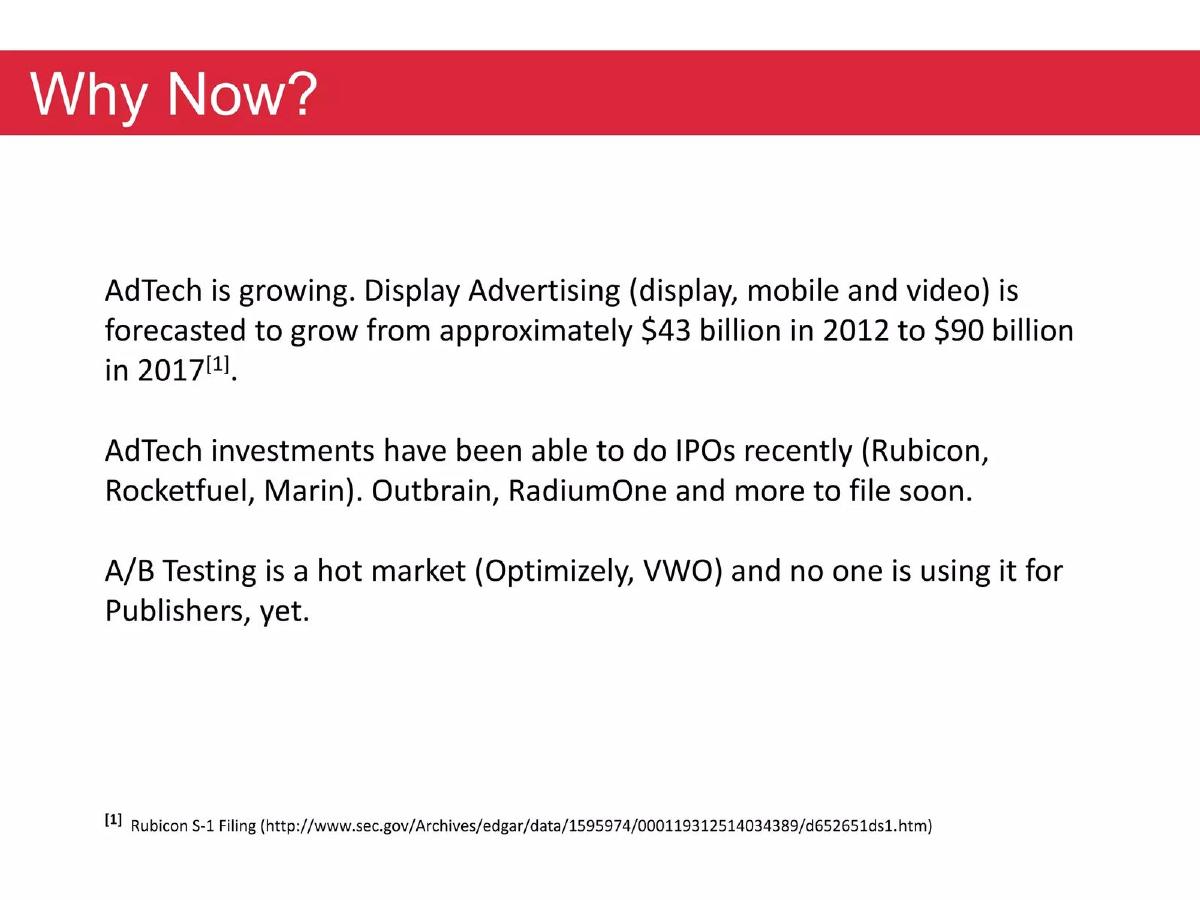
AdPushup deck, slide 4. Exact stored slide matched to this analysis.
Our analysis: Included partly as a contrast. The footnote to a public filing is good practice, but the first two points describe investor appetite for ad tech, not a change that makes AdPushup possible.
Evidence and limitation: "Others have IPO'd" is an argument about exits, which belongs elsewhere. The slide is plain paragraphs and would be hard to scan.
What a founder can adapt: Keep the source discipline, and lead with the third point: the specific gap (A/B testing not applied to publishers) is the actual timing argument.
Supporting analysis
What the deck claims: Three paragraphs: display advertising forecast to grow from about $43 billion in 2012 to $90 billion in 2017 (footnoted to Rubicon's S-1 filing); ad-tech companies have IPO'd recently (Rubicon, Rocketfuel, Marin) with others expected to file; and A/B testing is a hot market (Optimizely, VWO) "and no one is using it for Publishers, yet".
Presentation choice: Included partly as a contrast. The footnote to a public filing is good practice, but the first two points describe investor appetite for ad tech, not a change that makes AdPushup possible.
When it does not fit: "Others have IPO'd" is an argument about exits, which belongs elsewhere. The slide is plain paragraphs and would be hard to scan.
Most strong slides lead with one kind of change and support it with another. Pick the one that best explains why an incumbent has not already done this.
Kind of change
Best when
What it needs
Main risk
Examples
Problem getting worse
The pain is rising for a clear reason
The cause, with evidence, plus who can now act
Unsourced statistics
Snyk; Acerta
Technology or regulatory shift
Something newly available enables the product
The named enabler and what it does for you
Listing trends without effects
Footprint; Themis
Behaviour or buyer change
Who buys, or how they work, has shifted
A date, the new behaviour and the gap it leaves
Slow shifts invite "why not already?"
Clanbeat; Snyk
Market growth
Your customer base is expanding fast
The metric that counts your customers, with a source
Explains the market, not your timing
Bigblue; AdPushup (weaker)
Key Takeaways
Tie each shift to your product. Footprint lists specific technologies (passkeys, Nitro Enclaves, device attestation) and says they make its product usable and secure; that is a timing argument, not just a trend.
A worsening problem plus a newly empowered buyer is a strong pair. Snyk argues both that security gates no longer fit developer speed and that developers now drive security decisions, which explains why a developer-first product fits now.
Market growth alone rarely answers why now. Bigblue's and AdPushup's figures show a growing market, but a growing market is also true for competitors; the slide needs the change that favours a new entrant.
Put a date on the shift and a source on the number. Clanbeat anchors its change to 2016; Bigblue and AdPushup cite sources on the slide. Undated trends and unsourced figures are harder to believe.
Evidence can be a real event. Themis shows a news headline about a regulatory penalty, which makes "increased fines" concrete, but one headline is an example, not a trend.
Test your why-now slide in four lines
Answer these before designing. If the third line is empty, you do not yet have a timing argument.
The change. What specific thing changed, and when (technology, regulation, behaviour, cost)?
Evidence. What sourced number, event or date shows the change is real?
Why it favours you. How does this change make your product possible or necessary, and why can't incumbents simply respond?
Why not earlier. What stopped someone building this five years ago?
Copyable framework: Since [year], [specific change] ([evidence, source]). This makes [your product action] possible because [link]. Incumbents [can't / won't] because [reason].
Illustrative example 1 — written by us
Before: AI is booming and the market is growing rapidly.
After: Since [year], [specific capability] costs [x] less per [unit] ([source]), so [task] can now run automatically for [customer type]. Legacy vendors price per seat and [reason they cannot follow].
What improved: Our illustrative rewrite, not any company's text. It replaces a general trend with a dated change, its link to the product and a reason incumbents lag; bracketed values are placeholders.
What the why-now slide has to do
Sequoia's guide to writing a business plan lists "Why now?" as its own section and puts the test plainly: "why hasn't your solution been built before now?" If nothing changed recently in technology, regulation or behaviour, an investor will wonder why an incumbent has not already done this.
The slide works best directly after the problem and solution, as the bridge that explains why the solution can win now. (Sequoia Capital)
Common mistakes
General trends. "AI is growing" or "e-commerce is booming" is true for every competitor. Name the change that favours you.
No date. A shift without a year cannot answer why now rather than earlier.
Unsourced statistics. Print the source and year next to every figure.
Exit talk. Recent IPOs in your sector are about investor returns, not product timing.
Equal-weight lists. Three columns of trends can hide which one matters. Lead with the decisive shift.
Diagnostic checklist
Names at least one specific change and when it happened.
Every figure has a source and year on the slide.
States how the change makes your product possible or necessary.
Answers why this was not built five years ago.
Explains why incumbents cannot or will not respond quickly.
Market growth, if used, counts your customers and supports another argument.
Frequently asked questions
How we chose these examples
Corpus: published pitch deck teardowns on StartupFundraising.com. Founder-uploaded private decks are excluded.
Selection (2026-09-24): we searched extracted slide text for slides 2–6 beginning with "why now", "timing" or similar that also have a stored slide image, inspected eight candidates, and chose seven covering security, identity, automotive, HR, compliance, logistics and ad tech. AdPushup is included partly as a contrast. Bunch slide 6 was not selected.
Review: all seven stored slide images were inspected on 2026-09-24 and matched to company, deck and slide number (editorial model review). No person has yet completed an editorial review of this page.
Figures, headlines and sources are shown as printed on the slides; we have not verified them. Dates come only from the slides themselves.
We make no claim that any why-now slide caused a fundraising outcome.