AdPushup’s 2014 pre-seed deck is a masterclass in using early traction to validate a technical solution. With only 11 slides, the founders successfully communicated a complex AdTech problem—falling click-through rates due to banner blindness—and presented a clear, data-backed solution. The deck highlights a significant case study where RPM was optimized from $3.82 to $12.1, providing immediate proof of value. By showing a 64x increase in monthly impressions over just four months (from 500,000 in March to 32 million in June), the team demonstrated product-market fit before even finalizing thei…
Key takeaways
- The deck identifies 'banner blindness' as the primary driver behind falling display advertising CTRs on slide 2.
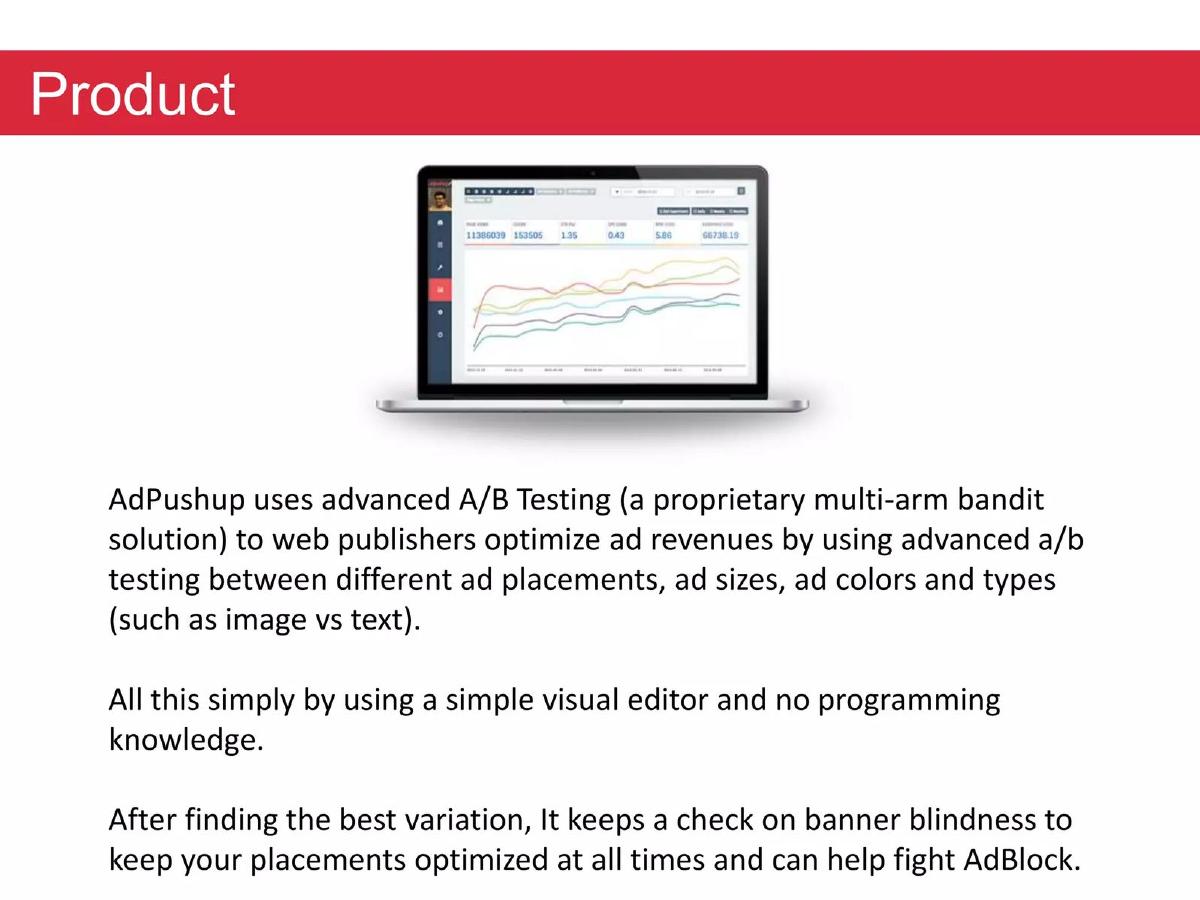
- AdPushup utilizes a proprietary multi-arm bandit solution for automated A/B testing of ad placements and sizes, as detailed on slide 5.
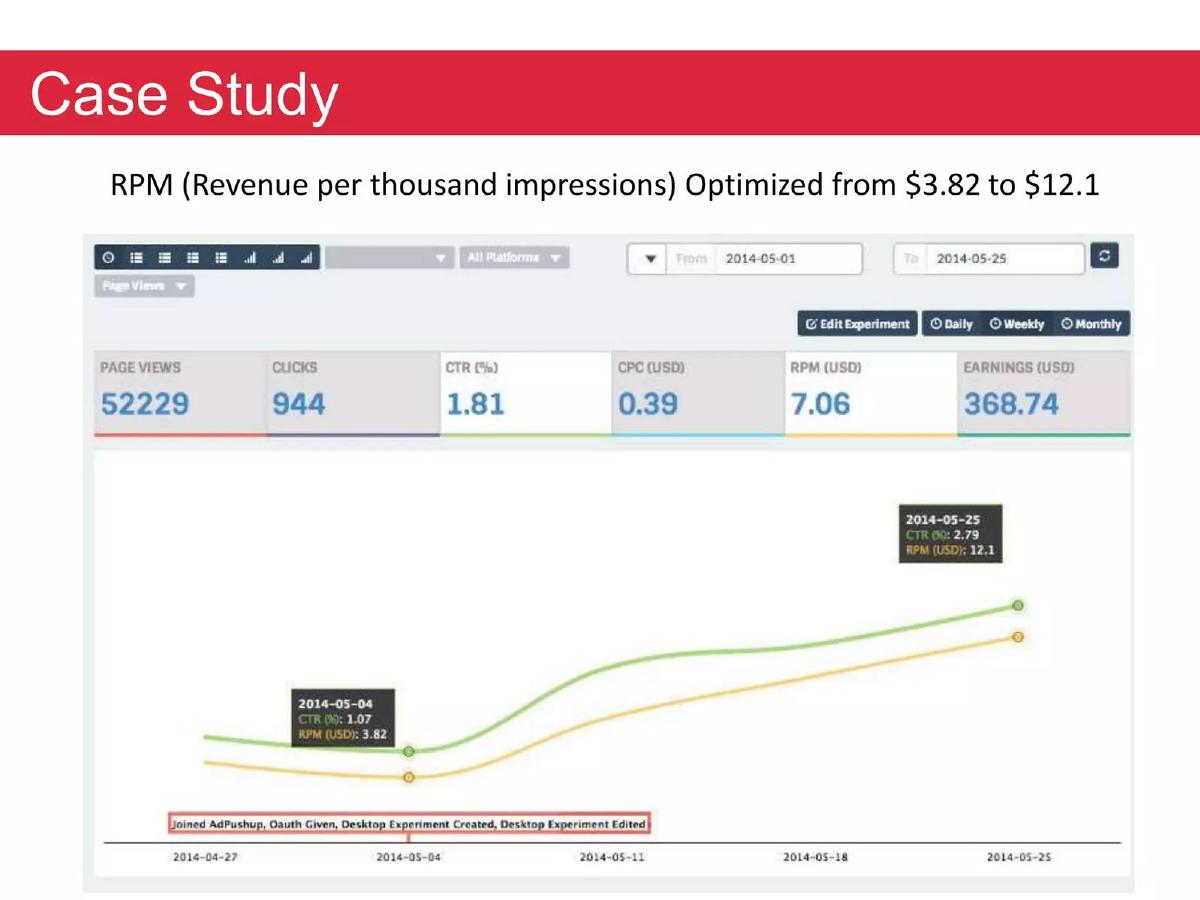
- A central case study on slide 6 demonstrates an RPM increase from $3.82 to $12.1, a nearly 217 percent improvement.
- Traction grew exponentially from 500,000 impressions in March 2014 to 32 million impressions by June 2014, according to slide 8.
- The founders, Ankit Oberoi and Atul Agarwal, had previously co-founded Innobuzz in 2007, establishing domain expertise on slide 10.
- The monetization strategy on slide 9 is deferred until the company hits a 'critical mass' of 1 billion impressions.
- The deck highlights a market opportunity where display advertising was forecasted to grow from $43 billion in 2012 to $90 billion in 2017 on slide 4.
- There is no specific 'Ask' slide detailing the amount of capital sought or the planned allocation of funds.
Introduction: The Lean AdTech Pitch
The AdPushup pitch deck from 2014 is a concise, 11-slide presentation that focuses heavily on problem validation and early traction. At a time when the AdTech market was seeing significant IPO activity from players like Rubicon and Marin, AdPushup carved out a niche by focusing on the publisher's side of the equation—specifically, the layout and placement of ads. This teardown examines how the founders used a simple narrative and impressive beta metrics to secure a $632k pre-seed round.
Slides 1-3: The Problem and Solution
Slide 1: Title Slide The deck opens with the AdPushup logo and the tagline: "Maximize Ad Revenues through Advanced A/B Testing." The subtitle, "Ad Revenue Optimization for Web Publishers," immediately identifies the target customer and the core value proposition. It is clean and functional, though it lacks the visual flair of modern decks.
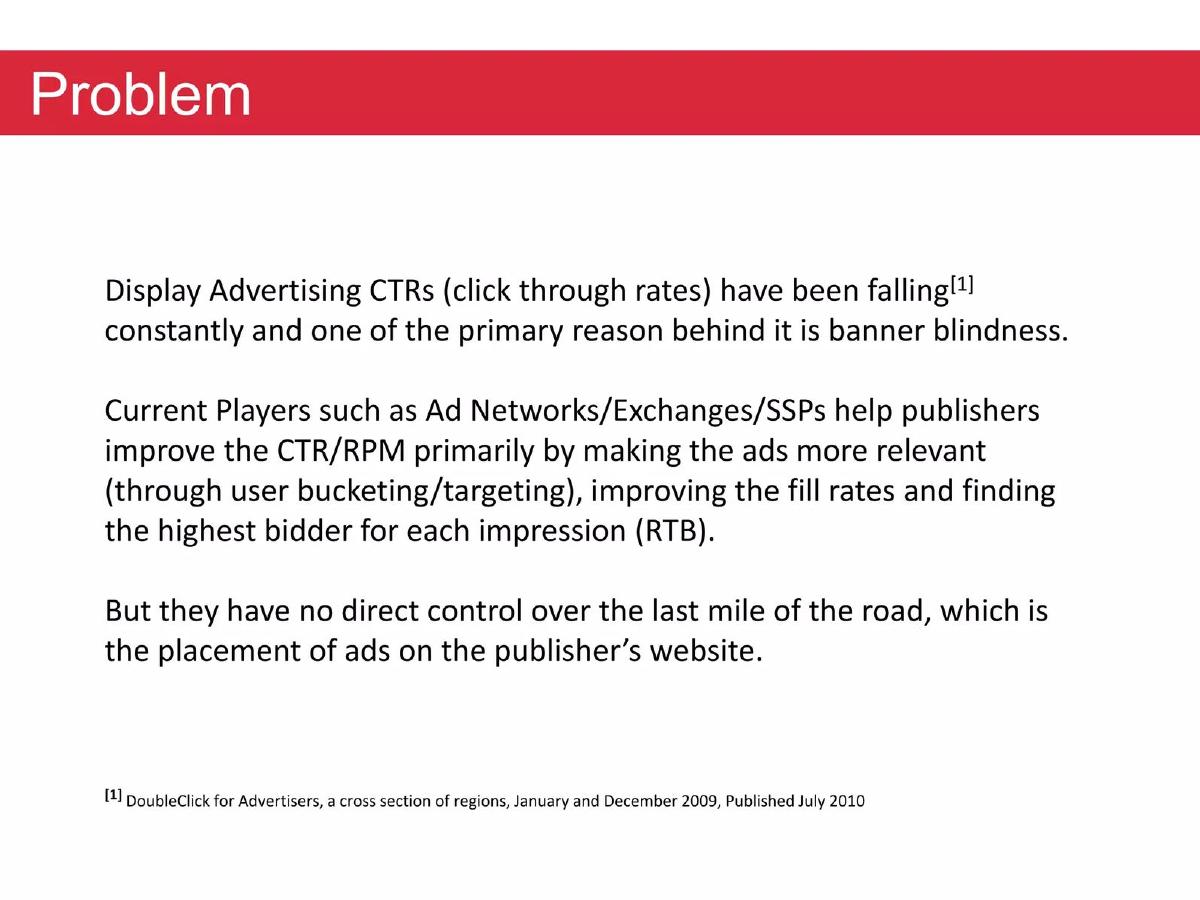
Slide 2: Problem The problem is framed around falling Click-Through Rates (CTRs) in display advertising. The slide cites a DoubleClick study from 2010 to support the claim that "banner blindness" is a primary driver of this decline. Crucially, it identifies a gap in the existing market: while Ad Networks and SSPs (Supply-Side Platforms) focus on relevance and bidding, they have "no direct control over the last mile of the road," which is the physical placement of ads on the website. This is a strong way to frame a niche that larger competitors are ignoring.
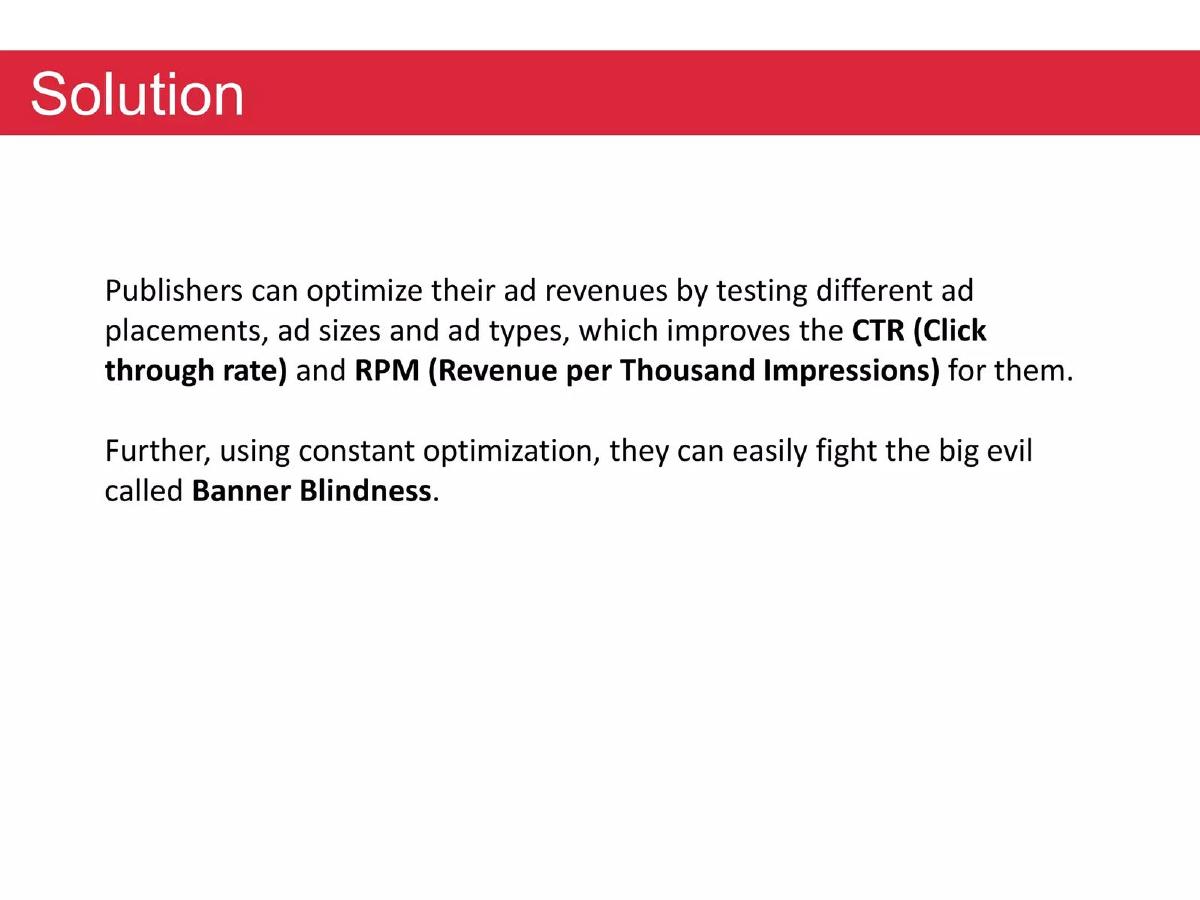
Slide 3: Solution The solution slide is text-heavy but clear. It promises to help publishers optimize revenues by testing different ad placements, sizes, and types. The stated goal is to improve CTR and RPM (Revenue per Thousand Impressions). The slide explicitly mentions that constant optimization is the tool used to "fight the big evil called Banner Blindness."
Slides 4-6: Market Timing and Product Proof
Slide 4: Why Now? This slide provides macro-economic context. It quotes a Rubicon S-1 filing, forecasting that display advertising will grow from "$43 billion in 2012 to $90 billion in 2017." It also lists recent IPOs (Rubicon, Rocketfuel, Marin) to show investor appetite for the sector. Most importantly, it claims that while A/B testing is a "hot market" (citing Optimizely and VWO), no one is yet applying it specifically to publishers. This creates a sense of urgency and untapped opportunity.
Slide 5: Product The product slide features a laptop mockup showing a dashboard with multiple data lines. The text explains that AdPushup uses a "proprietary multi-arm bandit solution" to automate A/B testing. It emphasizes ease of use, noting that publishers can use a "simple visual editor and no programming knowledge." It also mentions a secondary benefit: helping to "fight AdBlock," which was a rising concern for publishers in 2014.
Slide 6: Case Study This is arguably the most important slide in the deck. It provides visual proof of the product's efficacy. The slide shows a dashboard screenshot where RPM was "Optimized from $3.82 to $12.1." The graph shows a clear upward trajectory starting from the date the publisher joined AdPushup (2014-04-27). By showing a 217% increase in revenue for a real user, the founders move the conversation from theoretical benefits to proven results.
Slides 7-9: Milestones, Traction, and The Plan
Slide 7: Milestones The timeline shows the company's rapid evolution. It started as a "weekend project" in May 2013, moved to Proof of Concept (PoC) testing in August 2013, and the founders committed full-time in January 2014. The first private beta was released in March 2014. This timeline demonstrates founder commitment and a fast pace of execution.
Slide 8: Traction The traction slide is a simple list of monthly impressions, showing massive growth:
March 2014: 500,000 impressions · April 2014: 3 Million impressions · May 2014: 10 million impressions · June 2014: 32 million impressions
This 64x growth in four months is the primary signal that the product is working and that there is high demand among publishers.
Slide 9: The Plan The monetization strategy is presented as a "hybrid model" to be implemented after hitting a "critical mass" of 1 billion impressions. The proposed methods include: 1) SaaS plans for large publishers, 2) serving additional ad units for the long tail, and 3) monetizing inventory lost to Ad Blockers. While the plan is somewhat vague on pricing, it shows the founders are thinking about multiple revenue streams.
Slides 10-11: Team and Contact
Slide 10: Founders The team slide features a photo of Ankit Oberoi and Atul Agarwal. Their credentials are solid: both co-founded Innobuzz in 2007, a company that worked with CERT-IN and NASSCOM. Atul is noted for having experience with UGC websites monetized with AdSense. This establishes them as experienced entrepreneurs with domain expertise in web monetization. The slide also notes a total team size of 4 people.
Slide 11: Contact The final slide provides the website URL and a direct email address for Ankit Oberoi, following the standard "Thank you for your time" format.
What Works in This Deck
The Case Study: Slide 6 is the heavy lifter. In early-stage fundraising, one clear data point showing a 3x increase in a core metric (RPM) is more valuable than ten slides of market theory. It proves the technology works.
Growth Velocity: The traction shown on slide 8 is undeniable. Moving from 500k to 32 million impressions in a single quarter suggests a viral or highly efficient acquisition loop, which is exactly what pre-seed investors look for.
Narrow Focus: By identifying the "last mile" of ad placement as the specific problem, AdPushup avoids the trap of trying to compete with Google or Rubicon directly. They positioned themselves as a complementary tool that makes existing ad networks more valuable.
What Is Missing
The Ask: There is no slide stating how much money the company is raising, the valuation, or what the funds will be used for. While this information is often handled in person or in a follow-up, its absence makes the deck feel like a company update rather than a formal pitch.
Competitive Landscape: While slide 4 mentions Optimizely and VWO, it doesn't provide a direct comparison. A founder today would be expected to show a 2x2 matrix or a feature checklist comparing AdPushup to other header bidding or layout optimization tools.
Unit Economics: The deck mentions monetization plans but provides no data on the cost to acquire a publisher (CAC) or the expected lifetime value (LTV). For a SaaS/AdTech hybrid, these numbers are critical for assessing long-term viability.
What a Founder Should Copy
The 'Why Now' Logic: Slide 4 does an excellent job of combining market growth stats with recent exit activity (IPOs). This validates the sector and suggests that an acquisition or IPO is a realistic outcome for investors.
Simplicity of Problem Framing: Using a term like "Banner Blindness"—a concept most people intuitively understand—makes the technical solution (multi-arm bandit testing) feel necessary and accessible.
Milestone Transparency: Showing the transition from a "weekend project" to full-time commitment builds a narrative of organic growth and founder passion. It shows the project wasn't forced; it grew because the market demanded it.
Conclusion
The AdPushup deck is a product of its time—simple, text-heavy, and focused on raw growth. It succeeded because the underlying metrics were so strong that they overshadowed the lack of formal financial modeling or a polished design. For modern founders, the lesson is clear: if your traction numbers are growing 3x month-over-month and you can prove a 200% ROI for your customers, your pitch deck doesn't need to be 20 slides long to get a check.
Frequently asked questions
- How much did AdPushup raise with this deck?
- According to the catalogue facts, AdPushup raised approximately $632,000 in 2014 during their pre-seed round. The lead investor for this specific round remains unknown, though the company successfully leveraged this early capital to scale their operations and eventually secure further funding rounds.
- What is the core technology behind AdPushup?
- As described on slide 5, AdPushup uses a proprietary multi-arm bandit solution for advanced A/B testing. This technology allows web publishers to automatically optimize ad placements, sizes, colors, and types (such as image vs. text) without requiring programming knowledge, utilizing a simple visual editor.
- What specific problem does the company address?
- The deck identifies that while Ad Networks and SSPs optimize for relevance and fill rates, they have no control over the 'last mile'—the actual placement of ads on a publisher's site. Slide 2 notes that falling CTRs are largely due to 'banner blindness,' which AdPushup aims to solve through constant automated optimization.
- What was the company's traction at the time of the pitch?
- AdPushup showed significant growth during their private beta. Slide 8 lists their monthly impressions: 500,000 in March 2014, 3 million in April, 10 million in May, and 32 million in June. This represents a 6,300% increase in volume over a four-month period.
- What is missing from the AdPushup pitch deck?
- The deck is missing several standard components, most notably a specific 'Ask' slide detailing how much money they are raising and how it will be spent. It also lacks a detailed competitor matrix, a formal financial projection table, and a breakdown of unit economics or customer acquisition costs.