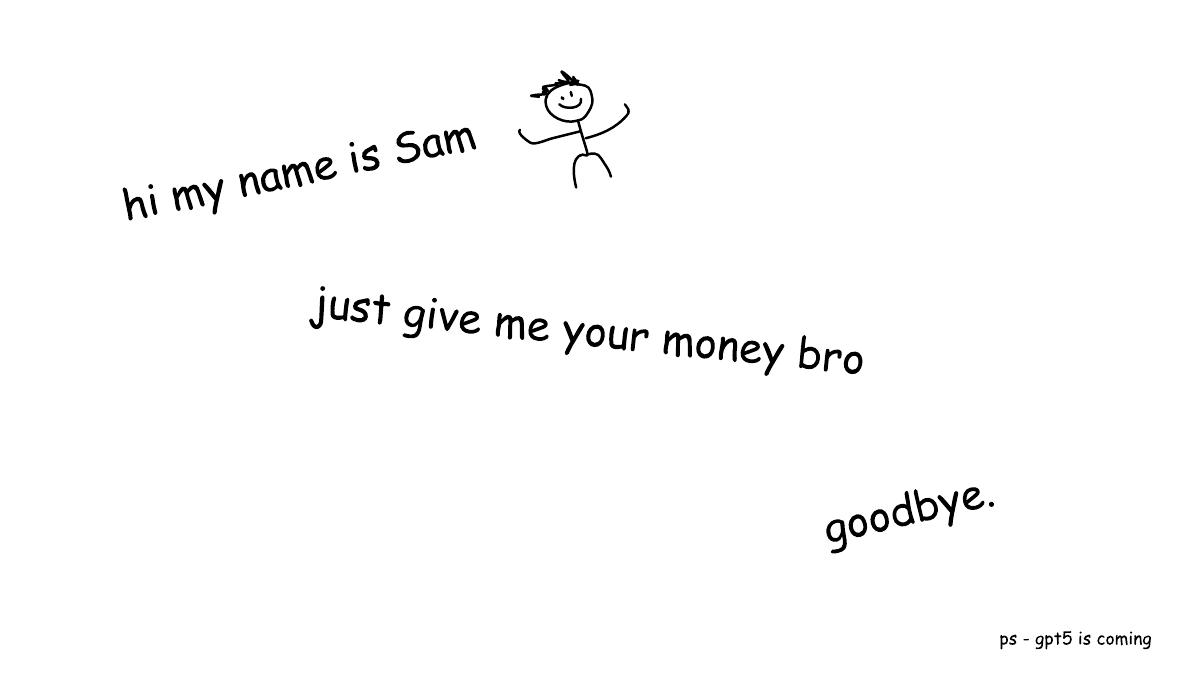
This is not a pitch deck; it is a conceptual statement of extreme market leverage and confidence. The document completely abandons traditional startup pitch structure, replacing data with a stark demand. The core message is an ultimatum: invest now because the future (GPT-5) is coming, with or without you. The deck inverts the typical investor-founder dynamic, positioning the company as the entity with all the power. Repetitive, minimalist slides function as a mantra, emphasizing the futility of a traditional due diligence process. Its effectiveness is entirely dependent on the pre-existing r…
Key takeaways
- This is not a pitch deck; it is a conceptual statement of extreme market leverage and confidence.
- The document completely abandons traditional startup pitch structure, replacing data with a stark demand.
- The core message is an ultimatum: invest now because the future (GPT-5) is coming, with or without you.
- The deck inverts the typical investor-founder dynamic, positioning the company as the entity with all the power.
- Repetitive, minimalist slides function as a mantra, emphasizing the futility of a traditional due diligence process.
- Its effectiveness is entirely dependent on the pre-existing reputation and perceived inevitability of OpenAI.
- For any other company, this would be an immediate 'pass'; for OpenAI, it's a calculated power play.
General Assessment
This document, presented as an early overview deck from OpenAI, is an extraordinary artifact. It is, in the simplest terms, not a pitch deck. It is a 'post-pitch' document, a communication that could only exist after a company has achieved a state of market dominance so profound that the conventional rituals of fundraising are deemed superfluous. It eschews data, narrative, and persuasion in favor of a raw, unadorned demand. This analysis will treat the document not as a failed attempt at a pitch deck, but as a successful, albeit highly unconventional, piece of strategic communication designed to assert power and leverage a unique market position.
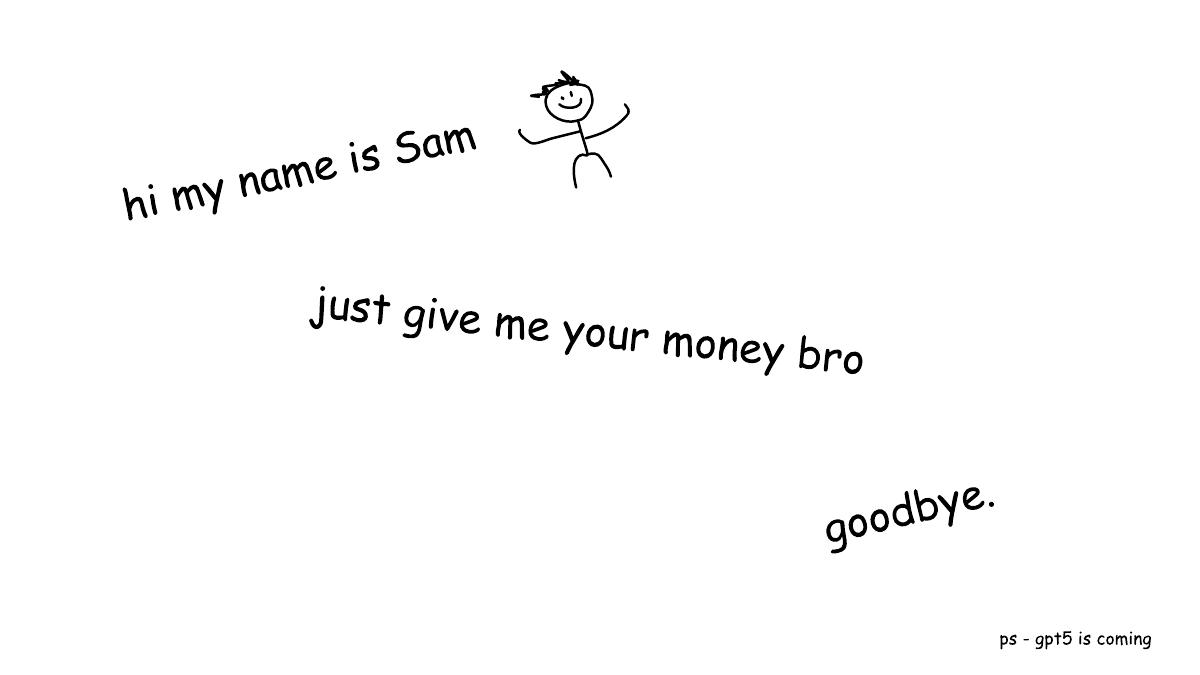
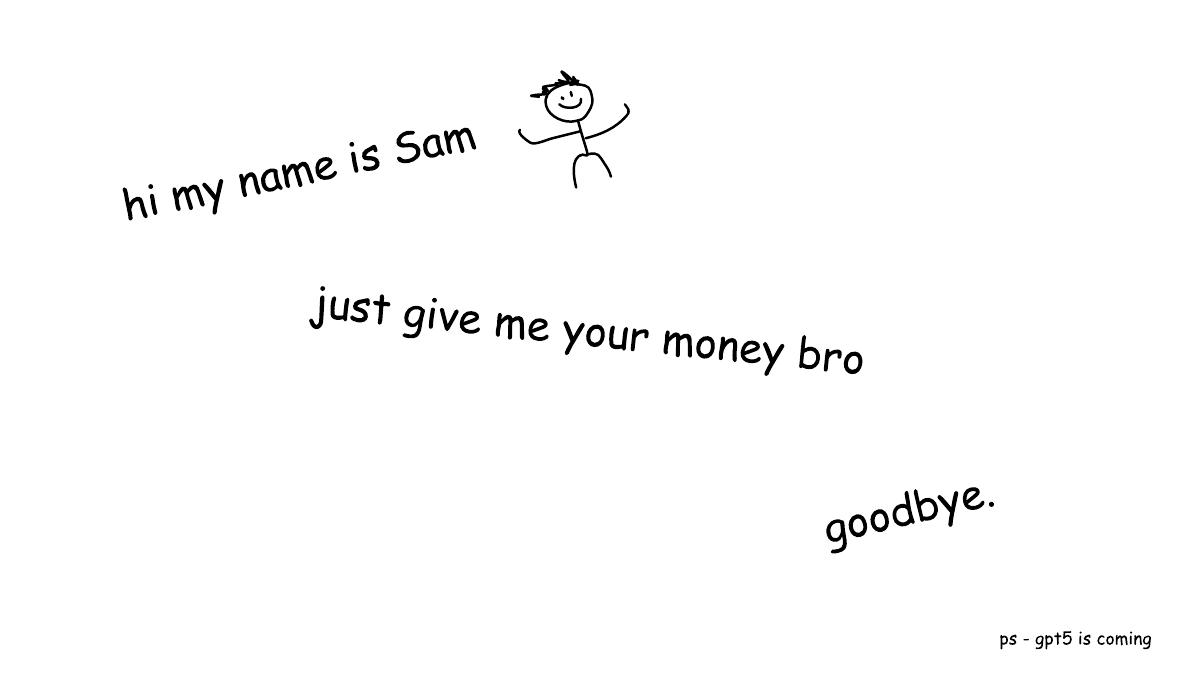
The deck's primary function is to invert the traditional power dynamic between founder and investor. Normally, a founder comes to an investor seeking capital, and in return, offers a compelling narrative of future growth, supported by evidence (traction, team, market analysis). Here, OpenAI presents no evidence and no narrative beyond a single, stark promise. The ask, "Just give me your money," is not a request but a command. The accompanying "goodbye" suggests that no discussion or negotiation is necessary or welcome. This is not a conversation; it is a directive.
The document's profound emptiness is its core feature. By providing nothing to analyze—no financials, no market sizing, no team slide, no go-to-market strategy—it renders the entire process of venture capital due diligence moot. The implicit argument is that the metrics by which a normal startup would be judged are irrelevant here. The only metric that matters is the impending reality of "gpt5," presented as a fact of nature rather than a product roadmap. This is a presentation built entirely on FOMO (Fear Of Missing Out), on a scale that few, if any, other companies could ever attempt.
Structural Analysis
The structure of the deck is brutally simplistic and serves to reinforce its core message. It consists of a single title slide followed by nine identical content slides. This repetition is not an error; it is a deliberate rhetorical device.
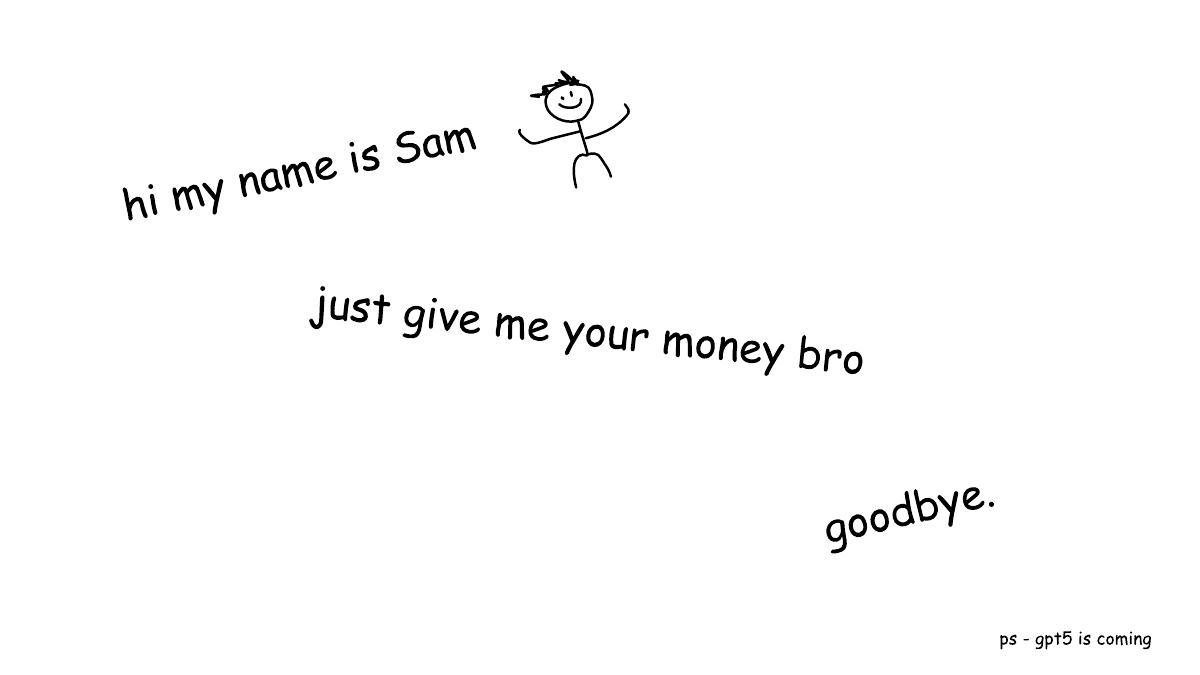
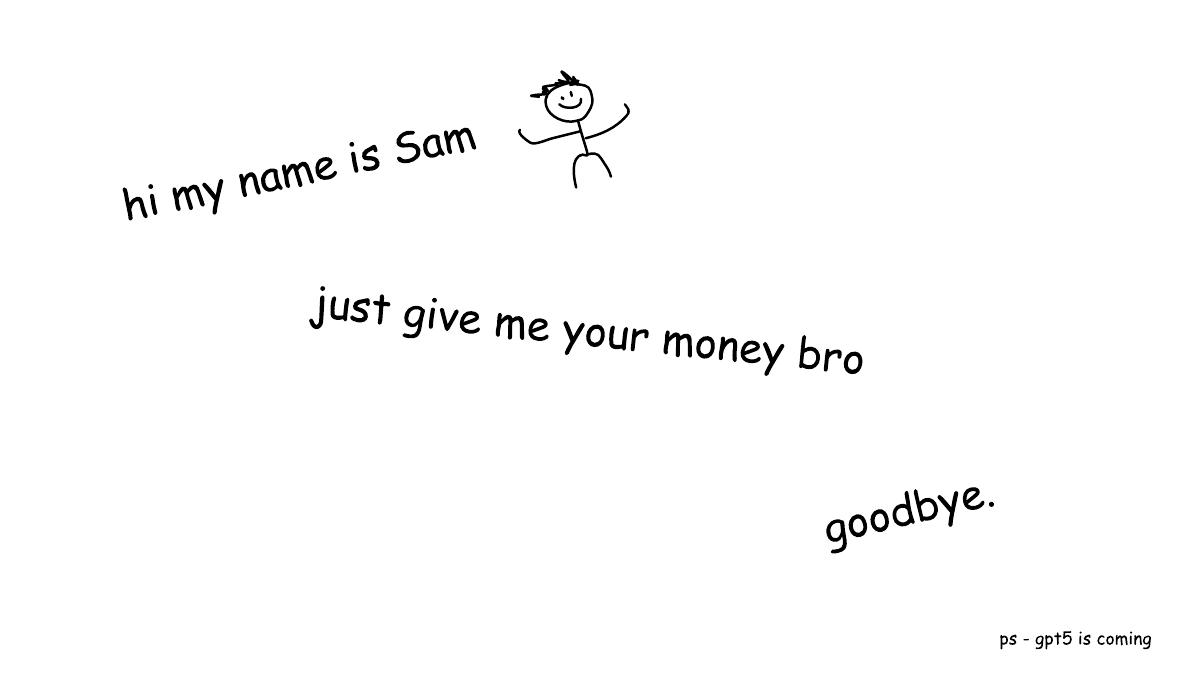
Title Slide: A single line of text, "@ OpenAl," against a stark background. The use of an '@' symbol suggests a digital-native identity, a handle rather than a formal corporate name, aligning with the informal and dismissive tone of the subsequent slides. · Content Slides: The repetition of the same slide nine times acts as a mantra or a drumbeat. It suggests there is nothing else to say. No new information will be provided on slide 3, 4, or 5. The message is complete from the first instance. This structure actively resists narrative progression. A typical deck builds an argument slide by slide; this deck presents its entire argument at once and then hammers it home through sheer repetition.
The visual content, described as garbled text and characters ("ame 'S >¢ n", "i oY"), complements the message. It can be interpreted in several ways: as a representation of raw, unrefined data, the chaotic substrate from which AI models are built; as a visual representation of a 'glitch in the matrix,' signaling a break from business-as-usual; or simply as contemptuous filler, signifying that the specific content of the slides is unimportant compared to the headline statements.
The structure communicates a clear metanarrative: "We have one thing to say. We will not elaborate. We do not need to. The future is coming, and that is all you need to know."
Slide-by-Slide Deconstruction vs. The Void
To understand the radical nature of this deck, it's useful to contrast what is present with what is expected in a standard early-stage pitch.
Slide 1: Title
Expected: Company logo, a clear tagline explaining the mission, and contact information. Provided: "@ OpenAl". A minimalist, almost cryptic identifier. It lacks a mission statement because the deck assumes the audience is already fully aware of OpenAI's mission and its significance.
Slide 2: The Problem
Expected: A clear and compelling description of a significant problem faced by a specific customer segment. Market pain should be quantified. Provided: "JUst give me Your money pp, goodb\la. ps - gpt5 is coming". The document does not define a problem in the market; it creates one for the investor. The problem is the risk of being left behind. The pain is the potential of missing out on the next technological paradigm shift.
Slide 3: The Solution
Expected: A presentation of the company's product or service as the elegant solution to the previously defined problem. Usually includes a demo or mockups. Provided: The same repeated slide. The solution is not a product available today, but the promise of a future product: GPT-5. The deck implies that access to this future is the solution, and that access is contingent on providing capital now.
Slide 4: Market Size (TAM, SAM, SOM)
Expected: Data-driven analysis of the Total Addressable Market, Serviceable Addressable Market, and Serviceable Obtainable Market to demonstrate the scale of the opportunity. Provided: Nothing. The absence of a market slide is perhaps the most audacious statement in the deck. The implicit claim is that the market for transformative AGI is, for all practical purposes, infinite. Sizing it is presented as a pointless academic exercise.
Slide 5: Business Model
Expected: A clear explanation of how the company makes money (e.g., SaaS, transaction fees, licensing). Provided: "JUst give me Your money pp,". This is the business model, stripped of all artifice. The model is to receive vast sums of capital to fund research and development, with the monetization specifics being a secondary concern to securing technological supremacy.
Slide 6: Go-to-Market Strategy
Expected: A plan for how the company will reach its target customers and gain market share. Provided: "goodb\la.". The go-to-market strategy is one of attraction, not pursuit. The message implies that when GPT-5 arrives, the market will come to them. There is no need to 'go' to the market. The dismissal suggests the company has no interest in a conventional sales and marketing process.
Slide 7: Competitive Landscape
Expected: An honest assessment of competitors and a clear articulation of the company's unique differentiators. Provided: Silence. The deck operates from a position where competition is considered irrelevant. The promise of "gpt5" is framed as an event that will reset the competitive landscape entirely, making any current analysis obsolete.
Slide 8: Team
Expected: Slides showcasing the key team members, their expertise, and their relevant experience. The goal is to build investor confidence in the team's ability to execute. Provided: Nothing. The team is assumed to be known and its world-class status self-evident. Including a team slide would be an act of justification, which this deck refuses to perform.
Slide 9: Financials / Projections
Expected: Historical financials (if any) and forward-looking projections for at least 3-5 years, showing key assumptions. Provided: Nothing. Projecting the financial impact of a technology presented as world-changing is framed as impossible and unnecessary. The investment is a bet on a step-change in technological capability, not on a predictable revenue model.
Slide 10: The Ask & Use of Funds
Expected: A specific amount of capital being raised and a breakdown of how that capital will be deployed (e.g., R&D, hiring, marketing). Provided: "JUst give me Your money pp,". The ask is direct but not specific in amount, suggesting it is for a large, strategic round. The use of funds is implicitly singular: to bring about the existence of GPT-5.
Investor Takeaway
An investor receiving this document is faced with a binary choice that has little to do with traditional investment analysis. There are no numbers to model, no team to reference-check in the usual way, and no market to size. The decision is reduced to a single question: Do you believe OpenAI is on the singular path to AGI, and is GPT-5 the next critical milestone on that path?
If the answer is yes, then the lack of information is irrelevant. The investment is a necessity to secure a stake in the future. The blunt and dismissive tone is not an insult but a reflection of a perceived reality where OpenAI holds all the cards.
If the answer is no, or if the investor requires a conventional, evidence-based process, then the deck serves as an effective filter. It pre-qualifies its investors for their belief in the mission and their tolerance for unprecedented risk and ambiguity. It is a communications tool that says, "We are not seeking partners for a journey; we are selling tickets for a departure. Either get on board or say goodbye."
In conclusion, while this document fails every test of a conventional pitch deck, it may be perfectly calibrated for its intended purpose and audience. It is an exercise in pure brand leverage, a testament to the power of a narrative so strong that it no longer needs to be told, only hinted at. It is less a presentation for raising money and more a confirmation of a reality that, in the eyes of its creators, has already been established.
Frequently asked questions
- What is the company's go-to-market strategy?
- The deck explicitly states 'goodbye.' This implies a strategy of attraction rather than promotion; the company expects the market to come to it once its next-generation product is released, making a traditional GTM plan unnecessary.
- How does OpenAI plan to use the funds raised?
- While not explicitly detailed, the entire document points to a single, overriding purpose: funding the research, development, and computational resources required to create 'gpt5.' The investment is for achieving the next technological milestone.
- What is the business model?
- The deck presents the business model in its most direct form: 'Just give me your money.' This suggests a pre-product, deep-tech funding model where the immediate goal is technological supremacy, not revenue generation. The return on investment is a stake in that future supremacy.
- Who are OpenAI's main competitors?
- The deck makes no mention of competitors. Its silence on the matter is a strategic choice, suggesting a belief that the company's trajectory and the impact of its next product will render current competition irrelevant.
- What is the core value proposition for investors?
- The value proposition is not a product or service, but a chance to invest in a perceived technological inevitability. The postscript, 'ps - gpt5 is coming,' frames the investment as a non-negotiable opportunity to be part of the next major technological leap, leveraging extreme Fear Of Missing Out (FOMO).