Onyx (formerly Danswer) presents a highly focused 9-slide deck that prioritizes traction over theoretical market sizing. The narrative centers on the inevitability of internal AI assistants, backed by a GitHub star growth rate of 30% month-over-month (Slide 3) and a weekly query volume reaching nearly 16,000 (Slide 4). Despite the open-source nature of the product, the deck demonstrates commercial viability by highlighting a transition from $0 to an undisclosed amount of ARR in just three months, with significant enterprise contracts from entities like UC San Diego and Ramp in final legal rev…
Key takeaways
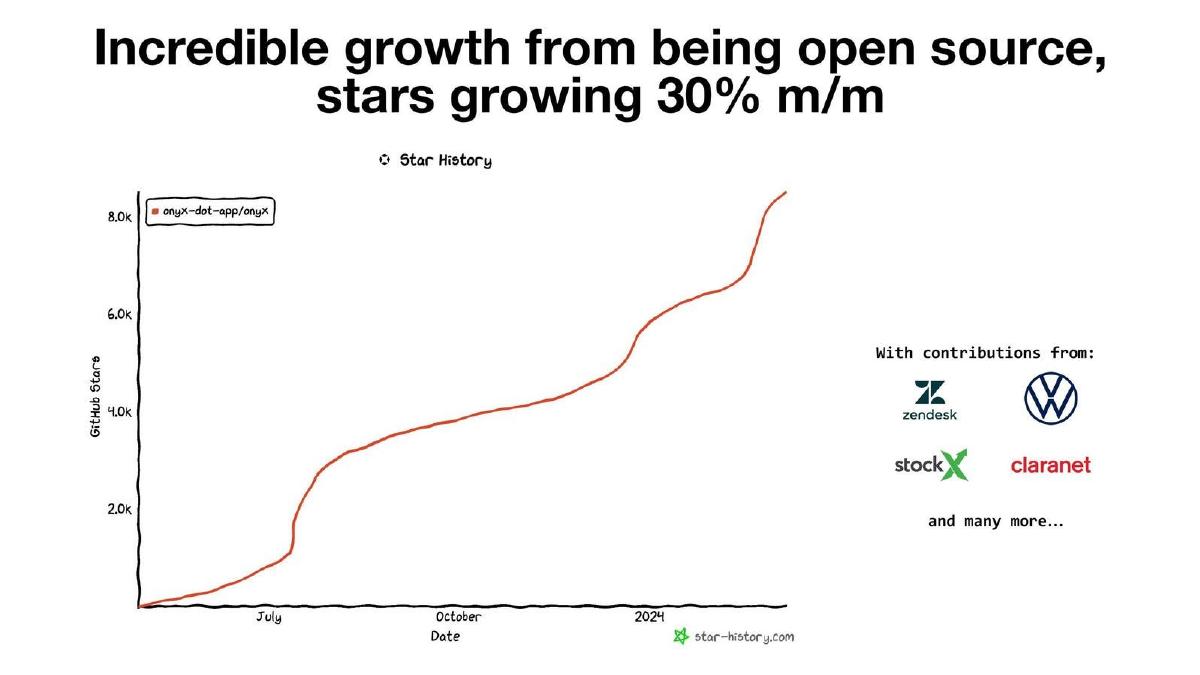
- The deck highlights a 30% month-over-month growth in GitHub stars, reaching over 8,000 by early 2024 (Slide 3).
- Usage data shows a peak of nearly 16,000 queries per week, captured via opt-out open-source telemetry (Slide 4).
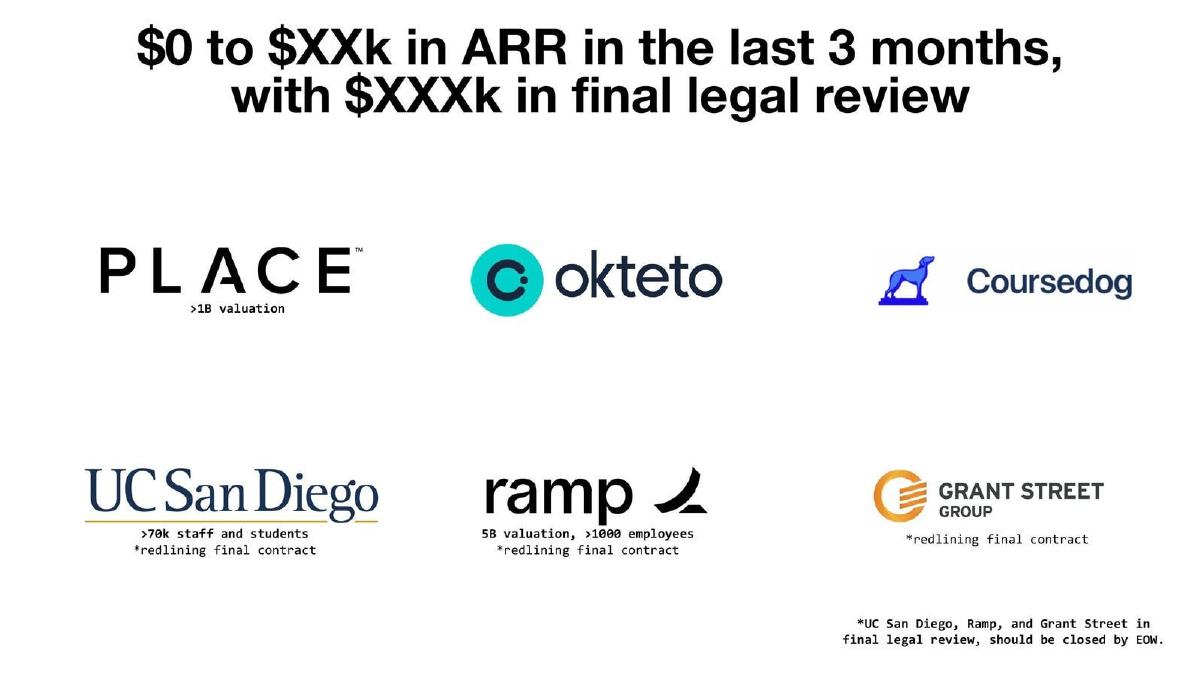
- Commercial traction is evidenced by a pipeline including UC San Diego, Ramp ($5B valuation), and Place (>$1B valuation) (Slide 5).
- The company successfully rebranded from Danswer to Onyx, as noted in the community evangelism slides (Slides 6 and 7).
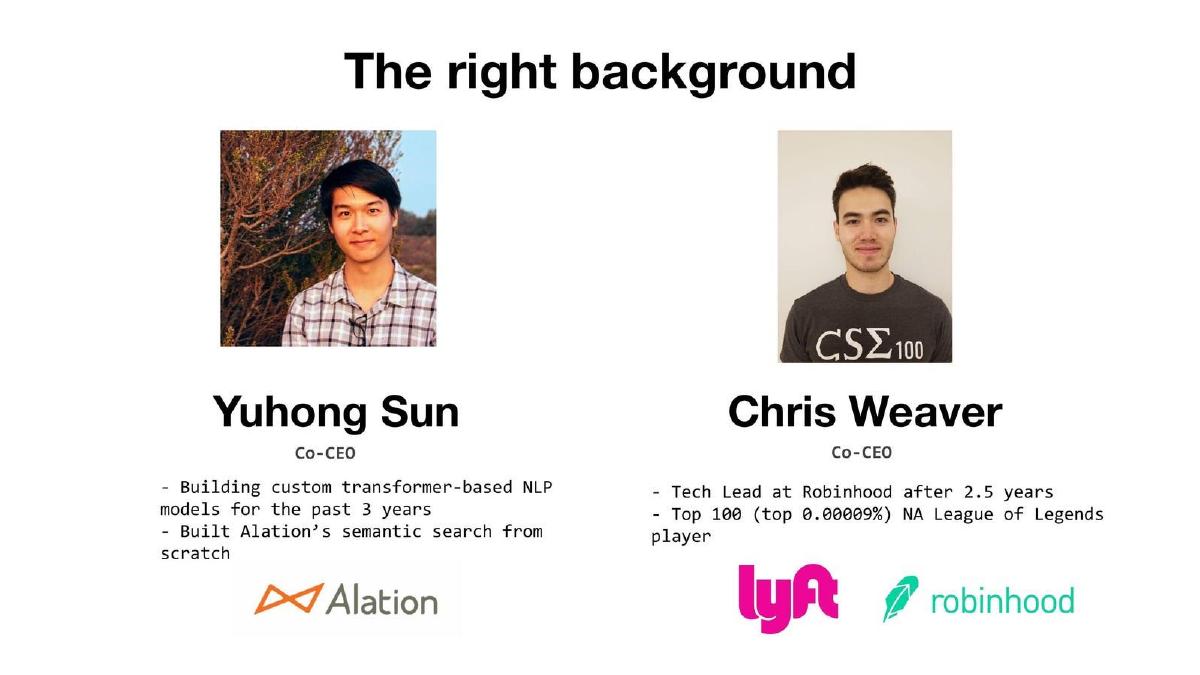
- Founder-market fit is established through Yuhong Sun's experience building Alation’s semantic search and Chris Weaver's role as Tech Lead at Robinhood (Slide 8).
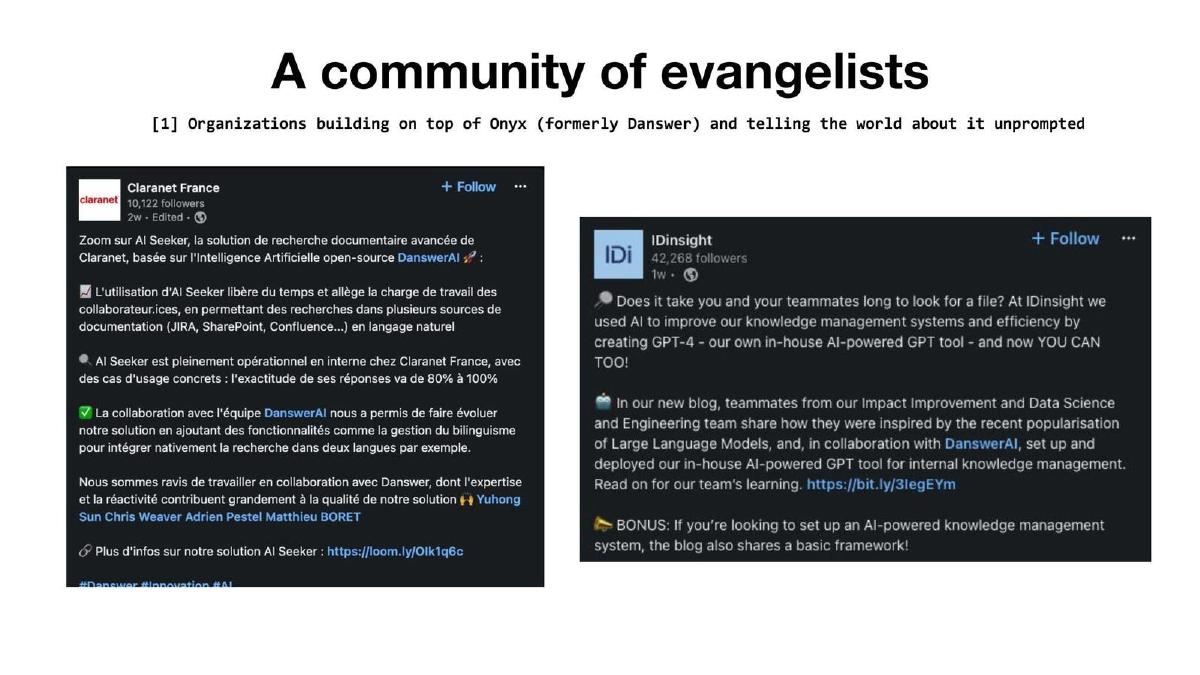
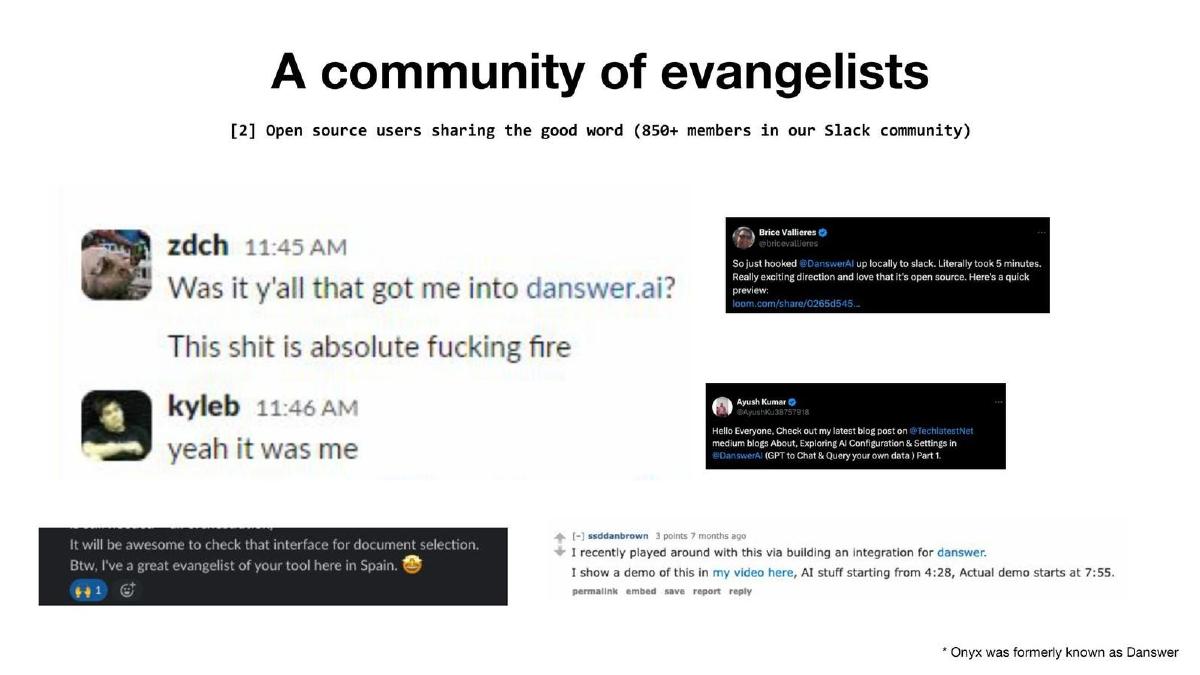
- The deck includes raw social proof, such as Slack screenshots and LinkedIn posts from organizations like Claranet France and IDinsight (Slides 6 and 7).
- The initial funding ask was $3 million to scale the team, though the actual round size reported was $10 million (Slide 9).
- The deck omits traditional slides like Market Size (TAM), Competitor Matrix, and detailed Product Roadmap.
The Power of Traction-First Storytelling
The Onyx pitch deck is a lean, 9-slide presentation that eschews the traditional 'Problem/Solution/Market' framework in favor of a 'Traction/Validation/Team' narrative. This approach is particularly effective for open-source companies where the primary goal is to prove that a community exists and that the community can be converted into paying enterprise customers. According to publisher-reported facts, Onyx raised $10M in a 2024 Seed round, despite the deck only asking for $3M on Slide 9. This discrepancy suggests the deck was highly effective at generating competitive tension among investors.
Slide 1: Title and Positioning
The deck opens with a minimalist title slide featuring the Onyx logo and the tagline: Open-source enterprise search . This immediately establishes the company's category and its primary differentiator. In a market dominated by closed-source AI assistants, the 'open-source' label is a strategic positioning tool aimed at enterprises concerned with data privacy and vendor lock-in.
Slide 2: The Vision Statement
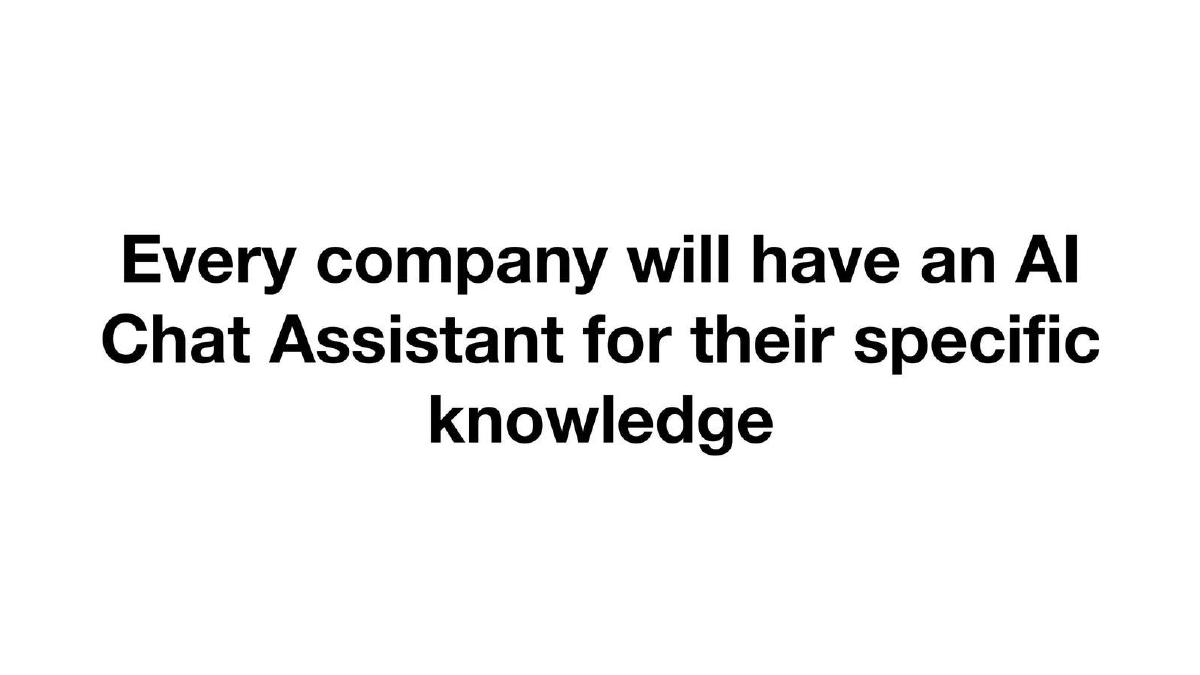
Slide 2 presents a single, bold claim: Every company will have an AI Chat Assistant for their specific knowledge . This serves as the 'Why Now' and 'Market Thesis' combined into one. It assumes the investor already understands the rise of LLMs and focuses instead on the specific application: internal corporate knowledge. By framing this as an inevitability, Onyx sets the stage for why their specific delivery mechanism (open-source) is the right way to capture this shift.
Slide 3: Open-Source Growth Metrics
Titled Incredible growth from being open source, stars growing 30% m/m , this slide is the core of the company's top-of-funnel validation. It features a 'Star History' chart from star-history.com showing a steep upward trajectory from July 2023 through early 2024, surpassing 8,000 stars. Crucially, the slide lists contributors from major organizations including Zendesk, Volkswagen, StockX, and Claranet . This proves that the project isn't just being watched; it is being actively improved by engineers at global enterprises.
Slide 4: Usage and Telemetry
While GitHub stars are a vanity metric, Slide 4 addresses the 'usage' reality. Titled Growing usage , it displays a line graph of Queries per week . The data, sourced from 'opt-out, open-source telemetry,' shows a climb from near zero in November 2023 to a peak of nearly 16,000 queries in February 2024. Despite a visible dip in early February, the overall trend is aggressively positive, providing hard evidence of product-market fit within the developer community.
Slide 5: The Path to Revenue
Slide 5 is perhaps the most important for a Seed-stage investor. It addresses the 'Can you make money?' question. The headline reads: $0 to $XXk in ARR in the last 3 months, with $XXXk in final legal review . While the specific dollar amounts are redacted in this version, the logos provided are high-signal. PLACE (>$1B valuation) and Okteto are listed as current users, while UC San Diego (>70k staff and students), Ramp ($5B valuation), and Grant Street Group are noted as being in 'final legal review' or 'redlining final contract.' This slide effectively de-risks the commercial aspect of the business by showing that large, complex organizations are willing to pay for the enterprise version of the tool.
Slide 6: Institutional Evangelism
Slide 6, titled A community of evangelists [1] , showcases screenshots of LinkedIn posts from Claranet France and IDinsight . The Claranet post specifically mentions their solution 'AI Seeker' is based on Onyx (formerly Danswer) and claims accuracy rates of 80% to 100%. This is powerful third-party validation that the software is being used as a foundation for other companies' internal tools, creating a 'platform' effect.
Slide 7: Individual Evangelism
Continuing the theme, Slide 7, A community of evangelists [2] , focuses on individual users. It cites 850+ members in our Slack community and includes raw screenshots from Slack and X (formerly Twitter). One Slack user, 'zdch,' is quoted saying, 'This shit is absolute fucking fire.' While informal, these types of 'raw' testimonials are often more convincing to Seed investors than polished corporate quotes because they reflect genuine developer enthusiasm. A footnote also clarifies the rebranding: Onyx was formerly known as Danswer .
Slide 8: The Team
Slide 8, The right background , introduces the Co-CEOs. Yuhong Sun is credited with building custom transformer-based NLP models and Alation’s semantic search from scratch . This is a direct hit on founder-market fit, as Alation is a leader in data cataloging and search. Chris Weaver is highlighted as a Tech Lead at Robinhood and, interestingly, a Top 100 NA League of Legends player . The inclusion of the gaming rank is a common 'high-performance' signal in Silicon Valley, suggesting a high level of competitiveness and skill. The logos for Alation, Lyft, and Robinhood provide additional institutional credibility.
Slide 9: The Ask
The final slide is a simple statement: We’re raising $3 million to scale our team . There is no breakdown of use of funds, no hiring roadmap, and no milestones. It is a direct, confident ask. As noted previously, the company reportedly raised $10M, suggesting that the traction shown in the previous eight slides led to a significant oversubscription of the round.
What Onyx Does Well
Traction as the Lead: By putting GitHub stars and query volume (Slides 3 and 4) before the team or the product details, Onyx proves there is a 'pull' from the market. · Specific Social Proof: Instead of vague testimonials, they show actual LinkedIn posts and Slack messages (Slides 6 and 7). Naming organizations like Volkswagen and Ramp adds immense weight. · Technical Credibility: The team slide (Slide 8) doesn't just list titles; it lists specific technical achievements (e.g., 'building Alation's semantic search from scratch') that are directly relevant to the problem Onyx is solving. · Transparency on Revenue Pipeline: Using terms like 'redlining final contract' (Slide 5) is much more persuasive than saying 'in talks with.' It indicates that the deal is past the 'if' stage and into the 'how' stage.
What is Missing from the Onyx Deck
Problem Slide: The deck assumes the investor already agrees that internal search is a problem. While this worked here, most decks benefit from a slide articulating the pain of 'information silos.' · Product Deep Dive: There are no screenshots of the actual Onyx interface or a diagram of how the 'connectors' work. The deck relies entirely on the fact that others are using it, rather than showing what 'it' is. · Competitive Landscape: The AI search space is incredibly crowded (Glean, Hebbia, Perplexity Enterprise). Onyx does not address how they win against these well-funded incumbents, other than the implicit 'open-source' advantage. · Financial Projections: There is no mention of the business model (Open Core, SaaS, etc.) or how the $XXk in ARR scales to $100M.
Founder's Playbook: Lessons to Copy
Use Telemetry: If you are building open-source or dev-tools, find a way to show active usage (queries, API calls, etc.) rather than just downloads. Slide 4 is a perfect example of this. · Leverage Rebranding: If you change your name, be transparent about it. Slides 6 and 7 handle the Danswer-to-Onyx transition seamlessly by using footnotes and parentheticals. · Show, Don't Tell, Evangelism: Don't just say you have a community. Show the Slack screenshots. Show the GitHub contributors. Investors want to see the 'smoke' that indicates a 'fire.' · Keep it Short: This 9-slide deck proves that you don't need 20 slides to raise a massive round if your traction metrics are strong enough. Focus on the 'Big Three': Growth, Revenue Pipeline, and Team.
Frequently asked questions
- Why did Onyx focus so heavily on GitHub stars?
- For open-source startups, GitHub stars serve as a proxy for developer interest and top-of-funnel awareness. Slide 3 shows a 30% month-over-month growth rate, which signals to investors that the product has organic reach and 'pull' from the technical community, reducing the perceived need for heavy initial marketing spend.
- How does Onyx prove enterprise demand without disclosing exact revenue?
- Slide 5 uses 'redlining final contract' status for high-profile logos like Ramp and UC San Diego. By naming specific, recognizable organizations and their valuations (e.g., Ramp at $5B), Onyx demonstrates that their open-source tool is being vetted by sophisticated enterprise legal and procurement teams, which is a significant hurdle for Seed-stage startups.
- What is the significance of the telemetry data on Slide 4?
- Open-source companies often struggle to prove actual usage because users self-host the software. By citing 'opt-out, open-source telemetry,' Onyx provides a concrete metric—queries per week—that proves the software isn't just being downloaded, but is actively integrated into daily workflows.
- Is the lack of a competitor slide a weakness in this deck?
- In the crowded AI search space, a competitor slide can often become a distraction. Onyx chose to focus on their unique 'open-source' positioning and the 'evangelism' of their community. By showing that users are already building on top of them (Slide 6), they imply a competitive advantage through community lock-in rather than a feature-by-feature comparison.
- Why did the founders include their League of Legends rank on the team slide?
- Slide 8 notes Chris Weaver is a 'Top 100 NA League of Legends player.' While seemingly unrelated to AI, in high-growth tech circles, this is often used as a signal of extreme competitiveness, discipline, and high cognitive load capacity, complementing his professional experience as a Tech Lead at Robinhood.