EnfoGrid's 8-slide deck, dated April 2012, outlines a proposal for a multisided platform in the smart grid sector. Positioned as an 'Information Aggregator,' the company aims to facilitate data exchange between energy retailers, device providers, and end users. The deck is notable for including raw interview results from six industry stakeholders, including representatives from Chilquinta Energía S.A. and Endesa Group. However, the presentation functions more as a project proposal or academic exercise than a professional investment vehicle. It lacks essential financial projections, a specific…
Key takeaways
- The company identifies as an Information Aggregator and Energy Market Portal (Slide 2).
- The business model relies on a multisided platform connecting end users, non-energy retailers, and energy retailers (Slide 3).
- Revenue is projected to come from smart product sales, services to retailers, and government subsidies (Slide 4).
- Primary research included six interviews with industry professionals, though a language barrier with Spanish speakers was noted as a challenge (Slide 5).
- Market feedback highlighted a critical risk: the lack of incentive for large utility companies to support this model (Slide 6).
- The MVP strategy involves selling energy management devices preloaded with third-party applications to collect user data (Slide 8).
- The deck omits a formal financial ask, valuation, or use of funds section.
- There is no mention of existing technology, patents, or a technical development timeline.
Deck Overview
The EnfoGrid pitch deck is an 8-slide presentation dated April 16, 2012. It outlines a conceptual startup focused on the smart grid sector, specifically acting as a data intermediary. The deck is structured as an initial pitch, likely for an incubator or an academic entrepreneurship program, rather than a Series A or Seed round for a mature startup. It relies heavily on the Business Model Canvas framework and raw interview data to establish its premise.
Slide 1: Title Slide
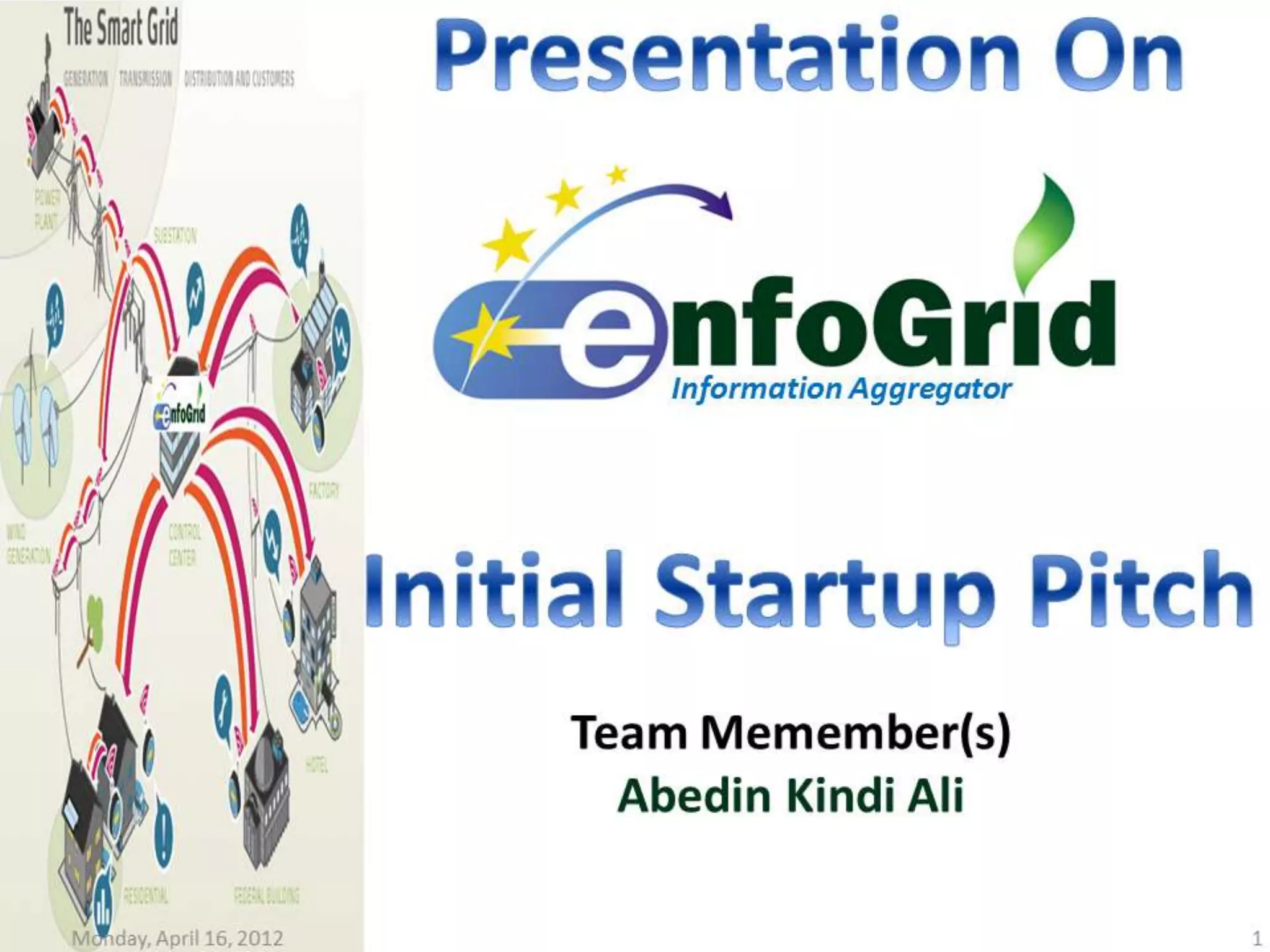
The cover slide introduces the company as "EnfoGrid" with the tagline "Information Aggregator." The presentation is titled "Initial Startup Pitch" and lists Abedin Kindi Ali as the team member. A graphic on the left side illustrates a "Smart Grid" ecosystem connecting generation, transmission, distribution, and customers. The date is clearly marked as Monday, April 16, 2012.
Slide 2: Pitch Value Proposition
This slide attempts to map the flow of value between various stakeholders. It identifies the core business as an "Information Aggregator" and "Energy market Portal." The "Detailed Area of Interest" includes smart grid communications, energy management, and consulting. A complex flow chart shows how EnfoGrid sits between end users, energy retailers, application providers, and device providers. A small table at the bottom notes that private participation in generation, transmission, and distribution is at 100%, suggesting a fully privatized market context, likely Chile given the later interview slides.
Slide 3: WIP Business Model Canvas (Part 1)
Using the standard Business Model Canvas format, the slide lists key partners, activities, resources, services, relationships, and clients. Key Partners include the Government, EPA, and various retailers. Key Activities focus on technical infrastructure, billing, and marketing. The Services section reiterates the focus on smart grid network consulting and security. The Clients are categorized as End Users, Non-Energy Retailers, Energy Retailers, and Government.
Slide 4: WIP Business Model Canvas (Part 2)
This slide covers the bottom half of the canvas: Cost Centres and Revenue Streams. Cost Centres include hardware, software, salaries, marketing, and rent. Revenue Streams are limited to two bullet points: sales of smart products/services to retailers and government subsidies. No specific dollar amounts or percentages are provided.
Slide 5: Interview Results - Qualitative
EnfoGrid provides a table of six interviews conducted to validate the concept. The interviewees represent major Chilean energy firms: Chilquinta Energía S.A. , Endesa group , and Chilectra S.A. . One interview was with the owner of Efizity . A notable inclusion is the "Challenge faced" section, where the author admits a language barrier due to poor Spanish skills, which may have impacted the quality of the data collected.
Slide 6: Interview Results - Quantitative
A 3D bar chart visualizes the interview findings. It shows high scores (5 or 6) for "Awareness of Smart Grid" and "Potential / Scope." However, the slide ends with a critical question raised by the interviewees: "What will be the incentive for the Utility Company to be supportive this business model being they are large players?" This identifies a major strategic hurdle that the deck does not subsequently answer.
Slide 7: MVP - The Platform Logic
The first of two MVP slides explains the multisided business logic. It states the platform will profit from transactions by "capturing indirect network externalities (INEs)." It describes an energy marketing portal where customers shop for deals and apps in exchange for providing "passive usage and preference data." Retailers are expected to pay for access to this customer data to evaluate market trends.
Slide 8: MVP - The Hardware and Data Loop
The final slide clarifies the hardware strategy. EnfoGrid intends to sell energy management devices (possibly subsidized) preloaded with third-party apps. The company acts as the link between manufacturers, developers, and users. The core value is the collection of "demand response" information, which is then sold to retailers. The slide concludes by stating that cash flows in both directions between retailers and end users, facilitated by the platform.
What Works
Direct Market Research: Including a list of specific companies interviewed (Slide 5) adds a layer of credibility that many early-stage decks lack. It shows the founder attempted to engage with industry incumbents. · Clear Positioning: The deck does not try to be a utility company or a hardware manufacturer. It clearly defines itself as an "Information Aggregator," which is a specific and understandable niche in the data economy. · Identification of Risks: By including the question about utility company incentives (Slide 6), the founder demonstrates an awareness of the primary barrier to entry, even if a solution isn't presented.
What is Missing
The Ask: There is no slide indicating how much money the company is looking to raise, what the valuation is, or what milestones the funding will achieve. · Competitive Analysis: The deck assumes a vacuum. There is no mention of existing smart meter companies, home automation giants, or other data aggregators already in the market. · Financial Projections: While cost centers and revenue streams are listed, there are no numbers. Investors cannot evaluate the scalability of the business without a basic pro forma or unit economics. · Technical Roadmap: For a company claiming to be a technical aggregator, there is zero information on the software stack, data security protocols, or how they will integrate with existing grid infrastructure. · Team Depth: Only one person is listed on the title slide. A multisided platform involving hardware, software, and utility-scale data requires a robust team of engineers and regulatory experts.
Founder Takeaways
Be Honest About Research Limitations: The admission of a language barrier (Slide 5) is refreshingly honest. While it might signal a weakness, it also sets realistic expectations for the data presented. · Use Frameworks Wisely: The Business Model Canvas (Slides 3-4) is a great tool for internal planning, but in a pitch deck, it often feels like a placeholder. Founders should translate the canvas into narrative slides (e.g., a dedicated 'Revenue Model' slide and a 'Partnership' slide). · Address the Elephant in the Room: If your interviewees identify a fatal flaw (like the lack of incentive for utilities on Slide 6), your very next slide must be the solution to that flaw. Leaving the question hanging creates doubt that lingers through the end of the deck.
Frequently asked questions
- What is EnfoGrid's primary business model?
- EnfoGrid operates as a multisided platform or 'Information Aggregator.' According to Slide 7 and 8, the company intends to provide end users with energy management devices and apps. In exchange for these tools, users provide data on their energy usage and preferences. EnfoGrid then sells access to this data and demand-response information to energy and non-energy retailers who are willing to pay for consumer insights.
- Who are the target customers for EnfoGrid?
- The deck identifies three main client segments on Slide 3: End Users, Non-Energy Retailers (such as appliance stores), and Energy Retailers. The platform also considers the Government as a client and potential source of subsidies. The model suggests that while end users receive the hardware/software, the primary paying customers are the retailers seeking data.
- What market validation did the founders perform?
- Slide 5 details six interviews conducted with professionals from Chilquinta Energía S.A. (3 people), Endesa Group (1), Chilectra S.A. (1), and Efizity (1). The founders noted a 'Language Barrier' as a challenge during this process. Slide 6 shows that while awareness and potential for smart grids were rated high by interviewees, they questioned the incentive for large utility companies to cooperate.
- What are the biggest omissions in this pitch deck?
- The deck is missing several critical components for a professional fundraise. There is no 'Ask' slide detailing how much capital is needed. It lacks a competitive landscape analysis, financial projections (revenue/expense numbers), a go-to-market timeline, and a detailed team slide beyond naming one individual. It also fails to explain the underlying technology or how the data aggregation will be handled securely.
- How does EnfoGrid plan to generate revenue?
- Revenue streams listed on Slide 4 include sales from 'Smart products and services' to both energy and non-energy retailers. Additionally, the company expects to receive government subsidies. Slide 8 further clarifies that retailers pay for access to customer profiles and demand-response data, creating a two-way cash flow facilitated by the EnfoGrid platform.