Dhajcraft is a designer footwear brand founded by Rashmi, a NIFT graduate, with the dual mission of providing employment to Bihar's artisans and reducing textile waste through a 'No Waste Policy.' The deck effectively establishes a social narrative, citing that informal workers account for more than 90% of Bihar's workforce (Slide 2) and that 85% of the Indian footwear industry is unorganized (Slide 7). However, the presentation is critically undermined by the absence of actual product photos, relying instead on generic illustrations. Furthermore, the financial section is purely theoretical,…
Key takeaways
- The brand focuses on social impact by employing artisans in Bihar, where informal workers make up over 90% of the workforce (Slide 2).
- Dhajcraft utilizes a 'No Waste Policy' by assembling footwear from waste fabrics sourced from boutiques or old clothes (Slide 4).
- The target market is the Indian middle class, which the deck claims covers 55% of the market (Slide 8).
- The deck identifies Fizzy Goblet, Needle Dust, and Coral Haze as direct competitors (Slide 9).
- A significant weakness is the lack of actual product photography, using only line drawings and illustrations to represent footwear (Slide 7, 11).
- The revenue model relies on a PMEGP (Prime Minister's Employment Generation Programme) loan and direct sales (Slide 13).
- The roadmap includes an ambitious goal for Series C funding by 2027, despite providing no current revenue or seed stage data (Slide 14).
- The cost distribution slide is a template placeholder, showing five items each at exactly 20% without naming the items (Slide 15).
Executive Summary and Brand Identity
Slide 1: Title Slide
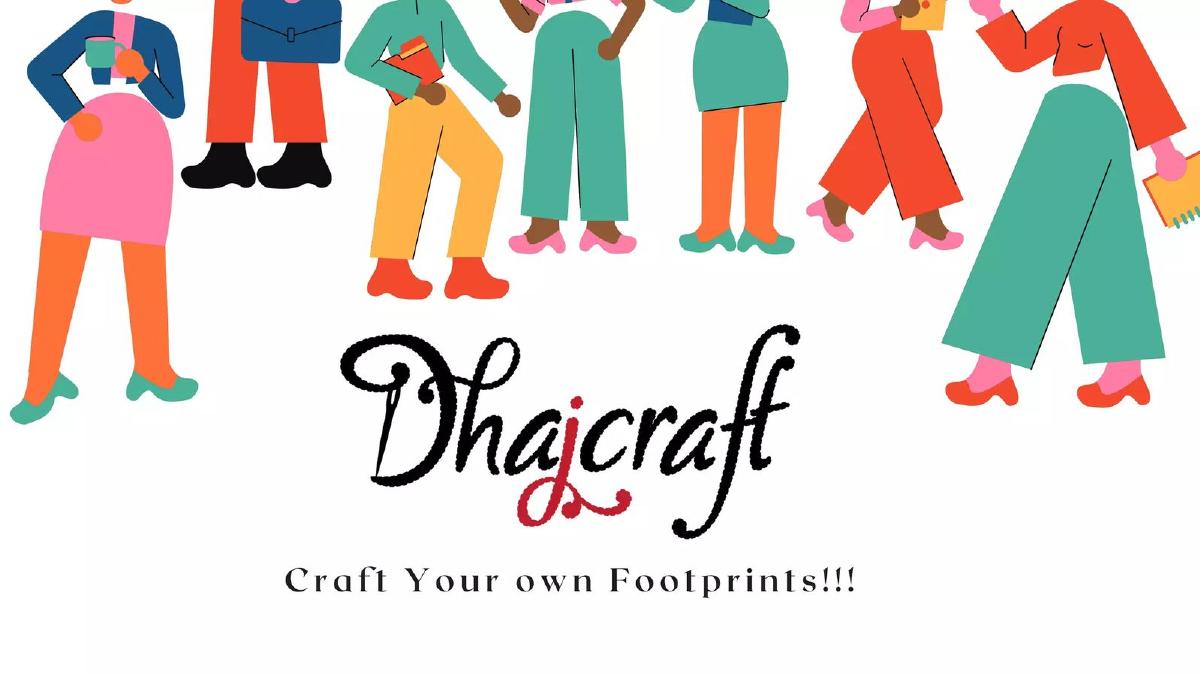
The deck opens with the brand name 'Dhajcraft' and the tagline 'Craft Your own Footprints!!!' The visual style uses flat, colorful illustrations of diverse people, suggesting a consumer-facing brand with a focus on individuality. The logo features a stylized script font with a red accent on the 'j'.
Slide 2: The Social Problem
This slide introduces the 'situation' through a character named Rajan, an artisan on the brink of starvation due to Covid-19. It provides regional context, stating that in Bihar, informal workers account for more than 90% of the workforce, a figure that has remained consistent for 15 years. It breaks down the Bihar workforce into 32% casual and 54.45% self-employed workers, noting that most rural self-employed workers are petty artisans.
Slide 3: Environmental and Health Problems
The deck expands the problem set to include environmental impact and personal health. It notes that materials take 200+ years to decompose in landfills, leaching toxic chemicals and methane. Additionally, it claims a large proportion of the population wears incorrectly sized footwear, leading to foot pain and disorders. This slide attempts to position the brand at the intersection of social good, sustainability, and wellness.
Slide 4: The Solution
Dhajcraft presents a three-pronged solution: 1) Employment to Artisans, specifically highly skilled Bihar artisans; 2) A No Waste Policy, where footwear is assembled from waste fabrics from boutiques or old clothes; and 3) Customizability, allowing customers to create footwear according to their specific foot shape and size.
Slide 5: Brand Definition
This slide explains the name: 'Dhaj' means to adorn oneself and defines yarn. It introduces the founder, Rashmi, a 25-year-old NIFT graduate based in Patna, India. The brand is described as a 'designer brand' that blends traditional handicraft with modern, contemporary designs.
Strategic Analysis and Market Positioning
Slide 6: Mission, Vision, and Value
The mission focuses on the fusion of Indian craft with modern style and artisan employment. The vision centers on restoring Indian tradition and sustainable production. Values include 'Value for money,' 'Comfort,' and 'Environment concern.' These are standard brand pillars but lack specific operational metrics.
Slide 7: SWOT Analysis
The SWOT analysis provides a glimpse into the company's self-perception. Strengths include cheap labor rates and production flexibility. Weaknesses admit to 'inadequate information of new technology' and market trends. Opportunities highlight e-commerce and the shift toward sustainable products. Threats note that 85% of the Indian footwear industry is unorganized, which could also be viewed as an opportunity for consolidation.
Slide 8: Target Market
The main target is the Indian middle class aged 15-64. The slide claims the middle class covers 55% of the market in India and that 67% of the population falls within the 15-64 age group. This is a very broad demographic, lacking the specificity usually required to define a Go-To-Market (GTM) strategy.
Slide 9: Competition
Direct competitors are listed as Fizzy Goblet, Needle Dust, and Coral Haze. Indirect competitors include major established brands like Bata India, Paragon, and Liberty. This slide is useful for understanding the brand's intended price tier (premium/designer) despite the 'middle class' targeting mentioned earlier.
Slide 10 & 11: Competitive Advantages
Slide 10 is a transition graphic. Slide 11 lists four advantages: 1) Competitors are 'lesser-known' (a questionable claim for brands like Fizzy Goblet), 2) Sustainable production, 3) Lower price points than competitors, and 4) Customizability. The slide contains a typo: 'available in all hape and size.'
Operational Strategy and Financials
Slide 12: Competitor Approach (Marketing)
The marketing strategy includes Public Relations (media coverage, storytelling) and Community Building. It specifies platform-specific content: Instagram for youth and influencers, Facebook for women over 25 and health-conscious groups, and LinkedIn for professional connections. It also mentions audience retargeting, though no technical implementation details are provided.
Slide 13: Revenue Model
The revenue model is remarkably simple, consisting of two icons: 'PMEGP Loan' (funded by a subsidy program) and 'Sales' (selling products). This suggests the business is currently reliant on government-backed entrepreneurship schemes rather than private venture capital or high-volume commercial sales.
Slide 14: Future Roadmap
The roadmap is highly optimistic but lacks milestones. It projects:
2023: Brand to be visible in PAN India. · 2027: Series C Funding. · 2028: Private Funding.
The jump from a government loan to Series C in four years without intermediate steps (Seed, Series A, Series B) indicates a lack of familiarity with standard venture capital stages.
Slide 15: Cost Distribution
This is the most problematic slide in the deck. It features a donut chart where five categories are each assigned exactly 20% . The categories are labeled 'Item 1' through 'Item 5,' meaning no actual financial data was entered into the template. This makes it impossible for an investor to evaluate the company's unit economics or capital efficiency.
Slide 16: Contact Us
The final slide provides a phone number, an info@ email address, and a website URL. The inclusion of a Patna-based phone number (+91-7903...) aligns with the founder's stated location.
What Works and What is Missing
What Works
Social Narrative: The deck does a good job of establishing the 'Why.' By linking the brand to the plight of Bihar artisans and the environmental impact of textile waste, it creates a compelling ESG (Environmental, Social, and Governance) story. · Founder Alignment: Highlighting the founder’s NIFT background provides necessary design credibility for a fashion startup. · Market Context: The statistics regarding the unorganized nature of the Indian footwear market (85%) effectively highlight the scale of the opportunity for a structured brand.
What is Missing
Product Photography: This is a footwear brand deck with zero photos of actual shoes. Relying on generic illustrations is a major red flag for investors who need to see the quality and aesthetic of the 'designer' products. · Financial Data: Slide 15 is a placeholder. There are no figures for Customer Acquisition Cost (CAC), Lifetime Value (LTV), gross margins, or current monthly revenue. · Investment Ask: The deck never states how much money the company is looking to raise or how those funds will be allocated. · Traction: There is no mention of current sales volume, number of artisans employed, or social media following to prove that the concept has moved beyond the idea stage. · Team Slide: Beyond the founder, there is no information on the production team, supply chain managers, or advisors.
Founder's Guide: What to Copy and What to Avoid
What to Copy
Specific Regional Data: Using localized stats (like the 90% informal worker rate in Bihar) helps ground a social mission in reality. · Clear Competitor Categorization: Distinguishing between direct (niche designer) and indirect (mass market) competitors shows a good understanding of the market landscape.
What to Avoid
Placeholder Charts: Never include a chart with 'Item 1, Item 2' labels. If you don't have the data, it is better to omit the slide than to show a template that hasn't been filled in. · Unrealistic Roadmaps: Claiming a 'Series C' in four years without showing a path through Seed and Series A funding makes the founders look inexperienced. · Lack of Visual Proof: For a physical product company, the product is the star. A deck without high-quality product photography will rarely get a second look from serious investors.
Frequently asked questions
- What is the primary problem Dhajcraft aims to solve?
- Dhajcraft addresses three distinct problems: the lack of stable revenue for artisans in Bihar following Covid-19, the environmental impact of textile waste which takes 200+ years to decompose, and the health issues associated with incorrectly sized footwear. Slide 2 highlights that 90% of Bihar's workers are informal, while Slide 3 notes that textiles in landfills generate methane gas and leach toxic chemicals.
- Who is the founder and what is their background?
- The brand was created by Rashmi at age 25. She is described as a fashion designer and a 'NIFTian' (a graduate of the National Institute of Fashion Technology) who started her career as an entrepreneur in Patna, India. This background is intended to establish design credibility, though the deck lacks a formal team slide detailing other key personnel or advisors.
- How does the company plan to differentiate itself from competitors?
- According to Slide 11, Dhajcraft differentiates itself through sustainable production (using old fabric to make masks and shoes) and customizability for all foot shapes and sizes. It also claims a price advantage, stating that direct competitors like Fizzy Goblet are 'comparatively expensive for middle-class people,' though no specific price points for Dhajcraft products are provided to verify this claim.
- What are the biggest red flags in this pitch deck?
- The most significant red flags are the total absence of real product photos and the use of placeholder data in the financial section. Slide 15 shows a 'Cost Distribution' pie chart where every category is exactly 20% and labeled 'Item 1' through 'Item 5.' Additionally, the roadmap on Slide 14 mentions 'Series C funding' in 2027 without providing any current traction, revenue figures, or a seed-round ask.
- What is the company's current stage and funding status?
- The deck does not explicitly state the current stage, but Slide 13 mentions a 'PMEGP Loan' as part of the revenue model, suggesting the company may be in the early startup or government-subsidized phase. There is no information regarding previous investment rounds, current valuation, or the amount of capital they are currently seeking from investors.