Elix Incubator’s 2017 deck outlines a specialized program for teen-led social ventures, citing that only 15% of high schools teach entrepreneurship. The incubator positions itself as California’s first social impact incubator for this demographic, utilizing a 1-3 year program divided into Design, Launch, Tinker, and Surge phases. Financially, Elix proposes a hybrid model: relying on grants and donations while taking a 20% royalty from incubatee profits and a tiered percentage of exit sales (ranging from 15% in years 1-5 down to 5% after year 15). While the deck showcases a strong mission and…
Key takeaways
- The problem slide identifies that 3.5 million low-income teens have untested entrepreneurial solutions due to lack of access (Slide 2).
- Elix operates a long-term incubation cycle lasting 1 to 3 years, significantly longer than traditional 3-month accelerators (Slide 6).
- The revenue model is highly unconventional, taking a 20% royalty on profits and a 'pyramidal' exit fee starting at 15% (Slide 13).
- Market size is estimated at $7 million for 'Teen Incubators' in 2015, with Elix targeting a 15% share worth $1.5 million (Slide 12).
- The deck lists six specific social ventures, including NovisTech and Eco Wash Network, as part of its portfolio (Slide 10).
- Impact projections for Q4 2018 include 120 incubatees, 30 launched ventures, and 96,000 gallons of water saved (Slide 11).
- The team slide includes Myers-Briggs Type Indicator (MBTI) personality types for all five core team members (Slide 16).
- The deck omits a specific funding ask, valuation, or breakdown of how investment capital would be deployed (Slide 17).
Executive Summary
Elix Incubator’s 2017 pitch deck presents a mission-driven organization focused on democratizing entrepreneurship for teenagers, particularly those from low-income backgrounds. The deck is structured to appeal to both social impact investors and grant-making bodies, blending traditional startup growth metrics with qualitative social goals. By positioning itself as a long-term partner (1-3 years) rather than a short-term accelerator, Elix attempts to solve the high failure rate of youth-led ventures through sustained mentorship and a unique royalty-based financial model.
Slide 1: Title Slide
The cover slide features the Elix logo—a stylized rocket ship—and the tagline "let's launch together." It is dated April 2017 and marked as a "Public Copy." The design is clean, using a muted blue and grey color palette that persists throughout the presentation.
Slide 2: The Problem
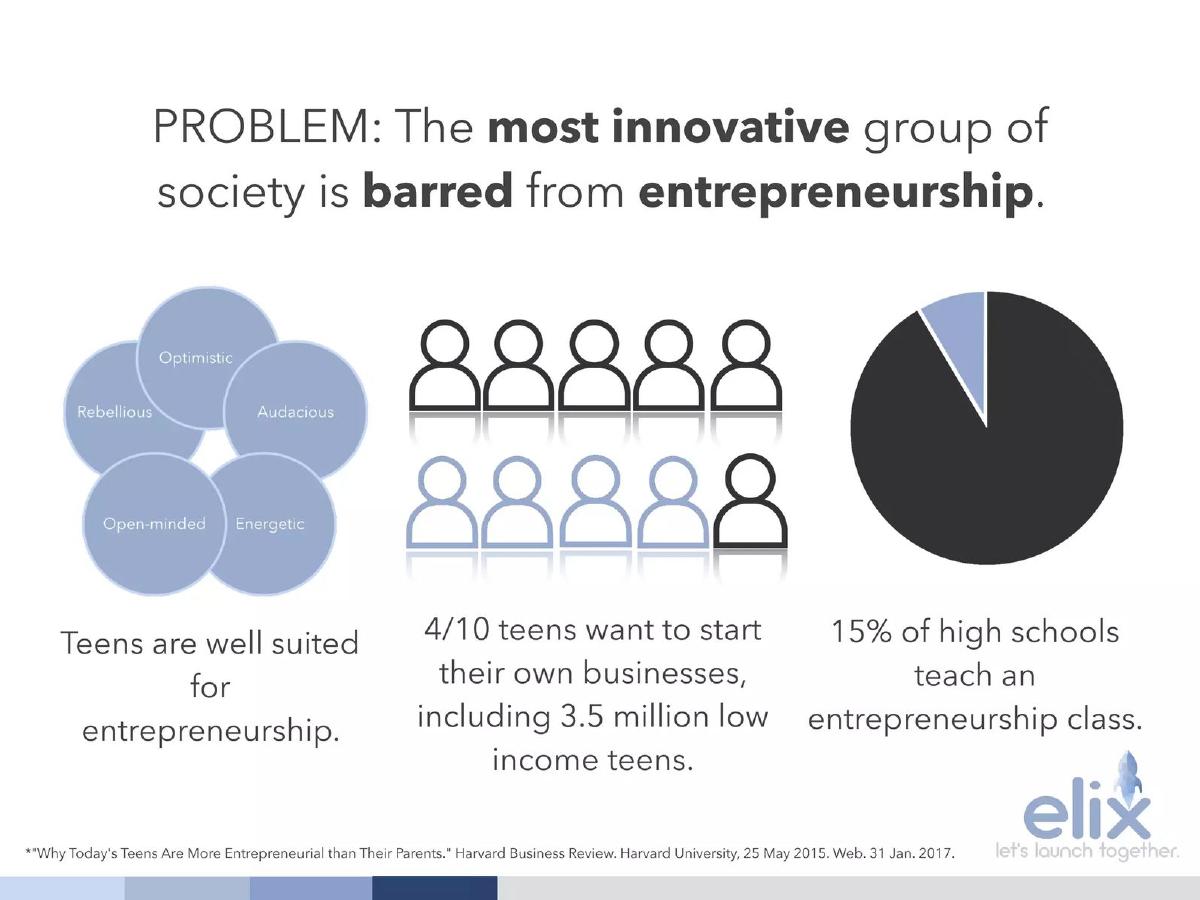
Elix identifies a gap in the education system. Citing a 2015 Harvard Business Review article, the slide states that while 4/10 teens want to start businesses, only 15% of high schools teach entrepreneurship. The slide highlights that 3.5 million low-income teens are part of this group, suggesting that socioeconomic status is a primary barrier to entry for the "most innovative group of society."
Slide 3: The Social Cost
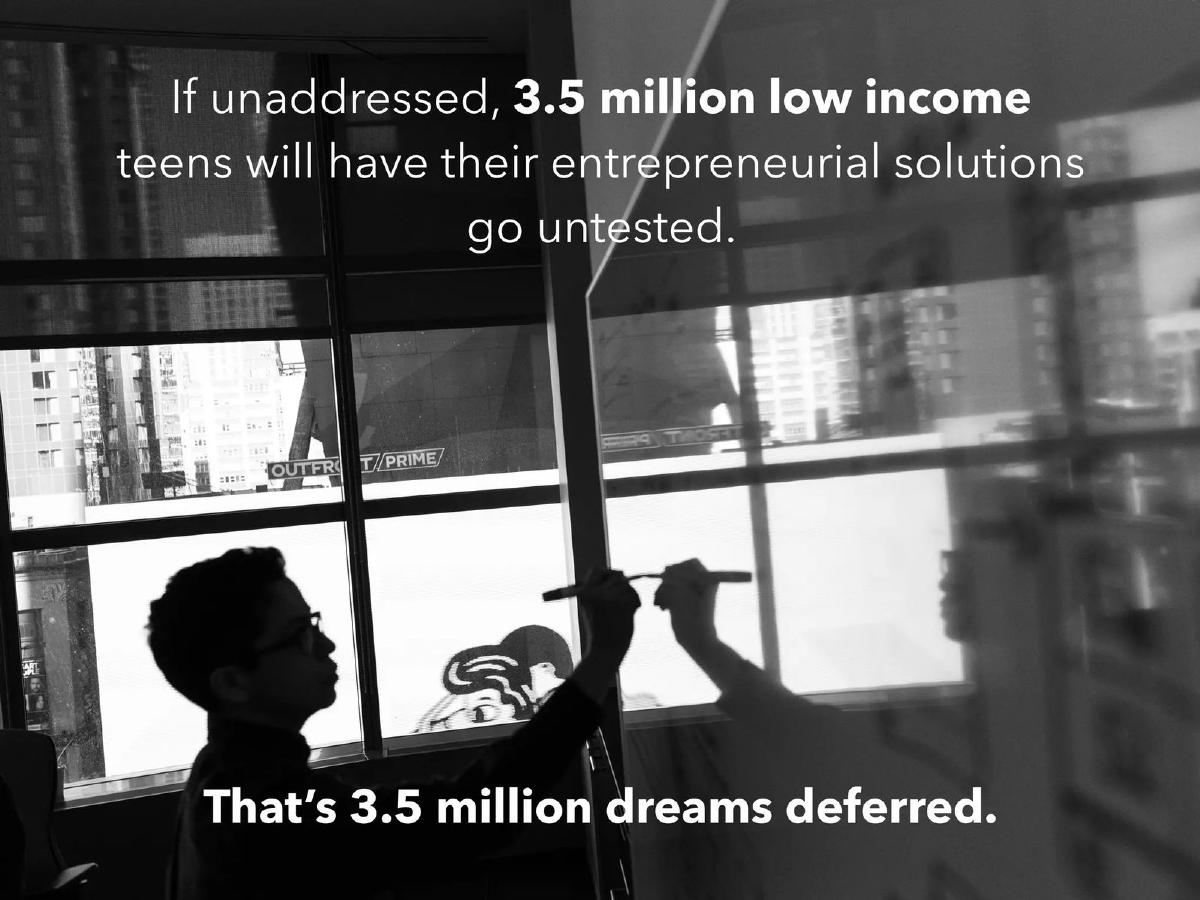
This slide uses a full-bleed black and white image of a student working at a glass whiteboard. The text emphasizes the human cost of the problem: "3.5 million dreams deferred." It serves as an emotional hook to reinforce the urgency of the social mission described on the previous slide.
Slide 4: The Solution
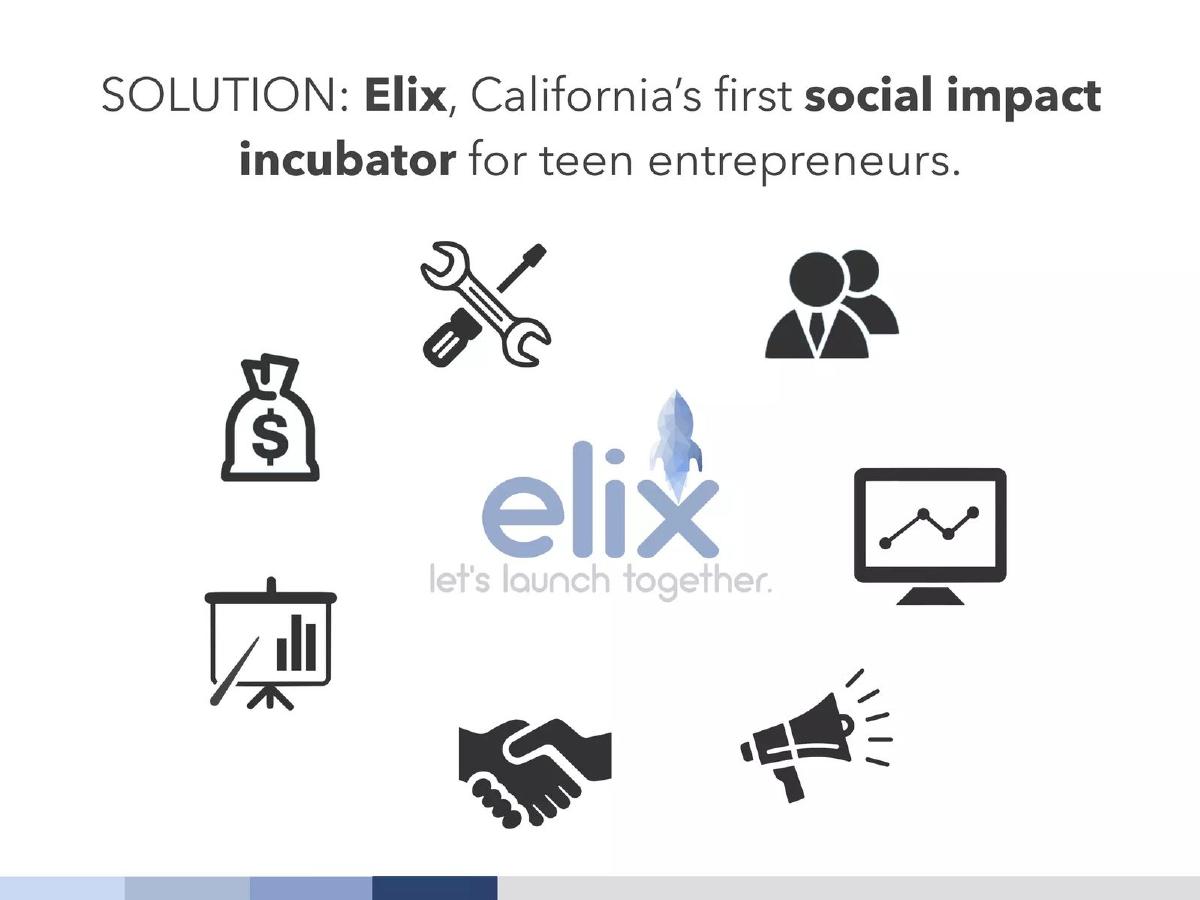
Elix is introduced as "California’s first social impact incubator for teen entrepreneurs." The slide uses icons to represent the resources provided: capital, tools, mentorship, data tracking, networking, and marketing. It positions the incubator as a centralized hub for all necessary startup resources.
Slide 5: Elix's Goals
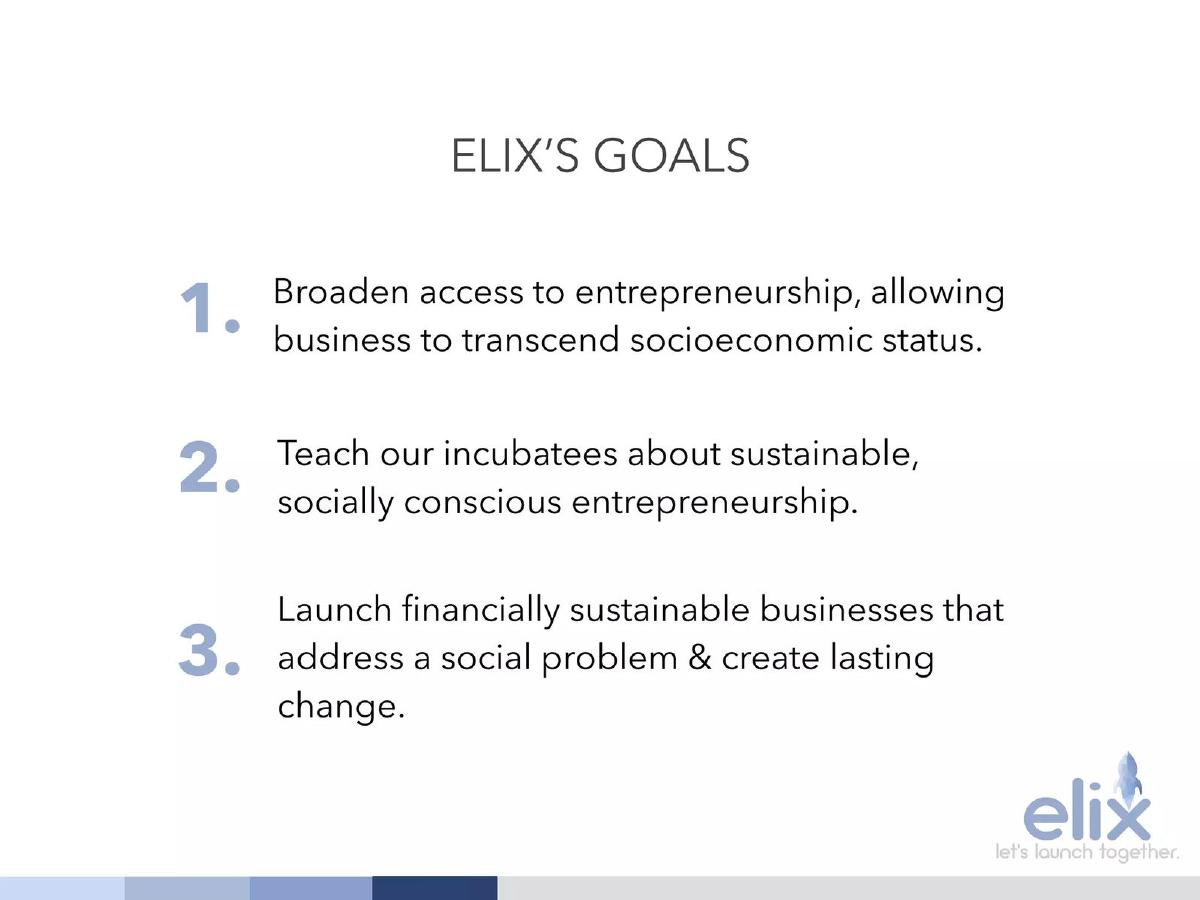
The organization outlines three primary objectives: 1) Broadening access to entrepreneurship across socioeconomic lines, 2) Teaching sustainable and socially conscious business practices, and 3) Launching financially sustainable businesses that address social problems. This slide clarifies that Elix is not just an educational program, but a launchpad for actual companies.
Slide 6: The Incubation Program
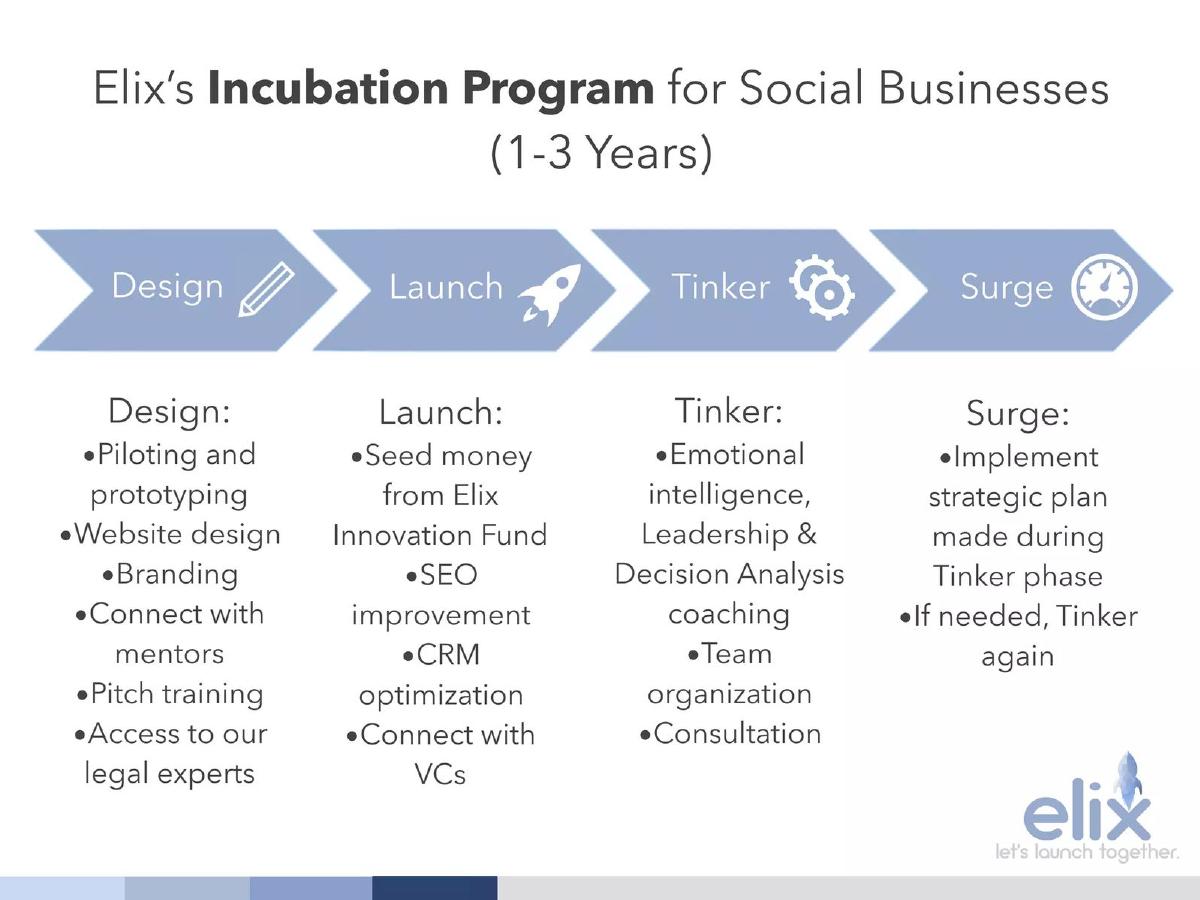
The deck details a four-stage process lasting 1-3 years. Design focuses on prototyping and branding. Launch provides seed money from the Elix Innovation Fund and connections to VCs. Tinker is a unique addition, focusing on emotional intelligence and leadership coaching. Surge involves the implementation of strategic plans. The 1-3 year timeframe is a significant departure from the standard 90-day accelerator model.
Slide 7: Go-To-Market Plan
The recruitment strategy involves three channels: social media ads (Instagram, Facebook), partnerships with school counselors and clubs, and partnerships with community organizations like SPARK and Junior Achievement (JA). The slide uses a flow chart to show how a single low-income 16-year-old can act as a catalyst to bring in peers, creating a viral loop for applications.
Slide 8: Competition
A standard 2x2 matrix plots Elix against competitors. The axes are "Traditional Business Incubator" vs. "Social Venture Incubator" and "Older Incubatees" vs. "Younger Incubatees." Elix places itself in the top-right quadrant (Social Venture/Younger). Competitors listed include Yunus Youth, SV2, and Bpeace for social impact, and Y Combinator and Harvard Innovation Lab for older demographics. Catapult and Young Entrepreneurs Academy are noted as competitors for the younger demographic but are categorized as traditional business incubators.
Slide 9: Competitive Advantages
Six advantages are listed: being an early market entrant, a no-equity model (which is later clarified in the business model slide), long incubation periods (1-3 years), a "Value of a Dollar" recycling model for donations, a safety net via the Innovation Fund, and the provision of seed money.
Slide 10: Elix's Social Ventures
This slide provides proof of concept by listing six ventures: NovisTech (tech repurposing), Savvy (political alerts/protests), Cozy (disaster relief), A-G (college readiness), Eco Wash Network (waterless carwash), and Smart Paint (nanotech paint). These serve as the "portfolio" of the incubator.
Slide 11: Impact Measures (2018 Q4 Projection)
The deck projects impact metrics for the end of 2018. It aims for 120 incubatees and 30 launched ventures. Specific KPIs for portfolio companies include 500 devices matched for NovisTech, 60 peace marches organized for Savvy, and 96,000 gallons of water saved for Eco Wash Network.
Slide 12: Market Size
Using data from the National Business Incubation Association, Elix estimates the total incubator market at $20 billion in 2015. They narrow this down to a $7 million "Teen Incubator" market. Elix sets a target of 15% of this niche market, valued at $1.5 million. The jump from $20 billion to $7 million is a massive reduction, suggesting a very specialized niche.
Slide 13: Business Model
This is the most critical slide for financial viability. Elix takes a "20% royalty from our incubatee’s profits" during incubation. For exits, they use a "pyramidal scale": 15% of exit profits for sales in years 1-5, 14% in year 6, 13% in year 7, and 5% for sales after 15 years. They also explicitly state a reliance on grants and donations.
Slide 14: EIF Financial Projections
A line graph shows projected revenue for the Elix Innovation Fund (EIF) from Q1 2017 to Q4 2019. The projection starts near zero and scales to just over $600,000 by the end of 2019. The slide attributes this to the "current growth rate," though it does not provide historical data to back up that rate.
Slide 15: Partners, Mentors, and Sponsors
A logo wall includes the UN Global Compact, Morrison Foerster, The Pollination Project, and the Barowsky School of Business. These partnerships lend significant credibility to a youth-led organization.
Slide 16: The Team
The team consists of Isabella Liu (CEO), Haley Catton (CMO), Stash Pomichter (CFO/CIO), Brendon Wright (CTO), and Andrew Yates (COO). Notably, each member's description includes their MBTI type (e.g., ENTJ, INFP). The descriptions focus on "primary objectives" rather than past professional experience or educational credentials.
Slide 17: Contact Slide
The deck ends with a photo of a group of young people in a meeting setting, providing Isabella Liu’s email and a San Francisco-based phone number. There is no final "Ask" or summary of funding needs.
What Elix Incubator Does Well
The deck excels at defining a specific, underserved niche. By focusing exclusively on teen social entrepreneurs, Elix avoids direct competition with massive accelerators like Y Combinator. The inclusion of a "Tinker" phase (Slide 6) shows a sophisticated understanding of the psychological needs of young founders, moving beyond mere business mechanics to address emotional intelligence and leadership. Furthermore, the impact projections (Slide 11) are tied to specific, measurable outcomes for their portfolio companies, which is highly attractive to social impact investors.
What Is Missing from the Deck
The most glaring omission is a clear funding ask. While Slide 14 shows financial projections, the deck never specifies how much money Elix is seeking or how those funds will be allocated between the Innovation Fund and operational overhead. Additionally, the team slide (Slide 16) lacks professional context; while MBTI types are interesting, they do not replace a track record of success in education, finance, or technology. Finally, the royalty model (Slide 13) is aggressive. Taking 20% of profits from a struggling startup is a high burden, and the deck does not explain how this affects the startups' ability to attract follow-on investment from traditional VCs who typically prefer equity over royalty agreements.
Instructions for Founders
Define your niche: Like Elix, founders should clearly identify a segment of the market that is currently ignored by larger players (Slide 8). · Use specific impact metrics: If you are a social venture, don't just say you will "do good." Citing "96,000 gallons of water saved" (Slide 11) is far more persuasive. · Visualizing the process: The four-phase timeline (Slide 6) is a great way to show investors exactly how their money and time will be spent over a multi-year period. · Avoid the 'No Ask' trap: Never end a pitch deck without a clear call to action. Investors need to know exactly what you want from them—whether it's $500k in seed funding or a specific partnership. · Balance personality with pedigree: While team culture is important, investors primarily want to know why you are qualified to run the business. Include relevant past achievements alongside personality traits.
Frequently asked questions
- What is the core business model of Elix Incubator?
- Elix uses a hybrid financial model. It relies on traditional grants and donations but also implements a revenue-sharing agreement with its startups. Specifically, it claims a 20% royalty on incubatee profits during the incubation period. Additionally, it takes a percentage of exit sales on a sliding scale: 15% for exits in years 1-5, 14% in year 6, 13% in year 7, and 5% for exits occurring after 15 years.
- How does Elix define its target market and opportunity?
- The company targets the 'teen entrepreneur' segment, noting that 4/10 teens want to start businesses, yet only 15% of high schools offer relevant classes. They value the 2015 teen incubator market at $7 million. Elix aims to capture 15% of this specific niche, which they calculate as a $1.5 million opportunity, positioning themselves as the first social impact incubator for this age group in California.
- What are the four phases of the Elix incubation program?
- The program lasts 1-3 years and consists of: 1) Design (piloting, branding, and mentor connection), 2) Launch (seed money from the Elix Innovation Fund and SEO/CRM optimization), 3) Tinker (emotional intelligence, leadership coaching, and team organization), and 4) Surge (implementation of strategic plans). This structure emphasizes long-term emotional and organizational development alongside technical business growth.
- What kind of companies does Elix incubate?
- The deck highlights six 'Social Ventures': NovisTech (repurposing surplus tech), Savvy (political engagement and election alerts), Cozy (disaster relief for children), A-G (college readiness app), Eco Wash Network (waterless carwash), and Smart Paint (nanotechnology for home power). These ventures span hardware, software, and service sectors, all united by a social impact mission.
- Is there a specific funding request in this deck?
- No. The deck concludes with a contact slide for the founder but does not state a specific dollar amount being raised, the terms of a potential investment, or a 'Use of Funds' breakdown. While it includes financial projections showing growth toward $600,000 by Q4 2019, it functions more as a program overview than a formal investment solicitation.