El Porto Shark is a data-driven initiative aiming to provide shark sighting forecasts for the California coast. The deck outlines a product suite including a predictive model and data visualization tools designed to educate the public and assist beachgoers. With a target market of 129 million annual Southern California beach visits and 3.2 million local surfers, the company seeks $250,000 in seed funding to build out infrastructure, expand the team, and launch marketing efforts. While the deck provides a clear look at the product interface and high-level market statistics, it lacks specific d…
Key takeaways
- The company is seeking $250,000 in seed funding for infrastructure, team building, and launch marketing (Slide 11).
- The product is positioned as a 'Shark Forecast for the California Coast' using a predictive model for sightings (Slide 3).
- Market data cites 129,000,000 annual visits to Southern California beaches and 3,288,000 surfers in California (Slide 7).
- Survey data indicates that 56% of people surveyed would use a shark forecast tool (Slide 7).
- The launch strategy relies on a mix of paid media, email blasts, PR, and word of mouth (Slide 9).
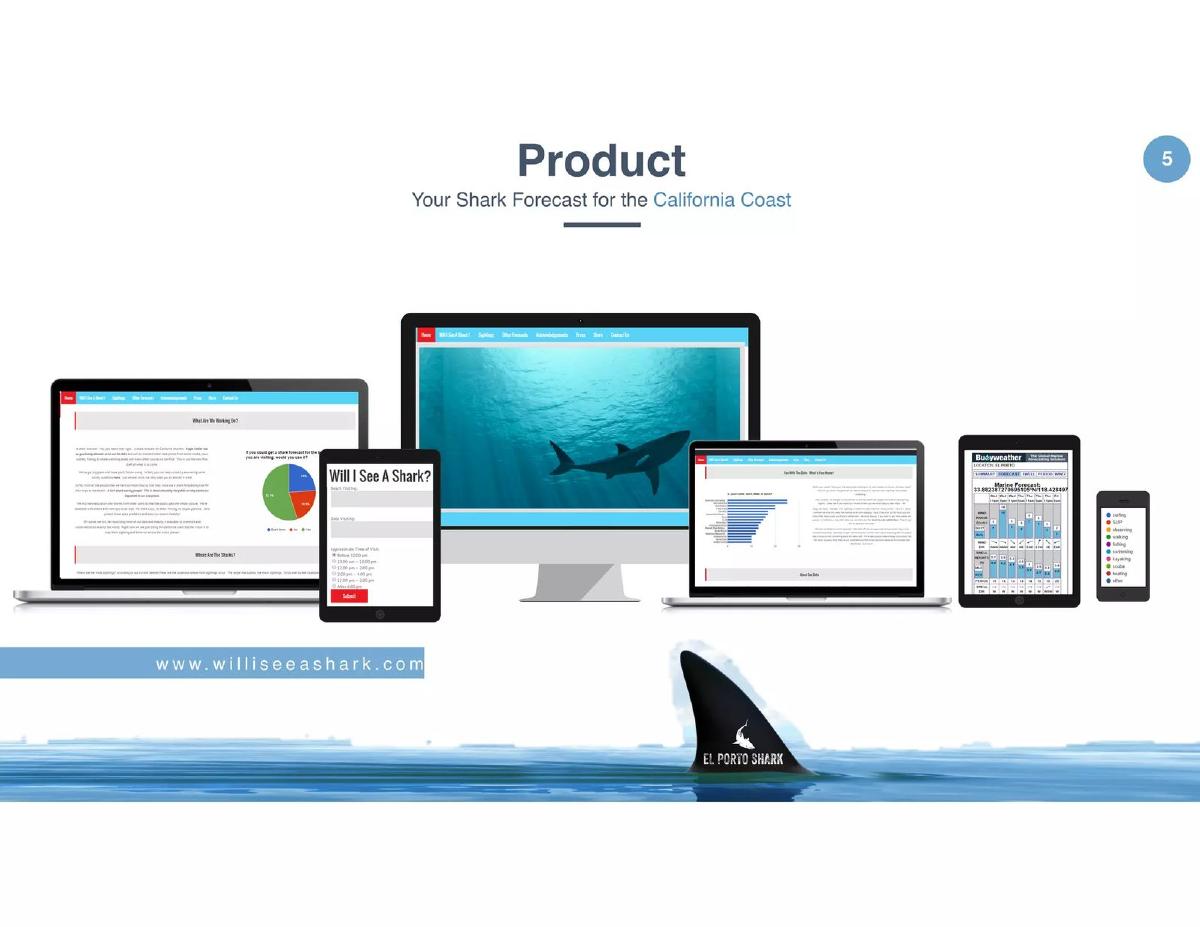
- The platform is accessible via web and mobile, with a dedicated URL at williseeashark.com (Slide 5).
- The algorithm is claimed to be applicable to any ocean-dwelling species beyond just sharks (Slide 3).
- The deck omits a formal business model or revenue generation plan in the provided slides.
Executive Summary: Niche Data for Coastal Safety
El Porto Shark is a specialized data play targeting the intersection of marine biology and coastal tourism. The pitch deck centers on the creation of a predictive model for shark sightings, primarily focused on the California coast. By leveraging the high volume of beach traffic and the specific needs of the surfing community, the company aims to turn shark sighting data into a consumer-facing forecasting tool. The deck seeks a modest $250,000 seed round to transition from a conceptual product to a marketed service.
Slide 1: Title and Branding
The cover slide establishes the brand identity with a logo featuring a shark fin and the tagline "Your Shark Forecast for the California Coast." The imagery is thematic, using a high-resolution ocean background. The branding is consistent throughout the deck, utilizing a specific color palette of greens, oranges, and blues that appear in the logo's accent bars.
Slide 3: The Solution
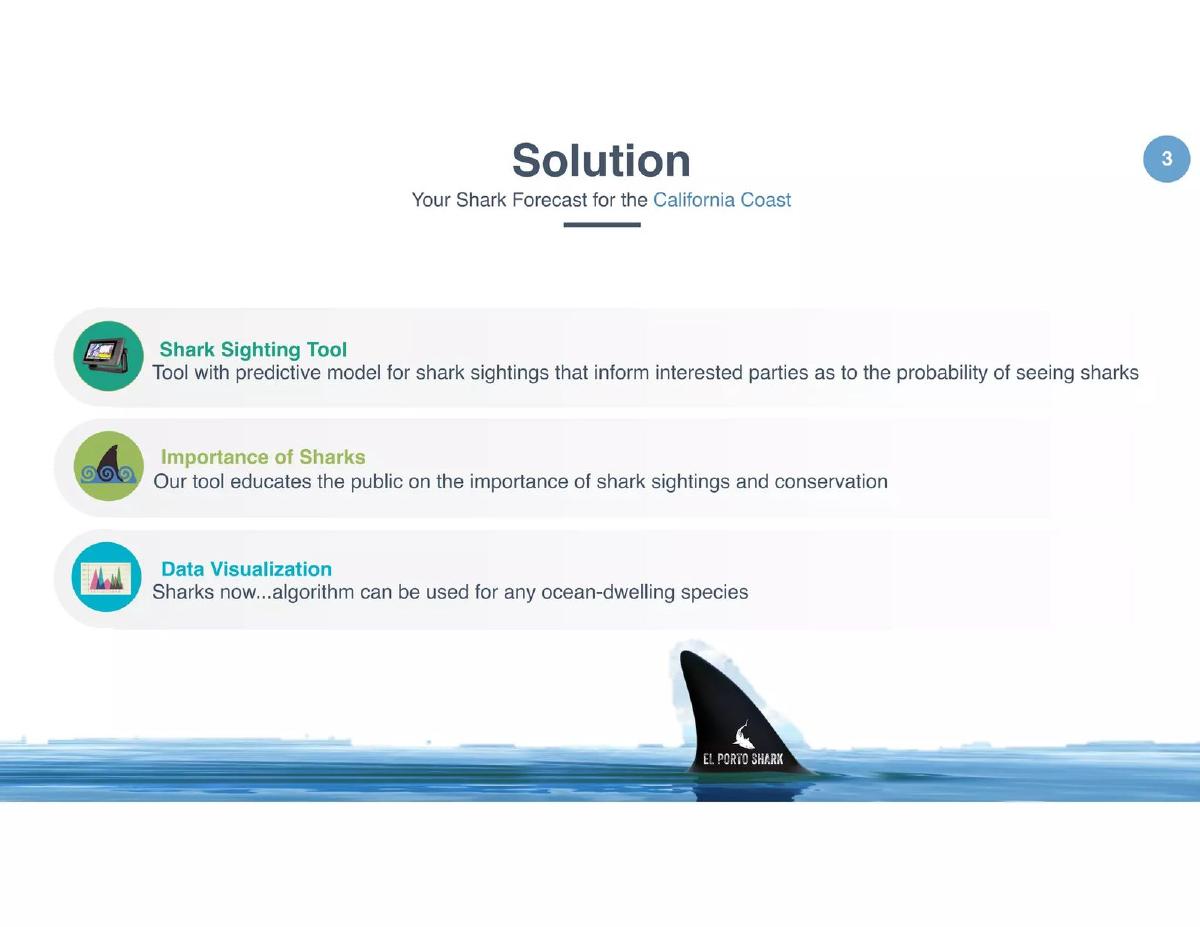
Slide 3 breaks down the solution into three pillars: the Shark Sighting Tool, the Importance of Sharks, and Data Visualization. The core value proposition is the "predictive model for shark sightings that inform interested parties as to the probability of seeing sharks." Notably, the slide claims that the underlying algorithm is versatile enough to be used for "any ocean-dwelling species," suggesting a potential for horizontal expansion into other areas of marine tracking or eco-tourism.
Slide 5: Product Interface and Accessibility
This slide showcases the product across various devices, including desktops, tablets, and smartphones. It highlights the URL www.williseeashark.com . The mockups show a user interface where beachgoers can select a location and date to receive a forecast. One screen titled "Will I See A Shark?" features a submission form for beach visiting details and time of visit. Another screen shows a "Marine Forecast" with technical data points like wind, swell height, and period, indicating that the tool integrates standard surf report data with its proprietary shark predictions.
Slide 7: Market Opportunity
The market slide uses geographic and demographic data to justify the scale of the project. It cites 129,000,000 annual visits to Southern California beaches and 3,288,000 surfers in California. It also notes a global population of 1,300,000 marine biologists. The slide uses gear-shaped infographics to present survey results: 56% of respondents would use the tool, 58% of sightings come from surfers, and 80% of people admit to being afraid of something in the ocean. This suggests the company is banking on both the utility for surfers and the curiosity/fear of general beach visitors.
Slide 9: Launch Strategy
The go-to-market plan is illustrated through a tree of social media icons and a process flow. The strategy includes "Paid Media" across platforms like Facebook, Twitter, and YouTube. The execution phase involves a "Launch Party," followed by a "Personal/professional email list blast," a "PR Blitz," and "Word of the Mouth" through friends and family. The inclusion of a PR blitz is particularly relevant given the sensational nature of shark sightings, which often garner significant local news coverage.
Slide 11: The Ask
The company is seeking $250,000 in seed funding. The slide divides the use of proceeds into three categories: Infrastructure , Team , and Launch Marketing . The infrastructure component is represented by a laptop, suggesting a need for hardware or cloud computing resources. The team component is represented by a woman standing in front of a chalkboard of equations, emphasizing the need for data science or mathematical expertise. The marketing component reiterates the social media focus seen in the launch strategy slide.
Slide 13: Closing Quote
The deck concludes with a quote from Jacques Yves Cousteau: "The sea, once it casts its spell, holds one in its net of wonder forever." This serves to align the company with the broader tradition of ocean exploration and conservation, ending the pitch on an emotional and aspirational note rather than a financial one.
What El Porto Shark Does Well
The deck is visually cohesive and stays strictly on-theme. The problem and solution are immediately understandable, even to a layperson. By providing a specific URL and showing the product on multiple devices, the founders demonstrate that the project has moved beyond the ideation phase and into development. The use of specific market numbers for California surfers provides a clear "beachhead" market that is easily identifiable and reachable.
Omissions and Weaknesses
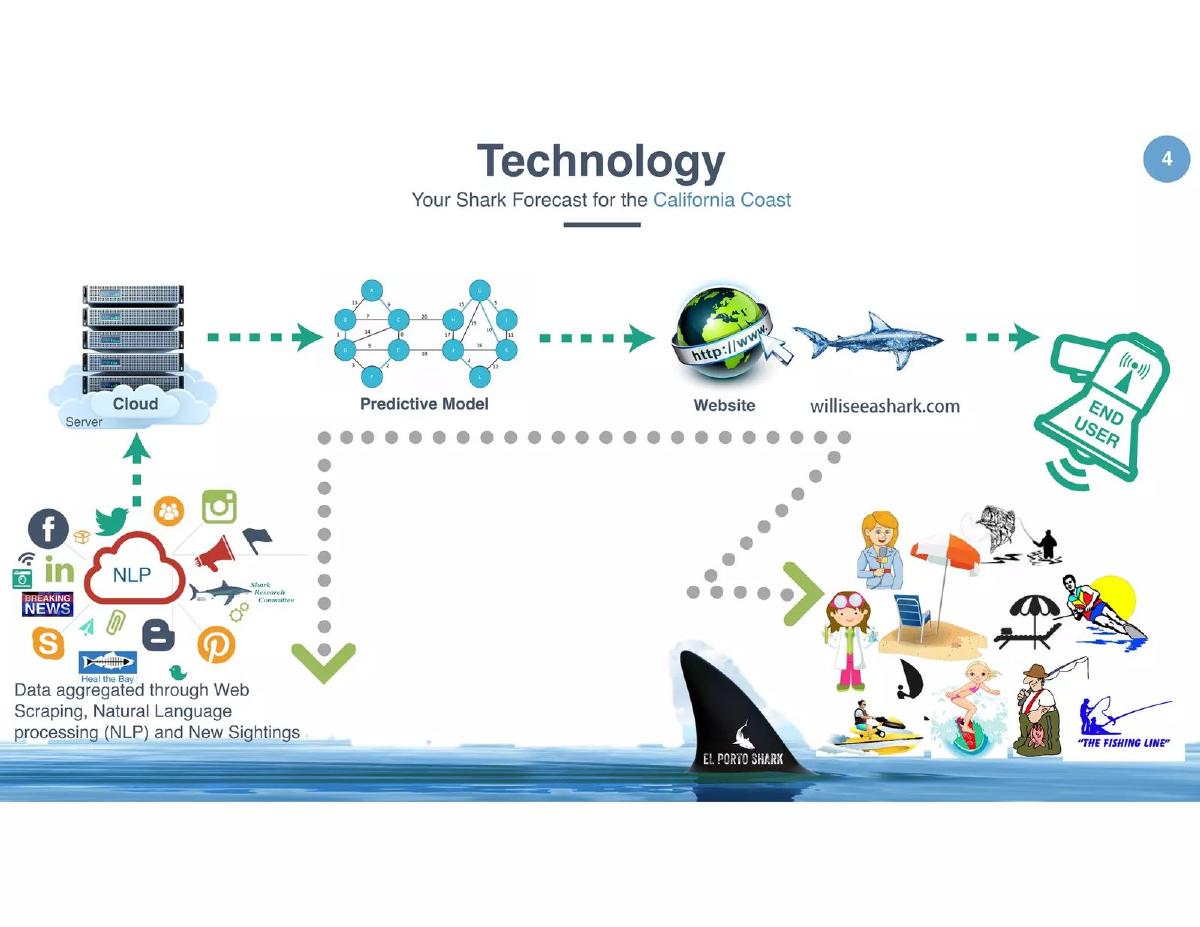
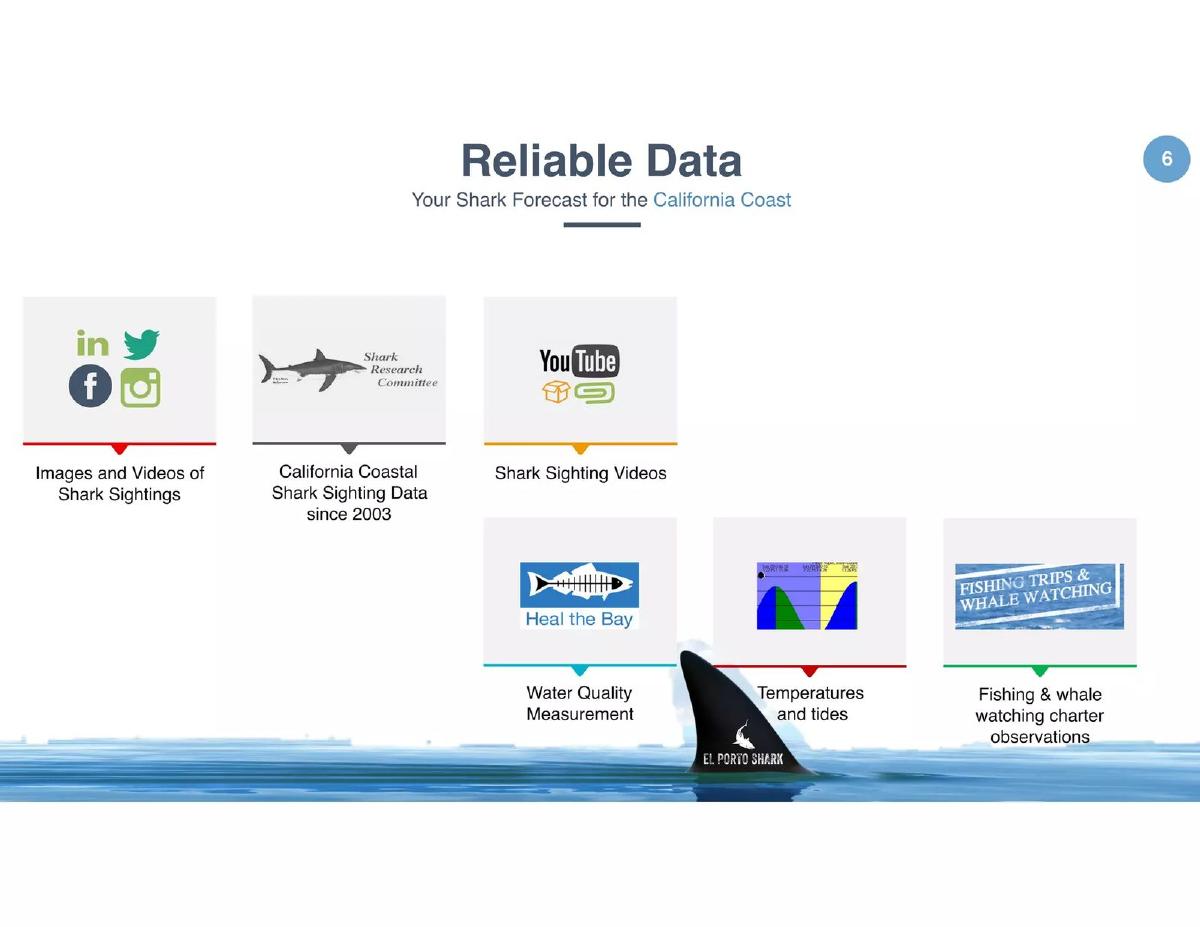
The most significant omission is the lack of a business model. There is no mention of how the company intends to make money—whether through subscriptions, advertising, data licensing to municipalities, or a freemium model. Furthermore, the "Team" slide is purely conceptual. In a company built on a "predictive model," investors would typically require proof of the founders' expertise in data science, marine biology, or software engineering. The deck also fails to address the source of the historical sighting data used to train the algorithm, which is a critical component of the product's credibility.
Founder Takeaways
Founders building niche data products should take note of how El Porto Shark uses survey data to prove interest. Even with a small sample size, showing that 56% of a target demographic would use a tool provides a data point for investors to latch onto. However, founders should ensure that their "Ask" slide is backed by a more detailed breakdown of the team's credentials. If you are asking for money to build a team, you must first prove that the current team has the vision and foundational skill set to lead those new hires effectively. Finally, always include at least one slide on monetization; even a seed-stage company needs to show a path to revenue.
Frequently asked questions
- What is the primary product offered by El Porto Shark?
- The primary product is a Shark Sighting Tool that utilizes a predictive model to inform users of the probability of seeing sharks. According to Slide 3, this includes data visualization and educational components regarding shark conservation. The product is delivered through a web and mobile interface, as shown on Slide 5, allowing users to check forecasts for specific beach locations.
- How much money is El Porto Shark raising and what for?
- El Porto Shark is raising $250,000 in seed funding. As detailed on Slide 11, the capital is earmarked for three specific areas: 'Infrastructure' (represented by a MacBook Pro), 'Team' (represented by complex mathematical equations), and 'Launch Marketing' (represented by a collage of social media icons).
- Who is the target audience for this tool?
- The deck identifies several key segments on Slide 7. The primary users are the 3,288,000 surfers in California and the broader 129,000,000 annual visitors to Southern California beaches. Additionally, the company identifies 1,300,000 marine biologists worldwide as a potential secondary audience interested in the data visualization and conservation aspects.
- What evidence of user demand does the deck provide?
- Slide 7 provides three data points from surveys: 56% of people surveyed said they would use a shark forecast tool, 58% of shark sightings come from surfers, and 80% of people surveyed are 'afraid of something in the ocean.' This suggests a market driven by both utility for frequent ocean users and fear-based interest from general tourists.
- What is missing from the El Porto Shark pitch deck?
- The provided slides lack a revenue model, unit economics, and a competitive analysis. Most notably, while Slide 11 mentions needing funds for a 'Team,' there is no slide detailing the current founders' expertise or scientific credentials. There is also no mention of existing partnerships with local municipalities or lifeguard organizations which would be critical for data validation.