EcoLocked’s 11-slide Seed deck focuses on the urgent need for decarbonization in the built environment, which accounts for 39% of global emissions. The company positions itself not just as a material supplier, but as a 'concrete optimization platform' that uses algorithms to create custom mix designs integrating biocarbon into existing production processes. By emphasizing a low-Capex model and cost-competitiveness against other 'green' alternatives, EcoLocked addresses the primary barriers to adoption in the conservative construction sector. While the deck is visually polished and strong on p…
Key takeaways
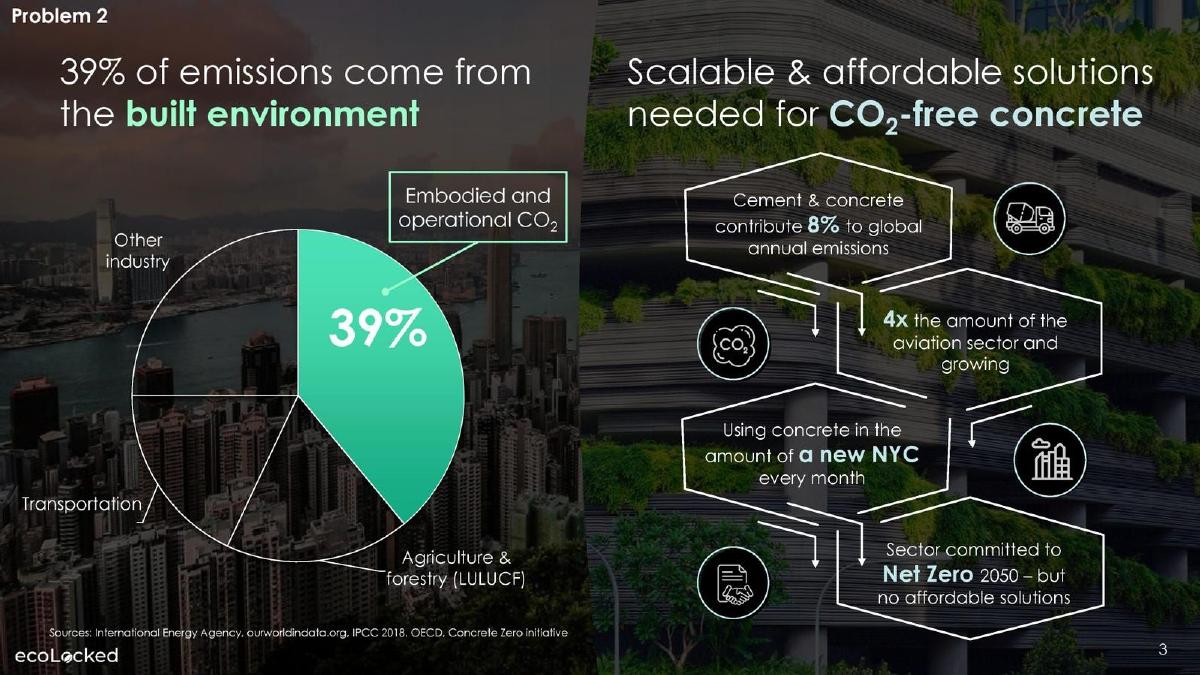
- The built environment is responsible for 39% of global emissions, with cement and concrete alone contributing 8% (Slide 3).
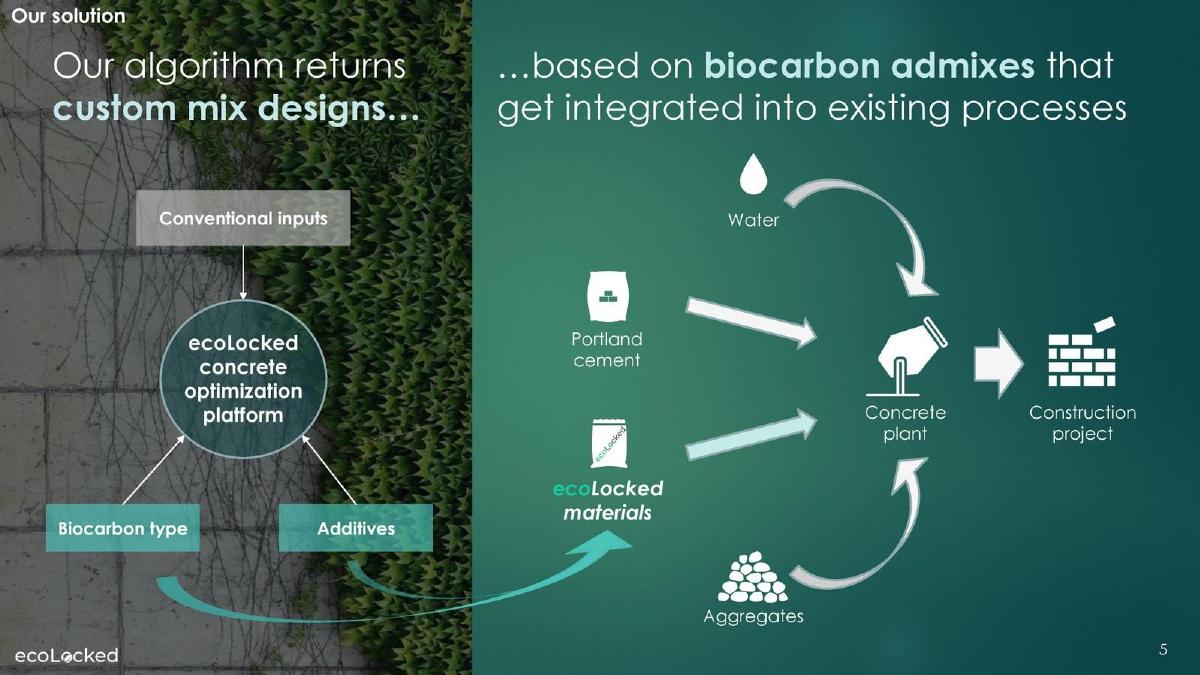
- EcoLocked uses an algorithm to return custom mix designs based on biocarbon types and additives (Slide 5).
- The solution is designed to integrate into existing concrete plants with minimal changes to the production process (Slide 5).
- The product is positioned as cost-competitive, sitting at a price point below other 'green' or performance-enhanced concretes (Slide 7).
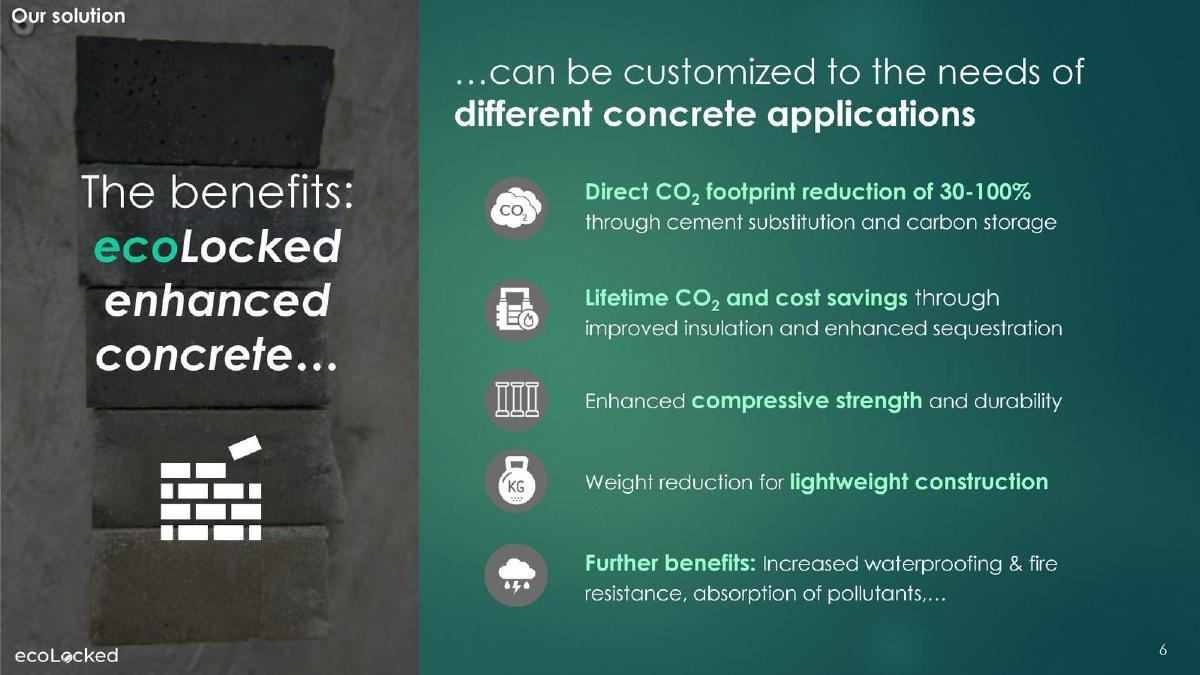
- Potential CO2 cost savings and performance enhancements are estimated to add 10-15% in value compared to standard concrete (Slide 7).
- The business model relies on a 'platform' approach to leverage insights from each new mix design (Slide 9).
- The deck omits a traditional team slide, though contact details for three key individuals are provided on the final slide (Slide 11).
- There is no explicit 'Ask' slide detailing the specific amount of capital sought or the intended use of funds within the 11-slide sequence.
EcoLocked: Decarbonizing the Foundation of the Modern World
Construction is one of the hardest-to-abate sectors in the global economy. With cement production alone accounting for a staggering percentage of global CO2 emissions, the race is on for a scalable, affordable alternative. EcoLocked entered the fray with a 2022 investor deck that eventually led to a $1.8M Seed round in 2023. The deck focuses heavily on the 'how'—specifically how a startup can integrate carbon-sequestering materials into a legacy industry without breaking the bank or the supply chain.
Slide 1: Title and Visual Hook
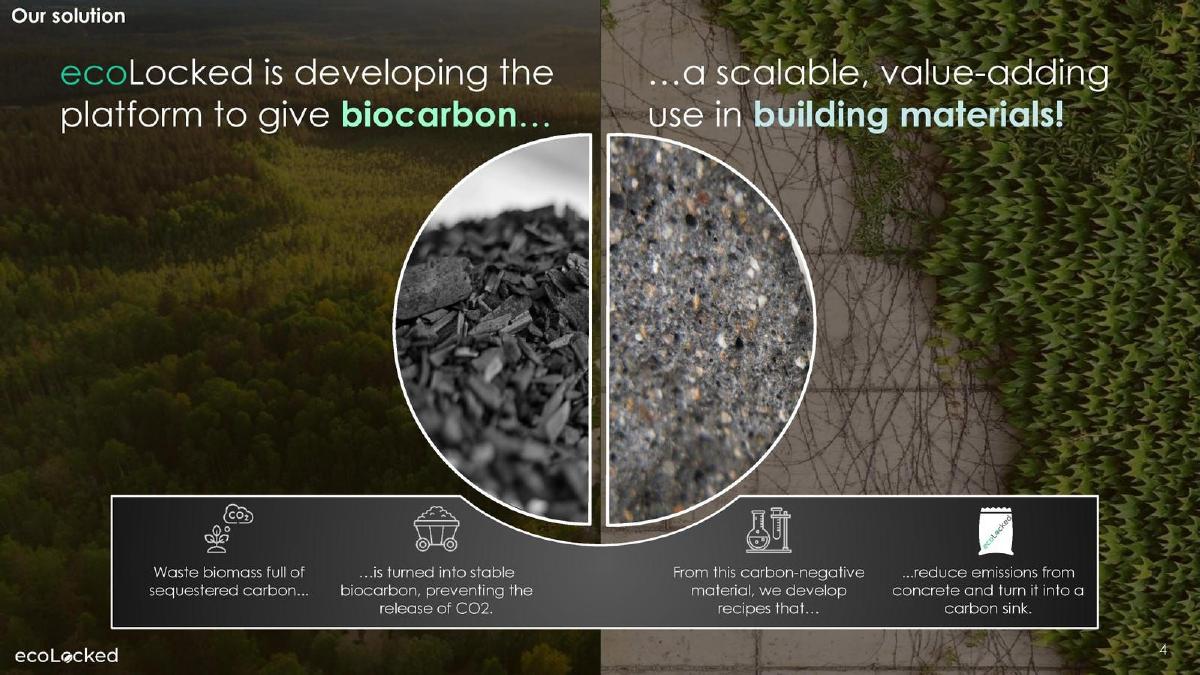
The deck opens with a high-resolution image of biochar—a dark, charcoal-like substance derived from organic waste. The tagline, "Making climate-positive concrete a reality," immediately establishes the company's mission. It is a clean, professional start that identifies the industry (construction) and the goal (sustainability) without unnecessary jargon.
Slide 3: The Macro Problem
EcoLocked uses Slide 3 to establish the urgency of their mission. They cite that "39% of emissions come from the built environment," a figure attributed to the International Energy Agency and the IPCC. The slide breaks this down further, noting that cement and concrete contribute 8% to global annual emissions , which is "4x the amount of the aviation sector and growing."
The most striking visual on this slide is the claim that the world is "using concrete in the amount of a new NYC every month." By framing the problem through both massive percentages and relatable physical scales, EcoLocked creates a compelling case for why the status quo is unsustainable. They also point out a market gap: while the sector is committed to Net Zero 2050, there are currently "no affordable solutions."
Slide 5: The Optimization Platform
Slide 5 shifts from the problem to the solution. EcoLocked describes itself as a "concrete optimization platform." This is a strategic phrasing; by calling it a platform rather than just a material supplier, they imply a software or algorithmic advantage that is more scalable than a simple commodity business.
The slide features a flow chart showing how their algorithm takes "Conventional inputs," "Biocarbon type," and "Additives" to return "custom mix designs." These materials are then integrated into the existing concrete plant process alongside Portland cement, water, and aggregates. The visual emphasizes that the "ecoLocked materials" are just one part of a familiar workflow, reducing the perceived risk for potential construction partners.
Slide 7: Strength, Sustainability, and Cost
One of the biggest hurdles for green tech in construction is the 'green premium'—the idea that sustainable materials are prohibitively expensive. Slide 7 addresses this head-on. It claims that EcoLocked concrete "can be cost-competitive with conventional concrete."
A bar chart compares the market price for standard concrete against the EcoLocked price. While the EcoLocked price appears slightly higher, the slide highlights "CO2 cost savings" and "Performance enhancement" (such as better insulation) that add an estimated 10-15% in value. Crucially, they show their price point sitting well below the "Market price for 'greener' concrete," positioning themselves as the pragmatic choice for developers who want to go green without doubling their material costs. The slide also notes that the product is suitable for "RMC, precast, 3D-printed & DIY concrete," suggesting a broad Total Addressable Market (TAM).
Slide 9: The Strategic Advantage
Slide 9, titled "Why ecoLocked?" , summarizes their competitive moat into three pillars: Focus on materials, A scalable model, and Collaborations.
Focus on materials: They emphasize an "R&D first" approach with dedicated scientists experienced in cementitious materials. · A scalable model: They reiterate the "minimal changes to concrete production process" and the use of "low-cost waste products." · Collaborations: They highlight partnerships with scientific institutions and the creation of an "attractive end market for biocarbon."
This slide is designed to reassure investors that the company has thought through the logistics of scale. By mentioning "VC support for quick GtM & scale-up," they signal that they are ready to use the capital to move fast.
Slide 11: The Team and Contact
The final slide serves as a combined Team and Contact slide. It lacks the traditional headshots and bios found in most decks, which is a notable omission. However, it provides direct contact information for three key figures: Mario Schmitt (Financing), Stefanie Gerhart (Partnerships), and Micheil Gordon (R&D). The background image of a forest path reinforces the "road to carbon-negative" theme.
What EcoLocked Does Well
The deck excels at contextualizing the problem. By comparing concrete emissions to the aviation industry and using the 'New York City every month' analogy, they make a dry industrial problem feel urgent and massive. This is essential for attracting climate-focused VCs.
Furthermore, the emphasis on low Capex is a masterclass in addressing industry-specific objections. Construction is a low-margin, conservative industry. By explicitly stating that their solution requires "no significant Capex" and integrates into "existing processes," they remove the biggest barrier to entry for their customers (the concrete plants).
The pricing strategy shown on Slide 7 is also highly effective. It doesn't just claim to be 'cheaper'; it uses a comparative bar chart to show exactly where they sit in the current market hierarchy—more expensive than the dirt-cheapest option, but significantly more affordable than the current 'green' competition.
What is Missing from the Deck
The most glaring omission is a dedicated Team slide. In a Seed round, investors are primarily betting on the founders. While contact names are listed on the final slide, there is no information about their previous exits, academic credentials, or specific industry experience. For a deep-tech/materials science play, the lack of visible 'expert' bios is a missed opportunity to build credibility.
There is also no Unit Economics or Financial Projections slide. While Slide 7 touches on price competitiveness, it doesn't show the company's margins or how they expect to reach profitability. Investors usually want to see a 3-5 year roadmap of revenue growth, even at the Seed stage.
Finally, the deck lacks a clear 'Ask' slide. While we know from publisher reports that they raised $1.8M, the deck itself does not state how much they are looking for or what specific milestones (e.g., building a pilot plant, hiring 10 engineers) that money will fund. This often suggests the deck was used as a supporting visual for a conversation rather than a standalone document.
Founder Takeaways: What to Copy
Use Relatable Analogies: If you are in a technical or industrial sector, follow EcoLocked's lead on Slide 3. Don't just say '8% of emissions'; say '4x the aviation sector.' It makes the scale of the opportunity undeniable.
Address the 'Green Premium' Early: If your product is sustainable, investors will immediately worry about cost. Use a slide like EcoLocked's Slide 7 to show exactly how you compare to both standard and 'green' competitors. Adding a 'Value Add' section (like their 10-15% performance enhancement) helps justify any remaining price gap.
Focus on Integration, Not Disruption: Many founders try to 'disrupt' an industry by demanding customers change everything they do. EcoLocked does the opposite. They emphasize that their product fits into existing workflows. If your solution is 'plug-and-play,' make that a central pillar of your pitch.
Visual Consistency: The deck uses a consistent color palette (dark greens and grays) and high-quality imagery that aligns with the brand. It feels like a cohesive story rather than a collection of disparate slides. This level of polish suggests a professional operation, which is vital when you are asking for millions of dollars.
Frequently asked questions
- What is the core technology behind EcoLocked?
- EcoLocked develops biochar-based admixes for concrete. Their core intellectual property appears to be an optimization platform—an algorithm that determines the ideal mix of biocarbon types and additives to integrate into standard concrete production without compromising structural integrity.
- How does EcoLocked compare to other green concrete solutions on price?
- According to Slide 7, EcoLocked aims to be cost-competitive with standard concrete. While it may carry a slight premium, the deck argues it is significantly cheaper than other 'green' alternatives and offers 10-15% additional value through CO2 cost savings and performance enhancements like better insulation.
- What is the environmental impact of the concrete industry cited in the deck?
- Slide 3 notes that the built environment accounts for 39% of global emissions. Specifically, cement and concrete contribute 8% of global annual emissions, which is four times the amount produced by the aviation sector.
- Does the deck explain how the product is manufactured?
- Slide 5 illustrates the process: EcoLocked materials are added alongside Portland cement, water, and aggregates at the concrete plant. The deck emphasizes that this requires 'minimal changes' to the existing production process and 'no significant Capex' for the manufacturer.
- Who are the founders of EcoLocked?
- While the deck lacks a dedicated team slide, Slide 11 lists three key contacts: Mario Schmitt (Financing & Jobs), Stefanie Gerhart (Pilot Projects & Partnerships), and Micheil Gordon (R&D Partnerships). These individuals represent the leadership team driving the $1.8M Seed round.