How climate startups present the solution in a pitch deck: the emissions cut per unit, why it costs the buyer no more than today's option.
Climate Solution Slide: Real Pitch Deck Examples
Eight solution slides from climate startups, shown in full, compare how each states the emissions saving, answers the buyer's cost question, and shows how much the buyer has to change to switch.
TL;DR
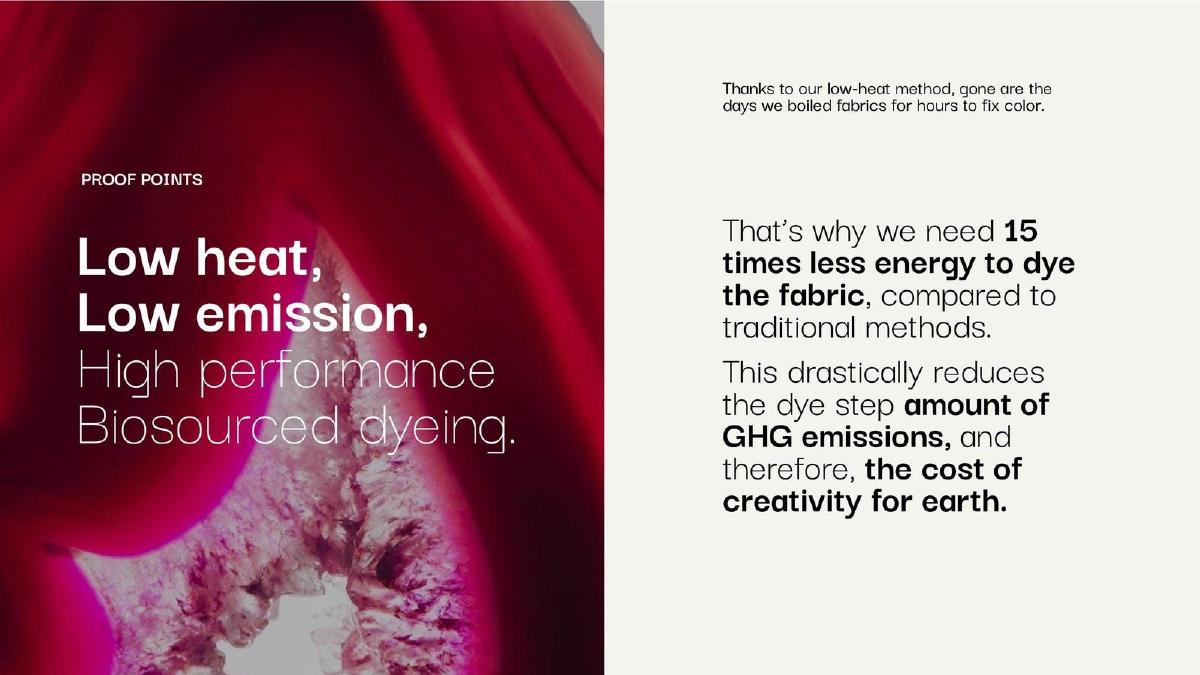
A climate solution slide should state the emissions cut per unit of product, show that the buyer pays no more (or gets better performance) than with today's option, and say how little the buyer has to change to switch. Circ says it "can fully recycle polycotton blends & compete on cost with virgin producers". ComBio promises "No upfront CapEx required from the client" and "a significant reduction in client OpEx". Ever Dye gives one measured ratio: "15 times less energy to dye the fabric". A planet-scale hypothetical such as Mootral's "if all 1.5 billion cows on earth" are fed the product shows the size of the prize, not what one customer gets.
Climate solution slides from real pitch decks
Each example shows the exact stored slide above its analysis and links to the full teardown. Figures are as shown on the slides; we have not verified them.
Circ solution slide — slide 5
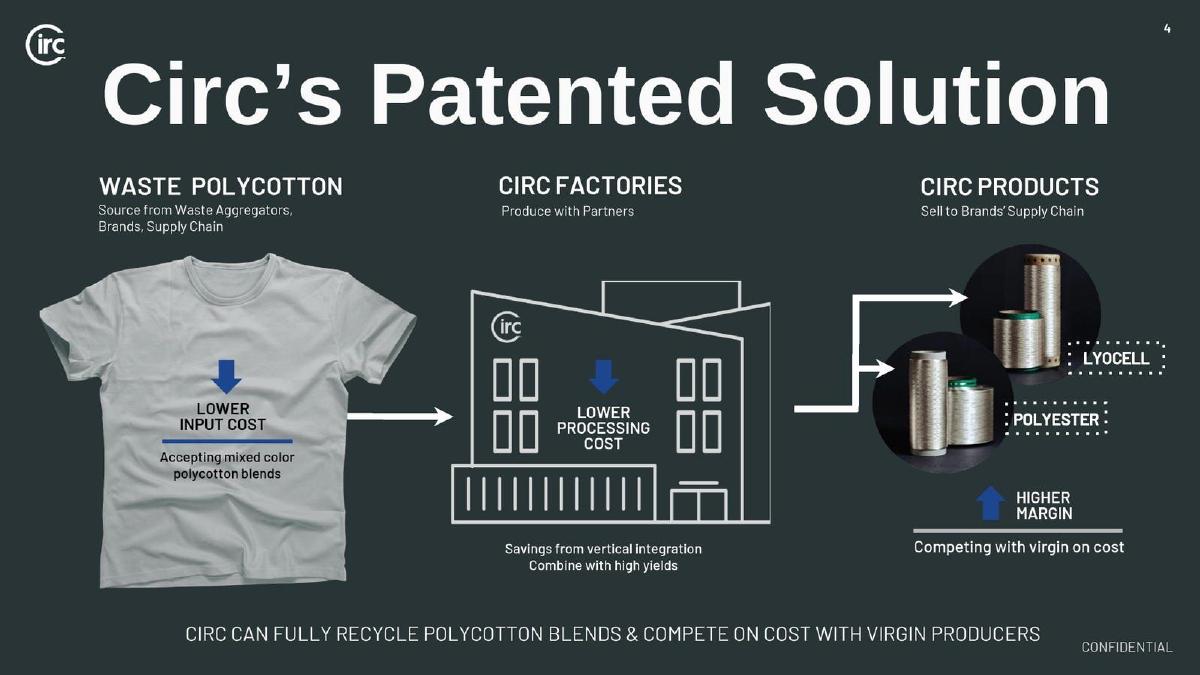
Textile recycling. A three-step flow with a cost argument at each step.
Circ deck, slide 5. Exact stored slide matched to this analysis.
Our analysis: Every step of the flow carries a cost label, so the green product is presented as a cheaper supply, not a premium one.
Evidence and limitation: No figures; cost claims are qualitative.
What a founder can adapt: Label each step of your process with its cost effect compared with the conventional route.
Supporting analysis
What the deck claims: "Circ's Patented Solution." "Waste polycotton — Source from Waste Aggregators, Brands, Supply Chain" ("Lower input cost", "Accepting mixed color polycotton blends") → "Circ factories — Produce with Partners" ("Lower processing cost", "Savings from vertical integration combine with high yields") → "Circ products — Sell to Brands' Supply Chain": lyocell and polyester ("Higher margin", "Competing with virgin on cost"). "Circ can fully recycle polycotton blends & compete on cost with virgin producers."
Presentation choice: Brands buy fibre on price; the slide answers that before the investor asks.
When it does not fit: Back "compete on cost" with one number, such as cost per tonne versus virgin fibre.
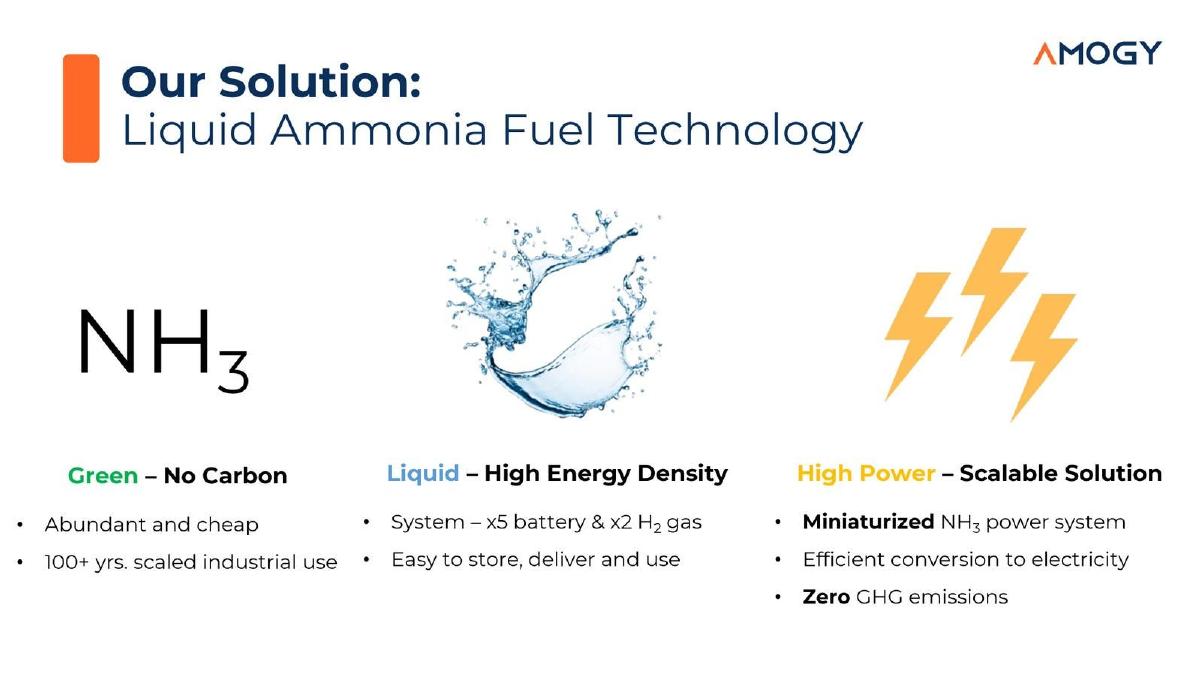
Ammonia-to-power for heavy transport. Three benefits, each with a comparison.
Amogy deck, slide 5. Exact stored slide matched to this analysis.
Our analysis: It answers the problem slide's point (batteries are heavy and slow to recharge) with a density comparison.
Evidence and limitation: Energy density stated as five times a battery and twice hydrogen gas.
What a founder can adapt: Compare your product with the option the buyer would otherwise pick, in the unit they care about.
Supporting analysis
What the deck claims: "Our Solution: Liquid Ammonia Fuel Technology." "Green – No Carbon: Abundant and cheap; 100+ yrs. scaled industrial use." "Liquid – High Energy Density: System – x5 battery & x2 H2 gas; Easy to store, deliver and use." "High Power – Scalable Solution: Miniaturized NH3 power system; Efficient conversion to electricity; Zero GHG emissions."
Presentation choice: The performance claim, not the carbon claim, is what makes a shipping or trucking buyer listen.
When it does not fit: Say what the "x5" is measured against (Wh per kg for the whole system?).
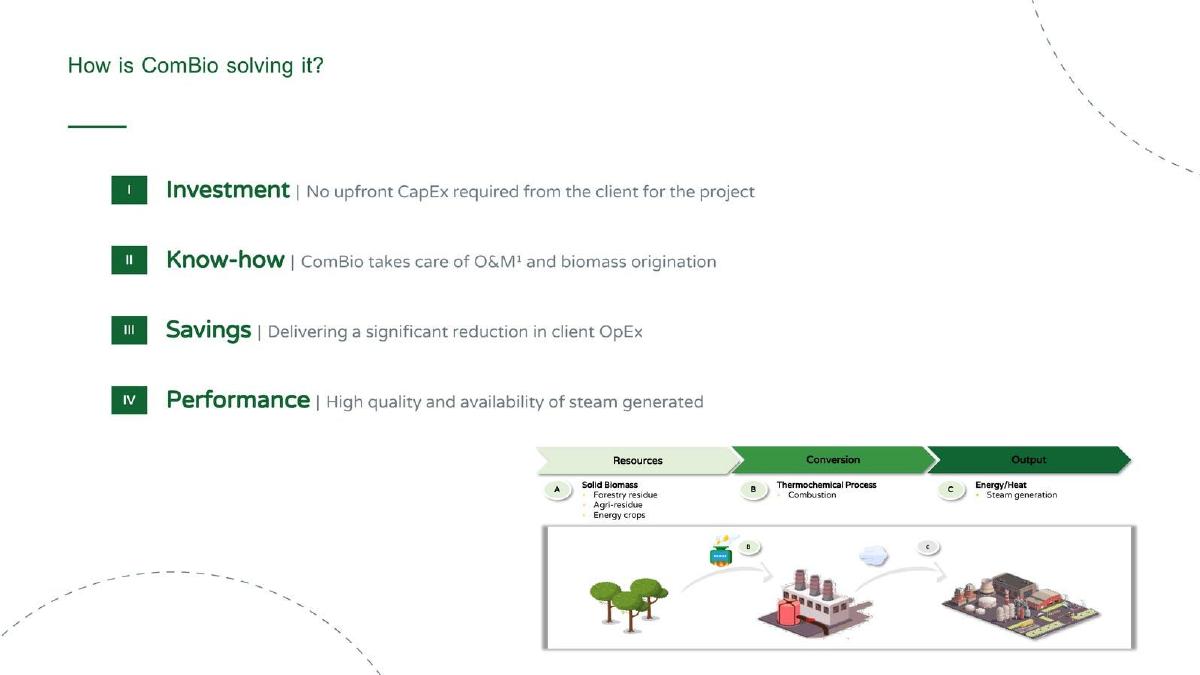
Biomass steam for industrial plants. Four answers to the buyer's objections.
ComBio deck, slide 3. Exact stored slide matched to this analysis.
Our analysis: It removes the three usual reasons a plant won't switch fuel: upfront cost, operating skill and reliability.
Evidence and limitation: No figures on the slide; "significant" is not quantified.
What a founder can adapt: List the buyer's reasons not to switch and answer each in one line.
Supporting analysis
What the deck claims: "How is ComBio solving it?" "I Investment | No upfront CapEx required from the client for the project." "II Know-how | ComBio takes care of O&M and biomass origination." "III Savings | Delivering a significant reduction in client OpEx." "IV Performance | High quality and availability of steam generated." A diagram: Resources (forestry residue, agri-residue, energy crops) → Conversion (combustion) → Output (steam generation).
Presentation choice: The buyer keeps its process; ComBio owns and runs the boiler.
When it does not fit: Put a figure on "significant reduction in OpEx", such as percent saved on steam cost.
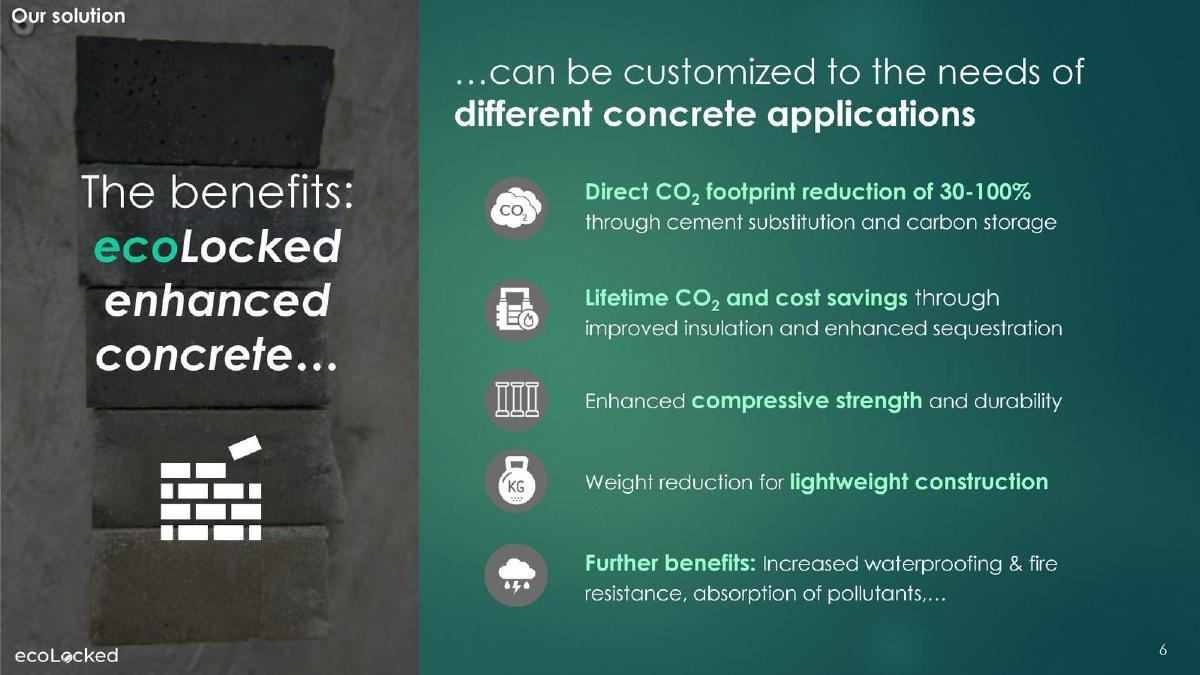
Low-carbon concrete additive. A saving range plus performance benefits.
ecoLocked deck, slide 6. Exact stored slide matched to this analysis.
Our analysis: It pairs the carbon cut with strength and weight, which builders already specify.
Evidence and limitation: A 30–100% CO2 reduction range; other benefits unquantified.
What a founder can adapt: Put your carbon saving next to the performance spec your buyer already checks.
Supporting analysis
What the deck claims: "Our solution ... can be customized to the needs of different concrete applications. The benefits: ecoLocked enhanced concrete ..." "Direct CO2 footprint reduction of 30-100% through cement substitution and carbon storage." "Lifetime CO2 and cost savings through improved insulation and enhanced sequestration." "Enhanced compressive strength and durability." "Weight reduction for lightweight construction." "Further benefits: Increased waterproofing & fire resistance, absorption of pollutants."
Presentation choice: Concrete buyers won't trade strength for carbon; the slide says they don't have to.
When it does not fit: Say which application gets 30% and which gets 100%; a wide range invites doubt.
Ever Dye deck, slide 6. Exact stored slide matched to this analysis.
Our analysis: One ratio links the method (low heat) to the saving (energy, therefore emissions).
Evidence and limitation: 15 times less energy than traditional dyeing.
What a founder can adapt: Give one ratio against the conventional process and name the step it applies to.
Supporting analysis
What the deck claims: "Proof points. Low heat, Low emission, High performance Biosourced dyeing." "Thanks to our low-heat method, gone are the days we boiled fabrics for hours to fix color." "That's why we need 15 times less energy to dye the fabric, compared to traditional methods. This drastically reduces the dye step amount of GHG emissions, and therefore, the cost of creativity for earth."
Presentation choice: Energy is also the dye house's cost, so the same number speaks to price.
When it does not fit: Say the cost effect outright; the slide stops at emissions.
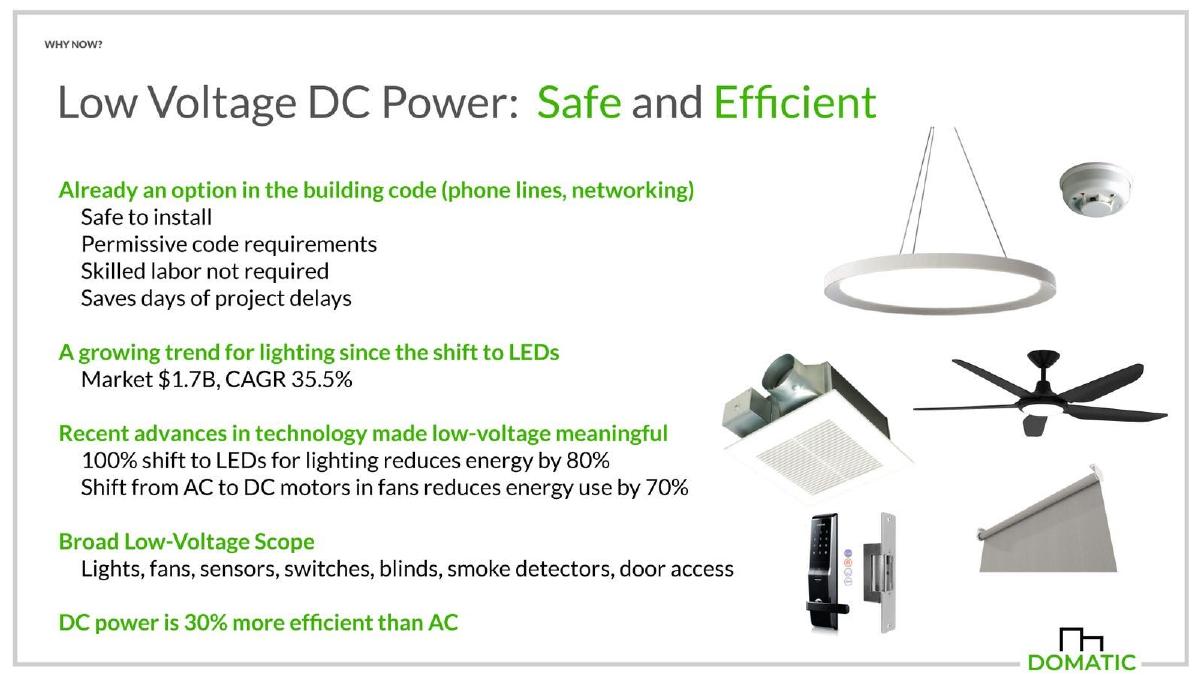
Low-voltage DC wiring for buildings. Efficiency plus ease of installation.
Domatic deck, slide 6. Exact stored slide matched to this analysis.
Our analysis: Most of the slide is about installation (code, labor, delays), which is where builders feel cost.
Evidence and limitation: Energy figures for LEDs (80%), DC fans (70%) and DC power (30%); market $1.7B, CAGR 35.5%.
What a founder can adapt: Show that your product fits existing rules and trades, and how much time it saves on site.
Supporting analysis
What the deck claims: "Low Voltage DC Power: Safe and Efficient." "Already an option in the building code (phone lines, networking): Safe to install; Permissive code requirements; Skilled labor not required; Saves days of project delays." "100% shift to LEDs for lighting reduces energy by 80%. Shift from AC to DC motors in fans reduces energy use by 70%." "DC power is 30% more efficient than AC."
Presentation choice: The slide is labelled "Why now" but works as the solution: efficiency plus easier installation.
When it does not fit: Separate your product's saving from the industry trends (the LED figure is not Domatic's).
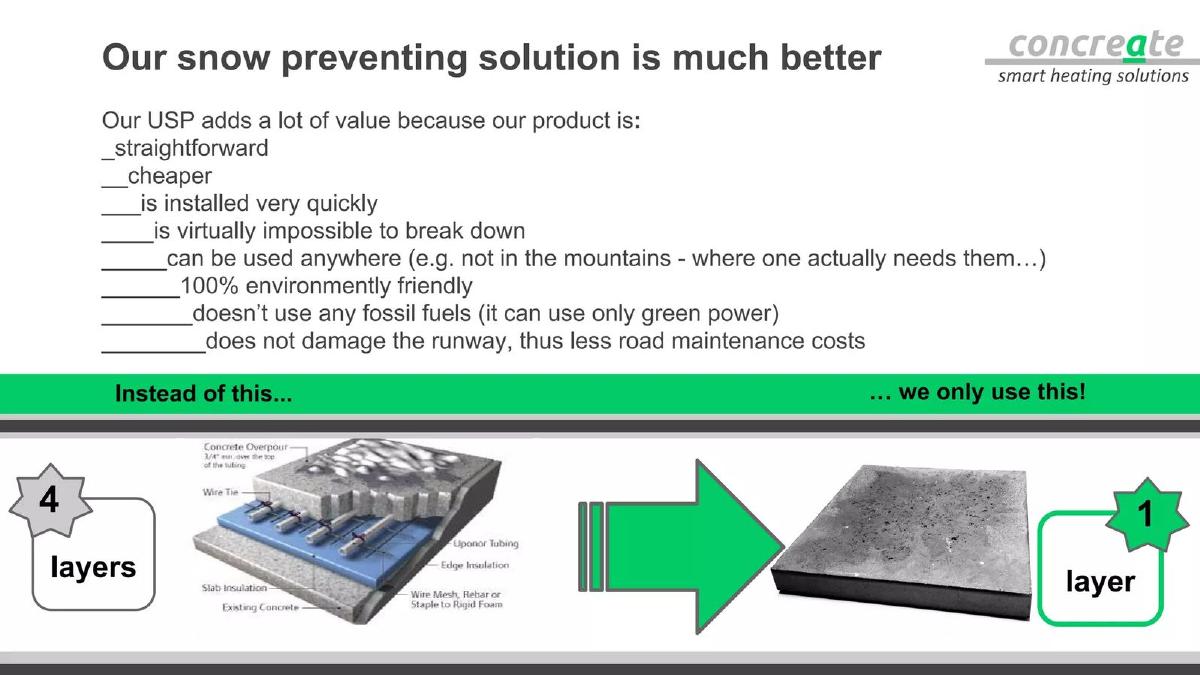
Heated concrete panels for snow-free surfaces. A before-and-after diagram.
Concreate deck, slide 5. Exact stored slide matched to this analysis.
Our analysis: The four-layers-to-one diagram shows simpler installation at a glance; the list is mostly adjectives.
Evidence and limitation: Four construction layers reduced to one; other claims unquantified.
What a founder can adapt: Show the old build and yours side by side, counting parts, steps or layers.
Supporting analysis
What the deck claims: "Our snow preventing solution is much better." "Our USP adds a lot of value because our product is: straightforward, cheaper, is installed very quickly, is virtually impossible to break down, can be used anywhere, 100% environmentally friendly, doesn't use any fossil fuels (it can use only green power), does not damage the runway, thus less road maintenance costs." "Instead of this ... [4 layers] ... we only use this! [1 layer]."
Presentation choice: The diagram does more than the eight-line list above it.
When it does not fit: A list of adjectives ("cheaper", "quickly") with no figures.
Cattle feed supplement to cut methane. Included as a weaker pattern.
Mootral deck, slide 5. Exact stored slide matched to this analysis.
Our analysis: It shows the ceiling if every cow worldwide used the product, not what one farm gains or pays.
Evidence and limitation: A global hypothetical with a cited car-equivalence method.
What a founder can adapt: Add the per-cow reduction and the cost per head, then show the global figure as upside.
Supporting analysis
What the deck claims: "A Gigaton Solution." "If all 1.5 billion cows on earth are fed Mootral Ruminant, it would reduce global GHG emissions by more than 1.5 Gigaton CO2e p.a. = Taking more than 1 billion cars off the road." Footnote: EU car emissions of 120g CO2/km and 12,000 km a year, with source links.
Presentation choice: Included as a contrast: planet-scale impact with nothing for the buyer.
When it does not fit: Leading with an "if everyone adopted it" number.
Whether each slide measures the saving, answers cost or performance, and shows how little the buyer changes.
Example
Saving measured
Cost or performance
Switching shown
Circ
No
Yes (competes with virgin on cost)
Sells into existing supply chain
Amogy
Zero emissions (claimed)
Yes (x5 battery density)
No
ComBio
No
Yes (no CapEx, lower OpEx)
Yes (ComBio runs it)
ecoLocked
Yes (30–100% CO2)
Yes (strength, weight)
No
Ever Dye
Yes (15x less energy)
Implied (energy cost)
No
Domatic
Industry figures
Yes (30% efficiency)
Yes (building code, no skilled labor)
Concreate
No
Claimed, not measured
Yes (4 layers to 1)
Mootral
Global hypothetical only
No
No
Key Takeaways
State the emissions or energy saving per unit a customer buys, not only for the whole planet.
Answer cost directly: equal or lower price, or no upfront spend.
Show what the buyer keeps: the same plant, the same building code, the same supply chain.
Pair the green benefit with a performance benefit (strength, energy density, faster install).
Link back to the barrier named on your problem slide and show how it is removed.
Build your climate solution slide
One line per part, each with a number if you have one.
Saving. What is the emissions or energy cut per unit your customer buys?
Cost. Does the buyer pay the same, less, or nothing upfront compared with today?
Performance. Which spec your buyer already checks do you match or beat?
Switching. What does the buyer keep, and what do they have to change?
Copyable framework: [Product] cuts [emissions/energy] by [X per unit] at [same/lower cost] and [performance claim]. Customers keep [existing equipment/process]; they only change [one thing].
Illustrative example 1 — written by us
Before: A revolutionary sustainable solution that could remove gigatons of carbon.
After: Our additive cuts cement use per cubic metre by 40% at the same price per truckload, with equal 28-day strength. Ready-mix plants add it at the existing dosing station.
What improved: Our illustrative rewrite; figures are invented for the example. It gives the per-unit saving, the cost, a performance spec and the switching step.
What this guide adds
The general solution slide guide covers presenting a product in any business. Climate buyers rarely pay extra just for lower emissions, so a climate solution has to win on cost or performance as well. This guide compares how climate startups make that case.
It pairs with the climate problem slide guide: four companies here (Amogy, Domatic, Ever Dye, ecoLocked) appear there with their problem slides, so you can read each deck's problem and solution together.
Three parts of a climate solution
Saving: the emissions or energy cut, measured per unit (Ever Dye, ecoLocked).
Cost or performance: why the buyer is no worse off, or better off (Circ, ComBio, Amogy).
Switching: what the buyer has to change, ideally little (ComBio, Domatic, Concreate).
Strong slides cover all three. Most real slides cover one or two.
Common mistakes
Planet-scale only. Give the saving per customer before the global total.
Green premium unaddressed. Say what the buyer pays compared with today.
Adjective lists. "Cheaper" and "faster" need a number each.
Borrowed figures. Separate industry trends from your product's own results.
Wide ranges. Explain what drives a 30–100% range, or pick the typical case.
Diagnostic checklist
The saving is stated per unit a customer buys.
The slide says whether the buyer pays the same, less or nothing upfront.
At least one performance spec is matched or beaten.
It shows what the buyer keeps and what they change.
It answers the barrier named on your problem slide.
Frequently asked questions
How we chose these examples
Corpus: published pitch deck teardowns on StartupFundraising.com. Founder-uploaded private decks are excluded.
Selection (2026-09-24): we searched extracted text of slides 2–6 for solution slides in decks mentioning carbon, emissions, energy, recycling or waste, and checked the solution slides of decks in the climate problem guide. About thirty candidates were inspected; Pakam was excluded because it appears in the general solution guide.
Overlap check: the general solution slide guide uses seven different decks (HelloBello, Eikona, Improvado, HomeHub, Arbol, Buynomics, Pakam); none appears here. Amogy, Domatic, Ever Dye and ecoLocked appear in the climate problem guide with different slides; ComBio appears in the impact slide guide with a different slide.
Mootral is included to show a weaker pattern. Domatic's slide is labelled "Why now" in its deck; it is used here because it presents the product's advantages.
Review: all eight stored slide images were inspected on 2026-09-24 and matched to company, deck and slide number (editorial model review). No person has yet completed an editorial review of this page.
Figures are as shown on the slides; we have not verified them. We make no claim that any slide caused a fundraising outcome.