Amogy’s 12-slide deck is a masterclass in technical positioning for hard-tech startups. The narrative hinges on a single, undeniable physics problem: heavy-duty mobility requires energy densities that current lithium-ion batteries cannot provide. By benchmarking ammonia against batteries (~200Wh/kg) and hydrogen (~400Wh/kg), Amogy establishes liquid ammonia as the only carbon-free fuel capable of matching the 1,000Wh/kg threshold required for heavy transport. The deck leans heavily on a successful 100kW tractor demonstration from May 2022 to prove technical viability. While the deck is light…
Key takeaways
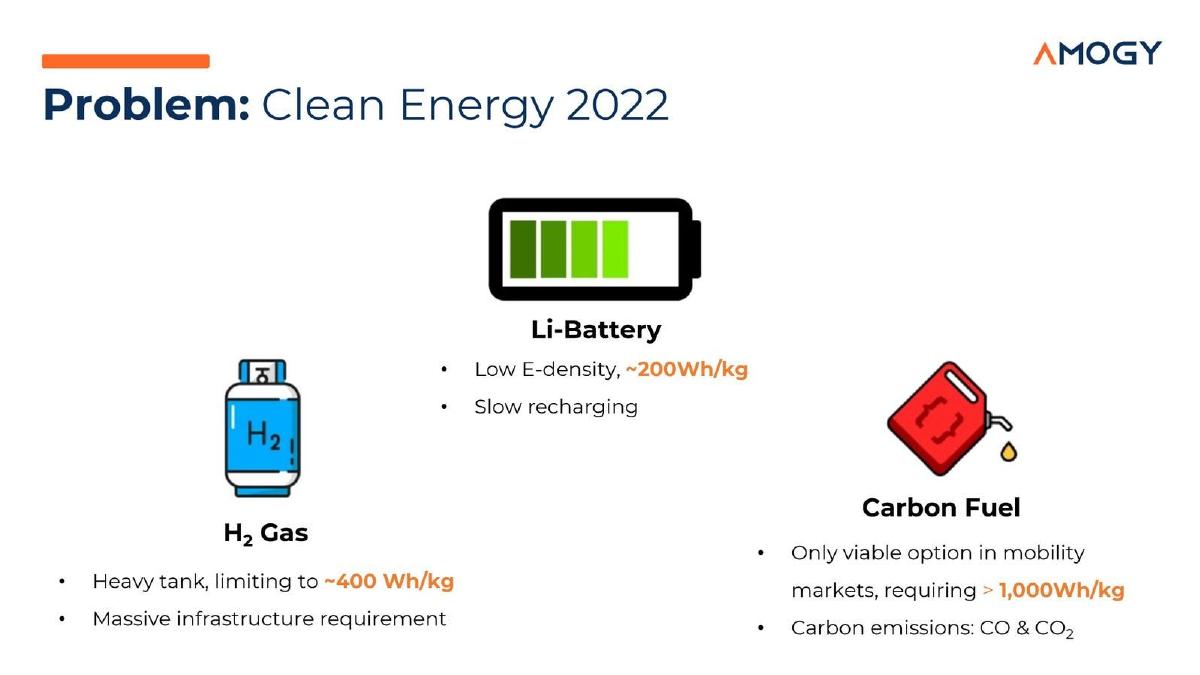
- The deck identifies a specific 'energy density gap' on Slide 2, noting that mobility markets require >1,000Wh/kg.
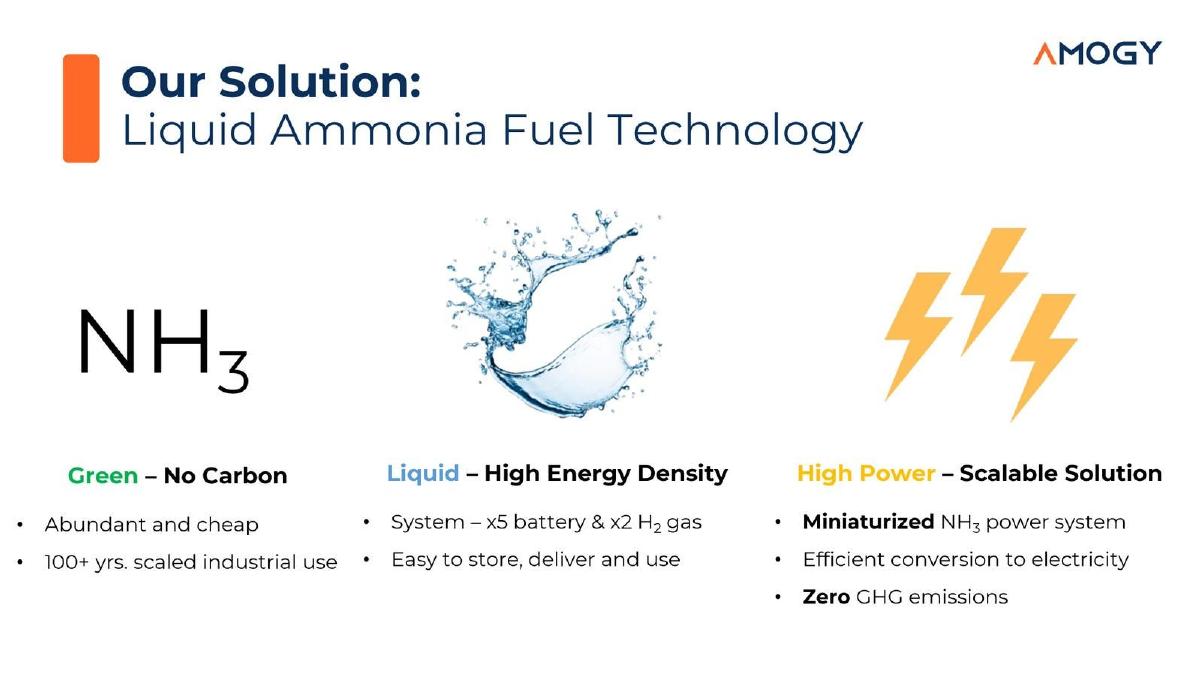
- Amogy claims their system offers 5x the energy density of batteries and 2x that of hydrogen gas (Slide 3).
- A 100kW tractor demonstration serves as the primary proof of concept, achieving >42% fuel-to-power efficiency (Slide 4).
- The technology is positioned for both mobile (trucking, tractors) and stationary power generation (Slide 5).
- The mission is quantified by a goal to eliminate ~5 Gt of CO2 globally by 2040 (Slide 6).
- Ammonia is marketed as a 'green' fuel with over 100 years of existing industrial infrastructure (Slide 3).
- The deck omits a traditional team slide, financial roadmap, and competitive landscape analysis.
- The 2023 Series A round raised $46M, according to publisher reports, following the 2022 tractor demo shown on Slide 4.
The Hard-Tech Narrative: Solving for Density
Amogy’s pitch deck is a focused technical argument for a specific chemical solution to a global climate problem. In the world of transportation, the 'easy' wins—passenger cars—have been claimed by lithium-ion batteries. Amogy’s deck ignores the easy wins and goes straight for the 'hard-to-abate' sectors. The narrative is built on the premise that for heavy-duty mobility, the current clean energy winners are physically incapable of doing the job.
Slides 1-2: The Energy Density Problem
The deck opens with a clean, minimalist title slide featuring the Amogy logo and the tagline: "Ammonia – a renewable fuel for zero emission mobility." This immediately sets the stage for a single-solution pitch. Slide 2, titled "Problem: Clean Energy 2022," is the most important slide in the deck for establishing the 'Why Now' and 'Why This'.
On Slide 2, Amogy benchmarks three existing technologies against the requirements of the mobility market. They note that lithium batteries have a low energy density of approximately 200Wh/kg and suffer from slow recharging. Hydrogen gas (H2) is dismissed due to its heavy tanks, which limit its density to ~400 Wh/kg , and its massive infrastructure requirements. Finally, they point out that carbon fuels are currently the only viable option because the market requires >1,000Wh/kg . By framing the problem as a gap between 400Wh/kg (the best clean tech) and 1,000Wh/kg (the market requirement), Amogy creates a logical vacuum that only their solution can fill.
Slide 3: The Ammonia Solution
Slide 3 introduces "Liquid Ammonia Fuel Technology" as the bridge for that density gap. Amogy highlights three core advantages: it is carbon-free (NH3), it has high energy density as a liquid, and it is a scalable solution. Specifically, they claim their system offers 5x the density of batteries and 2x the density of H2 gas . A crucial point of de-risking here is the mention of "100+ yrs. scaled industrial use." This tells investors that while the conversion technology might be new, the fuel source is already a global commodity with existing supply chains.
Slide 4: The 100kW Tractor Demo
For a hardware startup, a 'paper' pitch isn't enough. Slide 4 provides the proof of life: the "AMOGY 100kW Tractor Demo – May 2022." This slide is dense with technical specs that serve as a validation of their miniaturized reactor technology. They report a fuel-to-power system efficiency of >42% and an operational time of 8 hours per refueling . By showing a real John Deere tractor retrofitted with an Amogy reactor, FC hybrid, and NH3 tank, they move the conversation from theoretical physics to mechanical reality. This demo likely served as the primary catalyst for their $46M Series A.
Slide 5: Market Versatility
Slide 5, "AMOGY for Vehicles & Stationary Power," expands the use case beyond agriculture. It uses icons to represent trucking, ground vehicles, and stationary power generation. The key value propositions listed are 5x battery range, suitability for remote areas, and continuous power. This slide is intended to show that Amogy isn't just a 'tractor company,' but a platform technology capable of disrupting multiple multi-billion dollar industries.
Slide 6: The Global Impact Mission
The final slide in the provided sequence focuses on the "Amogy Impact." Using data from ourworldindata.org and the CAIT database, the slide visualizes global GHG emissions at ~50 Gt CO2e, with transport making up 17%. Amogy sets a bold target: eliminating ~5 Gt of CO2 globally by 2040 . This represents a 10% reduction in total global emissions. This slide is designed to appeal to ESG (Environmental, Social, and Governance) mandates, positioning the investment not just as a financial opportunity, but as a critical lever for hitting global climate targets.
What Works in the Amogy Deck
1. The Physics-First Approach: By starting with energy density (Wh/kg), Amogy grounds the pitch in undeniable scientific constraints. This makes their solution feel like a mathematical necessity rather than just another green alternative.
2. Tangible Proof of Concept: The tractor demo slide is the 'hero' of the deck. It provides visual evidence of the technology in a recognizable form factor, which is essential for hard-tech fundraising.
3. Leveraging Existing Infrastructure: One of the biggest hurdles for new fuels is the 'chicken and egg' problem of infrastructure. Amogy smartly notes that ammonia has been used industrially for over a century, implying that the world is already built to handle their fuel.
What is Missing from the Amogy Deck
1. Team Pedigree: The 12-slide deck (as presented) does not include a team slide. For a Series A round, investors typically want to see the PhDs, engineers, and executives behind the technology. Amogy was founded by MIT alumni, and omitting this pedigree is a missed opportunity for social proof.
2. Unit Economics and Business Model: While the technology is explained, the business is not. There is no mention of the cost per kilowatt-hour, the cost of the reactor units, or how they plan to monetize (e.g., licensing vs. manufacturing).
3. Competitive Landscape: Amogy isn't the only company looking at ammonia or hydrogen fuel cells. A slide addressing competitors like Teco 2030 or traditional fuel cell makers would have helped define their moat.
Founder's Playbook: What to Copy
Use 'The Gap' Strategy: If you are building in a crowded space, find a metric where the current leaders fail (like Amogy did with Wh/kg) and make that the focal point of your problem slide. If you can prove that the 'incumbent' clean tech is physically incapable of solving a specific segment of the market, you've already won half the battle.
Quantify Your Demo: Don't just say your demo worked. List the efficiency percentages, the run time, and the power output. Amogy's use of ">42% efficiency" and "8 hours" makes their claims auditable and credible.
Align with Global Mandates: If your startup has a high 'Green Premium' or technical risk, lean into the impact data. Amogy’s Slide 6 connects their success directly to a 10% reduction in global emissions, which is a powerful narrative for the current venture capital landscape.
Frequently asked questions
- Why does Amogy focus on ammonia instead of hydrogen?
- As shown on Slide 2 and 3, hydrogen gas requires heavy tanks and massive infrastructure, limiting its effective energy density to ~400 Wh/kg. Amogy argues that liquid ammonia is easier to store and deliver, offering 2x the energy density of hydrogen gas systems and 5x that of lithium batteries, making it more suitable for heavy-duty applications.
- What is the primary technical milestone featured in the deck?
- The centerpiece of the deck's traction is the May 2022 demonstration of a 100kW ammonia-powered tractor (Slide 4). This demo proved a fuel-to-power system efficiency of over 42% and an operational window of 8 hours per refueling, which directly addresses the 'slow recharging' pain point of electric alternatives.
- What industries is Amogy targeting?
- The deck identifies two primary verticals on Slide 5: Trucking & Ground Vehicles (including tractors and heavy machinery) and Stationary Power Generation (including remote areas and continuous power needs). Slide 6 further breaks down the impact by transport sub-sectors like shipping, rail, and aviation.
- What are the biggest omissions in this pitch deck?
- The 12-slide deck is notably missing a team slide, which is unusual for a Series A round where founder pedigree is critical. It also lacks a detailed 'Ask' slide, financial projections, or a competitive matrix comparing Amogy to other ammonia-to-power startups or fuel cell competitors.
- How does Amogy frame its environmental impact?
- On Slide 6, Amogy uses global GHG emission data to show that transport accounts for 17% of emissions (~8.7 Gt CO2e). Their stated mission is to eliminate ~5 Gt of CO2 globally by 2040, which would represent a 10% reduction in total global greenhouse gas emissions.