ElasticStage’s seed deck is a masterclass in identifying a massive supply-demand imbalance within a niche but growing market. By highlighting that global vinyl demand (400m units) vastly outstrips current capacity (160m units), the company positions its automated, on-demand manufacturing as the only viable solution for the 11 million independent creators currently locked out of the physical music market. The deck successfully argues that the 80-year-old traditional pressing process is environmentally harmful and economically inefficient for small runs. While the deck is light on specific unit…
Key takeaways
- The deck identifies a critical supply gap where global demand for vinyl is 400m units but capacity is only 160m units (Slide 3).
- Lead times for traditional vinyl pressing are cited as being as long as 12 months, which ElasticStage claims to reduce to 24 hours (Slide 3, Slide 8).
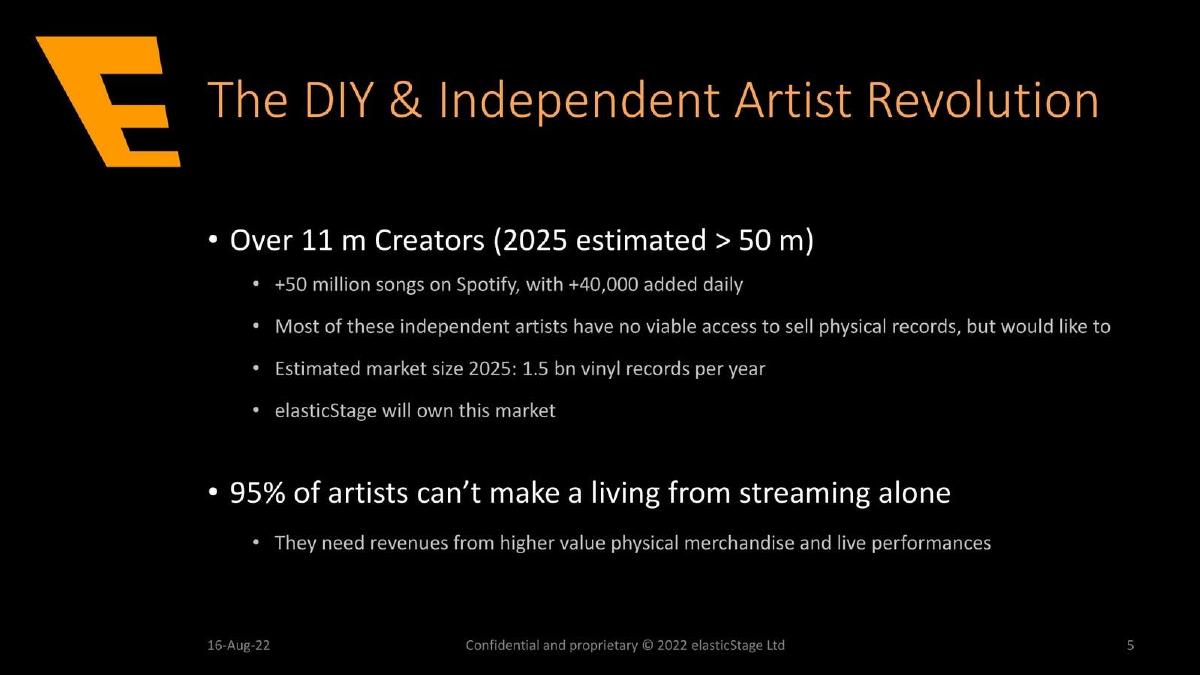
- The company targets the 'DIY & Independent Artist Revolution,' noting that 95% of artists cannot survive on streaming alone (Slide 5).
- ElasticStage proposes a 'patent-pending' manufacturing process that is fully automated and requires zero human intervention (Slide 2).
- The solution is positioned as environmentally friendly, explicitly stating it uses no PVC and no harmful chemicals (Slide 7).
- The business model includes a D2C platform where artists can upload and sell records at no upfront cost (Slide 9).
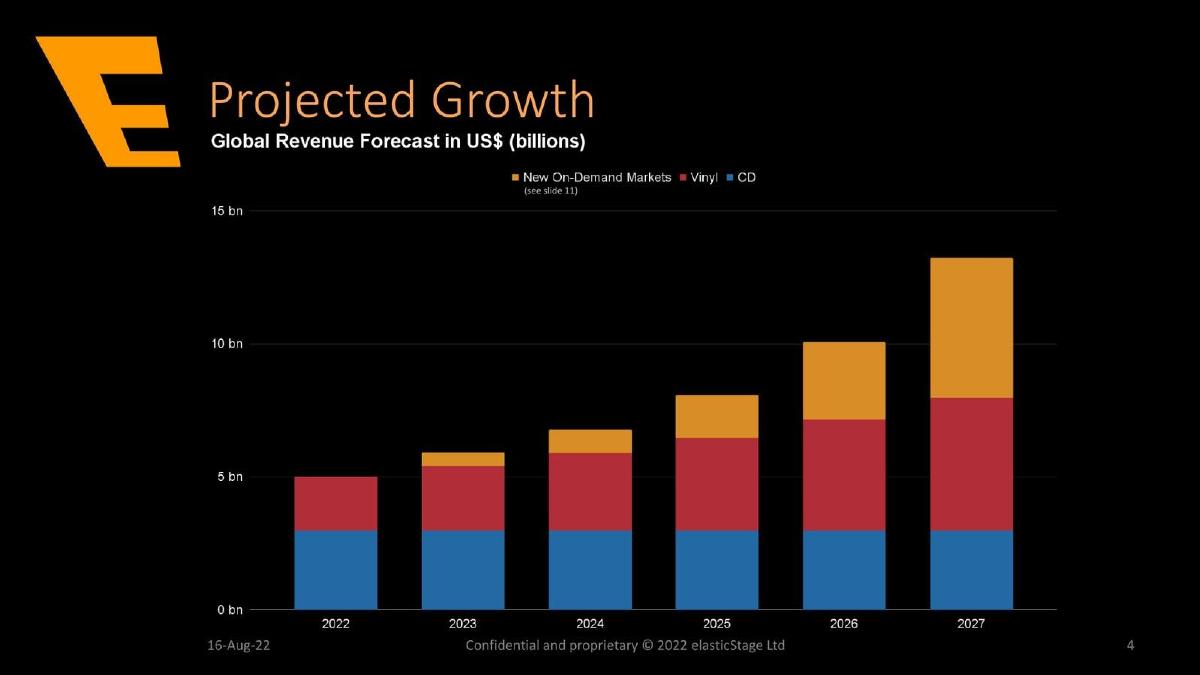
- Market projections suggest a new 'On-Demand' market segment could drive global revenue toward $14 billion by 2027 (Slide 4).
- The deck lacks a dedicated team slide and specific financial 'ask' details within the 10-slide sequence provided.
Slide-by-Slide Analysis
Slide 1: Title and Hook
The deck opens with a minimalist black background featuring a large orange 'E' logo. The subtitle, 'The On-Demand Revolution For Vinyl Records & CDs,' immediately establishes the sector. The use of a Neil Young quote regarding Steve Jobs listening to vinyl at home serves as a psychological anchor, validating the premium nature and enduring relevance of the medium despite the digital age.
Slide 2: Value Proposition
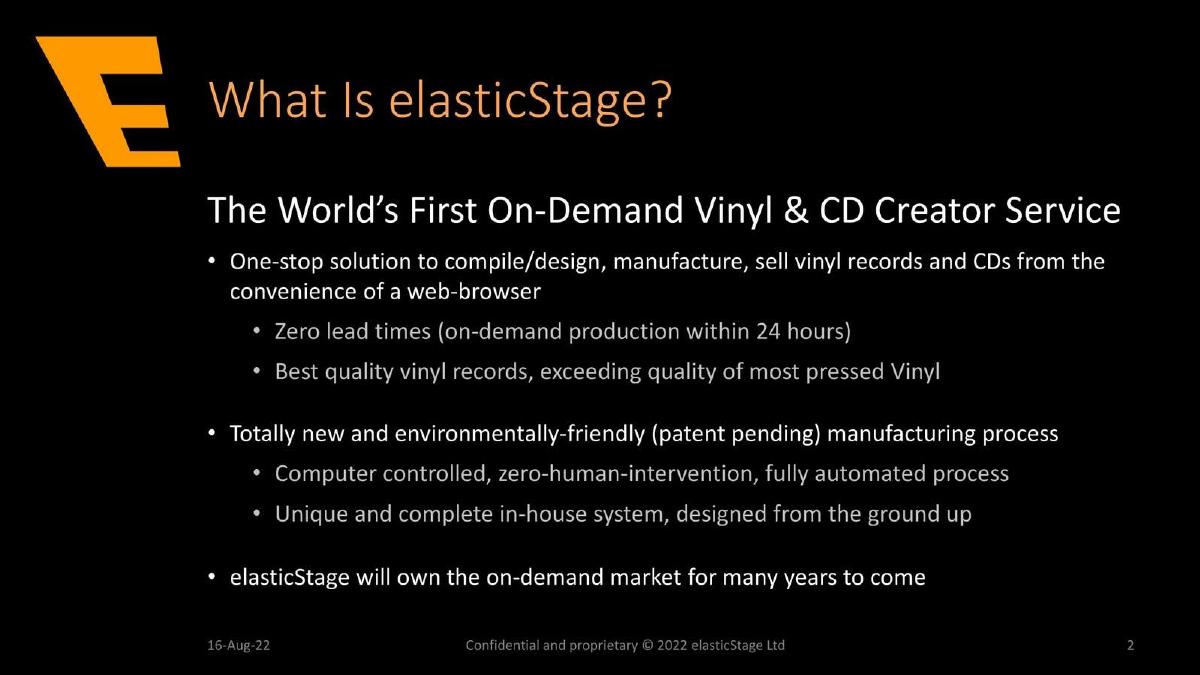
Slide 2 defines the company as 'The World’s First On-Demand Vinyl & CD Creator Service.' It lists three primary pillars: a one-stop web-based design and sales solution, a 24-hour production turnaround, and a 'patent pending' manufacturing process. The claim that they will 'own the on-demand market for many years to come' is a bold statement of intent, backed by the mention of a unique, in-house system designed from the ground up.
Slide 3: The Market Gap
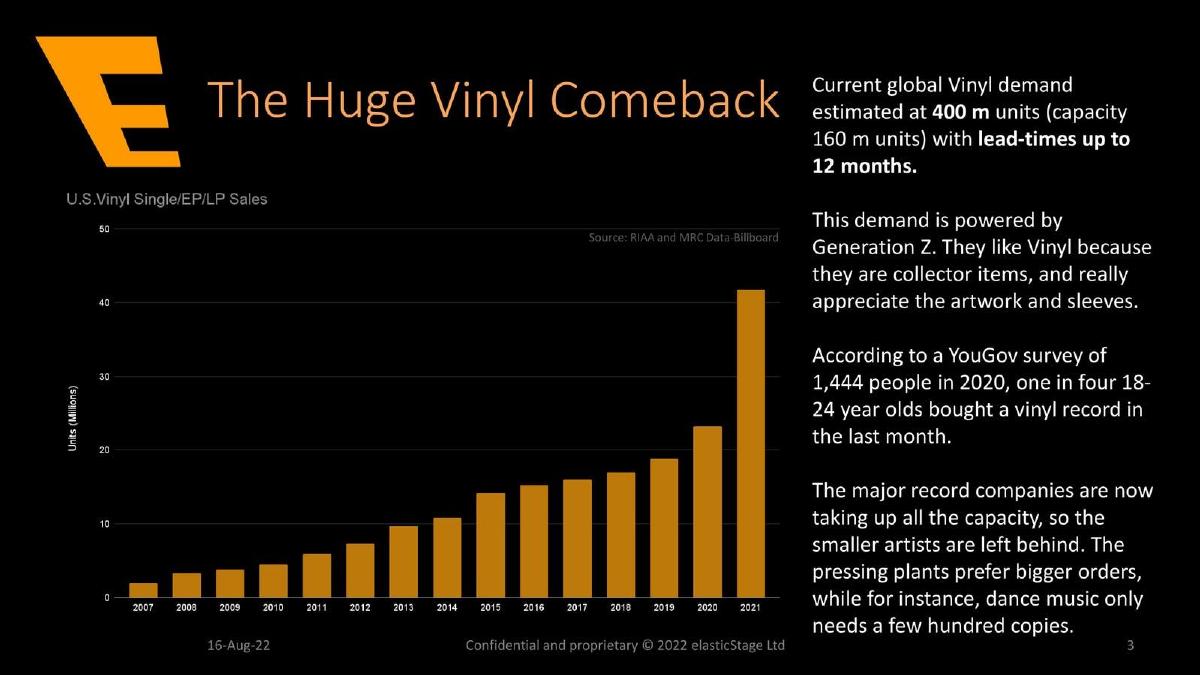
This is a crucial 'Problem' slide. It uses a bar chart from RIAA and MRC Data-Billboard to show the explosive growth of U.S. vinyl sales from 2007 to 2021. The text highlights a massive supply-demand mismatch: 'Current global Vinyl demand estimated at 400 m units (capacity 160 m units) with lead-times up to 12 months.' By noting that major record companies take up all existing capacity, ElasticStage identifies a clear 'underserved' segment: smaller artists and dance music labels that only need a few hundred copies.
Slide 4: Projected Growth
Slide 4 presents a global revenue forecast in USD billions. It projects the market growing from roughly $5 billion in 2022 to nearly $14 billion by 2027 . Notably, the chart introduces a new category: 'New On-Demand Markets,' which is projected to become the largest share of the total market by 2027. This suggests that ElasticStage isn't just fighting for a piece of the existing pie, but expanding the pie itself.
Slide 5: The Creator Economy Angle
Titled 'The DIY & Independent Artist Revolution,' this slide quantifies the target audience. It cites 'Over 11 m Creators' today, growing to an estimated 50 million by 2025. The most compelling stat here is that '95% of artists can’t make a living from streaming alone.' This positions ElasticStage as a necessary financial tool for the creator economy, rather than just a novelty manufacturing service.
Slide 6: The Technical Problem
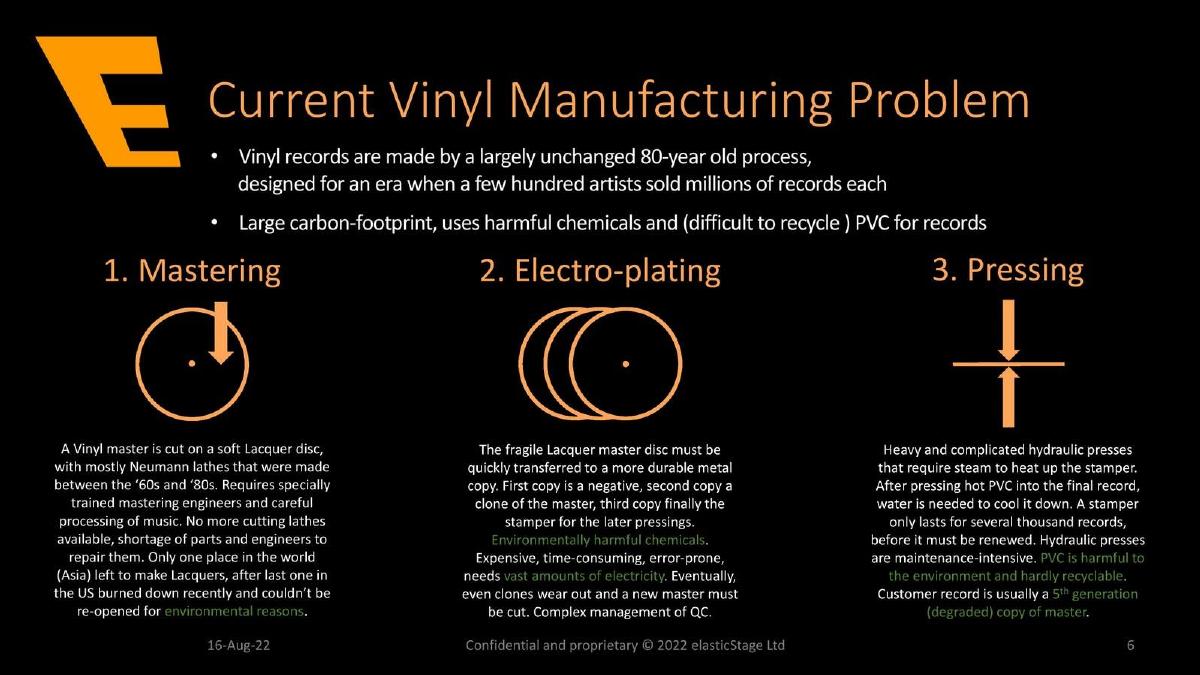
This slide provides a deep dive into why the current industry is failing. It breaks down the 80-year-old process into three stages: Mastering, Electro-plating, and Pressing. It highlights specific points of failure: the shortage of Neumann lathes, the environmental harm of chemicals used in electro-plating, and the maintenance-intensive nature of hydraulic presses. It concludes that the final customer record is usually a '5th generation (degraded) copy of master.'
Slide 7: The Solution
ElasticStage contrasts the previous slide with its 'On-Demand Vinyl Solution.' It promises a 'Very fast automated One-step process' that is 'Ethically sustainable' with 'No PVC, no chemicals.' The central claim is that they can produce a 'Master Record' for every customer within 24 hours. This addresses the quality issue (master vs. 5th generation) and the speed issue (24 hours vs. 12 months) simultaneously.
Slide 8: The Platform Workflow
Slide 8 shifts from manufacturing to the software layer. It describes the 'elasticStage Platform' as free to upload, easy to use for custom artwork, and integrated with music streaming platforms. It mentions the 'Industry standard (DDEX) platform,' which signals to investors that the company understands the technical infrastructure of the music business. It also notes a B2B play: helping major labels monetize 95% of their back-catalogue that is currently dormant due to high manufacturing costs.
Slide 9: Business Model Diagram
This flow chart illustrates the ecosystem. The 'Artist/Label' creates a store at no cost. The 'Consumer' searches and purchases. 'elasticStage' produces and ships within 24 hours. Crucially, the diagram shows the flow of money: ElasticStage pays royalties to the artist/label and mechanicals to writers/publishers via PROs (Performance Rights Organizations). This demonstrates a sophisticated understanding of music rights management.
Slide 10: Market Expansion
The final slide in the sequence explores 'New Formats.' It suggests consumer-facing products like turning streaming playlists into physical vinyl for gifts, influencer-curated compilations, and unique records for the NFT market. This slide is designed to show the 'upside' beyond just serving independent artists, hinting at a broader consumer tech play.
What Works in This Deck
The 'Why Now' is undeniable. By citing the 12-month lead times and the 240-million-unit capacity gap on Slide 3, the founders make a compelling case that the market is broken. Investors love supply chain bottlenecks because the demand is already proven; the only risk is the execution of the new technology.
Clear Technical Contrast. Slide 6 and Slide 7 work perfectly together. By detailing the 'Mastering, Electro-plating, Pressing' sequence and then showing how their 'One-step process' eliminates those steps, they provide a clear visual of their efficiency gains. The mention of 'No PVC' also hits the ESG (Environmental, Social, and Governance) requirements that many modern funds prioritize.
Focus on the Creator Economy. Linking the business to the 11 million independent creators on Spotify (Slide 5) moves the company out of the 'niche hobbyist' category and into the 'platform for creators' category, which typically commands higher valuations.
What Is Missing From This Deck
The Team Slide. In the provided 10-slide sequence, there is no mention of the founders' backgrounds. For a hardware-heavy, patent-pending manufacturing startup, the technical pedigree of the engineering team is paramount. Investors would need to know who built this 'one-step' machine.
Unit Economics. While the deck mentions the process is 'profitable' for small runs (Slide 7), it provides no data on the cost of goods sold (COGS), the retail price point, or the margins. Without these, it is difficult to assess if the business can scale sustainably.
The Ask. There is no slide detailing how much capital is being raised or how it will be deployed. While we know from publisher reports that they raised $4.2M, a standard pitch deck should include a slide outlining the milestones that the specific funding round will enable.
Competitive Landscape. The deck assumes that because traditional pressing is slow, there are no other competitors. It fails to mention other 'lathe-cut' services or smaller boutique pressing plants that might be attempting similar automation.
Founder Takeaways
Quantify the Gap: If you are entering a market with a supply shortage, lead with the numbers. ElasticStage’s use of the 400m vs. 160m unit stat is the strongest part of their pitch. · Visualize the Process: If your innovation is a technical process, use simple diagrams to show the 'Old Way' vs. the 'New Way.' Slide 6 and 7 are excellent examples of this. · Address the 'Long Tail': Many businesses overlook the 95% of a market that is 'too small' for incumbents. ElasticStage shows how aggregating that 95% (the independent artists) creates a massive opportunity. · Sustainability as a Feature: Don't just say you are 'green.' Specify what you are removing (PVC, chemicals) to make the claim tangible.
Frequently asked questions
- What is the core technology behind ElasticStage?
- According to Slide 2 and Slide 7, the company has developed a patent-pending, computer-controlled, fully automated manufacturing process. Unlike traditional pressing which uses steam, hydraulic presses, and PVC, ElasticStage claims a 'one-step process' that is re-engineered from the ground up to be sustainable and fast, producing a master record for every customer within 24 hours.
- How does ElasticStage solve the problem for independent artists?
- Slide 3 and Slide 5 explain that major labels currently consume all existing pressing plant capacity, leaving smaller artists with no viable way to sell physical records. ElasticStage allows these creators to sell made-to-order records with zero lead time and no upfront cost, providing a high-margin revenue stream that streaming (which 95% of artists can't live off) fails to provide.
- What are the environmental benefits mentioned in the deck?
- Slide 6 critiques the current 80-year-old process for its large carbon footprint and use of difficult-to-recycle PVC. Slide 7 states that the ElasticStage solution uses 'No PVC, no chemicals' and has a 'smaller carbon footprint,' though it does not specify the exact materials used in place of PVC.
- What new market opportunities does the deck suggest?
- Slide 10 outlines several 'New Formats,' including the ability for consumers to turn streaming playlists into custom vinyl records, curated records by influencers, and unique 'one-of-a-kind' releases for artists that could be paired with NFTs.
- Is there a breakdown of the company's financial performance?
- No. The provided 10 slides focus on market tailwinds, the technical problem with traditional manufacturing, and the proposed workflow. There are no slides detailing current revenue, burn rate, or specific unit costs for a single record production.