The Effective Fund Raising presentation by Raomal Perera for UCC IGNITE is a comprehensive educational resource that uses the founder's own journey with Valista (Network365) as a primary case study. Spanning 124 slides, the deck transitions from high-level fundraising theory—covering everything from angel funding to crowdfunding—to granular, real-world deal mechanics. It is particularly notable for disclosing specific financial milestones, such as a Series A2 round at IE £1.75 per share and a €10m Series C round at a €21m pre-money valuation. While the deck functions more as a seminar curricu…
Key takeaways
- The deck discloses a Series A2 round involving 724,700 shares at IE £1.75 each, resulting in a valuation just under IE £6 million (Slide 49).
- A Series C round is detailed with a €10m investment on a €21m pre-money valuation, featuring a 20% employee option pool (Slide 67).
- The Series C terms included keyman insurance for founders Raomal Perera and Denis Hennessy and a legal fee cap of £50k (Slide 67).
- Valista's value proposition in 2004 centered on 150+ million users and integration with over 1,000 digital and real goods merchants (Slide 37).
- The deck utilizes Steve Blank's 'Resegmented Market Revenue Forecast' model, showing a hockey-stick growth curve starting in Year 5 (Slide 13).
- Market data from IDC cited in the elevator pitch estimated the Internet Commerce Applications market at $1.7B, growing to $13B by 2003 (Slide 121).
- The presentation outlines a 'Build Profile' strategy involving partnerships with PWC, AIB, MOP, and Enterprise Ireland (Slide 43).
- Fundraising advice includes a warning to 'stop clinging to your valuation' and to focus on becoming cash-flow positive to survive (Slide 7).
Introduction: The Fundraising Curriculum of Raomal Perera
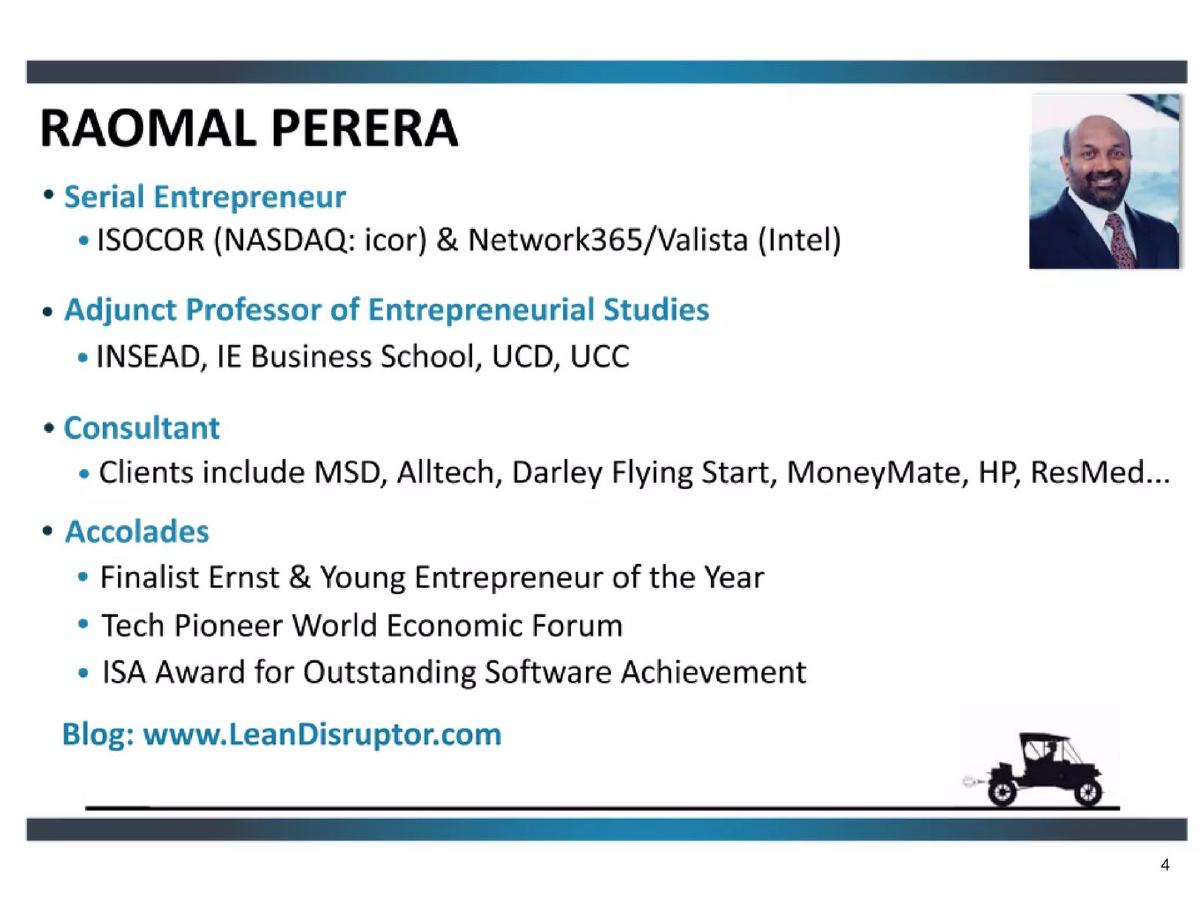
The 'Effective Fund Raising' deck is not a traditional pitch deck but a comprehensive educational presentation delivered by Raomal Perera for the UCC IGNITE Graduate Business Innovation Centre. Perera, a co-founder of Network365 (which became Valista), uses his own company's history to illustrate the mechanics of startup finance. The 124-slide deck (of which 21 are analyzed here) serves as a bridge between the late 90s dot-com era and the mid-2000s mobile commerce boom. It is a rare artifact that provides exact figures for valuations, share prices, and term sheet conditions that are usually kept confidential.
Slides 1-7: The Survival Mindset
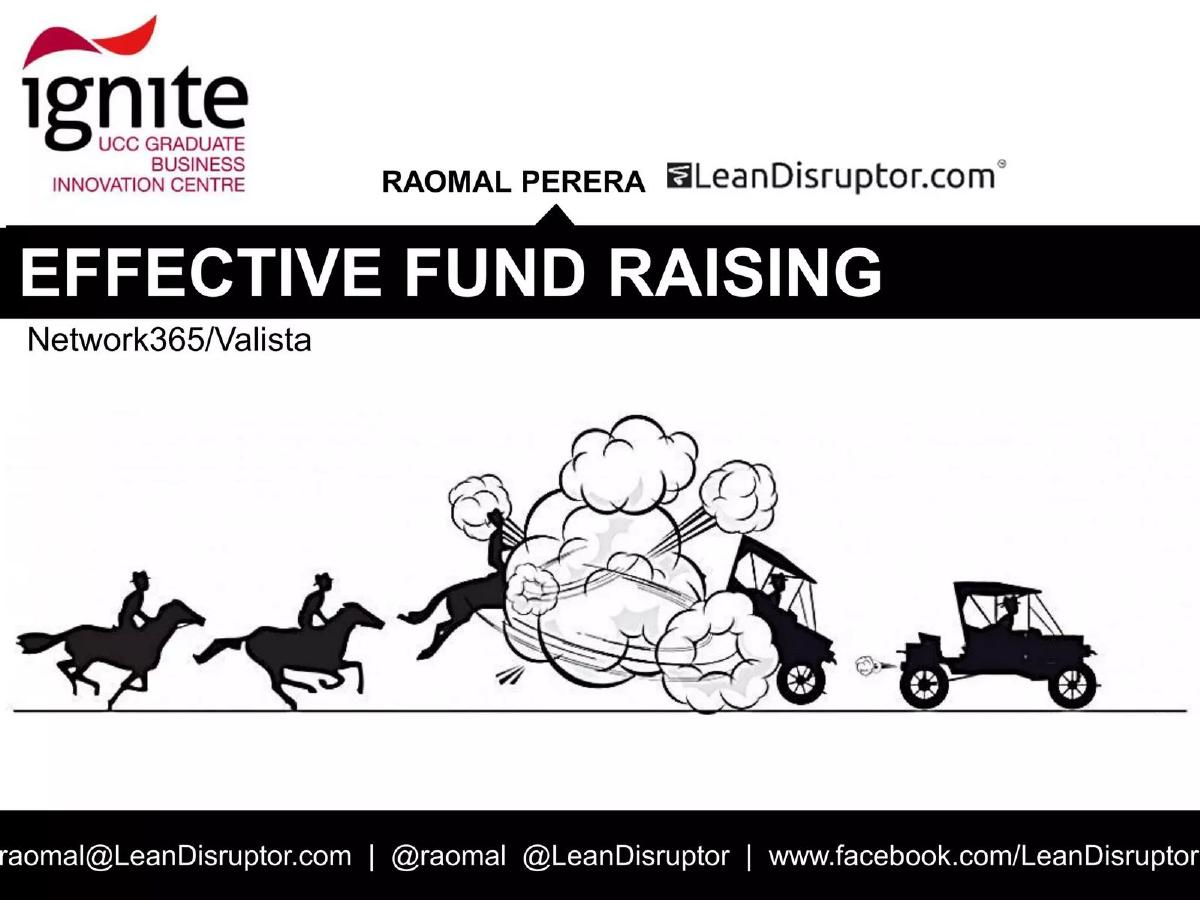
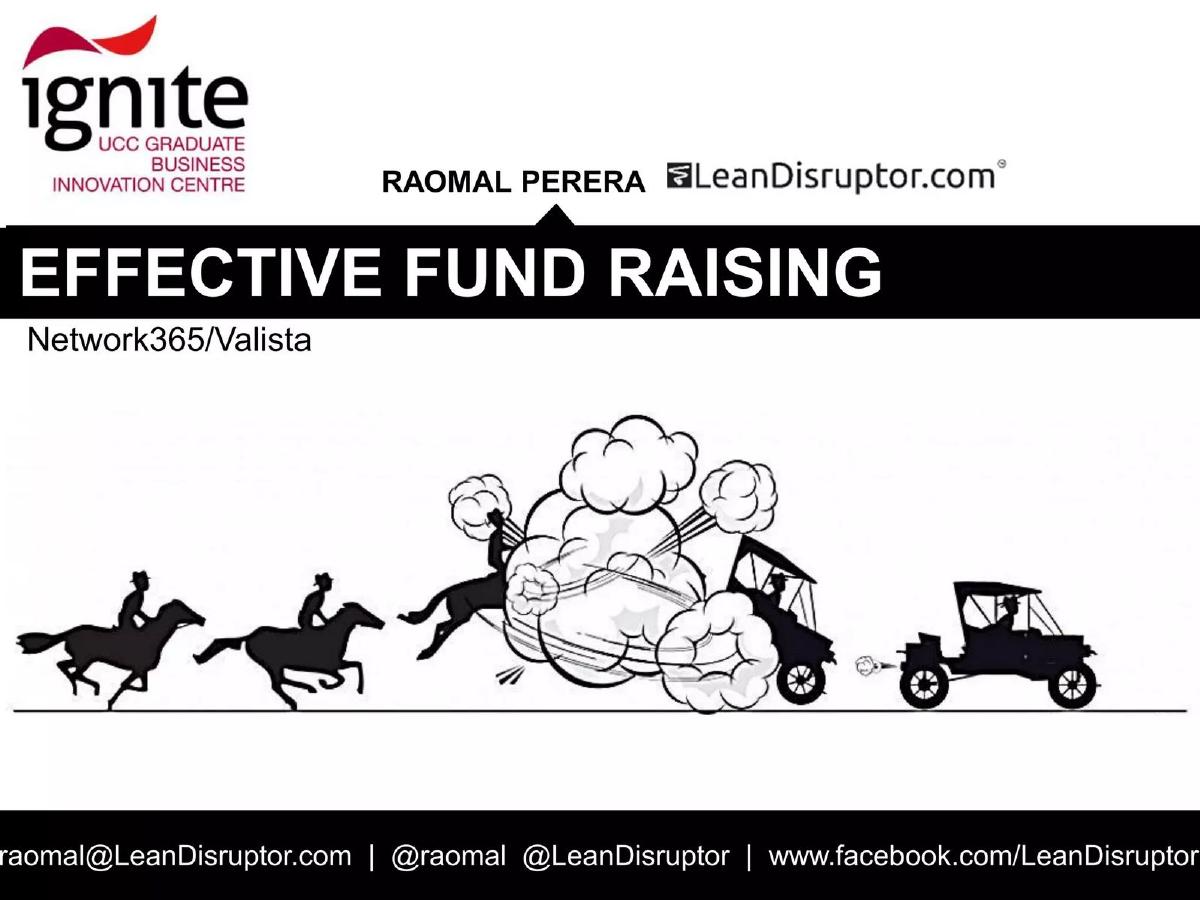
The presentation opens with a title slide (Slide 1) featuring the logos of IGNITE and LeanDisruptor.com, establishing the academic and entrepreneurial context. The imagery of a horse-drawn carriage exploding as it is overtaken by an early automobile sets the tone for technological disruption. By Slide 7, the deck moves into hard-hitting advice attributed to Heidi Roizen of DFJ. The core message is one of austerity and focus: 'Stop clinging to your valuation,' 'Redefine what success looks like,' and 'Get to cash-flow positive on the capital you already have.' This slide emphasizes that survival is the primary goal, urging founders to cut costs more than they think is necessary and to 'hunker down' while focusing maniacally on metrics.
Slides 13-25: Market Forecasting and Negotiation
Slide 13 introduces a 'Resegmented Market Revenue Forecast' sourced from Steve Blank. The graph shows a slow, linear progression for the first four years, followed by an aggressive exponential curve (the 'hockey stick') starting in Year 5 and continuing through Year 7. This acknowledges the long gestation period often required for deep-tech or infrastructure plays. Slide 19 marks the transition to 'The Toolkit,' presumably the practical steps for raising capital. Slide 25 focuses on 'Negotiation,' listing three priorities: achieving a fair result, preserving personal relationships, and fully understanding the deal structure. The inclusion of 'not killing your personal relationship' highlights the long-term nature of the founder-investor bond.
Slides 31-37: The Funding Journey and Valista's Value Proposition
Slide 31 provides a conceptual map of 'A company funding journey.' It plots Investment Size, Risk, and Revenue against stages ranging from Idea to Expansion. The slide includes speech bubbles reflecting common founder regrets, such as 'I sold out too early' and 'I should have retained more value.' This visualizes the trade-off between dilution and growth. Slide 37 is a core 'Value Proposition' slide for Valista (dated 2004). It segments the market into Buyers, Service Providers, and Sellers. Key metrics include '150+ million users' who can purchase using Valista technology and '1000+ digital and real goods merchants integrated.' The slide lists major partners and clients including O2, Vodafone, and T-Mobile, positioning Valista as a global player in e- and m-payment services.
Slides 43-49: Building Profile and Series A2 Details
Slide 43, titled 'Build Profile,' outlines the institutional ecosystem a startup needs. It names specific Irish and global firms: PWC (Accountants), AIB (Bank), MOP (Lawyers), and Kinman (PR), alongside Enterprise Ireland. This suggests that 'who' you work with is a signal to investors. Slide 49 is one of the most data-rich slides in the deck, detailing a 'Angel Funding Series A2.' It reveals a raise of 724,700 shares at IE £1.75 per share, totaling 3,375,000 shares and a valuation of 'just under IE £6 million.' A tip at the bottom suggests paying mentors a 'small success fee' for helping raise money, a practice that is often debated in modern venture circles.
Slides 55-67: The VC Reality and Series C Terms
Slide 55 defines the role of Venture Capitalists, emphasizing their long-term orientation and the goal of achieving liquidity through M&A or IPOs. Slide 61 differentiates a 'VC Pitch' from a 'Customer Sales Pitch,' noting that a VC pitch must be about the business as a whole rather than just the product. Slide 67 provides the specifics of a 'VC Funding Series C' round. The company raised €10m on a €21m pre-money valuation. The slide lists the participating investors: Advent Venture Partners, Amadeus, Enterprise Ireland, and TVC Holdings. It also notes that JAFCO was involved but is crossed out with a red line. Crucially, it lists structural requirements: a 20% employee option pool, three investor directors, and keyman insurance for Raomal Perera and Denis Hennessy. Legal fees were capped at £50k.
Slides 73-85: Investor Types and Crowdfunding
Slide 73 is a comprehensive table comparing 'The Good' and 'The Bad' of different funding sources: Founders (You), Angels, VCs, and Banks. It warns of 'conflicting agendas' and 'massive dilution' with VCs, and the 'bias on cash flow' and 'obligation to repay' with banks. Slide 79 points founders toward Enterprise Ireland as a specific funding resource. Slide 85 introduces 'Crowd Funding,' which was a nascent concept at the time. It notes platform fees between 2% and 10%+ and advises founders to choose between 'all or nothing' sites and to understand the difference between registered and active crowd sizes.
Slides 91-103: Options, Questions, and Tools
Slide 91 lists various funding options, including Regional Venture Capital Firms (RVCFs), Corporate Venturing, and 'Junior' stock markets like AIM and OFEX. Slide 97 addresses '16 Common Questions' from Steven McDermid, covering topics like the necessity of a full slide deck ('Make those interactions count') and the timeline for raising a round ('It takes time'). It also advises founders not to fear sharing information but to understand their cash burn and financials deeply. Slide 103 promotes 'LivePlan' as a tool for business planning and tracking.
Slides 109-121: Market Types and The Elevator Pitch
Slide 109 introduces 'Market Type,' a concept popularized by Steve Blank. Slide 115 focuses on 'Existing Markets,' using Google, Swiffer, and Facebook as examples. It notes that in existing markets, incumbents will defend their turf and network effects are a major risk. Finally, Slide 121 provides a 'Sample Elevator Pitch' for Network365. It frames the problem (moving beyond ring tones to 3G revenue streams) and the solution (a payment platform integrated into billing systems). It cites IDC market data ($1.7B growing to $13B) and clearly states the revenue model: license fees and usage fees charged to operators.
What Works in This Deck
Extreme Financial Transparency: The disclosure of exact share prices, share counts, and valuation caps (Slides 49 and 67) provides a level of reality rarely seen in fundraising presentations. · Structural Detail: Including terms like keyman insurance and legal fee caps (Slide 67) educates founders on the 'hidden' requirements of institutional rounds. · Ecosystem Mapping: Slide 43 explicitly names the service providers (PWC, AIB, MOP) required to build institutional credibility, which is a practical roadmap for early-stage founders. · Comparative Analysis: The 'Good vs. Bad' table for investor types (Slide 73) is an objective look at the trade-offs of different capital sources.
What Is Missing
Unit Economics: While the deck discusses total revenue forecasts and market size, it lacks a slide dedicated to Customer Acquisition Cost (CAC) or Lifetime Value (LTV). · Detailed Team Bios: Although key founders are mentioned in the context of insurance (Slide 67), there is no dedicated team slide showcasing the broader leadership's expertise. · Current Competitive Landscape: The deck uses historical examples (Slide 115) but lacks a direct competitive matrix for Valista against its contemporaries in 2004. · Use of Funds: While the Series C raise is detailed, the deck does not explicitly break down how the €10m was allocated across R&D, sales, or geographic expansion.
Founder Takeaways
Prepare for the 'Long Haul': The revenue forecast (Slide 13) and the funding journey (Slide 31) both suggest that meaningful scale takes 5-7 years, a reality founders should communicate to investors. · Signal with Partners: The 'Build Profile' (Slide 43) strategy shows that aligning with top-tier accountants and lawyers is a form of due diligence that investors value. · Understand the 'Price' of Capital: The Series C slide (Slide 67) demonstrates that a €10m check comes with significant strings attached, including board seats and mandatory insurance. · Differentiate the Pitch: As Slide 61 notes, the pitch to a VC must be about the 'business opportunity' to build a market leader, not just a demonstration of the product's features.
Frequently asked questions
- What were the specific terms of Valista's Series C round?
- According to slide 67, the Series C round raised €10 million on a pre-money valuation of €21 million. The deal structure utilized C convertible preferred shares priced at €2.801 per share. Notable conditions included the establishment of a 20% employee option pool, the appointment of three investor directors, and mandatory keyman insurance for the two primary founders.
- How did the company describe its market opportunity in the early 2000s?
- Slide 121 provides a sample elevator pitch citing IDC research that valued the Internet Commerce Applications market at $1.7 billion, with a projected growth to $13 billion by 2003. The company, then known as Network365, aimed to move beyond ring tones to provide a 3G-integrated payment platform for mobile network operators.
- What advice does the deck give regarding investor selection?
- Slide 73 provides a 'Good vs. Bad' comparison for different investor types. It notes that while VCs offer 'unlimited funding' and 'large networks,' they bring 'conflicting agendas' and 'massive dilution.' Conversely, banks offer 'no equity dilution' but have a 'bias on cash flow' and provide no mentoring or feedback.
- What was the company's revenue model according to the deck?
- As stated on slide 121, the revenue model for Network365 involved charging mobile network operators both a license fee and a usage fee. Additionally, the company provided 'managed services' to further monetize their payment platform technology within the 3G network ecosystem.
- Which professional service firms were part of the company's 'Build Profile'?
- Slide 43 identifies the specific firms used to build the company's institutional profile: PWC for accounting, AIB for banking, MOP (Matheson Ormsby Prentice) for legal services, and Kinman for PR. The slide also highlights Enterprise Ireland as a key institutional partner in the Irish ecosystem.