Equinom’s Series C deck is a masterclass in identifying a single, massive economic friction point and positioning technology as the specific lubricant. By highlighting a 250% cost gap between beef and plant-based burgers (Slide 4), the company moves beyond the 'sustainability' trope to address the 'affordability' barrier preventing mass-market adoption. The deck focuses heavily on the 'why'—specifically that current plant-based protein costs $25,000 per ton due to intensive factory processing (Slide 5). Equinom proposes moving that processing into the field via multi-trait breeding. While the…
Key takeaways
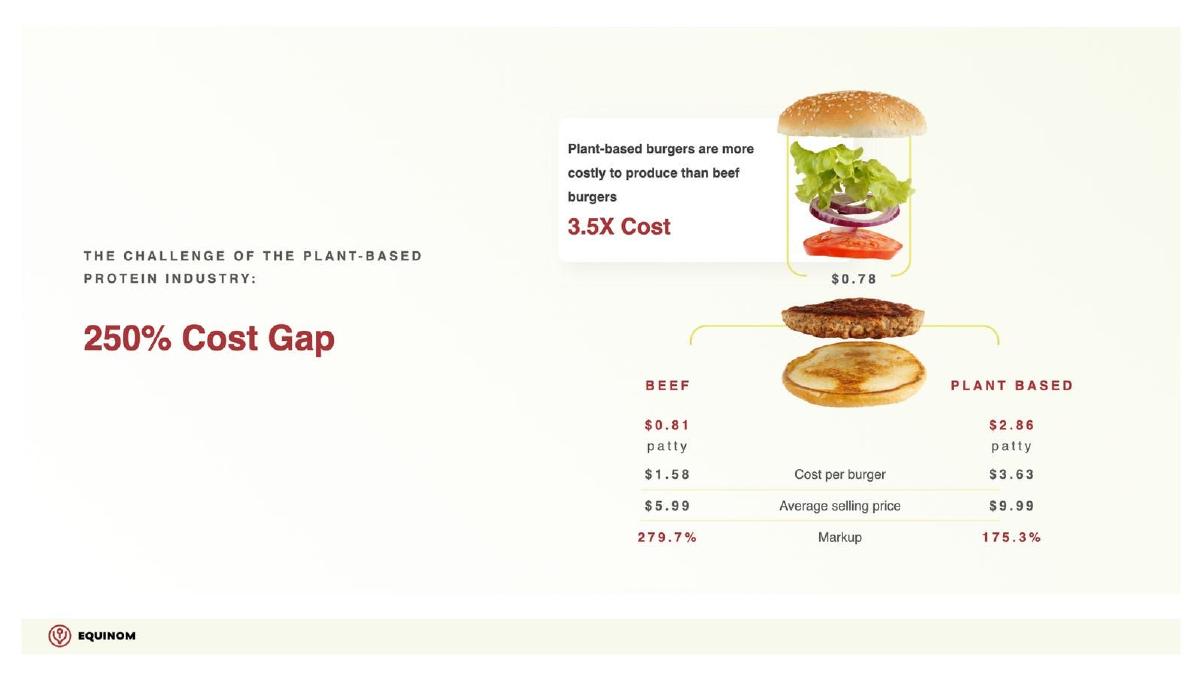
- The deck identifies a specific 250% cost gap between beef and plant-based patties, citing a $0.81 vs $2.86 price difference per patty (Slide 4).
- Equinom positions its technology as a way to 'process' ingredients in the field, eliminating the need for expensive factory processing (Slide 7).
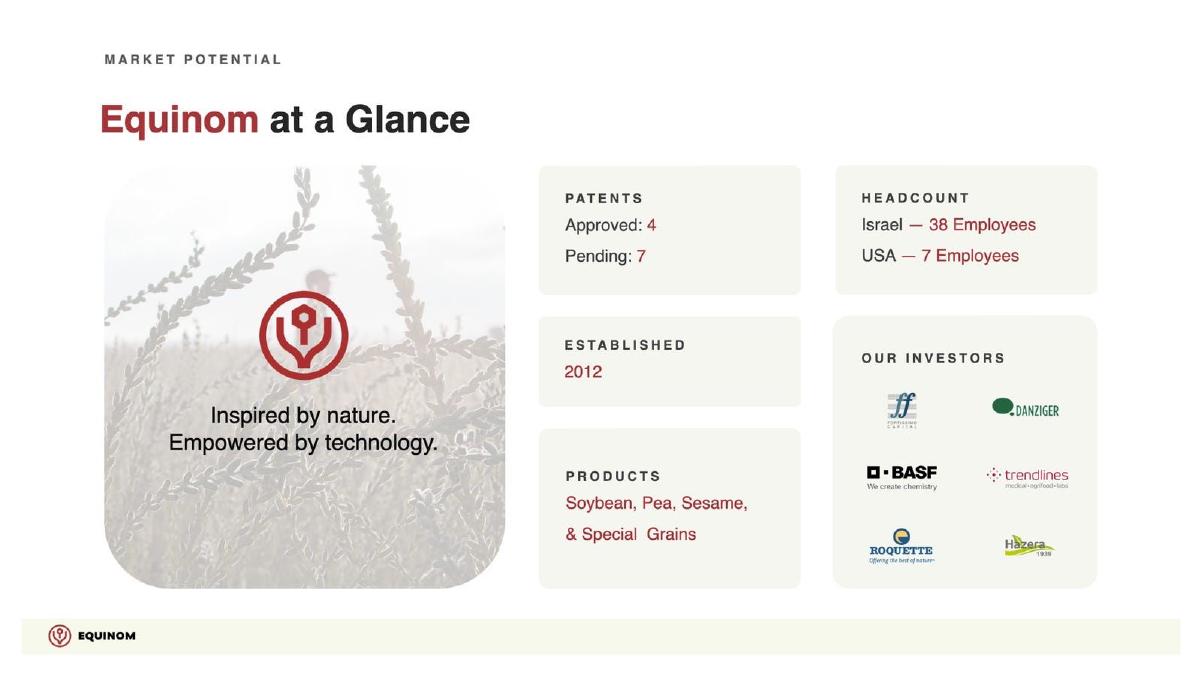
- The company demonstrates significant IP protection with 4 approved patents and 7 pending (Slide 2).
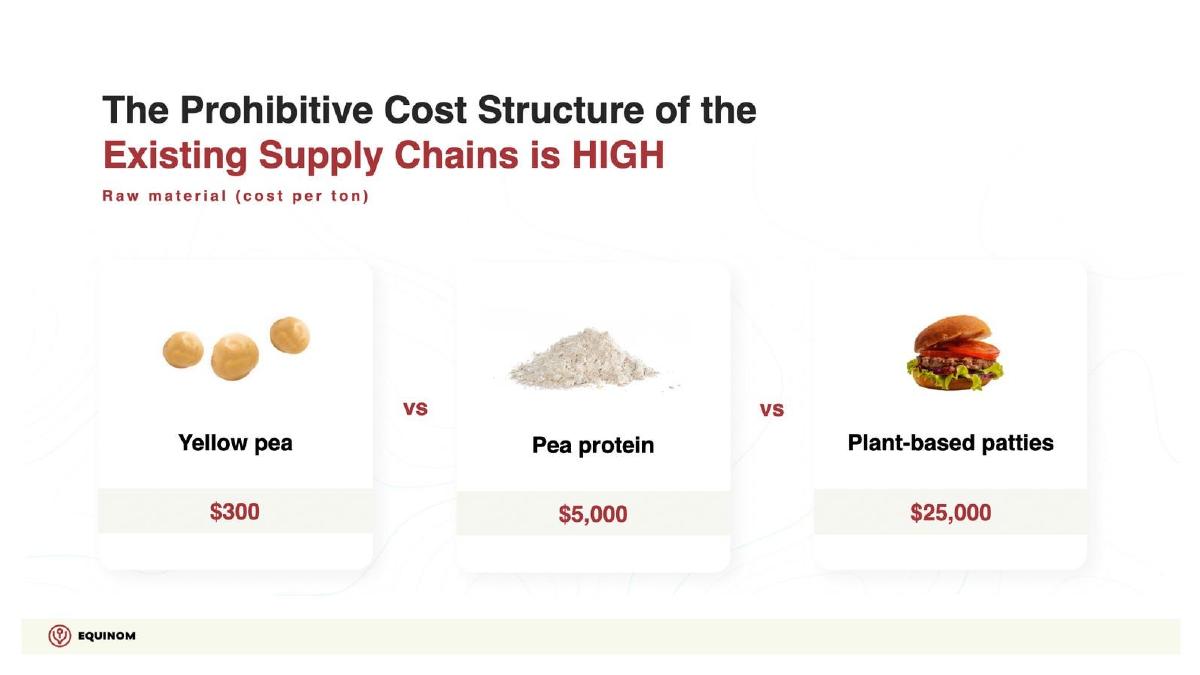
- The supply chain analysis shows a massive price escalation from yellow peas ($300/ton) to plant-based patties ($25,000/ton) (Slide 5).
- The deck targets a specific $5 billion opportunity through multi-trait breeding of crops like soybean, pea, and sesame (Slide 8).
- The company highlights a strong existing investor base including BASF, Roquette, and Fortissimo Capital (Slide 2).
- Equinom reports a headcount of 45 employees across Israel and the USA as of the Series C period (Slide 2).
- The deck completely omits a management team slide, which is highly unusual for a Series C round.
The Strategic Brevity of a Series C Brief
Equinom’s Series C deck, as reported by Business Insider, is an anomaly in the world of late-stage fundraising. At only 9 slides, it functions more as a high-level executive summary than a comprehensive diligence document. However, for a company founded in 2012 that had already secured partnerships with giants like BASF and Roquette, the goal of this deck wasn't to introduce the company, but to frame the specific economic problem they were solving for the next phase of growth.
Slide 1: The Vision Statement
The cover slide sets a minimalist tone. The tagline, "Seeding a sustainable plant-based future," is standard for the AgTech sector, but the sub-header "Investor Brief" is the most important text here. It signals that this is a condensed version of a larger data room, intended to hook interest rather than answer every technical question.
Slide 2: Equinom at a Glance
Slide 2 is a high-density credibility builder. It establishes the company's age (established 2012) and scale (45 total employees). The most critical metrics for a Series C investor are found in the Patents box (4 approved, 7 pending) and the Our Investors section. By showcasing logos like BASF and Roquette, Equinom proves it has already passed the technical due diligence of the world’s largest chemical and ingredient companies. This slide effectively says: "We are real, we are protected, and the industry leaders already trust us."
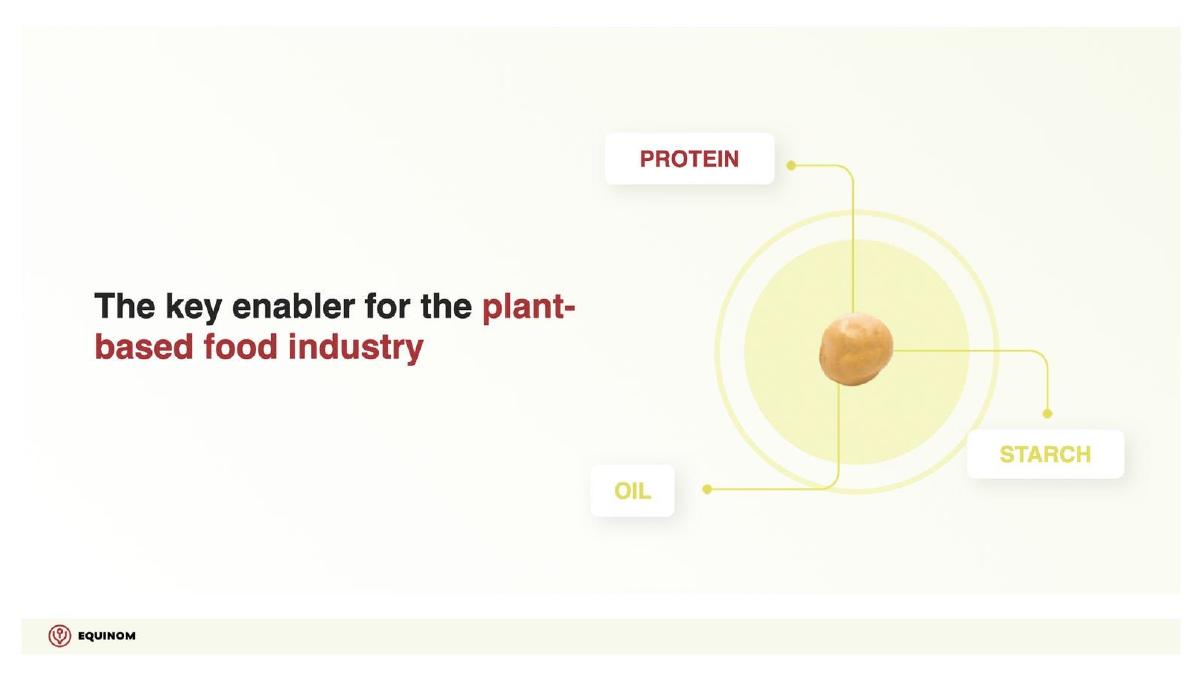
Slide 3: The Key Enabler
This slide serves as a transition, visually breaking down a seed into its constituent parts: Protein, Oil, and Starch . It positions Equinom not as a food company, but as the "key enabler" for the entire plant-based industry. The simplicity of the graphic suggests that by controlling the seed, you control the three pillars of plant-based food manufacturing.
Slide 4: The 250% Cost Gap
This is the 'villain' slide of the deck and arguably the most effective. Equinom moves away from environmental altruism and focuses on cold, hard economics. It compares a beef burger to a plant-based burger across four metrics: patty cost, cost per burger, selling price, and markup. The data is striking: a beef patty costs $0.81 while a plant-based patty costs $2.86 . By highlighting the "250% Cost Gap," Equinom identifies the single biggest hurdle to mass-market adoption of plant-based meat. They aren't just selling seeds; they are selling a way to fix a broken margin structure.
Slide 5: The Prohibitive Cost Structure
Slide 5 explains why the cost gap exists. It tracks the price escalation of raw materials. A ton of yellow peas costs $300 . Once processed into pea protein, the cost jumps to $5,000 . By the time it becomes plant-based patties, the cost hits $25,000 per ton. This 83x price increase from farm to table is the inefficiency Equinom aims to disrupt. It frames the current supply chain as "prohibitive," setting the stage for their solution.
Slide 6: The Culprit: Processing
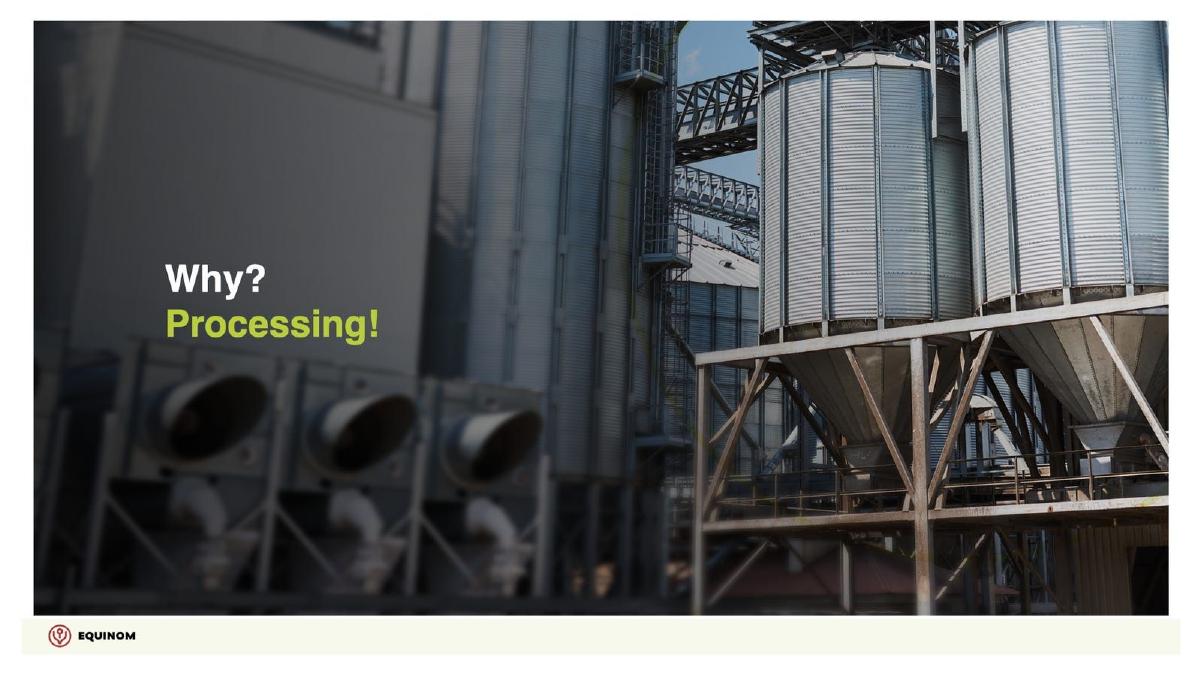
Slide 6 is a single-word punchline: "Processing!" overlaid on an image of industrial silos. It reinforces the argument that the current industry relies too heavily on expensive, energy-intensive mechanical and chemical processing to make plants taste and behave like meat.
Slide 7: The Solution: Smarter Seeds
Equinom presents its counter-narrative here. Instead of building more factories, they propose "processing in the field." The slide claims that their seeds enable ingredients to be optimized during growth, "without the need for factory processing." This is a powerful value proposition for a Series C investor: Equinom is a software-like solution (genetics) for a hardware problem (factories).
Slide 8: The $5 Billion Opportunity
The final content slide quantifies the market and the product. It claims a "$5 billion opportunity" and lists the specific crops (Soybean, Sesame, Yellow Pea) and "Golden Traits" they target. These traits include high protein, oil richness, and solubility. This slide connects the high-level economic problem back to the specific agricultural outputs Equinom produces.
Slide 9: Contact and Disclaimer
The deck ends abruptly with a "Thanks" and a contact email. There is no 'Ask' slide, no use of funds, and no roadmap. In a Series C context, this suggests the deck was used for initial outreach to a curated list of investors who would then be invited into a much deeper data room.
What Equinom Does Well
The deck is exceptionally focused. It avoids the common mistake of trying to explain the complex science of non-GMO breeding and instead focuses on the economic outcome of that science. By using the beef vs. plant-based cost comparison, they ground the investment opportunity in a relatable retail reality. The use of high-quality imagery and a clean, consistent color palette reflects a mature, Series C-ready brand.
What is Missing
The omissions in this deck are significant. There is no team slide , which is usually mandatory to show the pedigree of the scientists and executives. There is no competitive landscape , which is surprising given the presence of other AgTech players like Benson Hill. Most notably, there is no financial data —no revenue figures, no growth rates, and no projections. While this may be appropriate for a 'brief,' a $20M round usually requires a more robust narrative regarding the path to profitability.
Founder Takeaway
Founders should copy Equinom's approach to problem framing . Instead of saying "plant-based food is good for the planet," they said "plant-based food is too expensive to produce." One is a sentiment; the other is a business opportunity. If you can identify a massive cost inefficiency in your industry and show how your technology eliminates a specific, expensive step in the supply chain (like Equinom did with factory processing), you have a compelling case for investment at any stage.
Frequently asked questions
- What is Equinom's core value proposition?
- Equinom uses non-GMO multi-trait breeding to create seeds with higher protein, better taste, and improved functionality. Their goal is to move the 'processing' of plant-based ingredients from expensive factories into the field, significantly reducing the cost of the final food product.
- How does Equinom justify the need for its technology?
- The deck uses a stark comparison of production costs. It shows that while a beef patty costs $0.81 to produce, a plant-based patty costs $2.86. They argue this 250% cost gap is the primary barrier to industry growth and can only be solved by better raw materials.
- Which crops does Equinom focus on?
- According to Slide 8, the company focuses on three primary crops: Soybean, Sesame, and Yellow Pea. They breed these for 'Golden Traits' such as high protein, oil richness, and solubility.
- Who were the existing investors at the time of this deck?
- Slide 2 lists several high-profile strategic and venture investors, including Fortissimo Capital, Danziger, BASF, Trendlines, Roquette, and Hazera.
- What is missing from this Series C deck?
- This deck is remarkably brief for a Series C. It lacks a team slide, a detailed competitive landscape, financial projections, a go-to-market strategy, and a specific breakdown of how the $20M raise would be used.